State officials say the project will improve safety for bicyclists and pedestrians, but one cycling advocate says the plan will make the area more dangerous for cyclists
By RANDY SEAVER | Editor
Just when you thought it was safe to once again drive on Elm Street in Biddeford –another massive construction project will likely impact traffic on a small portion of the heavily-traveled Route One Corridor beginning next year.
Unlike last year’s extensive sewer upgrade project that snarled traffic throughout the downtown area, construction activity for this ‘upgrade and safety’ project will take place during evening hours in order to minimize impacts to motorists, residents and business owners.
. . .
According to Biddeford Public Works Director Jeff Demers, planning for this project began more than three years ago and will be coordinated by the Maine Department of Transportation (MDOT).
The entirety of Maine’s Route One corridor – from Fort Kent to Kittery — is a state-controlled highway.
MDOT representatives provided the Biddeford City Council on Tuesday with a presentation about their plans “to improve safety and traffic flow” on the north-south roadway.
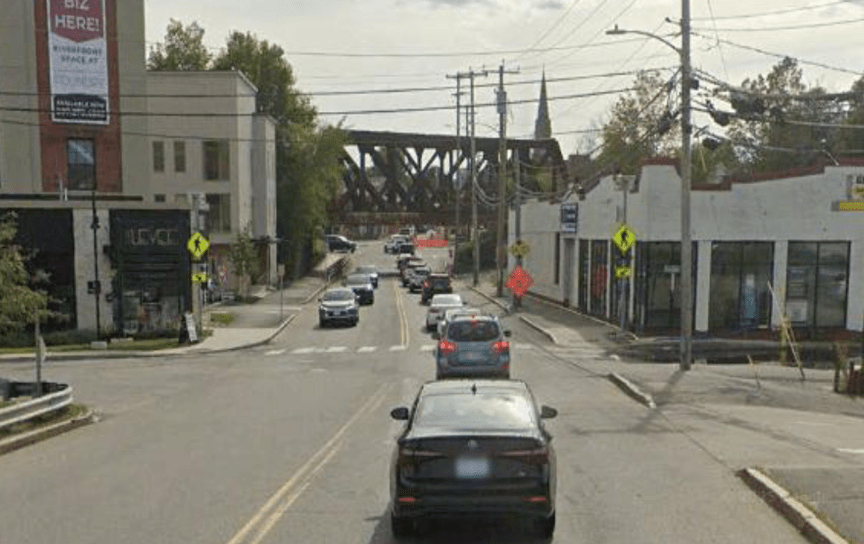
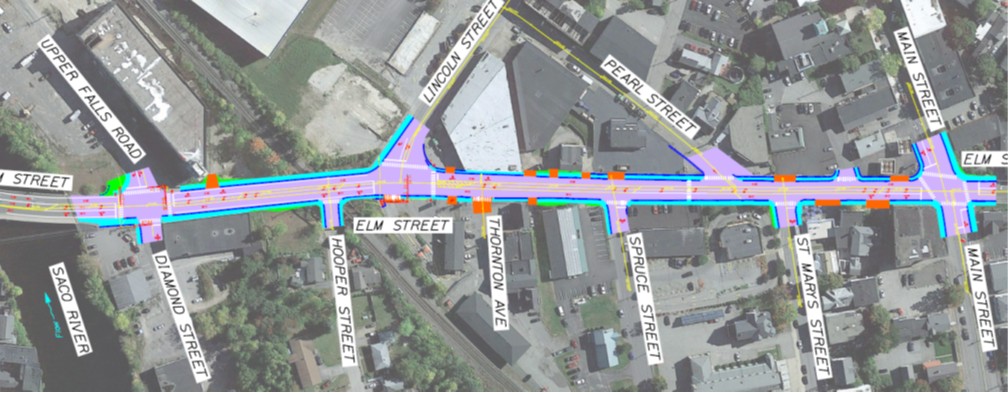
The project is not expected to begin until early next year. It will include adding two sets of traffic lights, making Pearl Street a one-way street, raised sidewalks and various safety improvements on a portion of the road that stretches roughly 1,600 feet, from the Elm Street bridge near Pine Street in Saco to the corner of Elm and Main streets in Biddeford.
Though Shawn Davis, one of the state’s project engineers, told the council that the project will improve safety for both bicyclists and pedestrians in an increasingly congested area, not everyone at Tuesday’s meeting was convinced that the project will improve safety for non-motorized traffic.
“This plan will literally create a highway in our downtown area,” said Patrick Conlon of Biddeford, pointing to the state’s plan to convert that section of Elm Street into a three-lane road, featuring a center turning lane.
Conlon — a member of Bike BS, a local cycling advocacy group – said the state’s primary focus is to move motor vehicle traffic more efficiently and that the project will actually make cycling more dangerous along that stretch of road.
Davis told the council that the state will be installing new signage, alerting motorists of so-called Sharrow lanes, which allows cyclists the same access to the roadway as a motor vehicle.
Sharrow – a combination of “share’ and ‘arrow’ – relies on signage to alert drivers that cyclists have the same right to use the full traffic lane, as opposed to a separate bike lane.
Sharrow markings are typically used when there is not enough space to allow for separate bike and motor vehicle travel lanes.
Conlon described Sharrow lanes are “an insult to bicyclists.”
“Imagine driving on Route One and being behind a bicycle that is only going 20 miles per hour,” Conlon said. “What are most people going to do? They’re going to honk their horns or worse yet – try to drive around the cyclists.
“We’re not making things safer,” Conlon said. “We’re making things more dangerous – in an area where we’re planning to add a lot more housing.”
“We’re not making things safer.
— Patrick Conlon
We’re making things more dangerous.”
Project engineers told the council that the MDOT will coordinate and host a public hearing before construction activity begins.
Ernie Martin, a senior project manager with the Maine Department of Transportation, told the council that planning the project has “been a challenge, and experienced a lot of hiccups.”
But Martin also said that the city’s previous work to address sewer infrastructure makes the planning of this project much smoother, adding that some federal funds will be used to complete the project.
Martin described the area near the intersection of Elm and Lincoln streets as a “high-crash area,” where a new traffic light will be installed to improve safety.
Another new traffic light will be installed at the intersection near Upper Falls Road and Diamond Street, which engineers described as a “complex intersection with multiple approaches.”
Although the new traffic lights are designed to improve safety, a current traffic light at the intersection of Spruce Street will be removed in order to improve traffic flow,” Martin said.
Council President Roger Beaupre – the city’s former police chief — questioned the need for two traffic signals that would be located so closely together.
Martin said the new traffic lights will be controlled by state-of-the-art fiber-optics and timed to allow traffic to flow through both lights at the same time.
Mayor Liam LaFountain said the city will work closely with area business owners to mitigate potential impacts similar to what may downtown businesses experienced last year.
The state will need to secure some easements from property owners along the small stretch of road in order to install poles for the new traffic lights.
Additional improvements will include the construction of new granite curbsides and concrete sidewalk facilities.
Martin stressed that public input remains as an important part of refining the final design and ensuring the project meets community needs. “We have to communicate and be transparent,” he said, adding that a project website will soon be available for the public.
Conlon was not convinced of the project’s benefits. “It’s a horrible plan,” he said.
VIEW/DOWLOAD | MDOT PROJECT PRESENTATION
. . .
.
Local Journalism Thrives When Community Stands Behind It
.
This story brought to you by the generous support of our readers and these local businesses


STAY CONNECTED | SUBSCRIBE FOR FREE TODAY
.

THE BIDDEFORD GAZETTE
“Keeping You Connected to Biddeford”
Editorial Standards & Policies
© 2026 Biddeford Gazette, Inc. All Rights Reserved
 BIDDEFORD GAZETTE