A new report sheds light on Maine’s current unhoused population crisis while also laying out strategies for municipalities to consider
TIME TO READ | 6-9 minutes (1,402 words)
By TOM MCPHEETERS | Biddeford Gazette
A new report on homelessness in Maine lays out a distressing — although hardly surprising — picture of our state’s inadequate infrastructure and lack of resources for addressing homelessness.
In light of the current angst in the Biddeford City Council over continued funding for the city’s only homeless services center, Seeds of Hope, the report at least provides some much-needed perspective. And it could suggest new ways for our city leaders and citizens to move in a more positive direction.
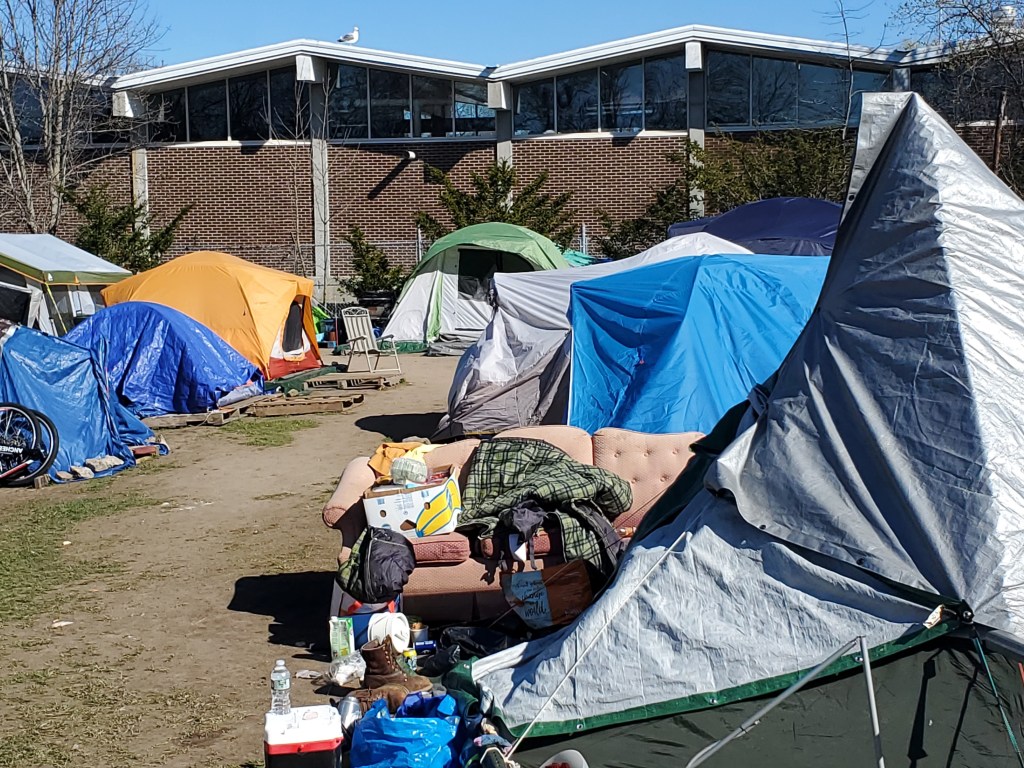
The 2025 Maine Homelessness Needs Assessment, commissioned by Maine Housing, is a compilation of data that mostly already exists to tell a simple story: Seventeen thousand people expected to experience homelessness in 2026; a $136 million gap in funding to meet the needs of those people; very little prospect that the gap will be met in the near future.
The report is broken down by regions, and York County is not in the worst shape, but is still quite dramatic. We spend almost nothing on outreach. We have not a single shelter. We do a pretty good job on problem solving, transitional housing and rapid rehousing, but we need more than $5 million in permanent affordable housing. Altogether, the report estimates that York County needs about $6.5 million in annual funding, most of it for shelter space and housing.
Not all of this is about Biddeford, of course, but of the three cities where homelessness is most prevalent (Kittery and Sanford are the others), Biddeford is by far most heavily impacted. With the closing of the York County Shelter in Alfred last year, Seeds of Hope has emerged as the only entity actually providing overnight beds year-round, one of two programs providing meals, and one of the few places where someone with troubles can go and find trained staff and access to medical, addiction and other services.
Seeds of Hope is not a shelter in the sense that this report uses the term. That is, it is not classified as a shelter eligible for state and federal funding but instead is classified as a “warming center.” This despite the fact that Seeds of Hope offers services and amenities (showers, hot meals, a change of clothing) not usually found in warming centers. This distinction is why the need for continued funding from the city of Biddeford.
Seventeen thousand people
— 2025 Maine Homelessness Needs Assessment
expected to experience homelessness
in 2026; a $136 million gap in funding
to meet the needs of those people;
very little prospect that the gap
will be met in the near future.
One useful aspect of the gaps report is its emphasis on the scope of the issues presented by homelessness — it is not simply about building more shelter beds to keep people out of sight. A working system “requires simultaneous investment across all program types,” the report says. That includes outreach, a working system of referrals and placements to existing services, and many more places for people to live long-term.
The gaps report actually provides a different framework for Biddeford’s leaders and citizens to look at our situation. As Vassie Fowler, the Seeds of Hope executive director, pointed out recently, it was the city only two years ago that asked Seeds of Hope to take on sheltering people so it could close the Water Street encampment near Mechanics Park.
From there Seeds of Hope evolved and grew to meet a need that is also growing. When York County Shelter closed, Seeds emerged as the only viables alternative not only in Biddeford but for most of York County. Its expansion has been consistent with city needs and requests, but also with the need to address the bigger picture. Thus, the recently announced takeover by Seeds of Hope of the family shelter in Sanford that was also operated by York County Shelters.
Recently, the city council asked for a report on the impact of homelessness in Biddeford. Now it is time to ask for information on how the entire system works, where the gaps area, and ideas on how it can be more effective. Rather than focus on Seeds of Hope as a problem, let’s look at strategies and new ideas to manage a difficult situation. Here are some suggestions:
“The city council asked for a report
on the impact of homelessness
in Biddeford. Now it is time
to ask for information on how
the entire system works,
where the gaps area, and ideas
on how it can be more effective.”
- Accept two realities. First, that homelessness is part of Biddeford’s future for some time to come. What we do with it is up to us, but if you’ve been to Portland’s downtown recently you’ve seen what neglect brings. Second, the idea of locating a “shelter” somewhere out of Biddeford’s downtown, or elsewhere in York County, is fantasy. All efforts to find other suitable sites, even for winter “warming centers” here, in Sanford and elsewhere have proven futile. The only actual shelter in York County, located in Alfred, closed its doors last year and it’s clear that Alfred does not want it back. Sanford couldn’t even come up with a site for a warming center last winter. In no other area of housing development is NIMBY so relevant and so toxic.
- Collaborate on new programs and alternative funding sourest. One of the complaints I hear frequently from people at Seeds is that they are bored. Getting people off the streets and into something better should be a priority. The Heart of Biddeford idea to start an ambassadors program is a good start. Other work programs are possible. Day programs (other than just a chair at McArthur Library) are also needed. These are not things the city needs to fund but finding the right partners and active participation and support by city officials make new programs work better, faster. Another promising area of partnership is new uses for the Opioid Settlement money flowing to Biddeford and York County. New uses could include a peer counseling programs.
- Build on Biddeford’s strong partnership with Seeds of Hope. The goals and mission of Seeds and city align in just about every respect, and the partnership through the city’s General Assistance office is already producing good results. Over the course of last year, intense collaborations between Seeds staff, the GA office and local not-for-profits and landlords resulted in more than 100 people moving out of homelessness and into housing. The need for more on-site programs is clear and is limited only by space and staffing constraints. Again, active participation by city officials is helpful to make sure partnerships continue to be a priority with Portland-oriented not-for-profits.
- Having an actual shelter in Biddeford has lots of advantages. How do we make Seeds of Hope into the well-funded and accountable organization that can reverse the tide of homelessness here? The answer to that starts with supporting the transformation of Seeds of Hope from what is now officially a warming center with some staffing into an actual shelter, using the definition required by HUD and the State of Maine. There are many reasons why this makes sense, but the most relevant for the city council right now is that federal and state funding would be available for shelters. The city would be off the hook for at least some of the $480,000 it currently gives to Seeds.
- Support Seeds as it develops satellite shelters. Unhoused individuals from outside the City of Biddeford should be able to get both temporary shelter and also access to all of the services available to individuals at Seeds of Hope and through the York County’s Coordinated Entry program. Satellite facilities can be as small as five beds in a residential building with staffing.
- Continue agreements with the cities of Saco and Old Orchard Beach to house those (rather few) individuals from those cities at the Seeds of Hope facility, with the cities of origin picking up the entire tab. People who originate in Sanford and Kittery (the other two centers of homelessness) should be sheltered either in or near those cities.
- Develop data and reach out to neighboring communities about cost sharing. In those cases when place of origin can be established, costs of sheltering and supporting individuals can easily be determined and billed. But the great majority of people who have been unhoused for more than a few months are basically drifters. They should not be just Biddeford’s responsibility. Rural and wealthy communities near Biddeford need to be convinced to share this burden.
_____

ABOUT THE AUTHOR | Tom McPheeters is a regular contributing writer for the Biddeford Gazette. He is also a volunteer in the Seeds of Hope dining room and the volunteer secretary for the Biddeford Homeless Task Force. Prior to moving to Biddeford, he spent 30 years working on poverty, homelessness and community development in Albany, New York.
READER FEEDDBACK
BONNIE SUE | Shame on this town for BULLYING its way through the postage sized parcel of land these people encamped on down the street. You scattered them all about when you BULLDOZED your way through all that they own. Driving through the Seeds of Hope “TRIFECTA“ is an absolute eyesore. The park across the street from SOH (a tribute to the 2 boys whom were shot there a few decades ago) is NOT neighborhood friendly, it’s an absolute disgrace.
MAUREEN DUREAU | I have an idea that could solve part pt of this homeless problem. How about a person that has a bedroom rent out to a person that has no criminal background, no addictions — just needs a place to live, and would not create problems for the tenant that has that room to rent? A good screening of person first would be required with proof for the safety of the apartment holder.
NADINE NIEDNER | Homeless people need a room. That’s all. A rooming house/home with community access to common kitchens and restrooms. It’s inhumane to have people sleeping outdoors with no place to put their stuff. It should be a right/dignity of a room. You can go on & on about data/studies. Rent prices are too high. H.U.D pays $2000 for what they used to pay $500, Legal greed. The natives did not have homelessness, did they??? That’s undignified to keep people in an overnight shelter than herd them out to street pasture like animals. Remember the rich man and Lazarus. (Luke 16) Peace b with you.
YOUR THOUGHTS?


STAY CONNECTED | SUBSCRIBE FOR FREE TOAY
THE BIDDEFORD GAZETTE

Community-Driven News, Opinion & Resources for Biddeford
Biddeford Gazette | Our Editorial Standards & Policies
© 2026 Biddeford Gazette, Inc. All Rights Reserved


Excellent article!But I hated the ridiculous comments posted
LikeLike