Joint budget workshop: ‘A Tough Pill to Swallow’

With a “challenging” budget hanging over their heads, members of the Biddeford City Council and the Biddeford School Committee participated in a joint workshop meeting Monday to examine the proposed budget.

Monday’s joint meeting was a rare occurrence that has happened only once before over the past 10 years.

“This is an unusual opportunity,” said Mayor Marty Grohman during his opening remarks. “We all share the same goals.”

School Superintendent Jeremy Ray said both the council and the committee are all in a “difficult situation, but we are being very conservative.”

In its current form, the proposed budget for next year shows an increase of 0.53 percent for the city; a 5.10 percent increase in school funding and an 0.08 percent increase in county taxes.

According to Acting City Manager Brian Phinney, every $100,000 of spending requires 2.3 cents on the tax rate.

As it stands now, the proposed budget would require an increase in the mil rate, from $14.22 last year to $15.03 this year.

Members of the Biddeford City Council and Biddeford School Committee discuss the proposed budget for next year. (Seaver photo)

Grohman said Monday’s evening was designed to bring both groups together under one roof so that they could each share their concerns and collaborate with one another about ways to soften the impact on taxpayers.

School Committee member Marie Potvin is a retired teacher who spent many years working in Biddeford schools.

“I was born and raised here,” Potvin said. “Our demographics have been changing significantly, and I am feeling somewhat anxious about all the things happening outside of the city that is creating so much uncertainty.”

School Committee member Megan Desjardins is a social worker. “Every single decision we make is in the best interest of our students,” she said. “Every day, we are being asked to do more for less.”

John McCurry, a former city councilor and current school committee member, described the budget as “quite high” McCurry said the city’s schools are always seeking ways to drive down costs, but he is worried about public perception.

“How do we get citizens involved?” McCurry asked, recalling previous budget debates when members of the public filled the council chamber, spilling out into the hallway.

Almost everyone at Monday’s meeting agreed that an 11.5 percent increase in the overall school budget is going to be a hard sell to voters.

“People just react to the numbers,” said School Committee member Chad Barrs. “There’s often a stark difference between perception and reality. It is much more complicated than it looks on paper.”

“Every day, we are being asked
to do more for less.”

— Megan Desjardins, School Committee member

City Councilor Marc Lessard said the council needs to make some “painful decisions,” reminding the group that Biddeford taxpayers have seen a 20 percent increase over the last three years.

“If everyone here is okay with a 5.7 percent increase, then let’s just go home,” Lessard said. “Our work is done,” adding that he will not support a 5.7 percent increase.

“Do we take money away from kids who need funding or do we take it from McArthur Library and the Heart of Biddeford?” Lessard asked rhetorically, suggesting that the city could slash all of its funding for social services requests.

Councilor Doris Ortiz rebuked Lessard. “A lot of those social service agencies help our kids,” she said.

Councilor Norman Belanger said the council should avoid creating an “us versus them mentality.”

What’s driving the school budget?

School Supt. Jeremy Ray pointed to what he described as a “seriously flawed” school funding formula that is used for determining state subsidy amounts.

During his presentation, Ray walked through several charts and spreadsheets that demonstrate how increasing valuations hurts the city’s schools.

One of those spreadsheets shows Biddeford being well behind many other communities when it comes to per pupil cost for education.

Biddeford’s per pupil cost last year was $9,904.76, compared to $16,085.68 in the town of Falmouth or $15, 936.72 in South Portland.

“Our focus is always about what our students deserve,” Ray said. “A child in Biddeford doesn’t deserve less than a kid in Cape Elizabeth. We have a tough population, but people still want excellence.”

Ray also provided an 11-year comparison for Biddeford’s school budget, which shows an average expenditure increase of 3.82 percent.

Last year, the school budget came in with a 6.1 percent increase in expenditures. This year’s requested increase is 5.39 percent.

City Council President Liam LaFountain said there is still a long road ahead in what the final budget will look like, including public hearings and additional council review.

“Some of this feels premature,” LaFountain said. “I want to make sure that we’re not just thinking about the short term, but are also considering a lot of long-term impacts.”

Councilor Dylan Doughty said “everyone is being asked to do more with less” on both the city and school side of the budget.

Barrs said the proposed budget is going to be a “tough pill to swallow” for taxpayers and voters who will ultimately decide on whether to approve the school budget in June.

Click on the link below to view/download a copy of the Biddeford School Budget Presentation

Randy Seaver is the editor of the Biddeford Gazette. He can be contacted at randy@randyseaver.com

Never miss another update! Subscribe for free today!

Budget tensions include homeless funding

Last week, more than two dozen people appeared before the Biddeford City Council, each of them requesting varying amounts of public funding for their respective non-profit organizations.

It is an annual process that is just one part of the city’s annual budget.

None of the public presenters were questioned or challenged about their funding requests – except one.

Vassie Fowler, executive director of the Seeds of Hope Neighborhood Resource Center, was questioned about her funding request by veteran City Councilor Marc Lessard.

Fowler told the council that her organization’s budget has exploded over the past 12 months, from a total of $345,000 last year to a projected $1.1 million this year.

Vassie Fowler, executive director, Seeds of Hope

“It’s hard for me to even say that number out loud,” Fowler told the council.

Last year, Fowler asked the council for a $50,000 donation. Ultimately, the council then approved a $28,000 expenditure for Seeds of Hope.

This year, Fowler is asking the city for a contribution of $180,000 primarily to support the installation of fire sprinklers on the second floor of the former church on South Street, where between 40 and 50 unhoused residents stay during the evening.

Fowler told the council that she expects to pay $150,000 for the sprinkler system, and said her organization is in “serious need” to support its daily meals, pointing out that a single gallon of orange juice now costs $8.

Fowler said Seeds of Hope served more than 36,000 meals last year. “We are focused on getting the most out of every dollar,” she said. “At this, point finding solutions to the growing need seems impossible.”

Fowler said her organization was quite different than other organizations asking for funds, such as the Heart of Biddeford, City Theater, LaKermesse or Subscircle, a community arts program.

“What we do is not fun to talk about,” she said.

After Fowler completed her presentation, Mayor Marty Grohman asked if any of the councilors had any questions. Lessard raised his hand.

Lessard pointed out that last summer the city committed $1.3 million to begin a new “test program” to provide structured services for unhoused residents. Almost nine months later, the city still does not have a permanent plan to address the issue.

City Councilor Marc Lessard

“We have no guarantees about what your operation will look like or how it will function after November,” Lessard said to Fowler.

During a telephone interview on Sunday, Lessard said he was simply asking the same questions he asked last year when Grohman and former City Manager James Bennett outlined a plan that would allow the city to close a sizeable homeless encampment near Mechanic’s Park.

“I am concerned that we have no long-term security in how this program will operate in the future,” Lessard said. “There’s nothing stopping them from becoming a for-profit organization or shutting down.

“I just want some assurances,” Lessard said. “I am trying to safeguard the city.”

Growing questions and a growing need

The city began its new “homeless approach” in July 2024, after the annual budget was already approved.

Bennett told the council then that the city could tap into some of the federal Community Development Block Grant (CDBG) funds that the city had received.

Bennett laid out a two-phase approach, the first part of which would be to hire a new homeless outreach worker and provide several zero-gravity chairs to Seeds of Hope. The second-phase included funding to make repairs and upgrades to the former church that included the installation of several shower stalls and a new kitchen.

But after learning that the city could not use the CDBG funds for work on an historic building, the renovation project was abruptly halted as the city struggled to find a new way to fund the renovation project.

Fowler said that once Seeds of Hope was asked to provide the city with overnight services, her operating costs skyrocketed because of the need for additional staffing, utility costs and other supplies.

“To me, it doesn’t make sense to fix something that isn’t broken,”

— Vassie Fowler

“I think it’s important to remember that this was the city’s plan,” Fowler told the Biddeford Gazette during a subsequent interview. “We’re just the vehicle the city decided to use to tackle this problem.”

When asked by Lessard about a guarantee or assurances, Fowler said it depends on what the city wants.

“We will always be a non-profit,” Fowler replied. “The answer is that’s a conversation that needs to happen. I’m open to it. I have always been open to it. We’re open to all possibilities.

“To me, it doesn’t make sense to fix something that isn’t broken,” Fowler added. “This is working. We are finding permanent solutions to homelessness in our community. I cannot imagine why we wouldn’t continue to do that.”

As a resident of Biddeford, Fowler told the Gazette that she very much appreciates Lessard and his fiscally-conservative perspective.

“Marc really cares about this city, and we need people like him who are going to keep a close eye on things,” Fowler said.

For his part, Lessard told the Gazette that it is sometimes hard being in the minority on the council.

“I have a very deep appreciation for everything that Vassie and Seeds does for our community,” Lessard said. “I don’t feel as if I’m asking for a lot by looking for some concrete assurances.

“We are facing a budget that is putting a big strain on the backs of most taxpayers,” he added. “We talk a lot about affordable housing but then we go ahead and make housing less affordable. It’s just not sustainable.”

“That’s a good back and forth,” Grohman said of the exchange between Fowler and Lessard on Thursday evening.

Randy Seaver is the editor of the Biddeford Gazette. He can be contacted at randy@randyseaver.com

Never miss another installment! Subscribe for free today!

OPINION: What is community? How much does it cost?

Former Biddeford Mayor Alan Casavant — now the vice president of the non-profit Biddeford Cultural and Heritage Center — appeared before the Biddeford City Council Thursday to present his organization’s annual funding request.

Before the meeting started, Casavant was seated next to me in the back row of the council chamber. We made some small talk as we were waiting for the meeting to begin.

We both agreed that this is going to be a brutal year for budget making in Biddeford. We both agreed that we were glad that neither of us were sitting on the other side of the council dais.

We both listened as presenter after presenter approached the podium to make their various pitches for some municipal funding. Representatives from McArthur Library, the Heart of Biddeford, the Biddeford Mills Museum, Seeds of Hope, Biddeford Community Gardens, La Kermesse and so many others each waited for their turn to explain why they should receive some modest funding from the city.

Casavant (left) and I chatting during his 2011 mayoral campaign

This part of the annual budget process is called the “social services” portion of the budget. These are organizations that are not part of city government or operations. These are all non-profits struggling to keep pace with inflation in an uncertain economy.

” “I also believe it is important — critical — that city government
try to find ways to bring people together . . .
to chat, to laugh and to find commonality.

— Alan Casavant

It’s easy to say we cannot afford these things, but ask yourself: can we afford to lose these things?

Laura and I are feeling the same economic pinch as many other families are feeling all across the country. We are in the process of trimming some fat from our own household budget. We really don’t have much of a choice in the matter, but there are some things that may look like fluff but are actually essential to our quality of life.

When it was his turn to speak, Casavant approached the podium with a certain amount of gravitas. He is the second-longest serving mayor in Biddeford’s history, first elected in 2011 and then re-elected five more times before stepping down last year,

Casavant reviewed details of his organization’s request, but it was his summary that caught me off guard and left me wondering if maybe I should reconsider some of my own thoughts about this year’s city budget.

“I realize you are facing a very difficult budget year,” Casavant said. “”But I also believe it is important — critical — that city government try to find ways to bring people together . . . to chat, to laugh and to find commonality.

“They’re not gonna find that from social media. They’re not gonna find that from their cellphones.

“People need things like festivals, musical events, historic awareness and social interaction to bring everyone together; to build community, which is also the responsibility of this council,” Casavant added.

The room erupted with vigorous applause, and I saw a glimpse that made me think: Biddeford is much more than a city. It is a community. So the question becomes, what is the value of community?

I honestly don’t know, but it’s something worth thinking about.

Disclosure: I served as Casavant’s campaign manager in 2011 and 2013.

Randy Seaver is the editor of the Biddeford Gazette. He can be reached at randy@randyseaver.com

Never miss another installment! Subscribe for free today!

Chamber director announces pending departure

After nearly seven years at the helm, Jim LaBelle announced Thursday that he will be stepping down as executive director of the Biddeford-Saco Chamber of Commerce + Industry.

LaBelle, 60, said he plans to stay in place and help the Chamber with its transition to new leadership.

“It’s not an easy decision because I really enjoy what I am doing,” LaBelle said during a telephone interview. “I’m just at a point in my life where I want to take a step back and focus on my personal life and goals.”

Jim LaBelle/ Contributed photo

LaBelle said he is proud of his accomplishments at the Chamber, most notably a significant increase in membership, from the mid-300s to more than 460 members today.

“We have held more than 100 ribbon cuttings, and this community has experienced unprecedented economic growth,” LaBelle said. “I live in this community. I love this community, and I will be forever rooting for this community.”

LaBelle said he believes the Chamber needs to be continually evolving in order to better serve its members and the overall business community.

“The next leader will need to be visionary,” LaBelle said. “Hopefully someone a bit younger with fresh ideas to make sure that the Chamber remains relevant well into the future.”

LaBelle, known for his trademark optimism, admits that he has always been a glass-half-full person. “It’s easy to be optimistic in this community,” he said.

“He’s basically working all alone, and yet he’s always ready to dig in.
Always looking for ways to help. It will not be easy to fill his shoes.”

— Mayor Marty Grohman

Biddeford Mayor Marty Grohman had nothing but praise for LaBelle and his performance as the Chamber’s executive director.

“Jim has been truly incredible,” Grohman said. “He makes it look easy, but he has done so many positive things for the community.”

A few years ago, Grohman served on the Chamber’s board of directors and today the mayor is an ex-officio member of the Chamber.

“From behind the scenes, I can tell you that Jim is one of those people. He’s the guy with the enthusiasm and the optimism. He’s basically working all alone, and yet he’s always ready to dig in. Always looking for ways to help. It will not be easy to fill his shoes.”

LaBelle said running the Chamber has not always been easy, pointing to the Covid pandemic. “You know, the Chamber is all about bringing people together, and we had to figure out how to do that without actually getting together in person,” he laughed.

LaBelle also looked for ways to capitalize on technology, and the use of social media to promote the community. During his tenure, a Chamber employee created what would become one of the area’s most prolific Facebook community groups. Today, the Biddeford+Saco Community page is no longer managed by the Chamber but has more than 18,000 members.

But for all of its benefits, social media proved to have its own pitfalls, continually requiring more time to moderate and manage the online forum.

For his part, LaBelle said he is looking forward to having some more down time. He’s not exactly sure what his future will look like, but says a change of pace will allow him the opportunity to take stock of where he is and where he wants to be.

“I have been really lucky so far,” he said. “Now, I’m just looking at the future as a blank page, but there is no doubt that I am going to miss the opportunity I had while working here.”

Never miss another update! Subscribe for free today!

OPINION | The Times, They Are A Changin’

The news was inevitable, but still sad.

We learned yesterday that the weekly Biddeford-Saco-OOB Courier will no longer be printed and now accessible only in digital form, online.

This is just part of a global trend in the newspaper industry. Let’s face facts. The cost of printing and distribution are significant.

But while technology marches onward, there are still many painful consequences. Nearly 50 employees got layoff notices yesterday from the Courier’s parent company, the Maine Trust for Local News.

Regardless of how you feel about evolving technology, we are entering an era that is making human workers more irrelevant with each passing day.

It’s not just newspapers. There are no more phone books. No more encyclopedia salesmen. EZ Pass reduces the need for human toll booth workers. Self-checkout at the grocery store, shopping online and using ATM cards are all part of the equation.

For older people who may be a bit skittish about apps, streaming television and AI (artificial intelligence), many of these changes (advancements?) are uncomfortable, if not downright terrifying.

When my children were growing up, I often told them: “Your environment does not adapt to you. You must adapt to your environment.” It’s a matter of survival.

Video Killed the Radio Star

I have written several columns about the media, advancing technology and consumer trends when it comes to news distribution, including this rather recent post: Pour Some Sugar on Me

But this latest news about the Courier leaves me feeling a bit nostalgic and a bit sad.

I am personally connected to this story nine ways from Sunday.

Let’s backup for a second. For more than 50 years, newspapers have been part of my life, first as a paperboy for the York County Coast Star, the Journal Tribune and the Portland Press Herald.

I dreaded Sundays because the weight of those Maine Sunday Telegram issues were more than twice as thick as their daily counterparts and quite heavy. I had to break my route up on Sundays simply because I could not fit all of the papers into my over-the-shoulder sack.

Even as a young boy, I had a fascination with news and politics. In high school, I even landed a short gig as an intern in the Journal Tribune’s newsroom.

Over the years, I wrote for a few different publications, but it was the Courier where I made my mark.

It was the Courier that launched my connection to the same exact communities where I grew up. The Courier became my life. Had I not been the Courier’s editor for a few years, I would not have met my wife.

Today, I own and operate an online-only “newspaper.”

I was lucky enough to work for the Courier back in the good ol’ days, when the paper was still locally owned and operated.

I very much doubt that the Courier’s current owners have even visited Biddeford, but still, they have the audacity to promote the paper by describing its coverage as “hyper-local.”

Ummm . . . not really hyper-local . . . . whatever that is supposed to mean.

It’s been a long time since I have seen a Courier reporter cover City Hall. I did not see a reporter from the Courier at this year’s Winterfest festival.

When Biddeford Mayor Marty Grohman scheduled a community event to support the family of a fallen police officer, the Courier was not there to cover it, but did publish a story a few days later. Liz Gotthelf from Saco Bay News was there. I was there, representing the Biddeford Gazette but that was it for media coverage during the actual event.

Make no mistake. It’s not the reporter’s fault. It is a situation playing out in newsrooms all over the country, where ad revenue trumps news coverage.

I very much doubt that the Courier’s current owners have even visited Biddeford, but still, they have the audacity to promote the paper by describing its coverage as “hyper-local.”

I Want To Be Sedated

Sydney Richelieu is today the primary reporter for the Courier. Her editors expect her to cover six communities every single week. Think about that for a minute.

Richelieu is responsible for covering news in Biddeford, Saco, Old Orchard Beach, Arundel, Kennebunk and Kennebunkport. I don’t care who you are or how hard you work, that beat is a really big nut to crack.

Consider this. When I left the Courier in 2006, we had four full-time reporters (including me) covering the same geographic area.

Today, the Maine Trust for Local News expects one reporter to cover the same beat that was previously covered by four reporters. The Maine Trust for Local News has set Sydney up for failure even before she inherited the beat last year.

The folks at the Maine Trust for Local News love to bloviate about their dedication to “local journalism,” but maybe they should put some of their money into the newsroom, you know? Local journalism?

The Courier and the Portland Press Herald are both owned and operated by the same company, so don’t expect the state’s largest daily newspaper to step in and fill in the cracks. The way they see it, Biddeford and Saco are already covered.

Newspapers – including both tabs (tabloids) and broadsheets — are printed in four-page increments. In order to cover costs, roughly 60 percent of the newspaper needs to be covered by paid advertisements.

When I left the Courier, we were consistently publishing 44-page papers. Today, the Courier is merely a shadow of itself, hovering around 16 pages (not including advertising inserts).

I’ll close with some good news for the Courier. This move by their parent company removes their handcuffs of being published just once a week. Now they can more effectively compete with the other digital publications in this area, Saco Bay News and the Biddeford Gazette.

Being online allows journalists to be nimbler, to be in a better position to scoop some breaking news. Something that hasn’t happened at the Courier in a long time.

As a Biddeford resident who appreciates and values local news from a variety of sources, I hope that this recent transition returns the Courier to its rightful position as a competitive, local news source.

We’ll see.

Never miss another installment | Subscribe for free today!

Political gamesmanship threatens vulnerable Mainers

By HENRY INGWERSEN, State senator

The last time I wrote to you, I spoke about the importance of MaineCare, our state’s version of the Medicaid program. MaineCare provides health care to low-income families and children, people with disabilities and pregnant women, and is overwhelmingly supported by Maine people.

I also wrote about how Maine faces the same challenge as many red and blue states – the cost of health care is rising and state budgets are having a hard time keeping up.

This fiscal year, which runs until the end of June 2025, we face a $117 million gap in MaineCare. If unaddressed, providers already facing financial challenges would be put in an even more difficult situation. In some dire cases, providers could be forced to shut their doors – and when those doors shut, they shut for all of us.

State Sen. Henry Ingwersen (D-York)

In the last month, members of the Legislature’s budget committee worked hard to reach a bipartisan agreement on a supplemental budget that would fix this gap and get funding out the door quickly.

 I was very pleased when, in early February, they reached a deal and voted unanimously to recommend passage of the supplemental budget to the full legislature. However, my Republican colleagues suddenly walked back on the deal and began insisting that to earn their support, we would need to make cuts to MaineCare and housing assistance.

While I disagree with these cuts, these are large policy conversations that can certainly be had as the Legislature moves to construct a biennial budget – which covers the next two fiscal years – in the coming weeks. Right now, Maine people are counting on us to keep MaineCare afloat and to do it quickly.

A unique aspect of Maine law requires a two-thirds vote in the Maine House and Senate to approve emergency funding, which means strong, bipartisan support. Without this two-thirds vote needed to get this funding out the door, the Department of Health and Human Services will begin cutting back funds owed to hospitals, nursing homes, and home and community-based services as early as March.

We have continued to hold votes, and Republicans continue to oppose the plan they had previously agreed to. The more votes we take, the less I understand why there is opposition.

State Sen. Henry Ingwersen

We have continued to hold votes, and Republicans continue to oppose the plan they had previously agreed to. The more votes we take, the less I understand why there is opposition. Our most rural communities rely heavily on keeping MaineCare functional – 45 percent of folks in Washington County; 40 percent in Aroostook County and an average of 37 percent across Oxford, Franklin, Somerset and Piscataquis counties are enrolled in MaineCare.

Many of us in the Legislature are here to make sure that our rural areas are not left behind.

In addition to the people covered by MaineCare in these areas, the small health care providers that strengthen our small towns are at most risk of harm. The Maine Primary Care Association recently told the Press Herald, “Health centers operate in small, rural towns in each county, and are also present and essential in Maine’s bigger cities; like many other health care providers, they are not designed to weather endless instability in payments.”

As I’ve learned in my time on the Legislature’s Health and Human Services Committee, Maine already has many “care deserts” across our state, forcing folks to travel long distances to get the services they need. I am deeply worried that not approving this funding means the problem would only get worse.

Every day in Augusta, as I chair the Health and Human Services Committee, I hear more stories of folks struggling with access to health care. Folks like Vickie, from Norway, who shared how her insurance did not cover services she felt would have made a real difference in her mental health care.

We need to be moving forward on health care access, not backward. I stand ready to support critical funding for MaineCare, and I hope my colleagues will join me to find a path forward for Maine people.

The people of my district and the rest of Maine are not the least bit interested in the political games taking place here in Augusta. They want to make sure that they continue to get the quality health care they deserve for their families. They deserve no less from us.

As always, if you have any questions about the information here or if you would like to reach out with a comment, question or concern, you can reach out to me any time. If you want to stay up-to-date on what we’re working on in Augusta, please sign up for my email newsletter at mainesenate.org or visit my Facebook page at facebook.com/IngwersenForMaine.

Henry Ingwersen represents District 32 in the Maine Senate, which includes Biddeford and the surrounding communities of Arundel, Dayton, Hollis and Lyman. He can be reached at Henry.Ingwersen@legislature.maine.gov or 207-287-1515

Editor’s note: The views expressed here are those of the author. If you would like to contribute an opinion column, please contact us at biddefordgazette@gmail.com This column was also published in the Biddeford-Saco Courier

Never miss another update! Subscribe for free today!

Biddeford Deserves Better | OPINION

I honestly don’t get it.

Six days ago, I broke and published a news story that Biddeford City Manager James Bennett was abruptly removed from his post.

Bennett, well-known in several communities throughout Maine, capped off his nine-year stint in Biddeford under a cloud of mystery. Six days ago.

I understand why the city is keeping tight-lipped, but I cannot believe that I am the only reporter in southern Maine asking questions. Six days!

The rumors are swirling, and yet every other media outlet in southern Maine is either unwilling or unable to cover the story.

If I had not published my story, the people of Biddeford would have almost no way of knowing what is happening at City Hall. Six days! Really?

I get that I have an unfair advantage because I have been covering Biddeford longer than anyone else and have developed a healthy Rolodex of sources, but six days??

This is a disservice to the people of Biddeford. This community deserves better than just my reporting.

I understand, maybe it’s difficult or embarrassing for other media outlets to acknowledge that I have been running circles around them on a zero-dollar budget for the past two months while only wearing boxer shorts in my basement and often forgetting to put in my dentures . . . but come on! Six days!

No wonder local government officials think they can do whatever they want. No one is apparently watching.

Yesterday, there was a glimmer of hope. A reporter from the Portland Press Herald sent me an email, asking me if I would share my source of the e-mail that was sent to city workers last week. I declined but offered to point her in the right direction. Then? Silence.

Seriously? Six days?

Pathetic.

Never miss another update! Subscribe for free today!

BREAKING NEWS | City Manager will not return

By RANDY SEAVER, Editor

According to multiple sources, embattled Biddeford City Manager James Bennett will not be returning to work after his brief vacation this week.

Employees report receiving an email Thursday from Brian Phinney, the city’s chief operating officer, that Bennett will not be returning to his post to finish out the remainder of his employment term.

Former city manager James Bennett

Phinney, apparently, will now serve as acting manager while the council continues its search for a permanent replacement.

Facing increasing public pressure, Bennett announced his resignation last October. In a deal he worked out with the City Council, he was scheduled to leave his post in April.

Bennett, hired in 2015, was the city’s fourth professional manager.

We have reached out to Mayor Marty Grohman and Council President Liam LaFountain for additional comment.

This story will be updated.

UPDATE:

Here is a copy of an email sent from Brian Phinney, the city’s chief operations officer, to all Biddeford city employees at 3:37 p.m. today.

“Good afternoon,

On behalf of the Mayor and members of the City Council, I want to take a moment to update you on a leadership transition development.

As you know, the City Council has begun the process of selecting a new city manager, with a decision expected late spring or early summer. In the interim, the Mayor and City Council have elected to begin implementation of the transition plan.

As part of the transition I have been asked to serve as acting city manager to ensure continuity in daily operations. In accordance with this plan, Jim will be on leave from this point forward.

We have every confidence in your abilities and know we have a shared desire for a smooth transition. Thank you all for your continued dedication to the city and the community we serve. Your work remains vital, and we appreciate your continued dedication during this time of change.”

RELATED | Bennett announces resignation

Never miss another update! Subscribe for free today!

____________________

ABOUT THE AUTHOR | Randy Seaver is the editor and founder of the Biddeford Gazette. He has been covering Biddeford news and politics for nearly three decades. He may be reached by email: randy@randyseaver.com

Activists drop lawsuit against city, developer

A lawsuit filed against the city of Biddeford and a local real estate developer has been withdrawn by two residents who were upset about a proposed housing development near Clifford Park in Biddeford.

According to court documents, the plaintiffs Loren McCready and Christopher Quint both own property that abuts the proposed housing development.

The withdrawal of the lawsuit caps off a nearly four-year saga that began when Mike Eon, president of E&R Development, and Gervais Dube presented a plan to the city for an 18-lot housing subdivision.

The main entrance to Clifford Park/ Photo by Joe McKenney, Biddeford Recreation Commission,

In order to meet development standards, Eon and Dube needed to acquire roughly four acres of land in Clifford Park, a forested park that offers hiking trails and other recreational opportunities on Pool Street, less than a mile from the city’s downtown core.

In exchange for the four acres, the developers proposed trading roughly 100 acres of land that they already owned near the park, leaving the city with a net gain of nearly 96 acres that could be permanently protected from any development and remain publicly accessible into perpetuity.

Although one city official described the proposal as a “win-win” scenario that would nearly double the popular park’s size and provide greater public access, a handful of opponents said the plan should be rejected.

According to a November 3, 2020 Portland Press Herald story, former Biddeford Recreation Director Carl Walsh appeared before the city council and said “It’s s quite an opportunity,” adding that the city has long desired to add the waterfalls — which is on part of the land that could go to the city — to the park.”

McCready, however, said the proposed land swap was a bad idea and could cause environmental damage. Shortly after the Biddeford Planning Board gave their initial approval to the project, McCready formed a non-profit group to prevent the project and address other “environmental concerns” in the city.

The Biddeford-Saco Climate Action Team still meets on a regular basis and its Facebook page shows 13 “Likes” and 19 ‘followers.”

McCready and Quint first appealed the Planning Board’s decision to the Maine Superior Court.

On November 22, 2023 Superior Court Justice James Martemucci ruled against the plaintiffs on a number of technical and procedural issues.

The plaintiffs then appealed their case to the Maine Supreme Court.

Meanwhile, the proposed project has been put on hold until all of the legal matters can be resolved.

Earlier this week, the Biddeford Gazette learned that McCready and Quint decided to withdraw their complaint against the city and the developers.

In an email statement to the Gazette, McCready wrote: “I remain committed to advancing housing solutions that are both inclusive and environmentally responsible.

“Moving forward, I will continue working with the Biddeford-Saco Climate Action Team to advocate for sustainable development practices that align with the City’s Climate Action Plan and prioritize long-term community well-being.”

McCready’s attorney Kate Hambley said the decision to withdraw her client’s complaint boiled down to money.

“While I felt and still feel my clients had strong legal grounds for appeal, my clients ultimately decided against using personal funds to pursue an appeal to the Law Court (which, as I’m sure you can imagine, can be quite an expensive undertaking),” Hambley wrote.

“This was a difficult decision given the environmental and community resources at stake, but they are confident they can still make positive changes in Biddeford, which they intend to do by promoting smart growth and affordable, sustainable infill housing within the city,” said Hambley.

Mike Eon said he was feeling relieved that the four-year battle is finally coming to a close. “It’s really hard to build affordable homes when you have to through four years of delays and increasing costs,” Eon said. “I always strive to do good projects that will benefit my community.”

Biddeford Mayor Marty Grohman also expressed a sense of relief that the litigation is over.

“I’m glad that this issue is finally settled,” Grohman said. “The city is getting a tremendous resource of additional public lands that will be protected into perpetuity.”

Never miss another update! Subscribe for free today!

Biddeford’s Housing Crisis: The experts speak

Editor’s Note: This is the second installment of our three-part series regarding Biddeford’s housing crisis.

A panel of experts offered their perspectives and guidance regarding Biddeford’s housing crisis during a special city council workshop meeting earlier this week.

For more than two hours, the nine panelists each offered their professional insights and took questions from both councilors and members of the public Tuesday evening.

Biddeford Mayor Marty Grohman described the workshop as a necessary “first step” for city officials who are trying to find innovative solutions for a problem that shows no signs of going away.

While Biddeford has seen recent success in attracting development of market-rate housing units, the city is still struggling with “affordable housing” options and a low inventory of single-family homes for young families, often described as “starter homes.”

RELATED: Biddeford grapples with housing crisis (Part One)

“We have a beautiful, dynamic and growing city,” Grohman said as he kicked off the discussion. “We’re in our 12th straight year of enrollment growth in schools. It’s immensely positive that we’re growing, and seeing this type of pressure on housing, but it’s also immensely challenging.”

George Gervais, the city’s director of economic and community development, started the meeting by providing an overview of the city’s current housing status.

According to Gervais, the city today has 10,576 housing units. Of those units, 9,431 are occupied, according to data from the 2020 Census.

Gervais said rental units make up slightly more than 52 percent of the city’s occupied housing.

Average monthly rents in Biddeford range between $1,700 and $3,200, ranging from studio apartments to three-bedroom units, Gervais said.

The average home values in Biddeford have risen by roughly five percent during the last year. The average home value in the city is slightly more than $478,000.

One of the city’s biggest challenges, however, is that area wages are not keeping pace with increasing housing costs.

“We have quite a bit coming at Biddeford,” Gervais said outlining the horizon in which more than 2,100 units of housing are currently in some form of development. “That’s a pretty impressive number,” he added.

The new development numbers include projects that are either under construction, under review by permitting agencies or projects that are conceived but have not yet gone through the permitting process.

Gervais said 319 of those units are planned as affordable housing units in which rental costs are calculated by the area’s median income (AMI).

During an earlier interview, Grohman said the city council has set a goal of creating 180 units of affordable housing each year over the next five years.

What the experts say

The panelists were broken into three main groups, focused on affordable housing; market-rate housing and a housing finance development panel. The panel also included a presentation regarding state government housing resources from Benjamin Averill, Housing Opportunity Program coordinator for the Maine Department of Economic and Community Development.

“Today, Biddeford is the place to be.
“It’s the cool place.
That’s great but it also poses problems.”

–Guy Gagnon, Biddeford Housing Authority

Guy Gagnon, executive director of the Biddeford Housing Authority, said Biddeford has undergone some dramatic changes in the last 15 years, pointing out that he joined the quasi-governmental agency in 2010.

Gagnon, a Biddeford native, said he is especially troubled by the fact that so many kids who grew up in Biddeford can no longer afford to live here. “I see my friends’ kids and even my own children being forced to look elsewhere for housing,” Gagnon said.

“It used to be that Biddeford was the second, third, fourth or even fifth choice when people were looking for homes,” Gagnon said. “Today, however, Biddeford is the place to be. It’s the cool place. That’s great but it also poses problems.”

Gagnon said the city needs to be creative and willing to look at alternatives that include modular housing and mobile home parks.

“It may not be for everyone,” Gagnon said, “but it may be for some people. Biddeford should be the community that thinks outside of the box.”

Kevin Bunker of Developers Collaborative said the city needs to stay aware of what is happening at the Legislature, especially in regard to statewide housing policies and assistance for affordable housing development.

“Those resources are limited and the state is facing a challenging budget,” Bunker said. “You need to remember that they are also trying to keep up with a huge demand.”

John Laliberte, the CEO of Reveler Development, provided an overview of his company’s projects in Biddeford, including 73 apartments at Riverdam, Phases One and Two of The Levee project and the recently offered market-rate units at The Eddy on Barra Road.

“We have had a lot of success in Biddeford,” Laliberte said. “There is a big demand for this type of housing, but our main challenge remains being able to attract the private capital necessary to get these projects off the ground.”

A common theme throughout the evening was centered upon the need to make the development process more streamlined and efficient to reduce costs for both renters and buyers.

Although not members of the expert panel, local real estate developers Chico Potvin and Matt Chamberlain both spoke during the public comment period, detailing how hard it is to get a project from design to out of the gate development.

Potvin, 61, said he has been building “starter homes” in the Biddeford area since 1987.

He said the city’s shortage of available single-family homes is “forcing people into apartments and making it harder for people to find apartments. “It’s a vicious cycle,” he said.

Potvin said his biggest challenges include skyrocketing labor costs and a growing myriad of red tape that cause time delays and increases building costs.

“Every year, the regulations increase,” Potvin said, questioning why the council chose to fund needed city-wide sewer improvements on the backs of new homebuyers.

“Almost every day I get calls from friends and other people asking what I can do for them,” he said. “They don’t want to wait two years for a project to get approved. I feel bad. The city needs to buckle down and treat housing the same way as you treated land for industrial parks.”

Potvin also said he is nervous about all the high-end apartments being built in Biddeford. “It scares me,” he said. “I’m not sure if it’s sustainable.”

Cat Bates said he grew up in Kennebunk and moved to Biddeford almost five years ago. He said he would like to see the city do a better job in streamlining the approval process for Accessory Dwelling Units and said it should be easier to get bank financing for that type of development.

City Councilor Doris Ortiz previously chaired the council’s affordable housing task force, and said she would like to see the city be creative in its approach to creating housing, including co-ops and micro developments.

Editor’s Note: The city has created an open portal for public comment and questions on the city’s website, where you can also find more information and documents about the housing workshop meeting.

Never miss another update! Subscribe for free today!

Biddeford’s Winterfest 2025 is a hit

Hundreds of people flocked to downtown Biddeford on Saturday for the 13th annual Winterfest celebration. The giant sledding hill on Adams Street was once again a popular attraction, but there were also a lot of other things happening, including tours of the newly renovated City Hall clock tower, dancing and music.

The Adams Street sledding hill was again a big favorite during Biddeford’s Winterfest celebration (Seaver photo)

Volunteers from the New Life Church had several tables set up, giving away free donuts, hot chocolate and hats and mittens.

New Life Church volunteer Roland LaFlamme poses with a Winterfest mascot (his wife Maureen) Seaver photo

Children also had the opportunity to see the inside of a fire truck, city plow and the police department’s mobile Crime Scene Unit.

Outdoor temperatures remained above freezing, making this year’s celebration even more enjoyable.

Alannah, 11, gets her fingerprints made by Cpl. Matt Baldwin of the Biddeford Police Department inside the mobile crime scene unit (Seaver photo)

Larry Patoine, one of the event’s lead volunteers, said it will take less than four hours for volunteers to remove the giant sledding hill this evening before another winter storm descends on the city

This year’s hill was constructed with snow from the Five Points Shopping Center. Patoine says the snow from the hill will be disposed of near Rotary Park.

A long line of children anxiously await their chance to experience the giant sledding hill on Adams Street (Seaver photo)

Former mayor Alan Casavant, who helped organize the very first Winterfest (La Fete d’ Hiver) in 2012, said he was pleased to see the festival growing in popularity with each passing year.

“This is what community is all about,” Casavant said. “It’s fun just watching so many people having fun.”

Mayor Marty Grohman struts his stuff during Winterfest (Seaver photo)
A good turnout at this year’s Winterfest in Biddeford (Seaver photo)
Evelyn (left) and Zoe check out what it’s like to ride in a fire truck (Seaver photo)

Never miss another update! Subscribe for free today!

Biddeford’s Housing Crisis: Part One

Editor’s Note: This is the first installment of a three-part series that examines Biddeford’s housing crisis.

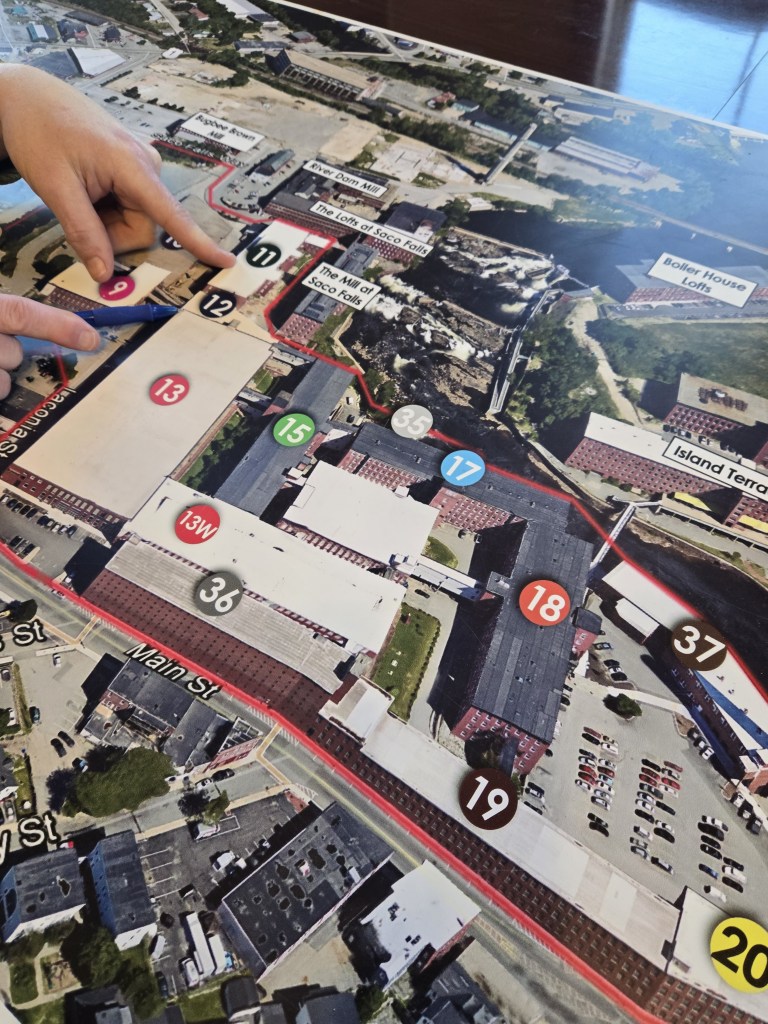
A large conference table takes up the center of Biddeford Mayor Marty Grohman’s second-floor office at City Hall. On that table is a large aerial photo of the city’s downtown area, where several new housing projects are either under construction or in development.

Grohman can’t help but to get excited when talking about the city’s potential for growth and prosperity, but he is also mindful of the struggles the city still faces in terms of increasing rental costs, home prices and the lack of affordable housing.

“It’s a big mix,” said Grohman during a recent interview with the Biddeford Gazette. “There are a lot of moving parts and they are all connected.”

All across Maine, cities and towns are struggling to keep pace with their community’s housing needs.

Mayor Marty Grohman points to several housing projects that are in development throughout the city’s downtown area.

“It’s not just Biddeford,” Grohman explains. “It’s virtually everywhere, and we – as elected leaders – have a responsibility to be part of the solution for this problem.”

In his search for creative solutions, Grohman is convening a special workshop meeting of the Biddeford City Council to address housing issues on Tuesday, Feb. 11.

At that workshop meeting, which will include an opportunity for public commentary, councilors and city officials will review the city’s goals and progress in meeting the various housing demands throughout the city.

For example, Grohman says the city council last year set a goal of creating 180 units of “affordable housing” each year over the next five years.

But even the term “affordable housing” creates confusion and resentment.

“A lot of this is subjective,” Grohman said. “What is affordable for one person may not be affordable for another person.”

In order to qualify for state and federal tax credits, affordable housing rental costs are based upon the region’s Area Median Income (AMI). The federal department of Housing and Urban Development (HUD) uses a formula that calculates rental rates at 80 percent of AMI.

According to the most recent statistics from the U.S. Census Bureau, Biddeford’s median income is $63, 261 per household or $32,763 for an individual.

For comparison purposes, the AMI in Saco is $81,326 per household or $44,596 for an individual.

Both the federal and state government use AMI data (and other measurements, such as total assessed property values) to determine a community’s need for federal grants and school funding.

“Our housing problems also adversely impact people who already have stable housing,”

State Rep. Traci Gere

While some people say that Biddeford’s population growth is creating an unsustainable spike in demand for housing, data from the U.S. Census Bureau shows only modest gains in the city’s population over the last 10 years.

Today, the city of Biddeford is listed with a population of 22,367 people, the largest of any of York County’s 46 municipalities. In 2000, the city’s population was 20,942. In fact, Biddeford’s population has actually decreased by 0.5 percent in just the last two years.

Like other urban centers throughout Maine, Biddeford has a notable population of unhoused residents, a problem Grohman says the city is fighting every day.

But the city is also facing some other serious housing issues, including a lack of so-called “work-force” housing options.

“If you talk with any of our department heads, whether it’s the school superintendent, the police chief or the fire chief, they will all tell you how hard it is to hire and retain new employees,” Grohman says. “We’re not going to get new teachers or police officers in our community if those people cannot afford to live here. It’s a big problem.”

Members of Biddeford’s legislative delegation all agree with Grohman’s assessment that housing is a big part of a growing problem in attracting workers and private businesses to the city.

Local legislative delegation rolling up its sleeves to tackle housing

“There are so many facets that fit under the umbrella of housing issues,” said State Rep. Traci Gere during a previous interview with the Gazette. This issue runs the gamut, she said, pointing out that roughly eight percent of Maine homeowners occupy manufactured housing.

Gere and other local lawmakers are hoping the Legislature will be able to help cities and towns across the state in revising zoning standards and cutting bureaucratic red tape, a problem that many developers say drives up the cost of housing.

“Our housing problems also adversely impact people who already have stable housing,” Gere said. “If we want a sustainable local tax base — and relief for homeowners — we have to find a way to help businesses maintain a stable pool of employees. For example, a hospital cannot function without support personnel, such as custodians or clerical workers.”

House Speaker Ryan Fecteau of Biddeford is very familiar with housing issues. In addition to his legislative service, Fecteau is employed as a senior officer of policy and planning for Avesta Housing, a non-profit affordable housing developer that operates throughout New England.

“There is an appropriate role the state can play in these local discussions,” Fecteau said. “We can certainly work harder in bringing resources to the table and help our municipal partners without stepping on their toes.”

A recent report issued by the Maine State Housing Authority (MSHA), says the state agency was able to complete 775 affordable housing units in 2024, and that 1,005 units of affordable housing are now in the process of being built.

The agency also points out that the average production costs of building those units is finally beginning to level off following three straight years of rising production costs.

Other factors pointed out in the report’s executive summary is that interest rates have leveled off and that MaineHousing’s “First Home” program is now maintaining rates well below the market average to a rate to 5.375 percent prior to the end of 2024.

But there are still many challenges that lie ahead for Maine’s housing landscape.

Although some recent “leveling off,” in home prices has helped cool the market, rising home prices continue to be a primary concern for homeownership access, according to the MSHA’s report.

From 2020 to 2024, the median home price in Maine grew by more than 50 percent, far outpacing a 33.3 percent increase in wages and salaries of Maine workers during the same period.

Other things such as utility and heating costs play big factors in housing affordability. For example, heating fuel prices have recently stabilized after record high prices in 2022 and 2023. According to the MSHA, heating fuel costs have now been trending downward since April 2024.

Since 2018, the rental cost burden across the state has increased sharply for most households, especially for those with household incomes between $35,000 and $75,000 in total household income.

NEXT: Housing developers discuss their challenges and opportunities.

Never miss another update! Subscribe for free today!

Council discusses winter parking bans

With another winter storm looming on the horizon, members of the Biddeford City Council discussed the city’s policy regarding overnight parking bans.

At the tail end of Tuesday’s council meeting, Councilor Neva Gross – who represents much of the city’s downtown area — raised the issue to her fellow councilors, asking if there is more the city can do to announce parking bans in advance of a storm.

“I personally live down here [downtown area] so I am affected by this every time there is [a ban],” Gross said. “I received some emails over the last few days from some folks whose cars were towed during a ban because they didn’t know about it.”

Photo: City of Biddeford

Gross acknowledged that city routinely updates residents about pending parking bans in a variety of ways, including the city’s website, the city’s official Facebook page and the ability for residents to sign up for email or text notifications.

The city — — along with several other communities throughout southern Maine — also notifies television news stations about upcoming parking bans.

“Is there some kind of way that we could notify folks who are not on social media or looking at the city’s website,” Gross asked.

City Councilor Marc Lessard drew a round of laughter when he suggested that the city may want to consider using a “fire horn” to alert downtown residents of a pending parking ban.

“The bottom line is that if you park your vehicle on a public road, in the wintertime,
and it’s going to snow; you have to assume that there is going to be a parking ban
and try to figure out a way to find out about that.”

City Manager James Bennett

“I’m kind of being serious,” Lessard said, recalling that decades ago the city used a central fire horn to inform citizens of fires and served as a curfew notice.

City Manager James Bennett said “there is just no way for us to do it right” in reference to snow parking bans.

Bennett said the city of Lewiston had a policy prohibiting all overnight parking during the entire winter season.

“I’m glad to look at ways for us to enhance getting that information out,” Bennett said, pointing out that residents should make an effort to stay informed.

“This probably sounds cold, or not customer-friendly, but the bottom line is that if you park your vehicle on a public road, in the winter time, and it’s going to snow; you have to assume that there is going to be a parking ban and try to figure out a way to find out about that,” Bennett said.

Bennett also told the council that “snow clearing” parking bans represent an additional challenge in keeping residents informed about parking bans because those do not happen during a storm. “We really have to go overboard in alerting residents about those [parking bans].” Bennett said.

“If you live downtown, please help us by also doing what you can to find out about parking bans,” Bennett said.

Mayor Marty Grohman also said he heard from some friends whose vehicles were towed during a parking ban. “I think making the lots on Water and Washington streets available has been helpful,” he said.

Editor’s note: Click here for more information about Biddeford parking bans or to sign up for email and text alerts

Never miss another update! Subscribe for free today!

UNE Refuses Citizen Request for Information

The University of New England (UNE) is, apparently, refusing to provide information to the public and the media about a federal grant the university received to construct a new “research pier” on the banks of the Saco River.

Over the last few weeks, John Schafer, a Hills Beach resident and former chair of Biddeford’s Harbor Commission, has repeatedly tried to get documents regarding a $3.5 million federal grant that the university received from the National Institute of Standards and Technology (NIST).

In previous interviews, the university says it is planning to use those funds to build a permanent pier on the Saco River that can accommodate its 60-foot marine research vessel.

Schafer says he and other residents simply want to see documents related to the grant. “I am a big believer in transparency and accountability,” he said. “I don’t understand why the university is unwilling to release details about a grant award of public funds. What are they hiding?”

The Biddeford Gazette attempted to contact both the university’s president James Herbert and Alan Thibeault, vice president of operations, for comment. Neither Herbert nor Thibeault returned our calls as of press time.

Sarah Delage, associate vice president of communications, replied to our inquiries with a one sentence response: “The University of New England has provided, and will continue to provide, all required and relevant documentation to the regulatory agencies and governmental bodies conducting the permitting process for our proposed research pier.”

After receiving that email from Delage, we sent another email inquiry to her, asking why the university is unwilling to simply share those documents with members of the public, especially those who live in close proximity to the school’s Biddeford campus.

Delage did not respond to our second email inquiry, as of press time.

The university formally submitted its plan for a new pier to the city of Biddeford in June last year. The grant application, however, was submitted several months prior.

UNE is still facing an arduous and likely lengthy review process for their proposal. In addition to the city of Biddeford, the U.S. Army Corps of Engineers and the Maine Department of Environmental Protection will need to review the proposed project.

Go here to see a copy of the application that the university submitted to the city of Biddeford.

RELATED: City review of UNE project remains unclear.

Schafer said he has been bending over backward to be courteous and professional with his requests, but says he feels as if he is being stonewalled by the university.

Schafer, wrote Herbert on January 21, asking the university president to release a copy of the application the university submitted to NIST.

Herbert, Schafer says, did not reply.

According to a recent press release issued by Schafer, Alan Thibeault called Schafer and told him that he did not need to see the application, while also saying that the university is “not required” to release it.

“I don’t get it. Why are they being so stubborn? There are no national security issues here.”

John Schafer

Thibeault did not respond to our request for comment.

Schafer says that Thibeault “reluctantly agreed to ask about permission to release the application and said he’d be back in touch.”

“I never heard back from him,” Schafer said. “At first, our conversation was very cordial, but it quickly became terse.”

Schafer says that Thibeault told him there was nothing in the grant application that wasn’t already given to various regulatory agencies.

Schafer then sent a second email to Hebert a few days later. Once again, Schafer asked to see the grant application, saying the documents should be available in the interest of transparency.

The university president has also not responded to Schafer’s second email request for disclosure.

“I don’t get it,” Schafer said. “Why are they being so stubborn? There are no national security issues here. These should be public documents. The public has a right to know how UNE presented their project to the federal government.”

Schafer commended both Biddeford City Manager James Bennett and Mayor Marty Grohman for informing UNE last year that the location of the proposed pier is not in any way approved by the city.

“The application filed with NIST could very well affect Biddeford’s regulatory process, but UNE doesn’t want it released to me, Biddeford or Saco. Luckily, freedom of information laws exist to deal with this type of obstruction,” Schafer said.

Never miss another update! Subscribe for free today!

Biddeford’s arts community gets a big boost: Five Questions

(This is the first of hopefully many more ‘Five Questions” interviews with a variety of people throughout the Biddeford Community)

For nearly 14 years, Delilah Poupore has been at the helm of the Heart of Biddeford, a non-profit organization with a mission to “foster a vibrant, inclusive and sustainable downtown for residents, businesses and visitors.”

Today, Poupore, 57, remains as excited and passionate about Biddeford as she was when she moved here from California to serve as the Heart of Biddeford’s executive director.

“Her enthusiasm is never ending,” said Joe McKenney, a Heart of Biddeford (HOB) board member. “She is the perfect fit for the role, and her passion for the city is infectious. We are very lucky to have her. We would not be where we are today without her.”

Examples of Poupore’s seemingly boundless energy can be seen and experienced throughout the downtown area and beyond, including a growing list of annual community events such as River Jam, Biddeford Oktoberfest, Winterfest and the I Heart Biddeford 5k Run/Walk race.

Delilah Poupore, Heart of Biddeford’s executive director

Poupore is constantly looking for new and creative ways to engage the community and to be a resource for a diversity of stakeholders, not just for downtown businesses.

The HOB’s umbrella includes small business owners, artists, musicians, entrepreneurs and those who may be struggling to be better connected to the community, including unhoused residents and new immigrants who are hoping to build a new life in the city.

The Heart of Biddeford had humble beginnings, but is constantly evolving, including recent news about the organization’s expansion.

Poupore describes creating the ‘Art of Biddeford’ as “adding another department” to HOB in order to meet the needs of the city’s growing arts community.

I fell in love with Biddeford because of the stories, the history of the city;
the immigrants who came here and built so much of the infrastructure.”

— Delilah Poupore

The Art of Biddeford is designed to help fill the void that was created when board members of another Biddeford non-profit – ENGINE – decided to dissolve last year.

“ENGINE was such a powerhouse for the arts community,” Poupore said. “Although it’s quite understandable why they chose to dissolve, it’s also sad for me to acknowledge that organization is no longer here.”

In a recent press release, ENGINE’s former board president Sarah LaFortune said the Heart of Biddeford is “the ideal steward to continue the work that ENGINE started.”

Poupore described Tamsyn Bodwell — ENGINE’s primary founder – as someone who was tireless and a passionate supporter of Biddeford’s arts community. “We worked on a lot of projects over the years,” Poupore said. “I cannot think of anyone who was more committed to supporting local artists in Biddeford.

“The Art of Biddeford is standing on the shoulders of what ENGINE built in this community.”

You moved here from California and immediately immersed yourself in the community. Why are you so passionate about Biddeford?

“We have so many people – from all sorts of backgrounds – living here; and a thing in common with a lot of them is that they are people who really embrace a creative life.

“I grew up in a post-industrial town, in Duluth, Minnesota. It was full of bricks and history and people sort of wondering about the future and equality and things like that.

“I fell in love with Biddeford because of the stories, the history of the city, the immigrants who came here and built so much of the infrastructure.”

What do you see when you contemplate the Heart of Biddeford’s future?

“I see so many opportunities ahead for both the city and the Heart of Biddeford. I want to make sure that Biddeford’s continuing revitalization is for Biddeford people.

“I want Biddeford to be a community that figures out how to revitalize without losing the people who built the place.”

What is the importance of a thriving arts community?

“There are so many things. The arts can lead to building a foundation for a creative economy that attracts investment and new opportunities for the community.

“And a creative economy is a great way to bring different people – of different backgrounds and perspectives – together so that they are excited about sitting at the table and looking at the community as whole. The arts is a natural bridge that strengthens relationships.”

What do you think is driving the Heart of Biddeford’s success?

“I think if you start with the people, then they know that you value them, and that you want them involved in the process. You just create different things when you bring people around the table saying what they think is important.”

You bubble with enthusiasm, but do you ever get discouraged?

“I am kind of used to waves in this job. Sometimes, it feels like there is so much to do, and so many things I want to do. So yes, sometimes it feels like a lot, but then things settle down again.

“I think of this as the investment time. I think it’s important for people to see what is happening rather than just reading about it on piece of paper.”

RELATED: Saco Bay News story: Heart of Biddeford launches Art of Biddeford

Never miss another update! Subscribe for free today!

NEWSLETTER: Where are we going?

Wow! Just wow. When I started the Biddeford Gazette, I had no idea how well it would be received by the community.

It’s a new year; we have a new president, and I now have a new project that will keep me occupied for the foreseeable future. Thus, welcome to my first newsletter!

WHERE WE ARE:

I did a soft launch of the Biddeford Gazette back in November. But a couple of weeks ago, we decided to make it official and bought a website domain that is exclusive for the Biddeford Gazette.

Within just the first two hours of our mid-January launch, more than 175 people subscribed to the Gazette. 175 people in less than two hours? Holy Cow! The subscriptions continue to climb beyond my expectations.

If you would like to subscribe, go here.

WHAT HAVE WE DONE?

In just the last two weeks, we have:

Traditional print publications charge families hundreds of dollars to publish an obituary. We do it for free and consider it a community service. With our social media partners, we have access to more than 35,000 readers in the Biddeford-Saco area.

  • Created a social media page to share and promote Biddeford news from other media outlets in southern Maine, including Saco Bay News, the Biddeford-Saco Courier, MaineBiz and Portland television stations.  All part of our mission to keep our readers informed about what is happening in the community.

WHERE ARE WE GOING?

The future certainly looks bright. Down the road, we hope to expand our operation.

Additional reporting: We have already been contacted by a few former journalists who are interested in freelance work and helping us with our mission of local news coverage;

High School Sports coverage: We are working to develop an internship for high school students interested about a career in journalism;

Improvements: We hope to improve our website design and functionality as we continue moving forward.;

Expanding community voices: We hope to provide an ongoing diversity of perspectives and experience on our pages. If you are interested in writing a column or submitting a press release, please contact us.

In-depth reporting: Next week will begin a three-part series that focuses on the issues of housing in the Biddeford area. This comprehensive project will include interviews with real estate agents, developers, local and state officials and homeless advocates and many others.

Creating an Advisory Council: We are looking for a few people who would be interested in providing guidance and ideas about our news coverage.

Thank you for the support, and please keep reading! With your support and input, we will continue our mission of reporting news and information about the city of Biddeford and its people.

Cheers!

Never miss another update. Enter your email address to subscribe for free today!

City council covers project shortfall

The Biddeford City Council voted unanimously Tuesday to fill the gap in funding for repairs and renovations to the Seeds of Hope Neighborhood Center, a private resource for the city’s unhoused residents.

The council’s move Tuesday is expected to solve lingering issues and questions about a shortfall of $255,000 of the $1.2 million project. (See Previous story)

Biddeford City Manager James Bennett reminded councilors and stressed the fact that the renovations at Seeds of Hope was never a city project. Instead, the city decided last year to award the non-profit agency with funding that would come from federal grants.

When the project was first proposed last year, the council voted to direct federal funds the city receives from Community Development Block Grants (CDBG).

Shortly after the renovation project started, the city learned that certain parts of the project did not meet the some of the criteria required for federal funds.

“I wasn’t happy with this from day one. The mechanics of this process were ugly from the start”

– Councilor Marc Lessard

Jim Godbout – a well-known plumber and community volunteer – was chosen by Seeds of Hope to lead the renovation project.

Despite the fact that funding for the two-phase project was now uncertain, Godbout and Seeds opted to press forward with the work so that it would done before the start of winter.

Awarding money to the Seeds of Hope, gave the city additional leverage and options for dealing with problematic homeless encampments throughout the city.

When the city of Biddeford decided to clean-out an encampment located near Mechanic’s Park last summer, the U.S. Supreme Court had yet to rule on a case filed by homeless advocates. That pending lawsuit required municipal governments to provide an alternative if they would not allow unhoused encampments.

In July, the city decided to direct federal funds to Seeds of Hope as a way to move forward with cleaning out the encampments.

The former homeless encampment on Water Street in Biddeford

During Tuesday’s council meeting, Bennett told the council the city could “just swap some funding around” so that Seeds of Hope, Godbout and his team would not be left hanging for work already performed.

The city council unanimously voted to follow Bennett’s recommendation of pulling $255,000 from the city’s contingency account.

Councilor Marc Lessard said using the contingency funds was “the right thing to do,” but harshly criticized the process to help fund the renovations for a non-profit organization.

“I wasn’t happy with this from day one,” Lessard said. “The mechanics of this process were ugly, but we do have an obligation to make things right.”

Never miss another update! Subscribe for free today!

Biddeford struggles with communication

Despite spending a little more than $45,000 last year on upgrades and consulting services, the city of Biddeford is still wrestling to improve its external communication platforms.

During almost every public meeting, the city struggles and stumbles as it attempts to allow people to remotely watch or participate in meetings at City Hall. As a result, many meetings begin late.

There are often sound issues and other glitches, especially when the council is hearing a presentation and trying to load third-party information onto its streaming platform.

Many residents also complain that remotely watching meetings is confusing, including poor sound issues and saying online public participation is often arduous

“It has gotten a bit ridiculous,” Biddeford Mayor Marty Grohman said during a recent interview with the Biddeford Gazette.

Unlike the city of Saco, Biddeford uses the ZOOM technology platform to both broadcast and archive past meetings of the city council, school committee, planning board and other government committee meetings.

Saco, on the other hand, uses more user-friendly technology including Facebook and YouTube.

Biddeford City Councilor Roger Beaupre said many senior citizens feel somewhat disenfranchised because the city is not doing a good enough job in getting news and information out through more traditional methods, including public access television and print media such as the Biddeford-Saco Courier and the Portland Press Herald.

“All this push to online communication is fine and dandy, but many seniors are not comfortable with using websites to get information about what is happening in the city,” Beaupre said.

During the tail end of a city council meeting earlier this month, Beaupre shared his frustration about the issue with his fellow councilors, suggesting that the city should focus on more traditional media platforms.

The city now offers a weekly newsletter that is available by email from the city.

I think we need to do a better job in making sure that the public is getting
the news and information they need.”

— Councilor Marc Lessard

Anyone with an internet connection can access and receive the Biddeford Beat newsletter. Updates are then automatically sent out weekly by email to subscribers.

Beaupre suggested that the council should also consider having the Biddeford Beat or something similar published in the weekly Biddeford-Saco Courier, a free newspaper that is distributed to every household in Biddeford, Saco and Old Orchard Beach.

For those who don’t receive the Courier in their driveway, the paper is also available at area newsstands.

Councilor Marc Lessard emphatically agreed with Beaupre’s idea.

“We don’t want to leave anyone in the dark, and we want to be open and transparent,” Lessard said. “But I think we need to do a better job in making sure that the public is getting the news and information they need.”

Grohman — who was elected as mayor a little more than a year ago — said he is also frustrated by the situation, an issue that has plagued almost every meeting he has chaired.

“Almost every meeting experiences some kind of technology glitch,” Grohman said. “We are striving to be open and inclusive, but we have to do better in getting information out to the public.”

Grohman had high praise for the city’s communications director, Danica Lamontagne.

“I think Danica does a really good job of putting the Biddeford Beat together every week,” Grohman. “The trick now is how do we make sure that everyone is able to see that information.”

Councilor Doris Ortiz said it’s the consensus of the council to solve the problems associated with broadcasting public meetings. She also said that many older people feel more comfortable with popular platforms such as Facebook, pointing out that city of Saco livestreams its meetings on the popular social media site rather than using ZOOM.

Although Saco seems to have a more user-friendly approach, there is no opportunity for remote public comment. Those who want to comment during a Saco meeting must attend the meeting in person, according to the city’s website.

City Council President Liam LaFountain sends out his own weekly newsletter for his constituents who use Facebook.

LaFountain uses the Biddeford -Ward 7 Facebook page to keep his constituents informed about what is happening in the city and to offer previews about upcoming issues that the council will face.

“A lot of people like that I do that,” LaFountain said. “But I have also heard complaints from people regarding how we currently stream live meetings.

“We want to use technology to increase efficiency and promote public participation, but we also have to make sure that our methods are user-friendly.

Never miss another update! Enter your email and subscribe for free today!

Housing, budget: top priorities for Biddeford lawmakers

As Maine lawmakers gear up for what is expected to be a grueling session, there are two topics that both Democrats and Republicans agree should be a top priority.

The 132nd Legislature will consider several bills aimed at tackling the state’s housing crisis while also addressing a projected $450 million budget shortfall and a new budget proposal that represents a 10 percent increase in state spending.

When it comes to issues of housing, Biddeford’s delegation is well poised and ready to tackle the complex issues of homelessness, the need for affordable rental units, protections for mobile home residents and the rather stagnant supply of workforce housing options, which includes starter homes for Maine’s families.

“There is a lot for us to do on these issues,” said State Rep. Traci Gere (D-Biddeford) “We’re just getting started, but I am optimistic that folks on both sides of the aisle are ready to roll up their sleeves.”

Gere was just elected to her third term. She represents coastal Biddeford and Kennebunkport, and was just appointed as the House Chair for the Joint Standing Committee on Housing and Economic Development.

Rep. Marc Malon (D-Biddeford) has also been appointed to serve on that same committee.

Though Gere’s coastal district is rich in land and real estate values, it is also home to an aging population – seniors who are wondering how they can remain in homes they have owned for generations while struggling to keep pace with rising property taxes.

“Our housing problems also adversely impact people who already have stable housing

— Rep. Traci Gere

“There are so many facets that fit under the umbrella of housing issues,” Gere said, pointing out that roughly eight percent of Maine homeowners occupy manufactured housing.

Gere is hoping the Legislature will be able to help cities and towns across the state in revising zoning standards and cutting bureaucratic red tape.

“Our housing problems also adversely impact people who already have stable housing,” Gere said, pointing out that both businesses and consumers are impacted when front-line workers cannot afford to live in the same community where they work.

Speaker Ryan Fecteau of Biddeford is very familiar with housing issues. In addition to his legislative service, Fecteau is employed as a senior officer of policy and planning for Avesta Housing, a non-profit affordable housing developer that operates throughout New England.

Like Gere, Fecteau believes the state can help municipalities by cutting some of the red tape that often slows housing development.

“There are more than 200 towns in Maine that don’t have any zoning regulations or designated growth areas for new housing,” Fecteau said. “That’s almost half of all municipalities.”

Fecteau said the Legislature can find an appropriate balance in working with communities without overstepping on the bounds of local, home rule.

State Rep. Traci Gere (Photo: Maine House)

“There is an appropriate role the state can play in these local discussions,” Fecteau said. “We can bring resources to the table and help our municipal partners without stepping on their toes.”

The looming budget battle

A few days ago, Gov. Janet Mills (D) submitted her proposal for the state’s next biennial budget.

Mills $11 billion budget request represents a roughly 10 percent increase over the current budget.

To support her proposed spending increases, Mills has suggested increasing taxes on a wide range of products and services, including a 50 percent increase on cigarette taxes and more modest increases on things such as streaming services, cannabis and ambulance fees.

Local lawmakers say they are still treading through the massive budget documents that were released less than two weeks ago, but say declining federal revenues that were available to states during the Covid pandemic are no longer available.

State Rep. Wayne Parry (R-Arundel) is back in Augusta for a third consecutive term. He previously served in the Maine House for four terms before taking a two-year hiatus because of Maine’s term limit laws.

Parry will once again serve on the Legislature’s Transportation Committee. When asked about the budget, Parry said he is not feeling very optimistic.

While a majority of Democrats, including Fecteau, say the state needs to increase revenues, Parry say he favors a spending freeze.

‘I know a lot of Republicans are going into this with a mantra of cut, cut and cut, I prefer that we do our best to freeze spending at its current level,” Parry said.  “Lots of people talk about the federal monies we received during Covid. Well, I have news, the pandemic is over.

“It just becomes a never-ending cycle of spend, spend, spend.”

Although a new state program designed to help seniors stay in their homes fell flat on its face last year because of huge demand and flaws in its implementation, Parry says there are still many opportunities to help seniors deal with crippling property tax increases.

“I find it really frustrating,” Parry said.  “We’re not taking care of our seniors and veterans. The focus is all about people who have lived in Maine for about five minutes.

“I support programs to help people out and lend a hand, but how can we keep inviting people who need financial assistance into our state when we can’t properly take care of the people who already live here?’

When asked about the budget shortfall and looming increase, Fecteau and Gere say that many of the newer programs the Legislature passed have wide and strong support among voters.

“When you look at some of the things we accomplished – as our commitment to fund 55 percent of local school budgets to help local property taxpayers, or the universal free me program for all students, I don’t think there would be much support for cutting those programs,” Fecteau said.

“But the cost for those programs does not stay flat. We have to consider inflationary impacts and shrinking federal funds.”

Parry criticized Mills for not recognizing the importance of Maine’s transportation needs, saying 100 percent of all revenue from the state’s vehicle sales tax should be used to support a vital part of Maine’s infrastructure.

State Rep. Wayne Parry (Courtesy photo)

Currently, Parry says, only about 40 percent of vehicle sales tax revenues are being used for transportation.

“It’s really frustrating,” Parry said. “Our transportation infrastructure, including bridges, highways and roads is essential for everything from day-to-day commerce to tourism.”

“It feels like we don’t have our priorities straight.” he added.

Editor’s Note: This is a corrected version of the story. In a previous version, we misquoted State Rep. Wayne Parry in reference to gasoline taxes, which should have read vehicle sales tax. We apologize for the error.

Never miss another update! Enter your email and subscribe for free today!

Popular brewery closing Biddeford location this weekend

A popular Biddeford ‘tap room’ will soon be closing its doors in order to expand brewing operations that will support its other locations.

According to co-owner Matt Haskell, the change at Blaze Brewing will allow the company to expand overall and the space will remain as a manufacturing location for at least the next few months.

“We have a lot of irons in the fire, and decisions like this are never easy,” Haskell said during a Thursday morning interview with the Biddeford Gazette.

(Photo courtesy Facebook)

Haskell and his wife, Evelina, opened their Biddeford location just days before Maine and many other states went into lockdown at the start of the Covid pandemic on March 15, 2020.

“It was a $600,000 investment that became really difficult on Day One,” Haskell said.

Despite the pandemic and other challenges, Haskell said his company has been doing well overall. “We really just needed more room, and we’re going to be opening another location soon.”

Blaze Brewing has several other locations throughout Maine, including Camden, Blue Hill, Bangor and Bar Harbor; and Haskell is excited about opening a new seasonal location in Greenville at the Big Moose Mountain ski resort in just a few weeks.

In a recent Facebook post about the change, Haskell said he grew up skiing at Big Moose Mountain and has “been working with and donating to Friends of the Mountain, the non-profit operating the ski mountain for several years.”

Haskell said the decision to close the Biddeford tap room was not easy, but Maine liquor laws would require one of their locations to be closed before securing a license for the Greenville location.

“We are not closing the door on Biddeford forever,”

Matt Haskell, co-owner

“We figured the Biddeford location made the most sense to close since we are planning to leave this facility in the summer ahead, and it’s the dead of winter,” Haskell wrote on Facebook.

The tap room at Blaze will be open through the upcoming weekend on Friday, Saturday, and Sunday.

Haskell said there were some challenges to operating in downtown Biddeford, most notably a lot of ongoing construction near the Pearl Street location, near the city’s municipal parking garage.

“We are not closing the door on Biddeford forever,” Haskell said. “We may return later, but for now we need more space to make more beer and cider.”