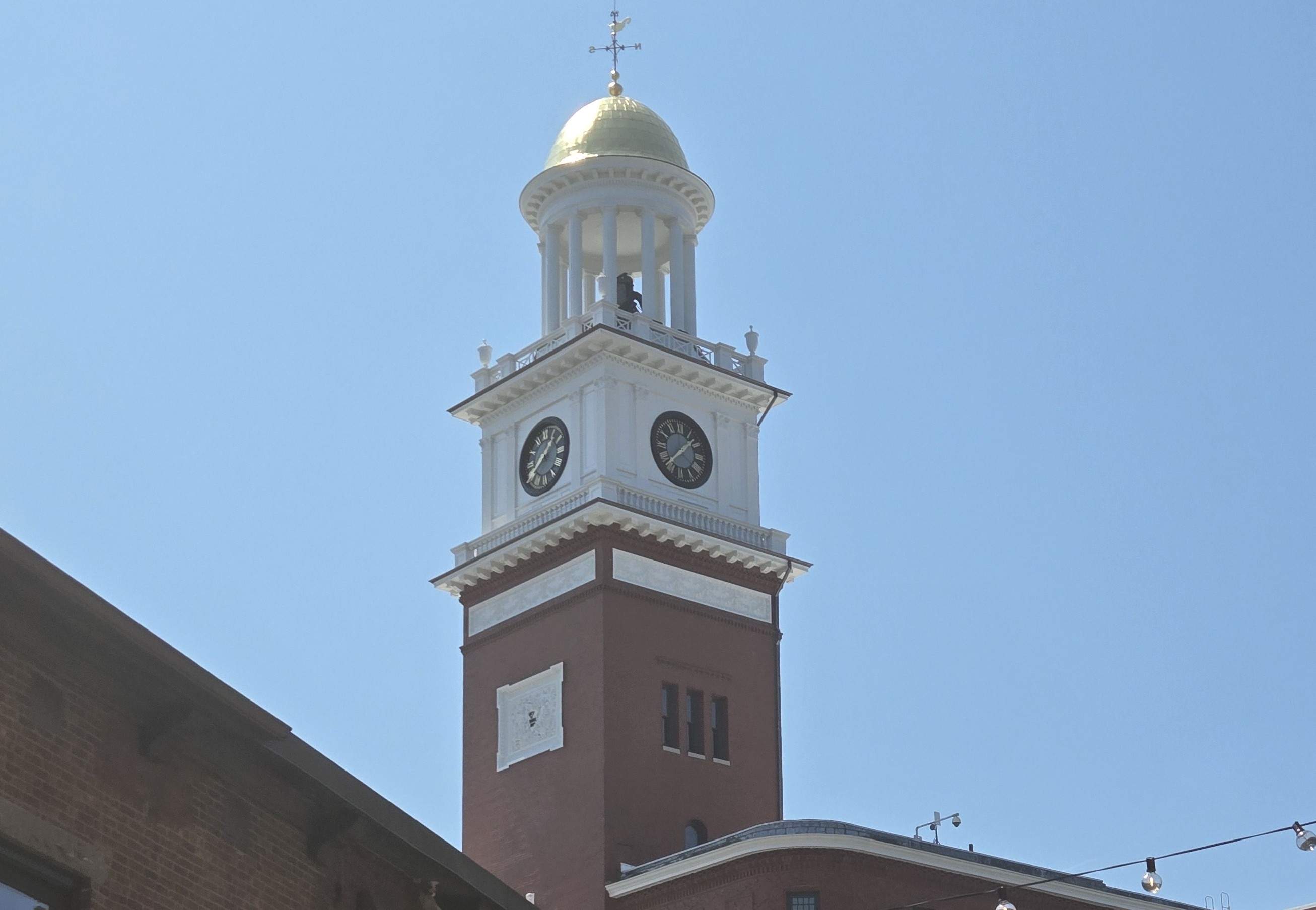
For nearly 50 years, Biddeford’s most iconic ‘bootstrap developer” has demonstrated a deep love for the city.
By RANDY SEAVER | Editor
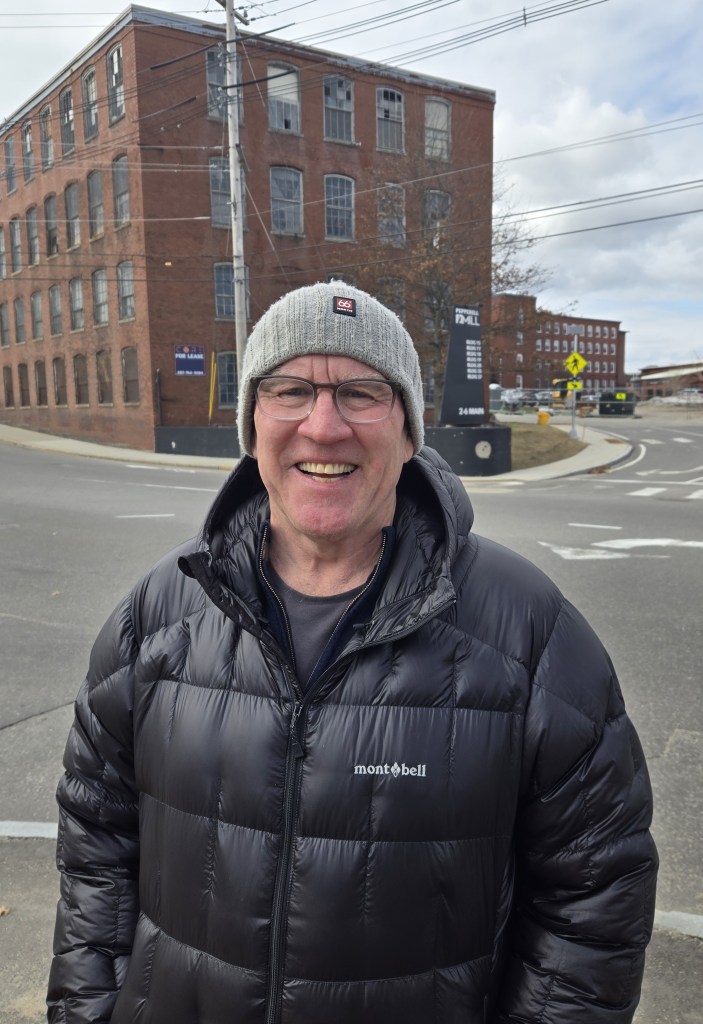
When looking back over the last 50 years of Biddeford’s history, there is no question that Doug Sanford played an extraordinarily pivotal and significant role in resurrecting a community that was brimming with potential but mired in despair.
_____________
Sanford, 68, could easily be described as the walking, talking definition of a bootstrap real estate developer. His projects and fingerprints can be found throughout Biddeford, most notably his renovation and revitalization of several vacant downtown mill buildings.
A few critics – generally those who offer public commentary from the sidelines – routinely dismiss Sanford’s numerous contributions to Biddeford – painting a picture of a “wealthy real estate developer from away.”
That misinformed narrative hardly holds water.
Although Sanford has been able to successfully capitalize on many of his investments, he first arrived in Biddeford more than 45 years ago – fueled only by an excessive intake of caffeine, a meager savings account and an instant love and admiration for the city of Biddeford.
“Doug has this mix of tenacity and creativity that really made the mill redevelopment possible,” said Delilah Poupore, executive director of the Heart of Biddeford, a nonprofit organization dedicated to the revitalization of downtown Biddeford.
“He saw something in Biddeford when a lot of people didn’t, and then just kept finding ways to make it work, tenant by tenant,” Poupore added. “He’s always been willing to push a little further than what people expect, and I suppose that can open you up to criticism; but it’s also what got Biddeford on the map.”
Poupore credits Sanford as the “spark” that led to the kind of walkable, livable downtown that her organization is continually working to promote and develop.
“From the Heart of Biddeford perspective, Doug and [his wife] Lauren have been thoughtful partners in the revitalization of the downtown and in supporting our organization in ways that have truly mattered.”
Former Biddeford Mayor Alan Casavant ran his first mayoral campaign in 2011 on a pledge to continue expanding on the foundational work of former Mayor Wallace Nutting and others who saw lots of potential in the city’s downtown area, despite the presence of a municipal trash incinerator that was located only 900 yards away from City Hall.
Casavant, a former history teacher at Biddeford High School, said he often taught his students about the historical impacts of industrialist John Rockerfeller and his ability to “see down the road and around the corner.”
“Doug Sanford had the same knack for seeing things that other people – for a variety of reasons – just could not see,” Casavant recalled.
“His reputation as a true visionary for Biddeford will certainly stand the test of time,” Casavant added. “He saw those shuttered mills as much more than just empty real estate. He saw the real potential, and he risked a lot to bring that vision to reality.”
Former newspaper publisher David Flood – another early believer in downtown Biddeford’s potential — described Sanford as a man of vision and hard work in his own 2015 blog post about the real estate developer who helped chart a new course for the city | Doug Sanford has been investing in Biddeford since the early 1980s.
________________
“He’s always been willing to push a little further than what people expect, and I suppose that can open you up to criticism; but it’s also what got Biddeford on the map.”
— Delilah Poupore, Heart of Biddeford
Humble beginnings and life lessons | A preacher’s son
Sanford was born as the youngest son of a modest church minister in central, rural New Hampshire. The family — including four other children and Sanford’s mother — had limited income and they relied on the generosity of the church, living in an adjacent parsonage building.
When Sanford was still quite young, he worked alongside his older brothers and his father, helping to build the family’s very first home in Auburn, New Hampshire, a small community located roughly 12 miles east of Manchester.
“You know, I do remember going to the town dump after dark and helping my father and brother load abandoned timbers that we used to build that house,” he laughed during a recent interview with the Gazette.
Sanford speaks fondly of his father and the lessons that he taught his children during one of the most socially turbulent periods of American history.
“The Vietnam War was consuming discussions everywhere,” Sanford recalled. “And then you had the assassinations of both Bobby Kennedy and Dr. Martin Luther King.
“My father was a steadying force during those difficult times. He offered sage wisdom for both his congregation and us kids.”
Sanford described his father as a “social justice leader,” a man who was proud of his role in coordinating a visit of several other New Hampshire ministers to Dr. King’s funeral.
“I learned a lot from my father,” Sanford recalled. “He was such a kind and decent man, always leading with his heart. Always willing to help those around him.”
Sanford and his wife, Lauren, were able to buy a 250-year-old, run-down house with 40 acres of land (but no mule) in the small, pastoral town of Shapleigh, Maine.
“They were offering owner financing, and that was a good thing because we had no [expletive] money,” he laughed. “The funniest part of that story is that we discovered – after a survey – that we actually had 120 acres.”
Sanford was now supporting his own young family by working in construction.
“We called that place the Sanford Family Project,” Sanford recalled with a chuckle. “When I say we had no money, I mean it. We had to come up with $4,000 cash for the down payment. I literally had quarters stacked on the table.”
Doug and Lauren raised three children, Cas, a 38-year-old attorney; Max, a 36-year-old veterinarian; and Jordan, a 33-year-old private equity manager.
“I call my kids a lawyer, a doctor and an Indian chief,” he laughed.
But today, Sanford’s top priority is spending time with his four grandchildren.
“I am very proud of my kids,” he said. “When I look back, I know –without hesitation – that your family is everything. Without them, I’m nothing.”
Now somewhat retired, Doug and Lauren enjoy time with their family on what was once a dairy farm in Waterford, a small community located in western Maine.
Welcome to Biddeford | A dicey proposition
Sanford first arrived in Biddeford in 1981. He didn’t have much money, but he had earned a decent credit score and a favorable commercial reputation from investments he made in a few small residential projects throughout New Hampshire.
The first property that caught Sanford’s eye in Biddeford was a large building owned by Herve and Romeo Binette on the corner of South and Elm streets.
“It was in tough shape, but I thought it had good bones,” Sanford said. “The very best part was that it had a ‘For Sale’ sign out front,” he laughed.
It was another owner-financed opportunity, and once again Sanford had to scramble and push all his chips to the center of the table to make the purchase work.

_______________
A little old lady who played piano
The only tenant that came with the building was an older woman who had actually been born and raised in the very same apartment on the building’s second-floor.
“She had one of those old Kerosene stoves that was also the unit’s heating source,” he recalled, rolling his eyes. “That stove scared the [expletive] out of me. I thought I was going to lose my entire investment in some terrible fire.”
According to Sanford, his new elderly tenant would often visit area nursing homes and play piano to entertain convalescent patients.
“You’re not going to believe this,” Sanford says, whispering and leaning over the table at the Time & Tides coffee shop on Main Street. “She only paid $25 per month in rent.”
“What the hell was I supposed to do?” he laughed, throwing his arms up in the air. “You think I’m going to evict a sweet little old lady who plays piano for senior citizens? Honest to God, she was literally born in that apartment. Talk about a public relations disaster.”
[At this point, we had to momentarily pause the interview because both Sanford and I were laughing so hard that it was difficult to speak.]
_______________
She was only paying $25 per month in rent. You think I’m going to evict a sweet little old lady who plays piano for senior citizens? Honest to God, she was literally born in that apartment. Talk about a public relations disaster.”
— Doug Sanford
A passion for Biddeford | Despite the odds
Sanford’s legendary piece-by-piece approach to revitalizing Biddeford’s downtown core was anything but easy.
“The 1980s were a really difficult and challenging time for Biddeford,” Sanford recalled. “A lot of people were giving up hope about the city’s future.”
Even today, many of Biddeford’s older residents often reminisce about the heyday of downtown shopping on Main Street in the 1940s and 1950s, when retailers like Woolworth’s, Butler’s and Youland’s jewelry store catered to a growing population of hardworking and thrifty millworkers.
But as the popularity of suburban shopping malls – such as the Maine Mall in South Portland –continued to rise, Biddeford’s downtown retailers experienced declining revenues.
More heartbreaking was the hard reality that Biddeford’s once thriving downtown textile mills were now winding down, unable to keep pace with foreign imports and increasing government regulations.
Those mills were the central and driving force of Biddeford’s economy right up until the last remaining were laid off and the doors were permanently closed.
City leaders in the 1980s found themselves engulfed in a myriad of public policy challenges.
The textile mills – the city’s largest employer and taxpayer – were winding down and headed toward extinction.
New consumer shopping trends created a ripple-effect of bad news in the downtown area. Once thriving shops were now boarded up with “For Lease” signs plastered on plywood meant to deter vandals.
On top of all that, the mayor and city council were facing increasing pressure from state regulators about the municipal landfill that was located on the Andrews Road.
In retrospect, the city made the horrendous decision to allow the development of a trash-to-energy incinerator smack dab in the middle of a dying and neglected downtown.
“But who can really blame them?” asked one Biddeford resident, speaking on the condition of anonymity. “They were sold a bill of goods with all sorts of promises and guarantees. Hindsight is always 20-20.”
Biddeford embraced the MERC incinerator as a way to maybe help the struggling mills by offering ventilation steam for industrial heating capacity. MERC was going to be the city’s biggest taxpayer. They were going to create nearly 100 good-paying, union jobs.
The bad part? MERC became a regional trash incinerator, accepting municipal solid waste (MSW) from more than 23 other communities throughout Maine and New Hampshire.
The unending stench of burning trash – combined with frequent explosions created by improperly disposed propane tanks – set Biddeford on a collision course toward failure.
City politics descended into chaos. There was plenty of finger-pointing and even accusations of “good-old boys” selling their souls, hinting at corruption that was never proven.
From the outside, Biddeford looked like a war zone, a dysfunctional city unable to get out of its own way.
But Doug Sanford saw things differently.
A new path forward for Biddeford
“Yup, there were people who questioned my sanity,” Sanford laughed. “But I just couldn’t look away from the potential. I believed in the city of Biddeford even when so many leaders had stopped believing in Biddeford.”
Sanford started small and carefully. A building here and a building there, all the while developing solid working relationships with local and state officials.
He also forged relationships with community partners, including donations to nonprofit organizations throughout the city.
The legend is true: Sanford was eventually able to purchase the abandoned 380,000 square-foot North Dam mill complex – former home of the Biddeford Textile Company — for $1 per square-foot. But he was taking a huge personal risk.
“It was all on the line,” he recalled. “You know what they say? Go big or go home.”
Sanford had to rely on his own assets because commercial lenders had serious concerns about potential liability issues, especially because Sanford was preparing to renovate 150-year-old brick buildings along the shore of the Saco River.
“The banking guys looked at it as a liability, not an asset,” he said. “But I just decided to move forward.”
That was not Sanford’s last major investment in Biddeford.
It was all on the line. You know what they say? Go big or go home.”
When the Pepperell Mill closed a few years later, Sanford purchased that property, too. “The two mills shared the resources of a steam plant,” he explained.
Other – better financed — real estate developers also wanted that property. Even city leaders doubted Sanford’s ability to pull off such a large and complex investment.
Sanford – sometimes forced to fight tooth and nail with other developers and certain city officials — persisted and won.
He converted that former mill complex as a business incubator for several emerging local businesses such as Hyperlite and Angelrox.
Portland Pie Company later decided to offer a location in that building.
“The pieces fell together nicely,” Sanford said. “It was a big risk for me – and for the city of Biddeford. I’m glad it worked out.”
Never miss an update | Subscribe for free today!
_______________
THE BIDDEFORD GAZETTE | Biddeford’s Trusted, Professional News Source
Our editorial standards and policies: Biddeford Gazette | Standards & Policies
© 2026 Biddeford Gazette, Inc. All Rights Reserved
 BIDDEFORD GAZETTE