A lawsuit filed against the city of Biddeford and a local real estate developer has been withdrawn by two residents who were upset about a proposed housing development near Clifford Park in Biddeford.
According to court documents, the plaintiffs Loren McCready and Christopher Quint both own property that abuts the proposed housing development.
The withdrawal of the lawsuit caps off a nearly four-year saga that began when Mike Eon, president of E&R Development, and Gervais Dube presented a plan to the city for an 18-lot housing subdivision.
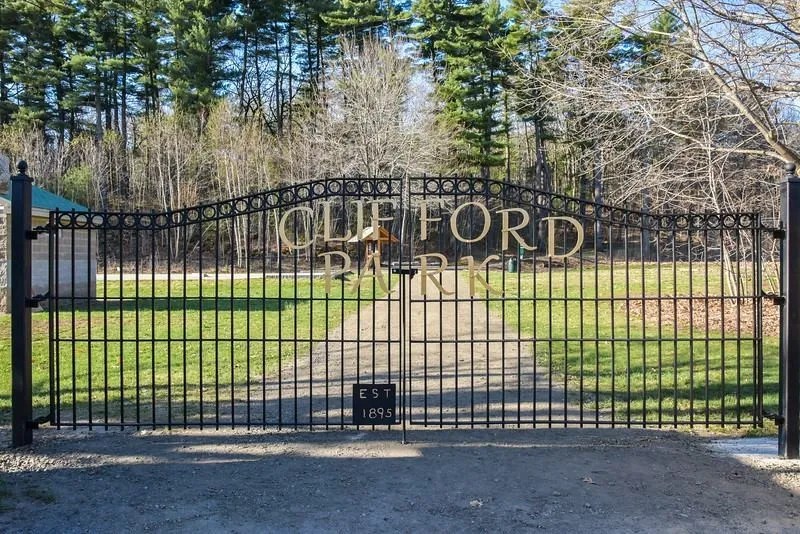
The main entrance to Clifford Park/ Photo by Joe McKenney, Biddeford Recreation Commission,
In order to meet development standards, Eon and Dube needed to acquire roughly four acres of land in Clifford Park, a forested park that offers hiking trails and other recreational opportunities on Pool Street, less than a mile from the city’s downtown core.
In exchange for the four acres, the developers proposed trading roughly 100 acres of land that they already owned near the park, leaving the city with a net gain of nearly 96 acres that could be permanently protected from any development and remain publicly accessible into perpetuity.
Although one city official described the proposal as a “win-win” scenario that would nearly double the popular park’s size and provide greater public access, a handful of opponents said the plan should be rejected.
According to a November 3, 2020 Portland Press Herald story, former Biddeford Recreation Director Carl Walsh appeared before the city council and said “It’s s quite an opportunity,” adding that the city has long desired to add the waterfalls — which is on part of the land that could go to the city — to the park.”
McCready, however, said the proposed land swap was a bad idea and could cause environmental damage. Shortly after the Biddeford Planning Board gave their initial approval to the project, McCready formed a non-profit group to prevent the project and address other “environmental concerns” in the city.
The Biddeford-Saco Climate Action Team still meets on a regular basis and its Facebook page shows 13 “Likes” and 19 ‘followers.”
McCready and Quint first appealed the Planning Board’s decision to the Maine Superior Court.
On November 22, 2023 Superior Court Justice James Martemucci ruled against the plaintiffs on a number of technical and procedural issues.
The plaintiffs then appealed their case to the Maine Supreme Court.
Meanwhile, the proposed project has been put on hold until all of the legal matters can be resolved.
Earlier this week, the Biddeford Gazette learned that McCready and Quint decided to withdraw their complaint against the city and the developers.
In an email statement to the Gazette, McCready wrote: “I remain committed to advancing housing solutions that are both inclusive and environmentally responsible.
“Moving forward, I will continue working with the Biddeford-Saco Climate Action Team to advocate for sustainable development practices that align with the City’s Climate Action Plan and prioritize long-term community well-being.”
McCready’s attorney Kate Hambley said the decision to withdraw her client’s complaint boiled down to money.
“While I felt and still feel my clients had strong legal grounds for appeal, my clients ultimately decided against using personal funds to pursue an appeal to the Law Court (which, as I’m sure you can imagine, can be quite an expensive undertaking),” Hambley wrote.
“This was a difficult decision given the environmental and community resources at stake, but they are confident they can still make positive changes in Biddeford, which they intend to do by promoting smart growth and affordable, sustainable infill housing within the city,” said Hambley.
Mike Eon said he was feeling relieved that the four-year battle is finally coming to a close. “It’s really hard to build affordable homes when you have to through four years of delays and increasing costs,” Eon said. “I always strive to do good projects that will benefit my community.”
Biddeford Mayor Marty Grohman also expressed a sense of relief that the litigation is over.
“I’m glad that this issue is finally settled,” Grohman said. “The city is getting a tremendous resource of additional public lands that will be protected into perpetuity.”
Never miss another update! Subscribe for free today!
Editor’s Note: This is the second installment of our three-part series regarding Biddeford’s housing crisis.
A panel of experts offered their perspectives and guidance regarding Biddeford’s housing crisis during a special city council workshop meeting earlier this week.
For more than two hours, the nine panelists each offered their professional insights and took questions from both councilors and members of the public Tuesday evening.
Biddeford Mayor Marty Grohman described the workshop as a necessary “first step” for city officials who are trying to find innovative solutions for a problem that shows no signs of going away.
While Biddeford has seen recent success in attracting development of market-rate housing units, the city is still struggling with “affordable housing” options and a low inventory of single-family homes for young families, often described as “starter homes.”
“We have a beautiful, dynamic and growing city,” Grohman said as he kicked off the discussion. “We’re in our 12th straight year of enrollment growth in schools. It’s immensely positive that we’re growing, and seeing this type of pressure on housing, but it’s also immensely challenging.”
George Gervais, the city’s director of economic and community development, started the meeting by providing an overview of the city’s current housing status.
According to Gervais, the city today has 10,576 housing units. Of those units, 9,431 are occupied, according to data from the 2020 Census.
Gervais said rental units make up slightly more than 52 percent of the city’s occupied housing.
Average monthly rents in Biddeford range between $1,700 and $3,200, ranging from studio apartments to three-bedroom units, Gervais said.
The average home values in Biddeford have risen by roughly five percent during the last year. The average home value in the city is slightly more than $478,000.
One of the city’s biggest challenges, however, is that area wages are not keeping pace with increasing housing costs.
“We have quite a bit coming at Biddeford,” Gervais said outlining the horizon in which more than 2,100 units of housing are currently in some form of development. “That’s a pretty impressive number,” he added.
The new development numbers include projects that are either under construction, under review by permitting agencies or projects that are conceived but have not yet gone through the permitting process.
Gervais said 319 of those units are planned as affordable housing units in which rental costs are calculated by the area’s median income (AMI).
During an earlier interview, Grohman said the city council has set a goal of creating 180 units of affordable housing each year over the next five years.
What the experts say
The panelists were broken into three main groups, focused on affordable housing; market-rate housing and a housing finance development panel. The panel also included a presentation regarding state government housing resources from Benjamin Averill, Housing Opportunity Program coordinator for the Maine Department of Economic and Community Development.
“Today, Biddeford is the place to be. “It’s the cool place. That’s great but it also poses problems.”
–Guy Gagnon, Biddeford Housing Authority
Guy Gagnon, executive director of the Biddeford Housing Authority, said Biddeford has undergone some dramatic changes in the last 15 years, pointing out that he joined the quasi-governmental agency in 2010.
Gagnon, a Biddeford native, said he is especially troubled by the fact that so many kids who grew up in Biddeford can no longer afford to live here. “I see my friends’ kids and even my own children being forced to look elsewhere for housing,” Gagnon said.
“It used to be that Biddeford was the second, third, fourth or even fifth choice when people were looking for homes,” Gagnon said. “Today, however, Biddeford is the place to be. It’s the cool place. That’s great but it also poses problems.”
Gagnon said the city needs to be creative and willing to look at alternatives that include modular housing and mobile home parks.
“It may not be for everyone,” Gagnon said, “but it may be for some people. Biddeford should be the community that thinks outside of the box.”
Kevin Bunker of Developers Collaborative said the city needs to stay aware of what is happening at the Legislature, especially in regard to statewide housing policies and assistance for affordable housing development.
“Those resources are limited and the state is facing a challenging budget,” Bunker said. “You need to remember that they are also trying to keep up with a huge demand.”
John Laliberte, the CEO of Reveler Development, provided an overview of his company’s projects in Biddeford, including 73 apartments at Riverdam, Phases One and Two of The Levee project and the recently offered market-rate units at The Eddy on Barra Road.
“We have had a lot of success in Biddeford,” Laliberte said. “There is a big demand for this type of housing, but our main challenge remains being able to attract the private capital necessary to get these projects off the ground.”
A common theme throughout the evening was centered upon the need to make the development process more streamlined and efficient to reduce costs for both renters and buyers.
Although not members of the expert panel, local real estate developers Chico Potvin and Matt Chamberlain both spoke during the public comment period, detailing how hard it is to get a project from design to out of the gate development.
Potvin, 61, said he has been building “starter homes” in the Biddeford area since 1987.
He said the city’s shortage of available single-family homes is “forcing people into apartments and making it harder for people to find apartments. “It’s a vicious cycle,” he said.
Potvin said his biggest challenges include skyrocketing labor costs and a growing myriad of red tape that cause time delays and increases building costs.
“Every year, the regulations increase,” Potvin said, questioning why the council chose to fund needed city-wide sewer improvements on the backs of new homebuyers.
“Almost every day I get calls from friends and other people asking what I can do for them,” he said. “They don’t want to wait two years for a project to get approved. I feel bad. The city needs to buckle down and treat housing the same way as you treated land for industrial parks.”
Potvin also said he is nervous about all the high-end apartments being built in Biddeford. “It scares me,” he said. “I’m not sure if it’s sustainable.”
Cat Bates said he grew up in Kennebunk and moved to Biddeford almost five years ago. He said he would like to see the city do a better job in streamlining the approval process for Accessory Dwelling Units and said it should be easier to get bank financing for that type of development.
City Councilor Doris Ortiz previously chaired the council’s affordable housing task force, and said she would like to see the city be creative in its approach to creating housing, including co-ops and micro developments.
Hundreds of people flocked to downtown Biddeford on Saturday for the 13th annual Winterfest celebration. The giant sledding hill on Adams Street was once again a popular attraction, but there were also a lot of other things happening, including tours of the newly renovated City Hall clock tower, dancing and music.
The Adams Street sledding hill was again a big favorite during Biddeford’s Winterfest celebration (Seaver photo)
Volunteers from the New Life Church had several tables set up, giving away free donuts, hot chocolate and hats and mittens.
New Life Church volunteer Roland LaFlamme poses with a Winterfest mascot (his wife Maureen) Seaver photo
Children also had the opportunity to see the inside of a fire truck, city plow and the police department’s mobile Crime Scene Unit.
Outdoor temperatures remained above freezing, making this year’s celebration even more enjoyable.
Alannah, 11, gets her fingerprints made by Cpl. Matt Baldwin of the Biddeford Police Department inside the mobile crime scene unit (Seaver photo)
Larry Patoine, one of the event’s lead volunteers, said it will take less than four hours for volunteers to remove the giant sledding hill this evening before another winter storm descends on the city
This year’s hill was constructed with snow from the Five Points Shopping Center. Patoine says the snow from the hill will be disposed of near Rotary Park.
A long line of children anxiously await their chance to experience the giant sledding hill on Adams Street (Seaver photo)
Former mayor Alan Casavant, who helped organize the very first Winterfest (La Fete d’ Hiver) in 2012, said he was pleased to see the festival growing in popularity with each passing year.
“This is what community is all about,” Casavant said. “It’s fun just watching so many people having fun.”
Mayor Marty Grohman struts his stuff during Winterfest (Seaver photo)
A good turnout at this year’s Winterfest in Biddeford (Seaver photo)
Evelyn (left) and Zoe check out what it’s like to ride in a fire truck (Seaver photo)
Never miss another update! Subscribe for free today!
Editor’s Note: This is the first installment of a three-part series that examines Biddeford’s housing crisis.
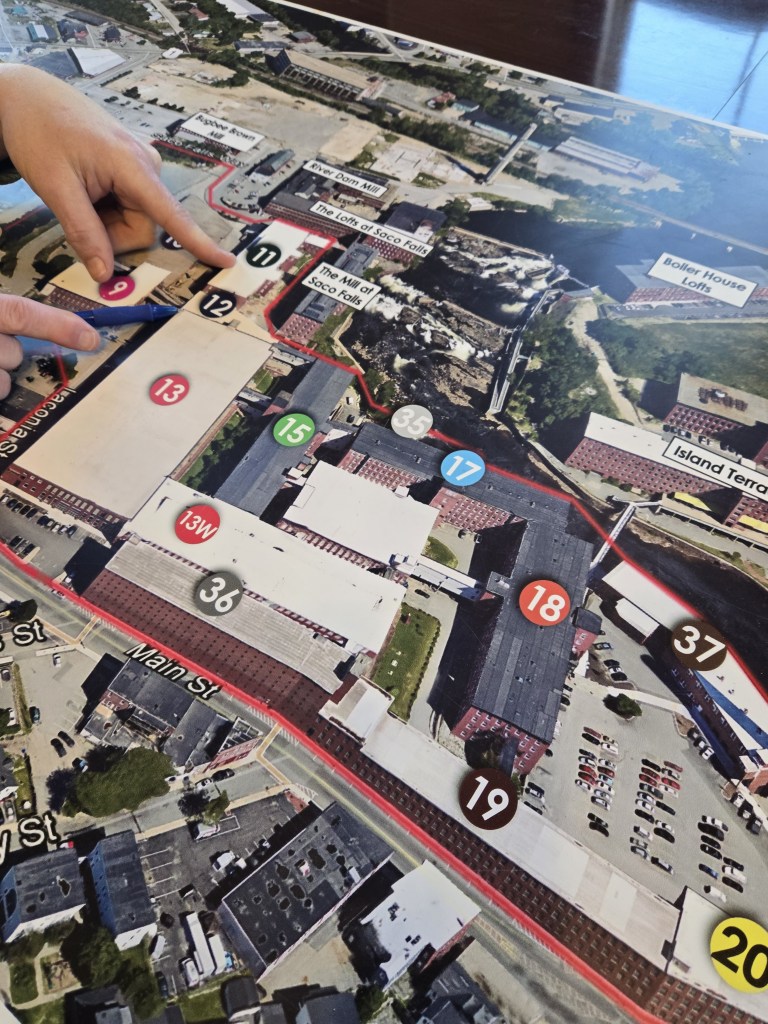
A large conference table takes up the center of Biddeford Mayor Marty Grohman’s second-floor office at City Hall. On that table is a large aerial photo of the city’s downtown area, where several new housing projects are either under construction or in development.
Grohman can’t help but to get excited when talking about the city’s potential for growth and prosperity, but he is also mindful of the struggles the city still faces in terms of increasing rental costs, home prices and the lack of affordable housing.
“It’s a big mix,” said Grohman during a recent interview with the Biddeford Gazette. “There are a lot of moving parts and they are all connected.”
All across Maine, cities and towns are struggling to keep pace with their community’s housing needs.
Mayor Marty Grohman points to several housing projects that are in development throughout the city’s downtown area.
“It’s not just Biddeford,” Grohman explains. “It’s virtually everywhere, and we – as elected leaders – have a responsibility to be part of the solution for this problem.”
In his search for creative solutions, Grohman is convening a special workshop meeting of the Biddeford City Council to address housing issues on Tuesday, Feb. 11.
At that workshop meeting, which will include an opportunity for public commentary, councilors and city officials will review the city’s goals and progress in meeting the various housing demands throughout the city.
For example, Grohman says the city council last year set a goal of creating 180 units of “affordable housing” each year over the next five years.
But even the term “affordable housing” creates confusion and resentment.
“A lot of this is subjective,” Grohman said. “What is affordable for one person may not be affordable for another person.”
In order to qualify for state and federal tax credits, affordable housing rental costs are based upon the region’s Area Median Income (AMI). The federal department of Housing and Urban Development (HUD) uses a formula that calculates rental rates at 80 percent of AMI.
According to the most recent statistics from the U.S. Census Bureau, Biddeford’s median income is $63, 261 per household or $32,763 for an individual.
For comparison purposes, the AMI in Saco is $81,326 per household or $44,596 for an individual.
Both the federal and state government use AMI data (and other measurements, such as total assessed property values) to determine a community’s need for federal grants and school funding.
“Our housing problems also adversely impact people who already have stable housing,”
State Rep. Traci Gere
While some people say that Biddeford’s population growth is creating an unsustainable spike in demand for housing, data from the U.S. Census Bureau shows only modest gains in the city’s population over the last 10 years.
Today, the city of Biddeford is listed with a population of 22,367 people, the largest of any of York County’s 46 municipalities. In 2000, the city’s population was 20,942. In fact, Biddeford’s population has actually decreased by 0.5 percent in just the last two years.
Like other urban centers throughout Maine, Biddeford has a notable population of unhoused residents, a problem Grohman says the city is fighting every day.
But the city is also facing some other serious housing issues, including a lack of so-called “work-force” housing options.
“If you talk with any of our department heads, whether it’s the school superintendent, the police chief or the fire chief, they will all tell you how hard it is to hire and retain new employees,” Grohman says. “We’re not going to get new teachers or police officers in our community if those people cannot afford to live here. It’s a big problem.”
Members of Biddeford’s legislative delegation all agree with Grohman’s assessment that housing is a big part of a growing problem in attracting workers and private businesses to the city.
Local legislative delegation rolling up its sleeves to tackle housing
“There are so many facets that fit under the umbrella of housing issues,” said State Rep. Traci Gere during a previous interview with the Gazette. This issue runs the gamut, she said, pointing out that roughly eight percent of Maine homeowners occupy manufactured housing.
Gere and other local lawmakers are hoping the Legislature will be able to help cities and towns across the state in revising zoning standards and cutting bureaucratic red tape, a problem that many developers say drives up the cost of housing.
“Our housing problems also adversely impact people who already have stable housing,” Gere said. “If we want a sustainable local tax base — and relief for homeowners — we have to find a way to help businesses maintain a stable pool of employees. For example, a hospital cannot function without support personnel, such as custodians or clerical workers.”
House Speaker Ryan Fecteau of Biddeford is very familiar with housing issues. In addition to his legislative service, Fecteau is employed as a senior officer of policy and planning for Avesta Housing, a non-profit affordable housing developer that operates throughout New England.
“There is an appropriate role the state can play in these local discussions,” Fecteau said. “We can certainly work harder in bringing resources to the table and help our municipal partners without stepping on their toes.”
A recent report issued by the Maine State Housing Authority (MSHA), says the state agency was able to complete 775 affordable housing units in 2024, and that 1,005 units of affordable housing are now in the process of being built.
The agency also points out that the average production costs of building those units is finally beginning to level off following three straight years of rising production costs.
Other factors pointed out in the report’s executive summary is that interest rates have leveled off and that MaineHousing’s “First Home” program is now maintaining rates well below the market average to a rate to 5.375 percent prior to the end of 2024.
But there are still many challenges that lie ahead for Maine’s housing landscape.
Although some recent “leveling off,” in home prices has helped cool the market, rising home prices continue to be a primary concern for homeownership access, according to the MSHA’s report.
From 2020 to 2024, the median home price in Maine grew by more than 50 percent, far outpacing a 33.3 percent increase in wages and salaries of Maine workers during the same period.
Other things such as utility and heating costs play big factors in housing affordability. For example, heating fuel prices have recently stabilized after record high prices in 2022 and 2023. According to the MSHA, heating fuel costs have now been trending downward since April 2024.
Since 2018, the rental cost burden across the state has increased sharply for most households, especially for those with household incomes between $35,000 and $75,000 in total household income.
NEXT:Housing developers discuss their challenges and opportunities.
Never miss another update! Subscribe for free today!
Despite frigid outside temperatures, a layer of warmth blanketed the cities of Biddeford and Saco Wednesday night as people from both communities turned out to support the family of a fallen police officer.
Sgt. Jacob Wolterbeek, a veteran member of the Biddeford Police Department, was killed in a traffic accident in December.
Biddeford Mayor Marty Grohman organized Wednesday’s event in order to raise funds for Wolterbeek’s family, including his wife and three young children.
Nearly 20 Biddeford restaurants, taverns and shops participated in the four-hour ‘Mayor’s Night Out’ event. Many of the businesses donated a percentage of their proceeds to a fund in honor of Wolterbeek.
Many residents wandered from location to location, donating funds along the way.
Wolterbeek’s parents, Jacob and Ky, were surrounded by supporters at Or Nell’s Barbecue on Franklin Street shortly after the event started.
Left to right: Mayor Marty Grohman, Ky Wolterbeek, Deputy Biddeford Police Chief Steve Gorton, Jacob Volterbeek, senior and Police Chief JoAnne Fisk
Wolterbeek’s parents each held back tears as they shared stories about their son with well-wishers, city officials and reporters.
“We are grieving internally and externally,” Ky Wolterbeek said.
Jacob Wolterbeek, Sr. said he was “deeply touched by the stories he read on social media about his son, especially one in which a resident wrote that Jacob had literally saved his life by helping him overcome a troubled life.
“He loved this city,” the elder Wolterbeek said. “He was passionate about it, and he always said how much he loved the opportunity to work with some very fine people. The last time I was in Biddeford was last August during the ceremony when he was being sworn in as a sergeant.”
Those who participated in the event said they were happy to support Wolterbeek’s family because he had given so much back to the community.
Former Biddeford Mayor Bonita Pothier (center) chats with Ky Wolterbeek (right) during the Mayor’s Night Out
“Jacob was a cop’s cop. He always had a good word for everybody. He was just a great human being.”
— Juliet Angis
Jim Albert, a Saco native and the owner of Cowbell Burger on Main Street, said it was a “no-brainer” when he was asked if his restaurant would participate in the event.
Jim Albert, owner of Cowbell Burger, Saco Mayor Jodi MacPhail and Saco City Councilor Tricia Huot. (Seaver photo)
“It’s a great cause,” Albert said, recalling Wolterbeek’s trademark smile. “He was very personable and super friendly. It is so tragic what happened to him, leaving behind three little kids. We were more than glad to help.”
Biddeford Police Chief JoAnne Fisk accompanied Wolterbeek’s parents during the event.
“Jake was one of the kindest, most thoughtful people I have ever met. That’s what made him a great cop,” Fisk said, choking up a bit with her words.
“He had a way of dialing into people he encountered,” Fisk added. “He had this uncanny ability to see beneath the surface and see people where they really are.”
Biddeford State Rep. Marc Malon is joined by Dianne and Bob Cyr of the Biddeford Cultural and Heritage Center at Banded Brewing.during the Mayor’s Night Out event
Saco Mayor Jodi MacPhail said she was honored to participate in the event.
“In times like these, there are no boundaries. We are one community,” MacPhail said. “We celebrate together, and we grieve together.”
Wolterbeek’s fellow officers spoke highly of their deceased co-worker and friend.
“We miss him every day,” said Corporal Matthew Baldwin, a 27-year veteran of the Biddeford Police Department who helped train Wolterbeek. “it still almost doesn’t feel real that he is gone. He was definitely one of the good guys.”
Deputy Police Chief Steve Gorton described Wolterbeek as a dedicated family man. “That was the thing about Jake. His top priority, first and foremost, was his family.”
Kennebunk Police Officer Juliet Angis shows a bracelet that she any many other officers are wearing to honor the memory of Sgt. Jacob Wolterbeek
Larry Angis, who recently retired from the department, said he is still processing the grief of losing his friend and co-worker. “I’m not there yet. He was a good cop and a good friend.”
Angis’ wife, Juliet, is a police officer in Kennebunk. “Jacob was a cop’s cop,” she said. “He always had a good word for everybody. He was just a great human being.”
Ky Wolterbeek said her son was the second of nine children, six of whom were adopted. “He was our second child, but oldest son, and it leaves a big void.”
“This is truly a great community,” she added. “The outpouring of support has touched us deeply.”
Editor’s Note:If you would like to donate to Sgt. Wolterbeek’s family, please visit the Trooper Black Foundation at https://trooperblackfoundation.orgthrough February 15.
Checks may also be mailed to the Trooper Black Foundation (PO Box 104, Cape Neddick, Maine 03902) and should be marked as designated for the Wolterbeek family.
Never miss another update. Subscribe for free today
With another winter storm looming on the horizon, members of the Biddeford City Council discussed the city’s policy regarding overnight parking bans.
At the tail end of Tuesday’s council meeting, Councilor Neva Gross – who represents much of the city’s downtown area — raised the issue to her fellow councilors, asking if there is more the city can do to announce parking bans in advance of a storm.
“I personally live down here [downtown area] so I am affected by this every time there is [a ban],” Gross said. “I received some emails over the last few days from some folks whose cars were towed during a ban because they didn’t know about it.”
Photo: City of Biddeford
Gross acknowledged that city routinely updates residents about pending parking bans in a variety of ways, including the city’s website, the city’s official Facebook page and the ability for residents to sign up for email or text notifications.
The city — — along with several other communities throughout southern Maine — also notifies television news stations about upcoming parking bans.
“Is there some kind of way that we could notify folks who are not on social media or looking at the city’s website,” Gross asked.
City Councilor Marc Lessard drew a round of laughter when he suggested that the city may want to consider using a “fire horn” to alert downtown residents of a pending parking ban.
“The bottom line is that if you park your vehicle on a public road, in the wintertime, and it’s going to snow; you have to assume that there is going to be a parking ban and try to figure out a way to find out about that.”
City Manager James Bennett
“I’m kind of being serious,” Lessard said, recalling that decades ago the city used a central fire horn to inform citizens of fires and served as a curfew notice.
City Manager James Bennett said “there is just no way for us to do it right” in reference to snow parking bans.
Bennett said the city of Lewiston had a policy prohibiting all overnight parking during the entire winter season.
“I’m glad to look at ways for us to enhance getting that information out,” Bennett said, pointing out that residents should make an effort to stay informed.
“This probably sounds cold, or not customer-friendly, but the bottom line is that if you park your vehicle on a public road, in the winter time, and it’s going to snow; you have to assume that there is going to be a parking ban and try to figure out a way to find out about that,” Bennett said.
Bennett also told the council that “snow clearing” parking bans represent an additional challenge in keeping residents informed about parking bans because those do not happen during a storm. “We really have to go overboard in alerting residents about those [parking bans].” Bennett said.
“If you live downtown, please help us by also doing what you can to find out about parking bans,” Bennett said.
Mayor Marty Grohman also said he heard from some friends whose vehicles were towed during a parking ban. “I think making the lots on Water and Washington streets available has been helpful,” he said.
A group of former mayors and Biddeford’s current mayor are all hoping to run into you at one of several downtown restaurants on Wednesday evening (Feb. 5)
The “Mayor’s Night Out” event will actually be a fundraiser to support the family of Sgt. Jacob Wolterbeek, an 18-year veteran of the Biddeford Police Department who was killed in a December traffic accident on his way home from work.
Wolterbeek left behind his wife Julie and three young children under the age of 5.
Mayor Marty Grohman said he has been thinking of different ways to help Wolterbeek’s family over the past few weeks.
“I can’t imagine how hard it has been for them to absorb this awful loss,” Grohman said during a recent interview.
Grohman said he decided to get other mayors and a number of local restaurants involved in the project.
During the event, Grohman and former mayors Alan Casavant and Donna Dion, and Saco Mayor Jodi MacPhail will join diners for conversation and connection by visiting participating Biddeford businesses throughout the evening.
Participants will have the opportunity to use a QR code on their smartphones at each location to make a donation to the Trooper Black Foundation, a non-profit organization that will direct the proceeds to the Wolterbeek family.
Some of the participating restaurants and businesses will also donate a portion of their sales during the event to support the Wolterbeek family, according to a press release from the city.
Saco Mayor Jodi MacPhail said she was happy to be part of the event. “The cities of Biddeford and Saco are essentially one community, and we’re always looking out for each other,” she said.
Participating business include Cowbell Burger, Sacred Profane, Fish & Whistle, Pizza By Alex, The Garden Bar, Apero, OG’s, Ore Nell’s Barbecue, Banded Brewing, Brickyard Hollow, Round Turn Distilling and the Super Sub Shop.
“Biddeford is a city that shows up for its own,” Grohman said. “This event will be a testament to the strength and compassion of our community. This event is about more than fundraising; it’s about honoring Jacob’s service and standing by his family in their time of need. I hope to see neighbors, friends, and families out for a great cause.”
Former mayor Alan Casavant agreed with Grohman.
“When something like this happens, we all wonder how we can help, how we can come together as a community,” Casavant said. “I like being downtown, so I was more than happy to be involved, and hoping to see a lot of people.”
Those who would like to support the Wolterbeek family but cannot participate in the event may direct donations to the Trooper Black Foundation at https://trooperblackfoundation.orgthrough February 15.
Checks may also be mailed to the Trooper Black Foundation (PO Box 104, Cape Neddick, Maine 03902) and should be marked as designated for the Wolterbeek family.
Never miss another update! Subscribe for free today!
Despite spending a little more than $45,000 last year on upgrades and consulting services, the city of Biddeford is still wrestling to improve its external communication platforms.
During almost every public meeting, the city struggles and stumbles as it attempts to allow people to remotely watch or participate in meetings at City Hall. As a result, many meetings begin late.
There are often sound issues and other glitches, especially when the council is hearing a presentation and trying to load third-party information onto its streaming platform.
Many residents also complain that remotely watching meetings is confusing, including poor sound issues and saying online public participation is often arduous
“It has gotten a bit ridiculous,” Biddeford Mayor Marty Grohman said during a recent interview with the Biddeford Gazette.
Unlike the city of Saco, Biddeford uses the ZOOM technology platform to both broadcast and archive past meetings of the city council, school committee, planning board and other government committee meetings.
Saco, on the other hand, uses more user-friendly technology including Facebook and YouTube.
Biddeford City Councilor Roger Beaupre said many senior citizens feel somewhat disenfranchised because the city is not doing a good enough job in getting news and information out through more traditional methods, including public access television and print media such as the Biddeford-Saco Courier and the Portland Press Herald.
“All this push to online communication is fine and dandy, but many seniors are not comfortable with using websites to get information about what is happening in the city,” Beaupre said.
During the tail end of a city council meeting earlier this month, Beaupre shared his frustration about the issue with his fellow councilors, suggesting that the city should focus on more traditional media platforms.
The city now offers a weekly newsletter that is available by email from the city.
I think we need to do a better job in making sure that the public is getting the news and information they need.”
— Councilor Marc Lessard
Anyone with an internet connection can access and receive the Biddeford Beat newsletter. Updates are then automatically sent out weekly by email to subscribers.
Beaupre suggested that the council should also consider having the Biddeford Beat or something similar published in the weekly Biddeford-Saco Courier, a free newspaper that is distributed to every household in Biddeford, Saco and Old Orchard Beach.
For those who don’t receive the Courier in their driveway, the paper is also available at area newsstands.
Councilor Marc Lessard emphatically agreed with Beaupre’s idea.
“We don’t want to leave anyone in the dark, and we want to be open and transparent,” Lessard said. “But I think we need to do a better job in making sure that the public is getting the news and information they need.”
Grohman — who was elected as mayor a little more than a year ago — said he is also frustrated by the situation, an issue that has plagued almost every meeting he has chaired.
“Almost every meeting experiences some kind of technology glitch,” Grohman said. “We are striving to be open and inclusive, but we have to do better in getting information out to the public.”
Grohman had high praise for the city’s communications director, Danica Lamontagne.
“I think Danica does a really good job of putting the Biddeford Beat together every week,” Grohman. “The trick now is how do we make sure that everyone is able to see that information.”
Councilor Doris Ortiz said it’s the consensus of the council to solve the problems associated with broadcasting public meetings. She also said that many older people feel more comfortable with popular platforms such as Facebook, pointing out that city of Saco livestreams its meetings on the popular social media site rather than using ZOOM.
Although Saco seems to have a more user-friendly approach, there is no opportunity for remote public comment. Those who want to comment during a Saco meeting must attend the meeting in person, according to the city’s website.
City Council President Liam LaFountain sends out his own weekly newsletter for his constituents who use Facebook.
LaFountain uses the Biddeford -Ward 7 Facebook page to keep his constituents informed about what is happening in the city and to offer previews about upcoming issues that the council will face.
“A lot of people like that I do that,” LaFountain said. “But I have also heard complaints from people regarding how we currently stream live meetings.
“We want to use technology to increase efficiency and promote public participation, but we also have to make sure that our methods are user-friendly.
Never miss another update! Enter your email and subscribe for free today!
I usually arrive for my shift at the Seeds of Hope Neighborhood Center a little before 9 a.m. to get coffee going, but on this Monday, I am also delivering a large pan of American Chop Suey. Since I am not a native Mainer, I have no idea why this is the name for what is essentially a noodle casserole, but it’s good and eagerly awaited. Several more pans arrive just after me, and what passes for a kitchen is a bit chaotic as we volunteers get ready to start serving.
The neighbors — (how Seeds of Hope describes the people we serve) some of whom have spent the night upstairs — are already in place at tables scattered throughout the dining room. All 36 seats are filled, and more people come through the front door as 9 a.m. It’s all ages, all backgrounds and races, and a mix of people who are staying upstairs, a few still living rough and those who live nearby and come for the meals and for the companionship.
A community gathers/ Photo courtesy Seeds of Hope
While waiting outside for one of the pans to arrive, I am approached by a young woman who wants to know if she can come inside. I tell her it’s not up to me and ask her why she wouldn’t be allowed. Turns out that last night she had smoked a blunt with some other stuff in it and ended up on the emergency room after causing a ruckus. She’ll need to sit down with staff before being let back in.
As the clock hits 9 a.m. we get busy getting out coffee, juice, milk, cereal, and taking orders for toast, waffles or English muffins. Then the bowls of Chop Suey go around and the room gets quieter for a bit.
We expect to serve about 50 people in the first 45 minutes, so it’s a hustle. There are usually four or five us serving food, including regulars Lee on the toaster and Carmelita Alison making and dishing out hot food, soup or sandwiches and a volunteer running for supplies and keeping trays filled. We are all volunteers, with the staff (Sylvia, Amanda and Jackie) stepping in as needed.
Today there is also one of the overnight staff who has stayed on to help out. At this point, we all know our jobs very well and know each other quite well too. As the morning goes on there is time to catch up and learn more about each other.
Because the new kitchen is not finished, what passes for a kitchen right now is all crammed into one end of the dining room. There is a table for cereal and condiments, a refrigerator, a coffeemaker, a sink, a stove and an industrial toaster. People are learning the dance of working together in very close quarter and even a minor spill is quite rare. But we do look forward to what a real kitchen will bring. The appliances are on order, I am told.
I see most of the same faces at the tables week after week, and many of the same groupings of families and friends who sit together and pass the time after eating. Today there is one family with two kids playing with new Christmas toys. A young woman is rotating the fishing game because the batteries have died.
At another table, a young man who keeps to himself is three-quarters through a jigsaw puzzle. People are giving the puzzle master a respectful space but still keeping an eye on his progress. On another Monday morning I watch a young man practicing card tricks. Pretty good but needs more practice.
Seeds of Hope occupies an old church building. It’s only in the last year that funding has come in to start renovations, and much of the lower level is pretty much in its original state. It’s tight.
Of course, in any environment where people are close together there is drama, but it’s not always evident to us volunteers.
Now that people are sleeping upstairs, there is even more compressed togetherness. That works for some people better than others. We know that there are still people sleeping outdoors, but now they are in out-of-the-way places. I serve one man who keeps ordering food because he’s famished having spent the night in our bitter cold. He says he’s not yet ready to go inside.
Public support for the homeless in Biddeford continues to evolve and expand as more people and organizations figure out how they can be effective.
I don’t often have time to sit and chat, but today my knee is bothering me, and I sit with people I don’t know well. The man opposite me works at Domino’s and is sleeping upstairs. We talk a bit about employment in Biddeford. I know of several others who come in after night jobs, and a few who head to work after eating. I am noticing one grouping of younger people and wonder about jobs and training for them.
Joe (I’ll call him), a gregarious regular who has made a life for himself sleeping in his car, is sitting glumly by himself. His car heater exploded over Christmas week and the car is a total wreck, without windows and doors and is currently being inundated by the rain.
“I don’t know what happened,” he says, one minute he’s looking at his phone and then there is a big flash and boom. He has scabs on his face and hands and feels lucky to get out alive, but all his possessions are in that car. And it’s raining.
Joe is not unusual at Seeds in that he has enough income for gas and food, but nowhere near enough to get a place to live unless he can find subsidized housing. Now he is staying at Seeds and is not happy with the “gravity chairs” that substitute for beds (because of state regulations).
One bright spot is that in order to stay at Seeds Joe was required to register with the city of Biddeford’s General Assistance (GA) Department. The GA department is now directed by a former outreach worker for the police department, Jake Hammer. Jake is now the central intake point for a variety of services, including programs that can help place people in affordable housing.
More to the point, some of those who go through GA also give permission to be part of the brainstorming sessions held on Monday mornings. These “huddle” meetings include city officials, representatives from the Biddeford Police Department, the Biddeford Housing Authority and various service providers. Mayor Marty Grohman is a regular attendee.
The goal of the “huddle” meetings is to get unhoused people into some form of housing as quickly as possible, and also to link them with service providers who can assist with health, addiction and mental health issues.
We’ll see. It’s slow going because there is so little affordable housing available in Biddeford. Everybody is keeping an eye on Washington D.C. and the new Administration to see what happens to federal programs, including funding for Section 8 vouchers and Community Development Block grants.
The huddle group is succeeding in finding housing for an average of one person per week.
“Housing may look different than what we would expect,” says Seeds of Hope’s executive director, Vassie Fowler.
“Traditional housing isn’t always the best fit for neighbors who experience chronic homelessness,” Fowler explains. “Group homes, sober living houses, single room occupancies are all viable options for getting people successfully housed.”
The people doing this work are treating it as a learning experience, constantly thinking about who else needs to be in the room. They are also thinking about how to reach those few neighbors who remain outside in this bitter weather. (A new issue for Biddeford is that as services here become more well known, other municipalities and over-stressed providers are sending their overflow here.)
The cities of Waterville and Biddeford are featured in a newly released ”White Paper” from the Maine Statewide Homeless Council titled Ending Homeless Encampments in Maine. The paper notes the extremely difficult problem Maine faces with a huge gap in affordable housing.
Public support for the homeless in Biddeford continues to evolve and expand as more people and organizations figure out how they can be effective.
This morning, there is a group of ladies camped in the still-unfinished kitchen offering basic first aid and a few supplies like socks and nail care. They are from a variety of churches in the Kennebunk area and come to Seeds several times each month.
There is also a line of people waiting for clothing, which is another service Seeds provides.
The meals that came in today are from a church in Biddeford Pool, which does this once a month. More home-cooked food seems to arrive daily. Another new development is that New Life Church has acquired a building off Alfred Street near the post office that is designed to serve as a faith-based outreach and service center for unhoused people and people at risk.
But the reality is that since closure of the encampment at Mechanics Park last summer, the old church building that Seeds of Hope currently occupies is close to capacity.
Staff and volunteers from Second Congregational Church across the street are frequent visitors. They also host the Bon Appetit evening meal, so there is a lot of familiarity with the same set of people and a lot of informal communications between the two organizations.
Second Congregational is an active church, which makes it difficult for it to dedicate more space than it already does for community services, or to get federal and state money to do what they do now for free.
As volunteers, we get to know some of the neighborspretty well, with relationships that vary from casual to pretty serious. Seeds is the kind of place where some locals get quite involved in the lives of individuals, but for the most part that’s not us volunteers. The staff, on the other hand, have a very hands-on relationship as they tackle individual problems or opportunities and pass problems on to appropriate partners.
Today was clean-out day, which had been advertised for months in every possible way so folks were forewarned. Stuff that people have left behind that they had hoped to retrieve later but never did. It now overflows a back-room that serves as both storage and laundry room. A couple of volunteers fill bins and cart them out to the street and into a dumpster that has just been delivered.
This is not a happy task. Even though these items were clearly abandoned there are always people who hate to see personal stuff go, and others who hate the idea of not recycling stuff that seems perfectly good.
Seeds does have some very limited storage space, but is otherwise bursting at the seams.
Each neighbor staying in the newly refurbished upstairs has their own tote basket so they can leave their valuables there with confidence they will be safe. They also have access to new bathrooms with showers, as well as the plentiful food, an unending supply of clothes, and as the weather gets colder, a safe place to keep warm.
Seeds of Hope Neighborhood Center is a place that emphasizes community and caring.
“We can’t meet all of the needs,” Fowler said, “but we are doing our best.”
Thomas McPheeters is community volunteer at the Seeds of Hope Neighborhood Resource Center on South Street. He is a former journalist and a Biddeford resident. He can be reached at tommcp@me.com
If you would like to contribute an op-ed or column regarding local interests, please send an email to biddefordgazette@gmail.com
Editor’s note: The views expressed here are solely those of the author and do not necessarily reflect the views and opinions of the Biddeford Gazette.
Never miss another update! Enter your email to subscribe for free today!














 BIDDEFORD GAZETTE