Mayoral candidates square off at debate

NOTE: An unedited audio recording of this event can be found at the end of this article

The three men who want to be Biddeford’s next mayor squared-off Friday evening during a public debate that was held at Biddeford High School.

The candidates – including incumbent Marty Grohman, Council President Liam LaFountain and City Councilor Norman Belanger – answered a wide range of topics, including public concerns about rising property taxes, infrastructure, homelessness and issues surrounding gentrification in the downtown area, including soaring residential rental costs

.
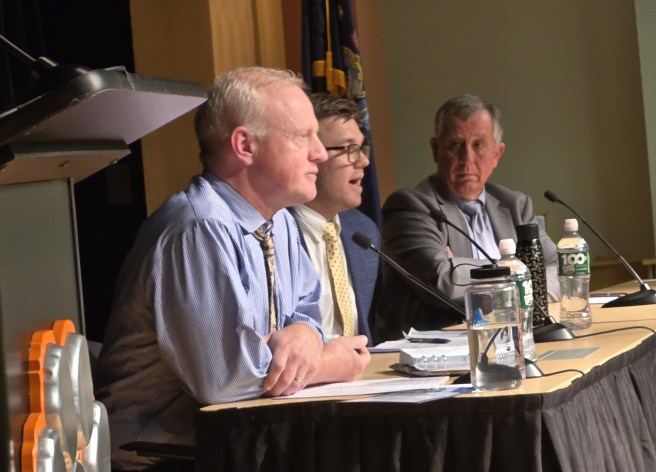
(Left to right: Mayor Marty Grohman, Council President Liam LaFountain and Councilor Norman Belanger tell the audience why they each think they should be Biddeford’s next mayor (Seaver photo)

Roughly 130 people attended the 90-minute debate that included several questions previously submitted by residents.

Craig Pendleton, former executive director of the Biddeford-Saco Chamber of Commerce, served as moderator of the event.

In their opening statements, each candidate laid out their vision of the city’s future and the reasons they are seeking to lead the community over the next two years.

“Biddeford needs a course correction,” LaFountain said. “The city’s leadership needs to be stronger and I will not support back-room deals with private developers.”

Belanger reminded the audience that he is a Biddeford native who grew up as the child of mill workers; worked part-time in the mills himself before earning his law degree at Harvard University.

Grohman also said he comes from humble roots, growing up on a dairy farm in Carthage, a rural community in western Maine.

“It has been a good two years, but there is still lots of work to do.” Grohman said,

“Biddeford needs a
course correction,”

— Liam LaFountain

All three candidates drew rousing applause when they each said they would not want to see the Biddeford Police Department enter into an agreement to assist the federal Immigration and Customs Enforcement (ICE) agency.

One of the early questions from the public centered on the issues of homelessness and its impacts on the downtown area, most notably near the entrance of the McArthur Library on Main Street.

“Certainly, homelessness is one of the most complex and complicated issues in our city,” LaFountain said. “It’s not just a Biddeford issue. It’s happening all across the country and the world.”

LaFountain said he would focus on creating stronger partnerships with state, federal and county agencies. He also suggested the creation of a day-time location that would offer shelter, WIFI and an alternative place to congregate. “Dignity must be at the center of these conversations,” he said.

“It has been a good two years,
but there is still lots of work to do.”

— Marty Grohman

Grohman said he is proud of his track record in addressing the issue of homelessness in Biddeford, describing it as one of his “signature issues.”

Grohman said he led the way in clearing out a growing encampment near Mechanics Park last year, a situation he called reminiscent of a “third-world country.”

Grohman also pointed out that his efforts, including weekly “huddle” meetings with advocates and others concerned about unhoused residents, have resulted in finding stable housing for 70 people during the last year.

Belanger said the issue is complex and requires a multi-faceted approach that includes more non-city resources for mental health and substance abuse without losing “compassion.”

“We need a regional solution,” Belanger said. “Biddeford can’t be expected to solve the issue. We need a reasonable solution, but we simply cannot do it alone.”

On the issue of what to do with the former JFK Memorial School building, Belanger said any decision should preserve its available parking, regardless of how the building is used.

Belanger said he would like to see the building used as some sort of a community center, perhaps a daycare center that would be privately operated.

LaFountain drew rousing applause when he said he opposes any credit enhancement agreements or tax increment financing (TIF) deals that do not benefit the entire city.

As an example, LaFountain pointed to the Marble Block building on Main Street, the home of a new bowling alley, saying the city provided nearly $1 million in incentives for a place where families have to pay $35 for a lane.

“I would rather see that money going to the city’s recreation resources that provide free opportunities,” he said, pointing out that he was the only candidate who voted against that particular deal.

“The public has lost its trust
in local government,”

— Norman Belanger

Given that a “citizens grievance” meeting will be happening in less than two weeks, all three candidates agreed that the city made “some mistakes” in how it handled a proposal by the University of New England to build a large research pier on the Saco River.

“I believe the university is a major benefit to the community, and something to be proud of,” Grohman said. “That said, some steps were bungled along the way. I’m hoping that the upcoming meeting will promote some community healing.”

On the UNE pier issue, LaFountain said there was a lack of accountability from former city manager James Bennett on a variety of issues. Bennett was removed from office in February. “We are still dealing with the ramifications of those mistakes,” LaFountain added.

Belanger agreed with LaFountain. “That [review] process was botched from the beginning,” he said.

The candidates discussed ways in which they would address increasing property taxes and rising housing costs.

In his closing statement, LaFountain said Biddeford is at a “cross roads” and needs data-driven leadership.

“We can continue down a path of decisions being made behind closed doors and residents shouldering the burden of unchecked growth,” LaFountain said. “Or, we can chart a new course grounded in accountability, transparency and a genuine commitment to the public good.”

Grohman said the city is at risk of “losing its magic” that has resulted in revitalization of the downtown area and an improved reputation as one of the state’s largest municipalities.

“I am proud to partner with people who want to invest in Biddeford,” Grohman said. “I think we want to keep building Biddeford, keeping it a better place with an opportunity for everyone to succeed.”

Belanger said the city has lost sight of its need to prioritize municipal spending. “The public has lost its trust in local government,” he said. “We can easily bankrupt ourselves with compassionate spending. We need to be careful how we spend taxpayer money.”

Note: There was a last-minute glitch in providing video recording of the event. We have included a rough, un-edited audio transcript of the debate.

______________

Randy Seaver is the editor and founder of the Biddeford Gazette. He may be reached by email: randy@randyseaver.com

c.) 2025 All Rights Reserved

Never miss another update! Subscribe for free today!

Candidates, residents meet during roundtable event

Several city council hopefuls and one of the three candidates for mayor in Biddeford attended an event Tuesday that was billed as a “Community Roundtable” discussion between candidates and members of the public.

The forum was held in an ante room at Pizza By Alex and was attended by 18 members of the public. Delilah Poupore, executive director of the Heart of Biddeford, served as moderator of the 90-minute Q & A session.

The event was organized by Better Biddeford, a non-profit organization focused mainly on residential tenant rights. On its website, the group describes its mission as follows: “to connect, inform and empower the community through shared resources and civic engagement.”

Moderator Delilah Poupore (far right) kicks off the candidate roundtable meeting

Several candidates were not able to attend the forum. Those who did attend provided short answers to a wide range of topics and questions from the audience, including concerns about affordable housing, ICE enforcement actions, sustainable development and making Biddeford a more walkable community.

Each candidate was also allowed to make brief opening and closing remarks.

Although Mayor Marty Grohman stopped by shortly before the event began, he said he was unable to participate because of a Traffic Committee meeting at City Hall. Mayoral candidate Norm Belanger also did not attend the event, telling the Gazette last week that he will be out of town on vacation.

City Council President Liam LaFountain did attend the event and said he is hoping that candidates will have even more opportunities to connect with residents and talk about their priorities.

Of the three at-large candidates, only Nasreen A Sheikh-Yousef attended Tuesday’s forum. Neither Councilor Marc Lessard nor Lisa Vadnais attended the meeting. The two council candidates from Ward Six — Roger Hurtubise and Jake Pierson – also did not attend. And Ward Two candidate John McCurry said he had a prior engagement.

Ward Seven council candidate Brad Cote pointed out that all Biddeford residents are facing increasing costs for food, utilities and healthcare on top of skyrocketing housing costs.

Council candidate Nasreen A Sheikh-Yousef answers a question while candidates Sam Pecor (left) and David Kurtz (right) listen.

“Sometimes it’s easy to simply say we should spend more on various projects, but we have to balance and prioritize our wants and needs,” Cote said. “We need to be creative in searching for sources of revenue that are not just reaching into the pockets of taxpayers.”

On the topic of how to increase “environmentally sustainable” housing, Sam Pecor, the other Ward Seven candidate, pointed out that Biddeford’s current housing stock is among some of the oldest in the nation.

Pecor — who owns a rental property on May Street – said housing is one of the biggest issues facing the city. “We have to be creative,” he said. “We have to look at different options. This is a really complex puzzle.”

Many of the candidates said the city needs to improve how it communicates with residents.

“As councilors, we have a responsibility to help educate and organize people into action,” said Sheikh-Yousef. “Citizens need to know what is happening in their own community.”

On the topic of accessible public information,” LaFountain pointed to the plans last year to convert apartments into market-rate condominiums at the Pepperell Mill complex.

“What really disturbed me is that we councilors were kept in the dark about those plans,” LaFountain said. “None of us were told about it until the news was dropped on the tenants in that building.”

Mayoral candidate Liam LaFountain (center) and Ward One council hopefuls Jim LaBelle and Pat Boston listen to a question from an audience member during Tuesday’s event.

Ward Five candidate David Kurtz will be unopposed on the ballot. He used some of his speaking time to warn residents that things happening on the national stage could and will impact the city, including federal funding cutbacks.

Kurtz also said he would like to see the city “slow down” its push for housing developments. “We are in a much different position now than we were 20 years ago,” he said. “We no longer need to offer commercial and residential developers sweetheart deals.”

LaBelle reminded the small audience that the demand for all types of housing is quite high in Biddeford, and private sector employers are also struggling to find workers who can afford to live close to the city.

Former Ward Four Councilor Bob Mills said he has long been an advocate for rent stabilization programs but found little support for any kind of rent control from his peers during his prior service on the council.

“I am one of those people in Biddeford who is earning more than $100,000 and still feels poor,” Mills said.

On the issue of ICE enforcement actions, all of the candidates said they do not want the Biddeford Police Department to enter into agreements or cooperate with the federal agency’s enforcement activities.

Ward Two council candidate Abigail Woods was one of the organizers of Tuesday’s event, and said the council should always act with compassion, especially for its most vulnerable citizens.

Former Ward One Councilor Pat Boston talked about the difficult realities of serving on the council.

“We have to be fiscally responsible,” she said. “But the hard part is ‘the how.’ How do we balance the city’s needs without pushing taxpayers over the edge?”

__________________

Randy Seaver is the editor and founder of the Biddeford Gazette. He may be reached by email at randy@randyseaver.com

Never miss another update! Subscribe for free today!

OPINION: Are you ready to rumble?

Today is the first full day of autumn.

Many people get excited about this time of year. They order pumpkin everything, pick apples, decorate their yards with mums and fret about having the cleverest Halloween costume for themselves and their kids.

I get excited this time of year for an entirely different reason. I am a political junkie with a local focus, and every two years Biddeford voters choose who will represent them as mayor, on the city council and as members of the school committee.

Unlike the rather dull 2023 cycle two years ago, this year’s upcoming elections are bringing some heat to the game.

We have three mayoral candidates this year, and almost every ward race will feature two candidates, except Wards Three and Five.

The last time Biddeford had more than two people running for mayor was in 2013, when former mayor Joanne Twomey and former councilor Perry Aberle both tried to deny Alan Casavant a third, consecutive term.

And one of the most interesting mayoral races in Biddeford took place in 2003 when Gen. Wallace Nutting – a Republican and Saco native – upset the ballot with a decisive win over School Committee member Dan Boucher and City Councilor Marc Lessard.

Few people predicted that outcome, and I was not one of them. For the record, that race generated a whopping voter turnout of more than 67 percent of registered voters.

Typically, turnout during local elections rarely break the 45 percent mark.

Today’s political landscape in Biddeford

Voters will also be asked this year to decide the fate of two rather significant municipal bond issues; and whether to convene another Charter Review Commission.

In my opinion, there are at least three significant issues driving more candidates and voters to participate in this year’s election.

First, issues connected to former city manager James Bennett angered many people in the community on almost every front: how federal grant money was being used, excessive staff turnover at City Hall, questions about discrepancies in the Finance Department, a blistering report from the city’s auditors and the city’s inability to pay a private contractor for his services to the city.

Former City Manager James Bennett

And Bennett was also a central figure in the controversy surrounding the University of New England’s plan to construct a large pier on the Saco River. Bennett sidelined both the city’s harbormaster and deputy harbormaster during local review of the pier proposal.

The council finally removed Bennett from office but not before he left a shitty taste in a lot of mouths across the city. Bennett filed a lawsuit against the city.

City officials, in turn, are pointing to concerns about how Bennett used his office for his own gain.

Secondly, the UNE pier proposal raised local concerns on a number of fronts as opponents raised questions about possible conflicts of interest and a lack of transparency during the project’s review.

Members of the public voiced concerns and anger earlier this year about the University of New England’s controversial plan to construct a large pier on the Saco River (Seaver photo)

Finally, continuing property tax increases are always an issue in local elections. Over the last two years, the city has passed on increased spending budgets of nearly six percent per year.

Not surprisingly, several incumbent candidates are now raising concerns about property tax burdens, yet many of them actually approved increased spending over the last two years.

Politicians will be politicians.

How will the Biddeford Gazette cover all the election news?

Our in-depth election coverage will begin on October 1.

We are now in the process of collecting questionnaires that were sent to all city council candidates.  We will use those surveys as the basis for upcoming stories about each of the contested ward races. We will also periodically examine each of the races and how they align with public concerns.

The contested ward races will be covered in a single story. For example, candidates Patricia Boston and Jim LaBelle from Ward One will be featured in the same story.

Likewise, the three at-large candidates will be introduced in one story, but we will also do follow-up stories on that race.

When it comes to the mayor’s race, we will publish three separate stories regarding each candidate during the first full week of October.

Profiles and interviews with Norman Belanger, Marty Grohman and Liam LaFountain will be published in alphabetical order on three consecutive days.

Obviously, we will be writing many other stories, especially about the mayoral candidates and their campaigns.

Upcoming mayoral debate

Finally, I am proud of the fact that I was able to organize at least one public debate among all three mayoral candidates. It took a lot or work to get this thing organized but I think it’s well worth the effort.

I am especially pleased that my colleagues from Saco Bay News, and the Biddeford-Saco Courier agreed to participate as panelists with me.

That debate will take place on Friday, October 10, from 6 p.m. to 7:30 p.m. at Biddeford High School’s Little Theater on Maplewood Avenue.

The debate will be streamed live and recorded for later viewing on social media sites.

While there will be no public comment during this event, we are hoping that most of the questions will come from the public in the form of written submissions before the debate.

If you would like to submit a question or comment, please email us at biddefordgazette@gmail.com

I have been covering Biddeford politics for three decades. I promise you that we will leave no stone unturned during our in-depth coverage.

Let the games begin!

______________________________

Randy Seaver is the editor and founder of the Biddeford Gazette. He may be reached by email: randy@randyseaver.com

You may view and learn more about our editorial standards and policies here:

Biddeford Gazette | Standards & Policies

Š 2025 All Rights Reserved; Biddeford Gazette, Inc.

Never miss another update! Subscribe for free today!

UNE pier opponents ramp up their efforts

Even as the University of New England begins construction of its controversial research pier, opponents of the project are ramping up their own efforts and raising new concerns about how the City of Biddeford handled its review of the project.

A group of Biddeford residents are now circulating a petition to require the mayor and city council members to host a citizens’ grievance meeting.

This aerial photo from UNE shows where the university is planning to construct its new research pier

According to the city’s charter, any Biddeford resident can force the council to publicly hear their concerns during a meeting in which only the citizens are allowed to speak if they can collect at least 100 signatures from registered voters.

Carole Alexander is one of the key organizers of the proposed Citizen Grievance meeting.

Alexander is the wife of the late Marshall Alexander who served as the city’s harbor master for 37 years. She says her husband proposed an alternate location for UNE’s pier more than 10 years ago.

“I’m angry,” Alexander said. “The city has bungled the entire process and the truth has been distorted. First, they removed our harbormaster, and now they are going after a planning board member who raised concerns. It’s time for citizens to stand up.”

RELATED: Planning Board member: ‘Something Smells Fishy”

Alexander says she is more than confident that her group can collect more than 100 signatures in order to force the meeting.

Meanwhile, questions are now being raised about the law firm that the city hired to represent the Zoning Board of Appeals and some potential conflict of interest issues.

Following the Planning Board’s approval of the university’s pier project, John Schafer – one of the project’s most vocal opponents — filed an appeal of that decision with the city’s Zoning Board of Appeals.

Schafer said that he and several other residents are appealing the planning board’s decision because it hinges largely on one central point: whether the university’s plan required the expressed approval of a harbor master.

“All I can hope for is that the zoning board will send this item back to the planning board,” Schafer said. “The planning board got bad information about whether a harbormaster approved the project.”

During the planning board’s review of the proposed pier, City Attorney Harry Center repeatedly told the board that the project had been approved by a harbormaster.

This audio clip of a discussion between Planning Board Chair Alexa Plotkin and Center during one of the Planning Board’s meetings shows that the role and definition of the harbormaster was a central issue of the board’s review.

RELATED: Planning Board approves UNE pier proposal

But Schafer and others point to the city’s own ordinances and say the private engineer who was hired to replace the city’s harbormaster does not meet the definition of a harbormaster from both city and state regulations.

According to city ordinances, a harbormaster must meet specific requirements to hold that title, including being a “city resident for no less than five years; must have five years of marine experience and must attend annual Maine Harbormasters Association training.”

Center, however, argues that the engineer hired by the city only needs to “facilitate” the review process and ensure that other local, state and federal agencies have approved the project.

But opponents say the city’s ordinances are crystal clear in what defines a ‘harbormaster’ and what his or her responsibilities are.

Section 74-35 of Biddeford’s ordinances reads: “Permission for the construction of any new wharf or pier within the jurisdictional limits of the city shall not be granted without approval of the Harbormaster, along with federal, state and local governing authorities.”

“The planning board never heard from an actual harbormaster,” Schafer said. “That’s a big oversight that needs to be addressed.”

More conflicts of interest?

Earlier this month, the city hired Archipelago Law, a small Portland-based law firm to represent the Zoning Board of Appeals.

Former city councilor Kyle Noble says that particular firm has several conflicts of interest issues because four of the firm’s 12 employees graduated from the University of New England’s Marine Sciences program.

Keith Richard, the attorney who will be representing the Zoning Board, refused to comment for this story.

Mayor Marty Grohman declined to comment on the matter because it is a pending legal issue for the city.

Council President Liam LaFountain also said he could not comment directly on the story, but did indicate that he is hoping to learn more about the firm and why they were chosen.

In an email response to Schafer, City Manager Truc Dever wrote: “While I cannot speak to your assertions regarding potential conflicts of interest, I will be looking into this in advance of the appeals hearing to ensure there is, in fact, no conflict.”

Next steps?

A UNE spokesperson said the university is currently searching for a contractor and has initiated a bid process for the project.

Sarah Delage, Associate Vice President of Communications, said an actual construction schedule has not yet been established and that the university will need a building permit from the city’s code enforcement officer.

“The total work can be done in six to eight months,” Delage said, pointing out that both the land portion of the project and the water portion can be done in phases, as opposed to concurrently.

Delage said the university has not reached out to mooring owners who may be impacted by the project, saying that responsibility rests with city officials.

Delage also said the university will periodically update construction information on the school’s website.

The Zoning Board of Appeals hearing has been set for October 9 and residents who are now gathering signatures for a Grievance meeting with the council say they expect to have more than the required number of signatures they need within a few days.

Editor’s Note: A copy of the citizens petition may be viewed or downloaded using the link below:

___________________

Randy Seaver is the editor and founder of the Biddeford Gazette. He may be reached by email at randy@randyseaver.com

Never miss another update! Subscribe for free today!

A new bridge between Biddeford and Saco?

It is a community project that has been in the “conceptual phase” for nearly two decades, but now the conversation about a new ‘multimodal’ bridge connecting the cities of Biddeford and Saco is once again bubbling to the surface.

On Tuesday, the Biddeford City Council will hear a proposal about the multimodal bridge that would connect Saco Island to the planned Pearl Point Park in Biddeford.

Representatives from the city of Saco and the Maine Department of Transportation will update the council about the project, a plan that will likely cost millions of dollars and require federal funding to complete.

The concept for a new bridge (City of Saco)

“It is an exciting concept,” said Biddeford City Council President Liam LaFountain. “But obviously, this is something that the two cities cannot take on alone. We would new federal and state funding.”

Although there is already a pedestrian bridge connecting the two cities closer to the Saco River falls, the new bridge is designed to be more user friendly

Creating a link between Saco and Biddeford is a long-term goal that has been identified in Saco’s comprehensive plans since 2011.

The new bridge is designed to improve walkability; promote equitable access to public transit and help alleviate traffic congestion by creating a shift away from personal vehicle use.

Proponents of the project also say the new bridge will encourage further economic development near the downtown core shared by both cities.

“It really is a very interesting project,” said Saco Mayor Jodi MacPhail. “We’ve been talking about this for a long time. It’s nice to see some forward momentum.”

MacPhail said the project has been an ongoing topic of conversation between the two cities during past joint workshop meetings.

She said conversation about the bridge “sort of fizzled” because former Biddeford City Manager James Bennett did not view the project as a priority.

Joint meetings between the two communities slowed for a period of time until both MacPhail and Biddeford’s Marty Grohman were elected as their respective city’s mayor in 2023.

“We’ve been talking about this
for a long time. It’s nice
to see some forward momentum.”

–Saco Mayor Jodi MacPhail

Today, both Grohman and MacPhail say the cities have an “excellent working relationship.”

The project is expected to cost roughly $5.5 million to construct. If the two cities decide to move forward and apply for federal funding, the project could start construction as soon as 2028.

“I think we can get back on track, and continue looking at things we can do together,” MacPhail said. “When you step back and look at it, we really are joined at the hip and one community.”

Disclosure: Saco Mayor Jodi MacPhail is the step-sister of Biddeford Gazette editor Randy Seaver.

_______________

Randy Seaver is the editor and founder of the Biddeford Gazette. He may be contacted by email: randy@randyseaver.com

NEVER MISS ANOTHER UPDATE! Subscribe for free today!

LaFountain joins mayoral race in Biddeford

By RANDY SEAVER, Editor

The race to become Biddeford’s next mayor has now turned into a three-way contest.

City Council President Liam LaFountain told the Biddeford Gazette this week that he will give up his Ward Seven council seat to join the race for mayor.

LaFountain now joins fellow city councilor Norman Belanger in opposing incumbent Mayor Marty Grohman.

“I’ve had many conversations with neighbors across the city, and there’s a clear message coming through. Too many decisions are being made without enough accountability, and I agree,” LaFountain said. “City government exists to serve the public. People are frustrated because they feel unheard, and in recent years, we’ve drifted away from the kind of leadership that takes responsibility and delivers results. It’s time for a course correction.”

LaFountain, a former member of the city’s Recreation Commission, first joined the council in 2021. Two years later, he was unopposed for his reelection to represent Ward Seven. He then won a bid to become the council president (6-3) ousting Belanger from that role.

Liam LaFountain (File Photo)

“The public interest must be at the center of every decision Biddeford makes,” LaFountain said.

LaFountain, 28, is employed as a senior data analyst for Healthcare Purchaser Alliance, a non-profit organization headquartered in Falmouth. He grew up in Biddeford, and his father Llyod LaFountain served on the Biddeford School Committee and as a state senator in the late 1990s.

The younger LaFountain is often described by his peers and other political observers as “thoughtful, analytical, measured and hard-working.”

LaFountain said that his professional experience as a data analyst will help him bring a fact-based, detail-oriented approach to City Hall. “I know for sure that smart decisions start with good information,” he said.

In recent months, LaFountain has pointedly raised concerns about controversial development deals involving credit enhancements and tax increment financing, proposals that have drawn the ire of many residents.

“Pointing out only the good news
doesn’t solve problems. The voters
know we have serious problems,
and they want hard facts.

True leadership is telling the truth
about a difficult issue and
then finding the best solution.”

— Liam LaFountain

He has also pushed for stronger financial accountability after Biddeford received sobering results from a recent fiscal audit in June.

“Voters are smart, and the last thing I’ll ever do is insult their intelligence,” LaFountain said.  â€œYes, Biddeford is a great city, yes, fantastic things have been happening here in the last decade, and yes, that will continue. But we can no longer gloss over the very real staffing, financial, and accountability challenges.

“Pointing out only the good news doesn’t solve problems,” he added. “The voters know we have serious problems, and they want hard facts. True leadership is telling the truth about a difficult issue and then finding the best solution.”

LaFountain said he is encouraged that he’s already drawing support from a wide range of Biddeford residents, people with different perspectives, experiences, and priorities, who also strongly agree that a fresh approach and much more transparency are needed.

“I’m getting tons of encouragement for the idea that Biddeford should work for the people, not around them,” he said.  “Voters are not inconvenient obstacles, in fact, quite the contrary. I look to Biddeford residents as a source of wisdom for city officials, and we need their full participation as we get back to basics with honest conversations, thoughtful planning, and decisions that serve the public good.”

LaFountain said his goals include increasing public engagement, strengthening oversight of city operations, and upholding the city’s fiduciary responsibility to manage taxpayer resources wisely, while advancing priorities like recreation investment, capital infrastructure, and responsible development that serves Biddeford’s long-term interests.

“I want every resident and taxpayer to know that, in my opinion. we need to right this ship and guesswork isn’t good enough. Data analysis will get us to evidence-based, forward-thinking policies that prioritize the public good over narrow interests. I hope to win the support of every Biddeford voter who agrees with that,” LaFountain said.

LaFountain graduated from Cheverus High School in 2015 and then attended Gonzaga University, a Jesuit school in Washington state, where he earned a degree in international relations.

He and his partner, Eisha, have been married five years and live on Elm Street.

Note: The Biddeford Gazette previously reported that both Marty Grohman and Norman Belanger are running for the mayor’s seat in the upcoming election. The Gazette plans to continue its comprehensive coverage of this year’s election, and we will have future stories about all the candidates,

______________

Randy Seaver is the editor and founder of the Biddeford Gazette. He may be contacted by email: randy@randyseaver.com

NEVER MISS ANOTHER UPDATE! Subscribe for free today!

NEWSLETTER: Summer In the City

Hopefully, you are all enjoying the beautiful weather this week! I am on semi-vacation, pinging back and forth between our campsite at Rangeley Lake and Biddeford.

No matter where you find yourself, this is a good week to be living in Maine.

This is also a very good week for those of us who closely follow local politics.

WELCOME TO BIDDEFORD POLITICS

Every two years, Biddeford voters select a mayor, city councilors and school committee members.

If you’re considering running for one of these positions, you first need to take out nomination papers and get the required number of signatures to place your name on the November ballot.

You should also read this piece I published last week regarding the pitfalls and benefits of public service.

This will be the Biddeford Gazette’s first election season, but I have been watching and reporting on this city’s local elections for nearly 30 years, and I can guarantee you the Gazette will be providing comprehensive coverage and the latest daily updates.

We are already running down information, including all the latest developments: reports of former councilors seeking a return; new faces considering a run, and incumbents who may or may not seek reelection.

There are already two candidates vying to be the city’s next mayor: Incumbent Marty Grohman and Councilor Norman Belanger. I would not be surprised to see some other people toss their hats into the ring. Stay tuned, and we’ll have some fun!

Nomination papers will be available beginning Thursday (July 24) at the City Clerk’s office.

A BIG MILESTONE

When Laura and I decided to formally start the Biddeford Gazette in January, we told ourselves we would not invest too much money into the venture and would wait six months before committing more time or resources.

Last week, the Gazette hit that six-month marker, and I am very proud of what we have accomplished so far.

The Gazette is not about me. The Gazette is about Biddeford, and our mission has not changed. We believe the city of Biddeford and its people deserve a dedicated, community-driven news source, something that has been missing for a few years now.

Over the last six months, the Biddeford Gazette has published 81 news stories, many of which were exclusive and most were reported days and even weeks before other media outlets filed reports.

We have also published 14 feature stories and seven “Community Voices” stories, which are written or submitted to us by other community members. That’s the part we’re really hoping to grow as we move forward.

WHAT’S NEXT?

We have started a new business section, a rudimentary community calendar — and beginning this week we will launch our newest feature, FLUFF PIECES – a project we are doing in partnership with the Animal Welfare Society to feature a different pet available for adoption each week.

We received hundreds of clever and funny suggestions from the community about the naming of this new section. Thank you to all who offered so many very cool suggestions!

I am especially pleased to announce that we are also now in the process of putting together a seven-member community advisory board.

If the Gazette is going to truly serve the community, it must have the pulse of the people who live, work and play here. We need and want constructive feedback from the community. We want to hear a diversity of new ideas and suggestions.

I think that’s more than enough for one newsletter. Get out there and enjoy Maine’s beaches, lakes and public parks. Be safe and have fun!

As always, thank you for reading!

Randy Seaver, editor

NEVER MISS ANOTHER UPDATE! Subscribe for free today!

Biddeford voters could face $47 million bond package

Biddeford voters could be asked to approve more than $47 million in municipal bonds to support ongoing sewer separation work and improvements to the city’s parks and recreational facilities.

During their July 15 meeting, city councilors discussed the prospect of an overall spending package intended to address items that would be much more costly if they were to be funded through the regular budget.

According to Acting City Manager Brian Phinney, the city will likely need to spend as much as $100 million over the next decade to continue state-mandated sewer separation projects.

(Photo courtesy of Associated Press)

The city is currently under a consent agreement with the Maine Department of Environmental Protection.

The city could face significant state and federal penalties if it fails to fund those sewer projects, Phinney told the council. Potential penalties could run as high as $10,000 per day.

Phinney said that in the near term, the city will need approximately $40 million to address the most pressing sections of the overall sewer separation work that needs to be done, as outlined in the consent agreement with the state.

Several councilors said they are concerned that voters might reject the bond because of its hefty price tag.

“We’re in this situation because prior
councils – if you go back decades –
didn’t make those investments.”

— Liam LaFountain

One option that many councilors seemed to favor was to break the $40 million into four separate bond questions or the ability to stagger the withdrawal of bond funds from their designated accounts.

According to Councilor William Emhiser, the impact of a $40 million bond would be approximately $350 per year for the average homeowner, based on an average $382,000 home.

Mayor Marty Grohman pointed out that current interest rates are running between 5.5 and six percent.

“It’s not fun to spend money on these types of projects,” said Council President Liam LaFountain. “But we really don’t have a choice. We have to do these projects. It’s the responsible thing to do, and we’re in this situation because prior councils – if you go back decades – didn’t make those investments.”

Most councilors agreed that a voter education effort will be critical in order to get the bonds approved at the Nov. 4 municipal election.

In a later discussion, LaFountain raised the idea of another bond package to support long overdue improvements and upgrades to the city’s recreational facilities, including Mayfield Park, Clifford Park, Rotary Park, Shevenell Park and the J. Richard Martin Community Center.

“It may seem like a lot, and it is,” said Councilor Marc Lessard. “But people ask us for these things, whether it’s a new skatepark or a Splash Pad. Now it’s going to be up to the people to decide if they want to spend the money on these items.

Councilor Doris Ortiz said she liked the idea of doing recreation funding through a bond package.

“I think it’s a good idea because there never seems to be enough funding for these needed items when get to the annual budget process,” she said.

The council is expected to vote at its next meeting scheduled for August 5 on whether to send the bond requests to voters in November.

________

Randy Seaver is the editor and founder of the Biddeford Gazette. He may be contacted by email: randy@randyseaver.com

NEVER MISS ANOTHER UPDATE! Subscribe for free today!

What is ‘affordable’ housing?

You see it all the time.

Whenever elected officials or media outlets use the words “affordable housing,” there is often an almost immediate pushback from people who say those housing units are not really “affordable.”

This is especially true in the city of Biddeford, the latest community to join southern Maine’s so-called “gold coast.”

Until just a few years ago, Biddeford was an anomaly among coastal communities in southern Maine. It was a mill town. Its demographics were dominated by working-class families.

The city’s downtown struggled throughout the 1990s, as the mills began closing. The city’s biggest downtown asset and largest overall taxpayer was the MERC trash incinerator that produced foul odors while burning trash from all over Maine.

That’s all changed over the last few years. Today, Biddeford is a desirable community and has the state’s highest number of younger adults. Biddeford is now a “cool place” to live, and people from all over New England and beyond are moving here for a better quality of life.

RELATED: BIDDEFORD HOUSING CRISIS: Part One

That positive change, however, has a big impact on regional housing costs.

So, what is “affordable” housing?

“A lot of this is subjective,” said Mayor Marty Grohman during a previous interview. “What is affordable for one person may not be affordable for another person.”

So, who decides if a housing unit is “affordable?”

Federal, state and local rules

State Rep. Ryan Fecteau (D-Biddeford) is also a senior development officer for Avesta Housing, Maine’s largest, non-profit housing development firms.

“The term ‘affordable’ really depends
on the family or the individual.”

State Rep. Ryan Fecteau (D-Biddeford)

“There is no state or county in the United States where a renter working full-time at minimum wage can afford a two-bedroom apartment,” according to Avesta’s website. “Housing availability has shrunk to record lows while rental costs have increased dramatically. The magnitude of the affordable housing crisis we are currently facing calls for bold and innovative solutions.”

Fecteau says that he and other legislators view the need for affordable housing in Maine as a top priority.

“The term ‘affordable’ really depends on the family or the individual,” Fecteau said. “But we do have state and federal requirements that developers need to follow if they want tax credits or other incentives to build housing projects.”

RELATED: Biddeford Housing Crisis, Part Two: The Experts Speak

Fecteau says the city of Biddeford has made significant strides in addressing a wide range of housing needs, including low-income projects, senior housing and affordable housing.

For most of York County, Fecteau said, low-income is considered to be 60 percent or below of the area’s median income (AMI).

Today only a person earning $44,900 or less qualifies for low-income housing. Low-income housing (usually including basic utilities) is targeted to cost 30 percent of the household’s net income.

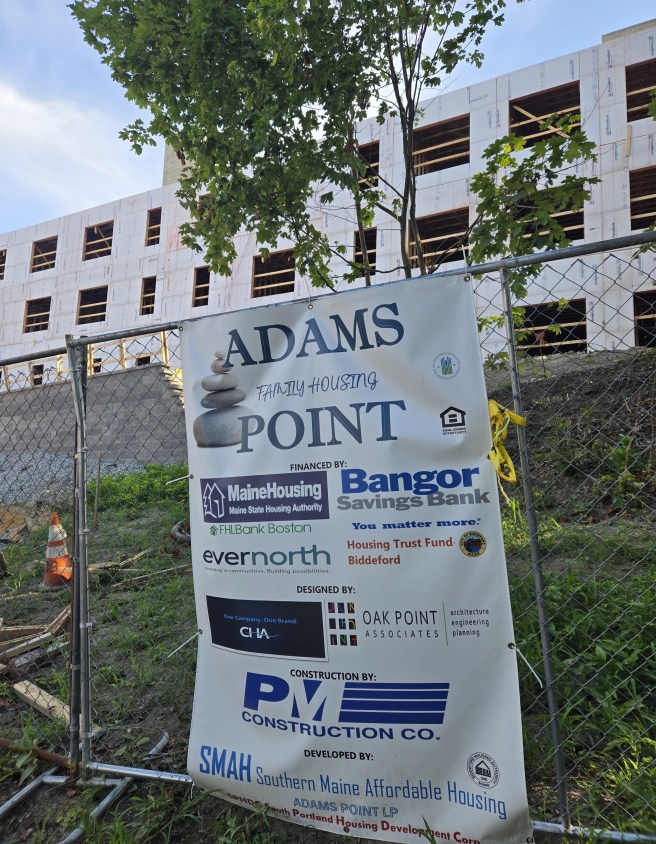
The Adams Point project in Biddeford is expected to open in March 2026, offering 39 low-income rental units. (Seaver photo)

Guy Gagnon, executive director of the Biddeford Housing Authority, says his non-profit organization caps their low-income rental costs at $1,350 for a one-bedroom apartment; and $2,125 for a three-bedroom unit.

Fecteau and Gagnon both point out that there is sometimes a big difference between low-income housing and other housing that is described as “affordable.”

Missing puzzle pieces

Gagnon points out that providing affordable housing is not just a Biddeford problem.

Since 2018, the rental cost burden across the state has increased sharply for most households, especially for those with household incomes between $35,000 and $75,000 in total household income.

According to George Gervais — Biddeford’s Director of Community and Economic Development — the city had 10,576 housing units at the beginning of March this year.

In just the last few months, several new housing units have been added to the mix, including projects such as The Levee and The Eddy, both of which are described as “affordable housing.”

More low-income housing is also being added to the mix. Within a few months, the Adams Street project will offer 39 new units for low-income renters.

Gervais said rental units make up slightly more than 53 percent of the city’s occupied housing.

Despite the increasing supply of housing, average monthly rents in Biddeford remain steep, ranging between $1,700 and $3,200, from studio apartments to three-bedroom units.

City Council President Liam LaFountain said he is feeling a bit discouraged because the increasing amount of housing is not doing much to drive down rental costs or the cost of a single-family home.

The average home values in Biddeford are continuing to rise, outpacing employment earning gains. The average home value in the city is slightly more than $478,000.

Earlier this year, Gervais told the city council that more than 2,100 units of housing are currently in some form of development.

Of those 2,100 new housing units, only 319 units are planned as affordable housing units in which rental costs are calculated by the area’s median income.

Grohman said that he and the city council set a goal last year to create 180 units of ‘affordable” housing every year for the next five years.

But can Biddeford residents keep up with rising housing costs?

Gagnon and LaFountain said they and others are doing everything possible to address the issue, at least on the local level.

“Our mission is to touch as many demographics as we can,” said Gagnon. “From our unhoused population to affordable apartments and homes for families and seniors.”

Gagnon said he is particularly concerned about families of two or more people being able to find an affordable living solution.

“You hear a lot of talk about one and two-bedroom apartments, but you don’t see much about three or four-bedroom units,” Gagnon said.

The Biddeford Housing Authority was responsible for the development of 47 “market-rate” units that range from $925 a month for a one-bedroom unit to $1,100 for a two-bedroom unit.

“We were able to pull that off because a lot of things went right for us,” Gagnon said. “We got our financing from a local lender with a very competitive interest rate and term. We were then able to pass those savings on to the renters.”

Gagnon said it is difficult for both non-profit and private developers to offer “affordable housing.”

“You have to consider interest rates, material and labor costs and lots of other factors,” Gagnon explained. “Typically, you don’t begin to see a return on your investment for 15 years or more.”

Gagnon said many people might be surprised to learn that it was President Ronald Reagan – a staunch fiscal conservative – who helped create federal tax credits for developers willing to build affordable housing for lower income families.

Gagnon says he would like to see the city and state move from a focus on creating more units and instead use that extra funding to develop fewer units that could be less expensive.

“People are generally impatient,” said Gagnon. “They want it fixed now, but the reality is that this is not just a Biddeford problem.”

Gagnon does, however, acknowledge that the city has some unique challenges.

“There are two very different groups of people in Biddeford,” Gagnon explained. “There is the old Biddeford and the new Biddeford. The new Biddeford people have access to higher regional incomes and can live here while tele-commuting.

“Meanwhile, the old Biddeford people are still relying on traditional incomes. I had a friend recently tell me that if Portland is Manhattan, then Biddeford is Brooklyn.”

The median household income in Biddeford is $69,794. For comparison purposes, the median household income in Saco is $84,328; and $93,167 in Kennebunk.

How do city officials define ‘affordable’ housing?

LaFountain says the city of Biddeford is using a diverse set of tools to address the costs of housing, including creating Inclusionary Zoning (IZ) rules that require any developer proposing to build more than eight units to offer at least 10 percent of those units within AMI guidelines.

“There should be housing that is attainable for all Biddeford residents,” LaFountain said. “That is the goal, but it’s going to take time, money, effort and a lot of other things beyond the city’s control to make that happen.”

The city of Biddeford describes affordable housing in the following ways:

Low-income: A development in which a household whose income does not exceed 70 percent of AMI as defined by the U.S. Department of Housing and Urban Development (HUD) stipulating that rental costs cannot exceed 30 percent of the household’s monthly income.

Owned housing: A development in which a household whose income does not exceed 120 percent of AMI;

Affordable housing: Housing for which the percentage of income a household is charged in rent and other housing expenses or must pay in monthly mortgage payments and does not exceed 30 percent of a household income.

Workforce housing: Housing where the rent is affordable to a household earning 80 percent or less than AMI, and where the units are rented to a household earning 80 percent or less than AMI.

“I understand why some people balk when we talk about affordable housing,” LaFountain said. “It is a subjective issue, but is also a very important issue.”

_____________

Randy Seaver is the editor and founder of the Biddeford Gazette. He may be contacted by email: randy@randyseaver.com

NEVER MISS ANOTHER UPDATE! Subscribe for free today!

Biddeford receives ‘troubling report’ about the city’s financial management.

Biddeford Mayor Marty Grohman and members of the Biddeford City Council received a blistering report Tuesday from the city’s independent financial auditor, Runyon, Kersteen and Ouellette (RKO).

Although Tuesday’s audit presentation focused on the FY 2023 audit — overdue for more than two years — it also painted a troubling picture about how the city’s finances have been handled during the last two years.

Sarah Dodge – an accountant at RKO – told the council that she found “several serious deficiencies” in how the city handled its finances, including an absence of cash reconciliations and mismanagement of federal grant money that was awarded to the city.

Dodge stressed that RKO found no evidence of fraudulent activity at City Hall.

Still, it was clear to those in the audience that many members of the council seemed troubled by the presentation.

Dodge made several recommendations to the council, saying the city should hire a grant manager.

In an interview with the Biddeford Gazette, Grohman said he knows that residents are frustrated by the continued news of financial management issues at the City Hall.

Grohman said that he and the council are also frustrated about the situation, but are also “fully committed to turning things around.”

“Completing the FY23 audit is an important milestone, and it shows that the investments we’ve made in stronger oversight are starting to pay off,” Grohman said. “Presenting the audit to the public in a full council meeting is part of the open book approach we are committed to.”

“What we’re facing is a need for better systems, tighter controls, and more timely reporting—and we’re making those changes,” Grohman added.

“What RKO presented this week
confirmed the depth and duration
of the city’s breakdown in basic
financial oversight.”

— Council President Liam LaFountain

Grohman said that the city has already implemented a new sewer billing program, and that payroll software upgrades are next.  â€œAll of these steps will bring more accuracy and predictability for both residents and employees,” he said.

Grohman also pointed out that the city’s “rainy day fund,” known as the “Fund Balance” remains healthy and strong.

“This turnaround won’t happen overnight, but it is happening,” Grohman said, pointing out that Gerry Matherne, the city’s new finance director, has been making tremendous progress in getting the city’s financial controls back on track.

City Council President Liam LaFountain chairs the city’s Finance Committee.

LaFountain agrees with Grohman, saying the city is working hard to address financial deficiencies.

“There is absolutely no excuse for what Biddeford’s FY23 audit report revealed,” LaFountain said. “What RKO presented this week confirmed the depth and duration of the city’s breakdown in basic financial oversight.”

LaFountain said the absence of timely reconciliations, delays in reporting, and failure to manage cash controls and grant compliance should never occur in any city, let alone persist across multiple fiscal years.

“The point is that it happened, and Biddeford residents and taxpayers deserve direct acknowledgment of that,” LaFountain said. “There is no sugarcoating it. The audit report is an embarrassing document, but it also serves as a valuable tool. It gives the city a roadmap. It shows us clearly what went wrong and what must be fixed.”

“Responsible public stewardship is not optional,” LaFountain added. “Without it, the risk of further financial damage is real.”

RKO’s entire summary report to the council can be viewed or downloaded below:

_____________________

Randy Seaver is the editor and founder of the Biddeford Gazette. He may be contacted by email: randy@randyseaver.com

NEVER MISS ANOTHER UPDATE! Subscribe for free today!

Councilor offers inside view of Biddeford’s budget

Editor’s note: The following is a response that Biddeford City Council President Liam LaFountain sent to a resident who expressed concerns about this year’s municipal budget.

By Liam LaFountain

Thank you for taking the time to write and for your thoughtful engagement with this year’s city budget. Your questions about affordability, sustainability, and fiscal discipline are essential. I appreciate the opportunity to respond and provide additional context on this year’s proposed budget.

Your recognition of the value that organizations like Heart of Biddeford, McArthur Library, and our food security and cultural institutions bring to the city is deeply appreciated. These organizations stretch every dollar and are actively engaged in fundraising and collaboration. They are not resting on municipal support alone.

RELATED: How about some tax relief?

For example, Heart of Biddeford, to which the Budget Committee awarded $110,000 this year (a 10% increase from last year), operates on a total budget of $270,500—meaning the City’s share is approximately 41%. In return, they run 16 community events (many spanning multiple days or weeks), manage the Art of Biddeford initiative, conduct business training, and support downtown vibrancy year-round.

Biddeford City Councilor Liam LaFountain

McArthur Library, a private nonprofit that functions as Biddeford’s public library, requested $1.25 million, and the Budget Committee awarded $1 million (a 33% increase from last year). That represents 48% of its $2.081 million annual budget. With 4,825 active cardholders and 6,500 in-person visits each month from Biddeford residents, it remains one of our city’s most widely used public services.

While the library holds a $6 million endowment, it’s my understanding that they are only able to draw down 4–5% annually per the terms of Robert McArthur’s will, and those funds are restricted in their use. I recognize the City’s contribution is substantial, but so is the library’s role in our city’s physical and social infrastructure.

Particularly in times of economic strain, the library’s value as one of the few free and welcoming places to access books, the internet, programming, and essential public services becomes even more critical. Every time I reflect on its role and its municipal funding, I am reminded of both childhood memories of the library and a quote from President Franklin D. Roosevelt: â€œI have an unshaken conviction that democracy can never be undermined if we maintain our library resources and a national intelligence capable of utilizing them.” With reduced federal and state support for libraries, Biddeford is fortunate to have one so deeply rooted in public service. Without the McArthur Library, Biddeford would need to build, staff, and maintain a municipal library from the ground up—a much more expensive alternative.

On the question of duplication and collaboration in food services, I believe the three food-related nonprofits supported by the City provide distinct, highly targeted services and collaborate extensively:

  • In-A-Pinch Non-Food Pantry: The Budget Committee awarded $4,500 (18% of their total budget). 100% of funding goes to supplies and services, and there is no paid staff.
  • Bon AppĂŠtit Community Meal Program: the Budget Committee awarded $24,000 (40% of their budget); volunteer-run, serving 26,000 hot meals in 2024—about 92 cents per meal for the City’s contribution.
  • Youth Full Maine: the Budget Committee awarded $10,000 (3% of their budget), supporting food distributions at Rotary Park and downtown, and direct deliveries to school pantries and teen programs. They served over 600 Biddeford residents last year—about $16 per person served in City funds.

Altogether, the Budget Committee awarded $38,500 to these these three organization and their food security efforts this year. I wish we did not have to allocate a single dollar to these programs. But the alternative—letting people go hungry—is not one I can support.

Biddeford Community Gardens, which the Budget Committee awarded $17,871 (28% of their budget), served over 500 residents in 2024. They operate in city parks and Housing Authority properties, charge no fees (but require a work service component for beneficiaries), and provide Bon AppĂŠtit Community Meal Program and Youth Full Maine with fresh produce (another key example of their collaborations). They also collaborate with over a dozen organizations across Biddeford and help maintain and beautify portions of Biddeford parks and public spaces.

Regarding holiday lighting, the Budget Committee awarded $5,000, not $20,000. These funds allow Heart of Biddeford and La Kermesse to install battery-powered lights in areas without electric access, helping create a welcoming winter atmosphere throughout the downtown without drawing on City staff time.

On local history and cultural preservation, the Budget Committee awarded:

  • $7,875 to the Biddeford Cultural and Heritage Center (29% of their budget), which maintains archives and offers year-round programming.
  • $7,500 to the Biddeford Historical Society (33% of their budget), which maintains our area’s oldest meetinghouse (7 Meetinghouse Road) and several historic cemeteries.
  • $2,625 to the Biddeford Mills Museum (6% of their budget). The museum is entirely volunteer-run and has no paid staff. In 2024, the Museum logged 1,213 volunteer hours, welcomed 525 museum visitors, led 438 standard tours, 16 special tours, and provided guided educational tours to 418 students about Biddeford’s industrial history.

The Budget Committee awarded $18,000 in total to preserve and promote Biddeford’s history through these three organizations—about 78 cents per resident.

In summary:
The Budget Committee received $1,974,957 in funding requests from social service and nonprofit partners and awarded $1,376,486.50—about 69.7% of what was requested. Some requests were partially funded, and others not funded at all.

These awards make up 2.9% of the City’s $47,821,494 municipal appropriation. In contrast, the largest cost drivers of the municipal budget and use of tax dollars remain Public Safety ($14,773,566) and Public Works ( $6,051,410)—with $20,824,976 budgeted this year across Police, Fire, EMS, Public Works, sanitation, and city infrastructure. The largest portion of those costs is for salaries and wages for the essential staff who protect public safety, plow and maintain roads, pick up trash, and keep the city’s systems functioning year-round.

On the education side, while the overall budget increased by 5.84%4.18% of that growth comes from the School Department. The City’s portion rose 1.44%, and County expenses increased 0.22%. Education costs are rising due to higher wages for teachers and support staff, increased needs for student services, and a sharp reduction in state funding. 

With 60% of students economically disadvantaged and 21% qualifying for special education, the state covers just 37% of Biddeford’s total school budget—leaving 63% to local taxpayers. At the same time, Biddeford educates students at a cost of $15,273 per pupil, below the state average of $17,028 and significantly less than South Portland ($19,592) and Saco ($17,347).

That efficiency also means we are investing less per student than many of our peers—not necessarily a point of pride, but a reflection of the financial constraints the School Committee and City Council must navigate. While local taxpayers may experience some relief from lower education spending per student compared to the state average and our peers, the consequences are borne by our students and educators through reduced resources and increased strain. These students are not only learners today—they are the future leaders, workers, and contributors to the strength of this city tomorrow.

Through more than 10 public meetings,
several other councilors and I proposed
dozens of amendments to the budget to
improve efficiency and reduce the tax commitment.

I’d be remiss if I did not also mention that over the past nine weeks, through more than 10 public meetings, several other councilors and I proposed dozens of amendments to the budget to improve efficiency and reduce the tax commitment. Some succeeded—such as reducing expenses for conferences and training, dues and memberships, user licenses, advertising, and cutting a transfer that subsidized the mooring program. Others, like adjusting development-related fees, were partially successful.

Efforts to raise dispatch service fees charged to other municipalities did not gain traction. I also advocated for increased funding for municipal building maintenance and capital investments—a line item that decreased this year despite growing need—but that, too, was not adopted. Unfortunately, the consequence of underfunding this area is often deferred maintenance that becomes more expensive to address later and can disrupt basic services if not resolved in time.

These were difficult calls. None of us entered this process expecting it to be easy. But every amendment offered reflected an attempt to balance long-term responsibility with today’s fiscal realities.

I understand the concern that the continued growth of the city budget is not sustainable for many Biddeford residents. That is why I believe it is critical that both City government and the organizations we support continue to ask tough questions, pursue efficiencies, and seek out alternative funding sources. This year’s process included many of those conversations.

While the final outcome is not perfect, it reflects real attempts to prioritize essential services while holding the line where we could. The choices ahead will continue to be difficult, and the pressure to do more with less is real. But I believe that preserving affordability and maintaining the services that support our city’s well-being are not mutually exclusive goals—both are part of what it means to meet these fiscal challenges head-on.

In closing, thank you again for raising these questions and for participating in this process. Thoughtful public input like yours plays a meaningful role in shaping how our city is governed and funded. I hope the information I’ve shared helps clarify how and why certain allocations were made, even if not everyone agrees with every outcome. I don’t agree with every allocation in this budget either.

The full Budget Packet [https://biddefordme.portal.civicclerk.com/event/735/files/agenda/1086] contains most of the details I referenced, and summary information is available in the City Council packet for tonight’s meeting [https://biddefordme.portal.civicclerk.com/event/841/files/agenda/2462].

I apologize for the length of this reply—it is difficult to capture two months of Budget Committee work, and the many hours of staff time that went into crafting this document. This year’s budget, like everyone I’ve been part of, is imperfect, but it reflects an earnest effort to balance what we value with what we can realistically sustain.

Thank you again for writing. Please reach out at any time.

__________________

NOTE: If you would like to submit a column to the Biddeford Gazette, please contact us

Never miss another update! Subscribe for free today!

Joint budget workshop: ‘A Tough Pill to Swallow’

With a “challenging” budget hanging over their heads, members of the Biddeford City Council and the Biddeford School Committee participated in a joint workshop meeting Monday to examine the proposed budget.

Monday’s joint meeting was a rare occurrence that has happened only once before over the past 10 years.

“This is an unusual opportunity,” said Mayor Marty Grohman during his opening remarks. “We all share the same goals.”

School Superintendent Jeremy Ray said both the council and the committee are all in a “difficult situation, but we are being very conservative.”

In its current form, the proposed budget for next year shows an increase of 0.53 percent for the city; a 5.10 percent increase in school funding and an 0.08 percent increase in county taxes.

According to Acting City Manager Brian Phinney, every $100,000 of spending requires 2.3 cents on the tax rate.

As it stands now, the proposed budget would require an increase in the mil rate, from $14.22 last year to $15.03 this year.

Members of the Biddeford City Council and Biddeford School Committee discuss the proposed budget for next year. (Seaver photo)

Grohman said Monday’s evening was designed to bring both groups together under one roof so that they could each share their concerns and collaborate with one another about ways to soften the impact on taxpayers.

School Committee member Marie Potvin is a retired teacher who spent many years working in Biddeford schools.

“I was born and raised here,” Potvin said. “Our demographics have been changing significantly, and I am feeling somewhat anxious about all the things happening outside of the city that is creating so much uncertainty.”

School Committee member Megan Desjardins is a social worker. “Every single decision we make is in the best interest of our students,” she said. “Every day, we are being asked to do more for less.”

John McCurry, a former city councilor and current school committee member, described the budget as “quite high” McCurry said the city’s schools are always seeking ways to drive down costs, but he is worried about public perception.

“How do we get citizens involved?” McCurry asked, recalling previous budget debates when members of the public filled the council chamber, spilling out into the hallway.

Almost everyone at Monday’s meeting agreed that an 11.5 percent increase in the overall school budget is going to be a hard sell to voters.

“People just react to the numbers,” said School Committee member Chad Barrs. “There’s often a stark difference between perception and reality. It is much more complicated than it looks on paper.”

“Every day, we are being asked
to do more for less.”

— Megan Desjardins, School Committee member

City Councilor Marc Lessard said the council needs to make some “painful decisions,” reminding the group that Biddeford taxpayers have seen a 20 percent increase over the last three years.

“If everyone here is okay with a 5.7 percent increase, then let’s just go home,” Lessard said. “Our work is done,” adding that he will not support a 5.7 percent increase.

“Do we take money away from kids who need funding or do we take it from McArthur Library and the Heart of Biddeford?” Lessard asked rhetorically, suggesting that the city could slash all of its funding for social services requests.

Councilor Doris Ortiz rebuked Lessard. “A lot of those social service agencies help our kids,” she said.

Councilor Norman Belanger said the council should avoid creating an “us versus them mentality.”

What’s driving the school budget?

School Supt. Jeremy Ray pointed to what he described as a “seriously flawed” school funding formula that is used for determining state subsidy amounts.

During his presentation, Ray walked through several charts and spreadsheets that demonstrate how increasing valuations hurts the city’s schools.

One of those spreadsheets shows Biddeford being well behind many other communities when it comes to per pupil cost for education.

Biddeford’s per pupil cost last year was $9,904.76, compared to $16,085.68 in the town of Falmouth or $15, 936.72 in South Portland.

“Our focus is always about what our students deserve,” Ray said. “A child in Biddeford doesn’t deserve less than a kid in Cape Elizabeth. We have a tough population, but people still want excellence.”

Ray also provided an 11-year comparison for Biddeford’s school budget, which shows an average expenditure increase of 3.82 percent.

Last year, the school budget came in with a 6.1 percent increase in expenditures. This year’s requested increase is 5.39 percent.

City Council President Liam LaFountain said there is still a long road ahead in what the final budget will look like, including public hearings and additional council review.

“Some of this feels premature,” LaFountain said. “I want to make sure that we’re not just thinking about the short term, but are also considering a lot of long-term impacts.”

Councilor Dylan Doughty said “everyone is being asked to do more with less” on both the city and school side of the budget.

Barrs said the proposed budget is going to be a “tough pill to swallow” for taxpayers and voters who will ultimately decide on whether to approve the school budget in June.

Click on the link below to view/download a copy of the Biddeford School Budget Presentation

Randy Seaver is the editor of the Biddeford Gazette. He can be contacted at randy@randyseaver.com

Never miss another update! Subscribe for free today!

Councilor explains Biddeford budget process

By Liam LaFountain

Every year, the city makes difficult choices about where to invest tax dollars — from public safety and road repairs to parks and essential services. Budget season is when those decisions take shape.

The city budget is more than numbers — it’s a fiscal statement of what Biddeford values and how much we value it. It determines funding for schools, emergency services, infrastructure, and other priorities. Every dollar spent reflects a choice about the kind of city we want and the future we are building together.

Biddeford’s fiscal year runs from July 1 to June 30, meaning we are currently operating under the Fiscal Year 2025 budget. The budget now under review will determine spending for FY2026, which begins July 1, 2025.

Biddeford City Council President Liam LaFountain (Courtesy photo)

Over the next few months, elected officials will balance priorities and make difficult choices. This process is one of the most comprehensive and consequential in local government, and understanding it empowers residents to engage effectively.

How the Budget Process Works

Each department submits a budget based on projected needs for the next fiscal year. Department heads submitted their requests in January. For example, Public Works must estimate how much salt will be needed for winter storms, a costly but essential factor. The Fire Department may request new life-saving equipment for emergency response. Other departments, from Police to Recreation, have needs ranging from staffing to facility maintenance, utility costs, and programming that must be balanced with competing needs and limited resources.

These requests go to the City Manager’s Office and Finance Department, which review and adjust them to balance needs with available revenues. This process, completed in February, ensures the proposed budget reflects department expertise and fiscal oversight before being submitted to the City Council in March.

How the City Council Reviews the Budget

Once submitted, the City Council forms the Budget Committee, which includes all councilors, to review the budget in depth. The committee meets regularly — typically on Monday and Thursday evenings for several months — to refine the budget.

The first few meetings provide an overview of each department’s budget, where department heads present their proposals and answer questions. These meetings, held in Council Chambers, are open to the public. The city’s website will provide a calendar of meetings, public hearings, and deadlines, ensuring residents have multiple opportunities to follow the process and provide input.

Every budget should reflect the values of the people it serves.
This is your money, your city, and your budget.

— Councilor Liam LaFountain

Key Cost Drivers: Why Costs Rise

The FY2025 municipal budget totaled $44.8 million, with the largest shares allocated to Public Safety ($14.2M) and Public Works ($5.9M). This does not include the $47.3 million school budget, which is managed separately by the School Committee.

Property taxes remain the primary funding source for municipal operations, as other revenue sources do not fully account for the level and quantity of services the city provides. While Biddeford also relies on state revenue sharing, tax programs like Homestead and BETE, and other revenue such as building permits and user fees, these sources covered only 35% of municipal expenses in FY2025, leaving property taxes to fund the remaining 65%.

As state revenue sharing and school funding formulas shift costs to municipalities like ours, Biddeford taxpayers have absorbed a greater financial share. Rising wages, energy expenses, and infrastructure needs continue to drive costs higher annually.

Additionally, unfunded state and federal mandates require municipalities to cover new expenses without additional funding, adding to financial pressures. Balancing rising costs while maintaining essential services is a key challenge.

How to Engage in the Process

Public input is crucial. Residents can participate by:

  • Attending public hearings and Budget Committee meetings (dates available on the city’s website).
  • Reviewing budget documents, available on the city’s website.
  • Contacting city councilors with questions or concerns.
  • Following updates through city communications and local media.

Every budget should reflect the values of the people it serves. This is your money, your city, and your budget. The choices made in this municipal budget will help shape Biddeford’s services, infrastructure, and priorities. Your engagement ensures a more informed and responsive budget.

If you have thoughts on priorities or questions about the budget process, please contact your city councilor. These discussions help shape the decisions that will impact our city’s future.

The views expressed in this column are my own and do not necessarily reflect those of the Biddeford City Council.

Liam LaFountain serves as president of the Biddeford City Council. He can be contacted at liam.lafountain@biddefordmaine.org

Editor’s note: This column is not exclusive to the Gazette. It was also published in the Biddeford-Saco Courier

Never miss another update! Subscribe for free today!

Biddeford struggles with communication

Despite spending a little more than $45,000 last year on upgrades and consulting services, the city of Biddeford is still wrestling to improve its external communication platforms.

During almost every public meeting, the city struggles and stumbles as it attempts to allow people to remotely watch or participate in meetings at City Hall. As a result, many meetings begin late.

There are often sound issues and other glitches, especially when the council is hearing a presentation and trying to load third-party information onto its streaming platform.

Many residents also complain that remotely watching meetings is confusing, including poor sound issues and saying online public participation is often arduous

“It has gotten a bit ridiculous,” Biddeford Mayor Marty Grohman said during a recent interview with the Biddeford Gazette.

Unlike the city of Saco, Biddeford uses the ZOOM technology platform to both broadcast and archive past meetings of the city council, school committee, planning board and other government committee meetings.

Saco, on the other hand, uses more user-friendly technology including Facebook and YouTube.

Biddeford City Councilor Roger Beaupre said many senior citizens feel somewhat disenfranchised because the city is not doing a good enough job in getting news and information out through more traditional methods, including public access television and print media such as the Biddeford-Saco Courier and the Portland Press Herald.

“All this push to online communication is fine and dandy, but many seniors are not comfortable with using websites to get information about what is happening in the city,” Beaupre said.

During the tail end of a city council meeting earlier this month, Beaupre shared his frustration about the issue with his fellow councilors, suggesting that the city should focus on more traditional media platforms.

The city now offers a weekly newsletter that is available by email from the city.

I think we need to do a better job in making sure that the public is getting
the news and information they need.”

— Councilor Marc Lessard

Anyone with an internet connection can access and receive the Biddeford Beat newsletter. Updates are then automatically sent out weekly by email to subscribers.

Beaupre suggested that the council should also consider having the Biddeford Beat or something similar published in the weekly Biddeford-Saco Courier, a free newspaper that is distributed to every household in Biddeford, Saco and Old Orchard Beach.

For those who don’t receive the Courier in their driveway, the paper is also available at area newsstands.

Councilor Marc Lessard emphatically agreed with Beaupre’s idea.

“We don’t want to leave anyone in the dark, and we want to be open and transparent,” Lessard said. “But I think we need to do a better job in making sure that the public is getting the news and information they need.”

Grohman — who was elected as mayor a little more than a year ago — said he is also frustrated by the situation, an issue that has plagued almost every meeting he has chaired.

“Almost every meeting experiences some kind of technology glitch,” Grohman said. “We are striving to be open and inclusive, but we have to do better in getting information out to the public.”

Grohman had high praise for the city’s communications director, Danica Lamontagne.

“I think Danica does a really good job of putting the Biddeford Beat together every week,” Grohman. “The trick now is how do we make sure that everyone is able to see that information.”

Councilor Doris Ortiz said it’s the consensus of the council to solve the problems associated with broadcasting public meetings. She also said that many older people feel more comfortable with popular platforms such as Facebook, pointing out that city of Saco livestreams its meetings on the popular social media site rather than using ZOOM.

Although Saco seems to have a more user-friendly approach, there is no opportunity for remote public comment. Those who want to comment during a Saco meeting must attend the meeting in person, according to the city’s website.

City Council President Liam LaFountain sends out his own weekly newsletter for his constituents who use Facebook.

LaFountain uses the Biddeford -Ward 7 Facebook page to keep his constituents informed about what is happening in the city and to offer previews about upcoming issues that the council will face.

“A lot of people like that I do that,” LaFountain said. “But I have also heard complaints from people regarding how we currently stream live meetings.

“We want to use technology to increase efficiency and promote public participation, but we also have to make sure that our methods are user-friendly.

Never miss another update! Enter your email and subscribe for free today!