Biddeford’s Housing Crisis: Part One

Editor’s Note: This is the first installment of a three-part series that examines Biddeford’s housing crisis.

A large conference table takes up the center of Biddeford Mayor Marty Grohman’s second-floor office at City Hall. On that table is a large aerial photo of the city’s downtown area, where several new housing projects are either under construction or in development.

Grohman can’t help but to get excited when talking about the city’s potential for growth and prosperity, but he is also mindful of the struggles the city still faces in terms of increasing rental costs, home prices and the lack of affordable housing.

“It’s a big mix,” said Grohman during a recent interview with the Biddeford Gazette. “There are a lot of moving parts and they are all connected.”

All across Maine, cities and towns are struggling to keep pace with their community’s housing needs.
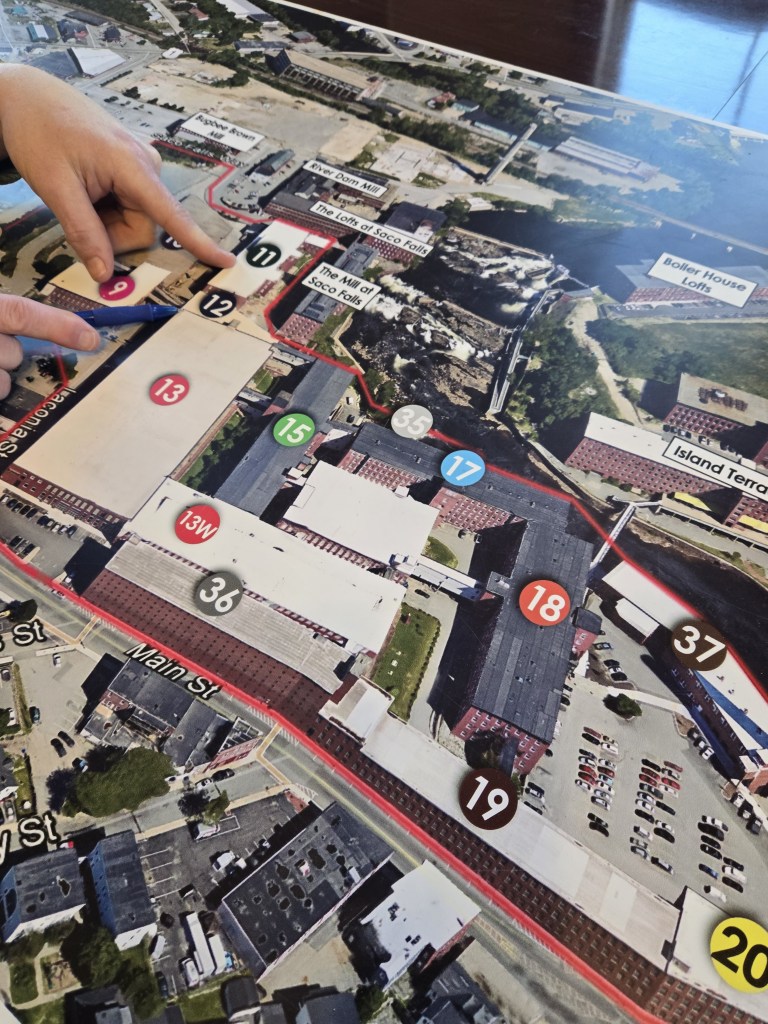
Mayor Marty Grohman points to several housing projects that are in development throughout the city’s downtown area.

“It’s not just Biddeford,” Grohman explains. “It’s virtually everywhere, and we – as elected leaders – have a responsibility to be part of the solution for this problem.”

In his search for creative solutions, Grohman is convening a special workshop meeting of the Biddeford City Council to address housing issues on Tuesday, Feb. 11.

At that workshop meeting, which will include an opportunity for public commentary, councilors and city officials will review the city’s goals and progress in meeting the various housing demands throughout the city.

For example, Grohman says the city council last year set a goal of creating 180 units of “affordable housing” each year over the next five years.

But even the term “affordable housing” creates confusion and resentment.

“A lot of this is subjective,” Grohman said. “What is affordable for one person may not be affordable for another person.”

In order to qualify for state and federal tax credits, affordable housing rental costs are based upon the region’s Area Median Income (AMI). The federal department of Housing and Urban Development (HUD) uses a formula that calculates rental rates at 80 percent of AMI.

According to the most recent statistics from the U.S. Census Bureau, Biddeford’s median income is $63, 261 per household or $32,763 for an individual.

For comparison purposes, the AMI in Saco is $81,326 per household or $44,596 for an individual.

Both the federal and state government use AMI data (and other measurements, such as total assessed property values) to determine a community’s need for federal grants and school funding.

“Our housing problems also adversely impact people who already have stable housing,”

State Rep. Traci Gere

While some people say that Biddeford’s population growth is creating an unsustainable spike in demand for housing, data from the U.S. Census Bureau shows only modest gains in the city’s population over the last 10 years.

Today, the city of Biddeford is listed with a population of 22,367 people, the largest of any of York County’s 46 municipalities. In 2000, the city’s population was 20,942. In fact, Biddeford’s population has actually decreased by 0.5 percent in just the last two years.

Like other urban centers throughout Maine, Biddeford has a notable population of unhoused residents, a problem Grohman says the city is fighting every day.

But the city is also facing some other serious housing issues, including a lack of so-called “work-force” housing options.

“If you talk with any of our department heads, whether it’s the school superintendent, the police chief or the fire chief, they will all tell you how hard it is to hire and retain new employees,” Grohman says. “We’re not going to get new teachers or police officers in our community if those people cannot afford to live here. It’s a big problem.”

Members of Biddeford’s legislative delegation all agree with Grohman’s assessment that housing is a big part of a growing problem in attracting workers and private businesses to the city.

Local legislative delegation rolling up its sleeves to tackle housing

“There are so many facets that fit under the umbrella of housing issues,” said State Rep. Traci Gere during a previous interview with the Gazette. This issue runs the gamut, she said, pointing out that roughly eight percent of Maine homeowners occupy manufactured housing.

Gere and other local lawmakers are hoping the Legislature will be able to help cities and towns across the state in revising zoning standards and cutting bureaucratic red tape, a problem that many developers say drives up the cost of housing.

“Our housing problems also adversely impact people who already have stable housing,” Gere said. “If we want a sustainable local tax base — and relief for homeowners — we have to find a way to help businesses maintain a stable pool of employees. For example, a hospital cannot function without support personnel, such as custodians or clerical workers.”

House Speaker Ryan Fecteau of Biddeford is very familiar with housing issues. In addition to his legislative service, Fecteau is employed as a senior officer of policy and planning for Avesta Housing, a non-profit affordable housing developer that operates throughout New England.

“There is an appropriate role the state can play in these local discussions,” Fecteau said. “We can certainly work harder in bringing resources to the table and help our municipal partners without stepping on their toes.”

A recent report issued by the Maine State Housing Authority (MSHA), says the state agency was able to complete 775 affordable housing units in 2024, and that 1,005 units of affordable housing are now in the process of being built.

The agency also points out that the average production costs of building those units is finally beginning to level off following three straight years of rising production costs.

Other factors pointed out in the report’s executive summary is that interest rates have leveled off and that MaineHousing’s “First Home” program is now maintaining rates well below the market average to a rate to 5.375 percent prior to the end of 2024.

But there are still many challenges that lie ahead for Maine’s housing landscape.

Although some recent “leveling off,” in home prices has helped cool the market, rising home prices continue to be a primary concern for homeownership access, according to the MSHA’s report.

From 2020 to 2024, the median home price in Maine grew by more than 50 percent, far outpacing a 33.3 percent increase in wages and salaries of Maine workers during the same period.

Other things such as utility and heating costs play big factors in housing affordability. For example, heating fuel prices have recently stabilized after record high prices in 2022 and 2023. According to the MSHA, heating fuel costs have now been trending downward since April 2024.

Since 2018, the rental cost burden across the state has increased sharply for most households, especially for those with household incomes between $35,000 and $75,000 in total household income.

NEXT: Housing developers discuss their challenges and opportunities.

Never miss another update! Subscribe for free today!

Council discusses winter parking bans

With another winter storm looming on the horizon, members of the Biddeford City Council discussed the city’s policy regarding overnight parking bans.

At the tail end of Tuesday’s council meeting, Councilor Neva Gross – who represents much of the city’s downtown area — raised the issue to her fellow councilors, asking if there is more the city can do to announce parking bans in advance of a storm.

“I personally live down here [downtown area] so I am affected by this every time there is [a ban],” Gross said. “I received some emails over the last few days from some folks whose cars were towed during a ban because they didn’t know about it.”

Photo: City of Biddeford

Gross acknowledged that city routinely updates residents about pending parking bans in a variety of ways, including the city’s website, the city’s official Facebook page and the ability for residents to sign up for email or text notifications.

The city — — along with several other communities throughout southern Maine — also notifies television news stations about upcoming parking bans.

“Is there some kind of way that we could notify folks who are not on social media or looking at the city’s website,” Gross asked.

City Councilor Marc Lessard drew a round of laughter when he suggested that the city may want to consider using a “fire horn” to alert downtown residents of a pending parking ban.

“The bottom line is that if you park your vehicle on a public road, in the wintertime,
and it’s going to snow; you have to assume that there is going to be a parking ban
and try to figure out a way to find out about that.”

City Manager James Bennett

“I’m kind of being serious,” Lessard said, recalling that decades ago the city used a central fire horn to inform citizens of fires and served as a curfew notice.

City Manager James Bennett said “there is just no way for us to do it right” in reference to snow parking bans.

Bennett said the city of Lewiston had a policy prohibiting all overnight parking during the entire winter season.

“I’m glad to look at ways for us to enhance getting that information out,” Bennett said, pointing out that residents should make an effort to stay informed.

“This probably sounds cold, or not customer-friendly, but the bottom line is that if you park your vehicle on a public road, in the winter time, and it’s going to snow; you have to assume that there is going to be a parking ban and try to figure out a way to find out about that,” Bennett said.

Bennett also told the council that “snow clearing” parking bans represent an additional challenge in keeping residents informed about parking bans because those do not happen during a storm. “We really have to go overboard in alerting residents about those [parking bans].” Bennett said.

“If you live downtown, please help us by also doing what you can to find out about parking bans,” Bennett said.

Mayor Marty Grohman also said he heard from some friends whose vehicles were towed during a parking ban. “I think making the lots on Water and Washington streets available has been helpful,” he said.

Editor’s note: Click here for more information about Biddeford parking bans or to sign up for email and text alerts

Never miss another update! Subscribe for free today!

Biddeford’s arts community gets a big boost: Five Questions

(This is the first of hopefully many more ‘Five Questions” interviews with a variety of people throughout the Biddeford Community)

For nearly 14 years, Delilah Poupore has been at the helm of the Heart of Biddeford, a non-profit organization with a mission to “foster a vibrant, inclusive and sustainable downtown for residents, businesses and visitors.”

Today, Poupore, 57, remains as excited and passionate about Biddeford as she was when she moved here from California to serve as the Heart of Biddeford’s executive director.

“Her enthusiasm is never ending,” said Joe McKenney, a Heart of Biddeford (HOB) board member. “She is the perfect fit for the role, and her passion for the city is infectious. We are very lucky to have her. We would not be where we are today without her.”

Examples of Poupore’s seemingly boundless energy can be seen and experienced throughout the downtown area and beyond, including a growing list of annual community events such as River Jam, Biddeford Oktoberfest, Winterfest and the I Heart Biddeford 5k Run/Walk race.

Delilah Poupore, Heart of Biddeford’s executive director

Poupore is constantly looking for new and creative ways to engage the community and to be a resource for a diversity of stakeholders, not just for downtown businesses.

The HOB’s umbrella includes small business owners, artists, musicians, entrepreneurs and those who may be struggling to be better connected to the community, including unhoused residents and new immigrants who are hoping to build a new life in the city.

The Heart of Biddeford had humble beginnings, but is constantly evolving, including recent news about the organization’s expansion.

Poupore describes creating the ‘Art of Biddeford’ as “adding another department” to HOB in order to meet the needs of the city’s growing arts community.

I fell in love with Biddeford because of the stories, the history of the city;
the immigrants who came here and built so much of the infrastructure.”

— Delilah Poupore

The Art of Biddeford is designed to help fill the void that was created when board members of another Biddeford non-profit – ENGINE – decided to dissolve last year.

“ENGINE was such a powerhouse for the arts community,” Poupore said. “Although it’s quite understandable why they chose to dissolve, it’s also sad for me to acknowledge that organization is no longer here.”

In a recent press release, ENGINE’s former board president Sarah LaFortune said the Heart of Biddeford is “the ideal steward to continue the work that ENGINE started.”

Poupore described Tamsyn Bodwell — ENGINE’s primary founder – as someone who was tireless and a passionate supporter of Biddeford’s arts community. “We worked on a lot of projects over the years,” Poupore said. “I cannot think of anyone who was more committed to supporting local artists in Biddeford.

“The Art of Biddeford is standing on the shoulders of what ENGINE built in this community.”

You moved here from California and immediately immersed yourself in the community. Why are you so passionate about Biddeford?

“We have so many people – from all sorts of backgrounds – living here; and a thing in common with a lot of them is that they are people who really embrace a creative life.

“I grew up in a post-industrial town, in Duluth, Minnesota. It was full of bricks and history and people sort of wondering about the future and equality and things like that.

“I fell in love with Biddeford because of the stories, the history of the city, the immigrants who came here and built so much of the infrastructure.”

What do you see when you contemplate the Heart of Biddeford’s future?

“I see so many opportunities ahead for both the city and the Heart of Biddeford. I want to make sure that Biddeford’s continuing revitalization is for Biddeford people.

“I want Biddeford to be a community that figures out how to revitalize without losing the people who built the place.”

What is the importance of a thriving arts community?

“There are so many things. The arts can lead to building a foundation for a creative economy that attracts investment and new opportunities for the community.

“And a creative economy is a great way to bring different people – of different backgrounds and perspectives – together so that they are excited about sitting at the table and looking at the community as whole. The arts is a natural bridge that strengthens relationships.”

What do you think is driving the Heart of Biddeford’s success?

“I think if you start with the people, then they know that you value them, and that you want them involved in the process. You just create different things when you bring people around the table saying what they think is important.”

You bubble with enthusiasm, but do you ever get discouraged?

“I am kind of used to waves in this job. Sometimes, it feels like there is so much to do, and so many things I want to do. So yes, sometimes it feels like a lot, but then things settle down again.

“I think of this as the investment time. I think it’s important for people to see what is happening rather than just reading about it on piece of paper.”

RELATED: Saco Bay News story: Heart of Biddeford launches Art of Biddeford

Never miss another update! Subscribe for free today!

OPINION: Some notable changes in local media outlets

(Originally published on the Lessons In Mediocrity site)

There’s no denying it. This is not your father’s news industry anymore. That’s good news, but it’s also very bad news.

I’m writing this because there were three significant local changes in the news industry that happened in just the last two weeks.

More about that in just a moment.

Traditional, legacy media outlets are no longer the sole guardians of truth and justice, and that fact — like it or not – will impact you — and it might even hurt you.

For centuries, newspapers, (and then later) radio and television news operations kept an immeasurable amount of gravitas in their pants’ pocket, like so many nickels and dimes. The publishers, editors (and oftentimes the reporters) took your trust in them for granted.

Nearly 300 years ago, Edmund Burke, a member of British Parliament, reportedly coined the term “Fourth Estate” to describe the press, pointing out its obligations as a check in government oversight and its responsibility to frame political issues as well as to be an advocate for the general public.

Pretty big responsibility, eh?

The industry that was once the trusted and almost sole gatekeeper of vital public news and information is now scrambling, desperately trying to find a way to remain relevant or at least financially solvent.

So, what are the threats and challenges facing both you as a news consumer and traditional media outlets?

First and foremost, social media platforms are taking over the distribution of news and information. There are no more paperboys and even newsrooms are shifting away from brick-and-mortar structures.

In survey after survey; in poll after poll, one fact becomes abundantly clear. Consumers want their news on their schedule (on demand). Readers also try to skirt paywalls, no longer seeing the value of paid news subscriptions.

Readers today gravitate toward click-bait headlines and “news” websites that match their own political ideology.

Photo: The Death of the Newspaper Industry | John W. Hayes)

Never-ending competition, a 24-7 news cycle and the disturbing rise of AI (artificial intelligence) all remain as threats to established and not-so-established news outlets.

And to top it off, reader trust in traditional news outlets is plummeting faster than shares of K-Mart stock.

In his Nov. 29, 2022 opinion column, Boston Globe columnist Jeff Jacoby pointed to a recent Gallup report, which revealed that just one out of three Americans claimed to have a “great deal” or a “fair amount” of confidence in the media.

We could talk all day about the national news scene and the spiraling demise of legacy media, but let’s take a deeper look at the news on a local level, right here where it hurts the most.

Today, almost everyone is a journalist – or so they believe. All you need is a keyboard and an internet connection and its off to the races.

While I love certain aspects of “citizen journalism” it does sort of invite a Wild, Wild West approach in reporting news.

These citizens journalists typically do not have editors or the resources of an editorial board. They have no professional training. Ethics and objectivity are now electives, no longer requirements.

In other ways, however, these pesky citizen journalists and their social media followers do keep some much needed pressure on those Fourth Estate guys, the traditional legacy media outlets.

We’re not in Kansas anymore

Speaking of legacy, traditional media, the Bangor Daily News (BDN) – Maine’s preeminent source of political news – decided last week to shut down its editorial board. The paper will no longer have an Op-Ed (Opinion-Editorial) section.

I found that news strange. It struck me as counter-intuitive, especially since so many people are saying that readers are flocking toward opinion and away from objective news reporting.

While I love certain aspects of “citizen journalism” it does sort of invite
a Wild, Wild West approach in reporting news.

In a Jan. 24 columnthe BDN described the move as “the end of an era.”

Susan Young, the paper’s opinion editor, said the news was “bittersweet.”

“Far too few people read opinion content, so we have to try different things,” Young told me during an online conversation, saying the decision was influenced by the paper’s digital analytics.

The BDN’s decision will also mean the end of rigorous and highly regarded opinion columns from people like Amy Fried on the political left to Matt Gagnon on the political right.

Still closer to home, the publishers of the Biddeford-Saco Courier announced on Wednesday that they will now offer their subscribers a digital weekly update via email.

That “announcement” dropped exactly two weeks after I formally launched the Biddeford Gazette, a free digital newspaper dedicated to covering Biddeford news, opinion and events.

For more than 30 years, the Courier has relied upon free delivery of its print publication at newsstands or tossed into the driveways of private homes.

The Courier was founded and locally owned by David and Carolyn Flood. A few years ago, the paper was then sold to the owner of the now defunct Journal Tribune, a daily newspaper that was later acquired by the daily Portland Press Herald. Today, the Press Herald owners also contributor several weekly and daily publications throughout central and southern Maine.

Courier reporter Sydney Richelieu announced the “inaugural edition” of “Biddeford-Saco | Now” in an email sent to subscribers. The move, she said, is designed to offer readers another option in finding out what is happening in their community.

I have some unsolicited advice for Sydney and the Courier’s editors, please stop printing press releases and then labeling them with a byline of “Staff Reports.”

Otherwise, I am quite pleased that you guys finally want to step up your game in covering local news.

To be honest, I have a bit of an advantage over the other guys. I’m a Biddeford native and resident, and I have been covering Biddeford for nearly three decades. I have a stockpile of sources and lots of time on my hands.

Just a few days ago, a close friend of mine remarked that other local publications are now starting to pay more attention (deservedly so) to the city of Biddeford, since I launched the Gazette.

That’s actually really good news, especially for the people of Biddeford.

The other guys may not like the fact that I am now in the mix, but they should remember the folks at the Journal Tribune were none too happy when the Courier was launched in 1989; and the folks at the Courier were none too happy that Saco Bay News came along in 2019 and showed off the nimble advantages of being a digital publication.

Increased competition does not help the Courier, Saco Bay News or the Biddeford Gazette, but it does keep a fire lit under our asses; and that is good news for readers.

The people of Biddeford should not have to rely upon just one reporter for the news that matters to them.

Competition keeps reporters motivated, but more importantly – it keeps them in check.

The Biddeford Gazette is not trying to put anyone else out of business. In fact, the opposite is true.

The Biddeford Gazette uses its own social media pages on Facebook, BlueSky and X to round up and share local news stories from other media companies. No one else does that.

You read that right. We take the time to share news from the other guys on our social media pages. And when you click to read those stories, you are not directed to our website, instead all the postings will link automatically to whatever source produced the news, whether it’s Saco Bay News, the Courier or WGME-TV.

Please visit our new Facebook page and follow us to experience a new level of local news coverage.

Whenever or wherever news about Biddeford is published, we will be there to make sure you know about it.

That’s my mission. That’s my passion.

I value your trust.

I will not stop.

Editor’s Note: This is a corrected version of an earlier story. The Biddeford-Saco Courier was originally acquired by the publisher of the Journal Tribune, not the Portland Press Herald. We regret the error and apologize for any confusion it may have caused.

NEWSLETTER: Where are we going?

Wow! Just wow. When I started the Biddeford Gazette, I had no idea how well it would be received by the community.

It’s a new year; we have a new president, and I now have a new project that will keep me occupied for the foreseeable future. Thus, welcome to my first newsletter!

WHERE WE ARE:

I did a soft launch of the Biddeford Gazette back in November. But a couple of weeks ago, we decided to make it official and bought a website domain that is exclusive for the Biddeford Gazette.

Within just the first two hours of our mid-January launch, more than 175 people subscribed to the Gazette. 175 people in less than two hours? Holy Cow! The subscriptions continue to climb beyond my expectations.

If you would like to subscribe, go here.

WHAT HAVE WE DONE?

In just the last two weeks, we have:

Traditional print publications charge families hundreds of dollars to publish an obituary. We do it for free and consider it a community service. With our social media partners, we have access to more than 35,000 readers in the Biddeford-Saco area.

  • Created a social media page to share and promote Biddeford news from other media outlets in southern Maine, including Saco Bay News, the Biddeford-Saco Courier, MaineBiz and Portland television stations.  All part of our mission to keep our readers informed about what is happening in the community.

WHERE ARE WE GOING?

The future certainly looks bright. Down the road, we hope to expand our operation.

Additional reporting: We have already been contacted by a few former journalists who are interested in freelance work and helping us with our mission of local news coverage;

High School Sports coverage: We are working to develop an internship for high school students interested about a career in journalism;

Improvements: We hope to improve our website design and functionality as we continue moving forward.;

Expanding community voices: We hope to provide an ongoing diversity of perspectives and experience on our pages. If you are interested in writing a column or submitting a press release, please contact us.

In-depth reporting: Next week will begin a three-part series that focuses on the issues of housing in the Biddeford area. This comprehensive project will include interviews with real estate agents, developers, local and state officials and homeless advocates and many others.

Creating an Advisory Council: We are looking for a few people who would be interested in providing guidance and ideas about our news coverage.

Thank you for the support, and please keep reading! With your support and input, we will continue our mission of reporting news and information about the city of Biddeford and its people.

Cheers!

Never miss another update. Enter your email address to subscribe for free today!

Biddeford struggles with communication

Despite spending a little more than $45,000 last year on upgrades and consulting services, the city of Biddeford is still wrestling to improve its external communication platforms.

During almost every public meeting, the city struggles and stumbles as it attempts to allow people to remotely watch or participate in meetings at City Hall. As a result, many meetings begin late.

There are often sound issues and other glitches, especially when the council is hearing a presentation and trying to load third-party information onto its streaming platform.

Many residents also complain that remotely watching meetings is confusing, including poor sound issues and saying online public participation is often arduous

“It has gotten a bit ridiculous,” Biddeford Mayor Marty Grohman said during a recent interview with the Biddeford Gazette.

Unlike the city of Saco, Biddeford uses the ZOOM technology platform to both broadcast and archive past meetings of the city council, school committee, planning board and other government committee meetings.

Saco, on the other hand, uses more user-friendly technology including Facebook and YouTube.

Biddeford City Councilor Roger Beaupre said many senior citizens feel somewhat disenfranchised because the city is not doing a good enough job in getting news and information out through more traditional methods, including public access television and print media such as the Biddeford-Saco Courier and the Portland Press Herald.

“All this push to online communication is fine and dandy, but many seniors are not comfortable with using websites to get information about what is happening in the city,” Beaupre said.

During the tail end of a city council meeting earlier this month, Beaupre shared his frustration about the issue with his fellow councilors, suggesting that the city should focus on more traditional media platforms.

The city now offers a weekly newsletter that is available by email from the city.

I think we need to do a better job in making sure that the public is getting
the news and information they need.”

— Councilor Marc Lessard

Anyone with an internet connection can access and receive the Biddeford Beat newsletter. Updates are then automatically sent out weekly by email to subscribers.

Beaupre suggested that the council should also consider having the Biddeford Beat or something similar published in the weekly Biddeford-Saco Courier, a free newspaper that is distributed to every household in Biddeford, Saco and Old Orchard Beach.

For those who don’t receive the Courier in their driveway, the paper is also available at area newsstands.

Councilor Marc Lessard emphatically agreed with Beaupre’s idea.

“We don’t want to leave anyone in the dark, and we want to be open and transparent,” Lessard said. “But I think we need to do a better job in making sure that the public is getting the news and information they need.”

Grohman — who was elected as mayor a little more than a year ago — said he is also frustrated by the situation, an issue that has plagued almost every meeting he has chaired.

“Almost every meeting experiences some kind of technology glitch,” Grohman said. “We are striving to be open and inclusive, but we have to do better in getting information out to the public.”

Grohman had high praise for the city’s communications director, Danica Lamontagne.

“I think Danica does a really good job of putting the Biddeford Beat together every week,” Grohman. “The trick now is how do we make sure that everyone is able to see that information.”

Councilor Doris Ortiz said it’s the consensus of the council to solve the problems associated with broadcasting public meetings. She also said that many older people feel more comfortable with popular platforms such as Facebook, pointing out that city of Saco livestreams its meetings on the popular social media site rather than using ZOOM.

Although Saco seems to have a more user-friendly approach, there is no opportunity for remote public comment. Those who want to comment during a Saco meeting must attend the meeting in person, according to the city’s website.

City Council President Liam LaFountain sends out his own weekly newsletter for his constituents who use Facebook.

LaFountain uses the Biddeford -Ward 7 Facebook page to keep his constituents informed about what is happening in the city and to offer previews about upcoming issues that the council will face.

“A lot of people like that I do that,” LaFountain said. “But I have also heard complaints from people regarding how we currently stream live meetings.

“We want to use technology to increase efficiency and promote public participation, but we also have to make sure that our methods are user-friendly.

Never miss another update! Enter your email and subscribe for free today!

Hello, Goodbye

Dear readers,

Once again, I have some good news and some bad news. Let’s start with the good news.

Roughly 24 hours ago, Laura told me it was time for me to get a bit more serious about the Biddeford Gazette, an online multi-media news source focused on the city of Biddeford.

Instead of trying to run the Gazette as a subpage on my personal blog site, I went ahead and purchased a new domain so that the Gazette could stand on its own without all the clutter and distraction of my blog, Lessons in Mediocrity.

Going forward, as time and funding allows, I will be making enhancements to the Biddeford Gazette site to improve its functionality and design.

My goal is to give you an alternative and comprehensive overview of what is happening in the Biddeford area.

Now the bad news.

As I continue working to build the Biddeford Gazette, I am going to need your help. Mainly, I’m hoping you will subscribe (for free) and follow us on social media.

By subscribing, you will get an email update every time a new story is published. Your email address will NOT be shared with anyone else. Go here to subscribe.

I hate to be a pain in the ass, but if you are already a subscriber of my blog, you will need to subscribe separately to the Biddeford Gazette. It’s free and it’s worth it.

Throughout all of this, I will continue my blog on a more personal scale. To learn more about the Biddeford Gazette go here.

As always, thank you so much for reading!

Richard Rhames | Dirt farmer pundit

Note: This is an unedited interview that contains coarse language, which some readers may find offensive.

By RANDY SEAVER | Editor

Although he wears many hats, Richard Rhames of Biddeford could probably best be described with just three words: authentic, passionate and persistent.

Rhames, 78, is a well-known commodity at City Hall. He is an outspoken member of the public, a former city councilor and a tireless member of the both the city’s Conservation Commission and Cable Television Committee.

Richard Rhames | The proverbial fly in the ointment to many of Biddeford’s well-heeled political and business class interests. And he’s not backing down anytime soon (Seaver photo)

_______________________

Over the last four decades, Rhames has developed a reputation as someone who means what he says and says what he means. He rarely pulls punches when criticizing local leaders and their policies; and he is always willing to fight even when he knows the odds are insurmountably stacked against him.

Today, Richard and wife Pat own and operate Shady Brook Farm on outer West Street. That 80-acre farm has been in Rhames’ family for three generations, and the land represents one of the last family-owned farms in the area.

Rhames, who serves as president of the Saco Valley Land Trust, laments the loss of small farms, but keeps his hands firmly on the plow in a time when farming has pretty much become a corporate enterprise.

“If farming was easy, everyone would do it,” he said with a wry grin. “Let me assure you, nothing about farming is easy.”

To the casual observer, it seems that Rhames is always willing to do things the hard way. He dismisses the notion of going along to get along.

Sticking to his principles and beliefs has cost Richard some friends and his seat at the table of local power, where he was widely considered a thorn-in-the side of the Chamber of Commerce types.

Richard was an at-large member of the Biddeford City Council when the September 11 terrorist attacks occurred. Within days, the council had decided to place miniature American flags along the council dais. There was one flag in front of each councilor.

At the beginning of the next council meeting, Rhames used his arm to move the flag to his side as he was spreading out paperwork. A fellow city councilor expressed outrage, and a reporter from the Journal Tribune wrote that Rhames had “shoved the flag away.”

The public was largely unforgiving. It was a time of hyper-patriotism and there was little tolerance for anything deemed to be “un-American.”

Rhames had already been long criticized for his questioning of U.S. policies in the Middle East, including Iraq. He was unapologetic. Just a few weeks later, Biddeford voters showed him the door.

“I never shoved the flag,” he said. “But the damage was done. The political class was not happy with me, and they gladly grabbed onto a piece of red meat.”

Rhames never stopped sharing his political views. He wrote a regular column in both the Journal Tribune and the Biddeford-Saco Courier. Much of his written work focused on labor issues, workers’ rights and conservation issues.

He is a long-time advocate for single-payer healthcare and says if the city is serious about the issue of affordable housing, the best weapon to bring to that fight is municipally-mandated rent control.

He is also a fairly well-known musician, playing rhythm guitar with two different bands throughout the area.

What got you involved in local government?

“It was the airport. Back in the ‘70s, they started pushing a plan to build a cross-wind runway. They intended to buy the George Fogg property, which was between the paved part of Granite Street Extension and the town line. That’s always been the wet dream – – the cross-wind runway.

“I started going to Planning Board meetings and council meetings. I was probably the only guy in town who had actually read the master plan.  I mean, who are we kidding? Master plan? Fuck that.  It was supposed to be a done deal. The powerful people, the people with connections; it was what they wanted.

“Because Mayor [Babe] Dutremble was pissed that some of his political friends had been moving forward behind his back, he shut it down all by himself. It was in the papers, the York County Coast Star and the Journal.

“Then about 10 years later, in the mid-1980s, it came back again, with a vengeance. The new plan was even more grandiose. It would have Biddeford become a reliever for the Portland Jetport. We were going to get the freight shipments; it would have included 60,000-pound aircraft. They dream big, here in Biddeford. The FAA loved it, you know? And they thought they had it.

I mean, who are we kidding? Master plan? Fuck that.  It was supposed to be a done deal. The powerful people, the people with connections; it was what they wanted.

–Richard Rhames

“We fought it. They wanted to change the zone to Industrial. That’s back when wetlands were just dismissed as swamps. We got some other people riled up and involved, and at one of our first neighborhood meetings we came up with a name at the supper table: NOISE (Neighbors Organized In Stopping Expansion).”

You have often complained about the fact that there is so little public participation in city meetings.

“In order to know what’s going on, you got to be there all the fucking time. And you’ve got to have no life, which is ideal for me. (Laughs)

But it’s not just local issues that get you fired up.

“Yeah, well you know. If I’m pissed about something, I’m going to stand up and say something. I don’t know any other way to be. I have this bad attitude, right?

“When I was younger, I could have gone back to teaching (public school). I was no longer 1A. I didn’t have to fight the draft anymore. When I grew up, I remember watching television and all the incessant propaganda. The whole mantra: the Russians are coming; the Russians are coming. The constant beating of the drum. The propaganda. The free world.

“I grew up in the ‘60s. I mean we were all drinking from the same propaganda trough, but it was the draft that literally forced a lot of young people to start recognizing what was happening, even though I went to a little white-bread Midwest college.

“I was as unquestioning as anyone else back then, until all this shit started happening. We had access to libraries and learning opportunities. We did this bus caravan thing. We went to Midland, Michigan, the home of Dow Chemical.

“I grew up in the ‘60s. I mean we were all drinking from the same propaganda trough, but it was the draft that literally forced a lot of young people to start recognizing what was happening”

— Richard Rhames

“We were all white bread kids; nobody had long hair; we were wearing suits at the march and the locals hated us because we had a rally in the park (Laughs).

“But we were earnest, and we had been looking into this a little bit. Most of us had some idea about the history of southeast Asia; how we took over for France in Vietnam. There was a history there that the newspapers never reported, but we came to understand that it was really fucked up; and why would anybody want to die for that?

“But to openly resist meant costs. Most of us were banking on what we were taught since elementary school: that we had some kind of career waiting for us in regular society.”

Do you ever get tired of fighting the good fight?

“I’m pissed, and I have been pissed for a long time. I don’t find that hope is terribly motivating. You gotta be pissed. It wasn’t right. It wasn’t right what we did on the grand scale.

“Even today, as much as the whole thing in Palestine is wrong, the Israelis, the Zionists, are pikers compared to the United States of America. The body count that we have rung up during my lifetime is really fucking impressive.

“Nobody talks about it, but if you want somebody killed, call us. We’ll either provide you with the weapons; better yet, we’ll do it ourselves. We’re really good at that. Spending a trillion dollars a year on the military? That’s easy.

“But if you speak up, they come after you. It’s dangerous, Randy. Why did they come after me the way they did after 9/11? Why have they come after me, including you, . . . why was I such a target? You know? This unassuming clodhopper with the big words and all that shit, you know? Why was I the target?

“Because I was willing to stand up and say this shit.”

What do you think about all the changes as Biddeford becomes a destination community?

“We were last in line. We had the incinerator [MERC]. They stopped pulping in Westbrook and that city began to gentrify almost immediately, and Westbrook isn’t placed nearly as well as we are. Against all the political odds . . . and the only reason that we got rid of the incinerator is because they wanted to leave . . . they [Casella Waste Systems] were ready to go.

“It always kills me, I guess it shouldn’t — when Alan [Casavant] expresses surprise, disbelieving; and talks about how quickly the shift started, how much things changed once we got rid of MERC. It would have happened anyway, but you had this whole Heart of Biddeford gentrifying, national advertising campaign. The whitewashing of Biddeford culture.

“We created a myth of what Biddeford is in order to entice new people to come here and exploit us, which they are doing.

“But we haven’t learned. The political class is still bending over backwards to subsidize private development.

“. . . you had this whole Heart of Biddeford gentrifying, national advertising campaign. The whitewashing of Biddeford culture.”

— Richard Rhames

“I keep telling them: Isn’t it time to pump the brakes a little? You don’t have to beg people to come here anymore. There’s no incinerator anymore. We’ve got all this ocean frontage, river frontage and all these old buildings from when Biddeford was the Detroit of New England.”

You are one of the most strident and vocal supporters of public access community television, even as the city slides further away from televised meetings to online forums.

“When we started with public access, there was some good stuff on the channel, but the political class was always uncomfortable. It frightened them because they couldn’t control the message.

“We used media for public education, to pull back the curtain and give information that you really couldn’t find anywhere else. It was good stuff, and I was never home.

“We were doing advocacy for ordinary people. You don’t generally find that on the airwaves. Who wants to do research to make a point? T.V. is something done to you now.”

Any thoughts on running for office again?

(Sighs) “I’m too old. My time is over. I understand how the world works. I’m not the one. I’m just not the one.”

EDITOR’S NOTE | This interview I conducted and wrote was originally published in Saco Bay News on May 14, 2024. This is the unedited version of that story.

_____________

ABOUT THE AUTHOR | Randy Seaver is the editor and founder of the Biddeford Gazette. He has been covering Biddeford news and politics for nearly three decades. He may be reached by email: randy@randyseaver.com

Never miss an update! Subscribe for free today

THE BIDDEFORD GAZETTE | A Legacy of Trusted, Independent Journalism

Our editorial standards and policies: Biddeford Gazette | Standards & Policies

© 2026 Biddeford Gazette, Inc. All Rights Reserved