Saco River Corridor Commissioners listened to more than 90 minutes of public testimony about a controversial research pier and how it might violate a 2001 ruling
By RANDY SEAVER | Editor
As expected, the central issue of Wednesday’s public hearing about the University of New England’s controversial research pier landed squarely in the lap of whether the project adheres to a so-called “250-foot buffer zone” that was created 25 years ago and surrounds the shoreline of UNE’s Biddeford campus.
Roughly 75 people attended the Saco River Corridor Commissions’ hearing about whether UNE should be granted an extension for a permit that was already approved by the agency nearly two years ago.
Construction of the pier has been stalled because the city of Biddeford refused to issue a building permit after learning in October that the project might violate an agreement the university made in 2001.
That agreement to create a 250-foot shoreline buffer was part of a compromise that allowed UNE to build two dormitories that exceeded the city’s height restrictions.
Today, the city is seeking clarity on whether the 250-buffer prohibits the clearing of several mature trees and construction of an access road that is necessary to build the pier.
The SRCC’s executive director told the Biddeford Gazette in October that her agency failed to consider the impacts of the buffer zone when granting UNE’s original permit two years ago.
RELATED | UNE pier approval tainted by glaring SRCC mistake
Following presentations by school officials and Biddeford City Attorney Harry Center, fewer than a dozen members of the public offered testimony, which was evenly divided between those who supported granting the extension and those who believe the project should go back to the drawing board.
Commissioners of the quasi-state agency listened carefully to all the testimony and will likely vote on the issue at their Aug. 26 meeting in Dayton.
Divided public comments
. . .
Those who spoke on Wednesday against granting UNE an extension drew the most rousing applause from the audience, but those supporting the university’s proposal were undaunted and unfazed by the mood of the audience.
Dr. Will Kochtitzky, an assistant professor at UNE’s School of Marine and Environmental Programs, said he was “deeply offended by much of the public rhetoric and commentary surrounding the issue.”
Kochtitzky accused project opponents of spreading “deliberate misinformation” which ignores the numerous public benefits that the pier will create by allowing the university to conduct year-round marine research.
But Matt Haas, a former UNE employee and graduate, told commissioners that he specifically recalled when the university pledged to never put any development within 250-feet of the Saco River.
Hass pointed out that the SRCC’s Rules Committee acknowledged the agency’s error at a July meeting and said the school should live up to the original intent and its commitment to the buffer zone.
“It’s time to make the right decision,” Hass told the commissioners.
Ray Lemay of Biddeford said the SRCC seems to use a double standard when enforcing its rules and regulations.
“You give private landowners a hard time if they want to cut down just one tree, and now you’re saying it’s perfectly okay for UNE to cut down several trees?” Lemay asked rhetorically.
Tricia Thibodeau of Saco is a member of UNE’s faculty and told commissioners that the university has undergone a “lengthy and good-faith review process” by several agencies.
“The permit is valid,” she said. “We have waited too long, and this project will be extraordinarily valuable to the community.”
John Schafer – one of UNE’s most outspoken critics – told commissioners that he is not opposed to the pier, but he has concerns about a “flawed review process that ignores environmental and visual concerns that led to the creation of the 250-foot buffer zone.”
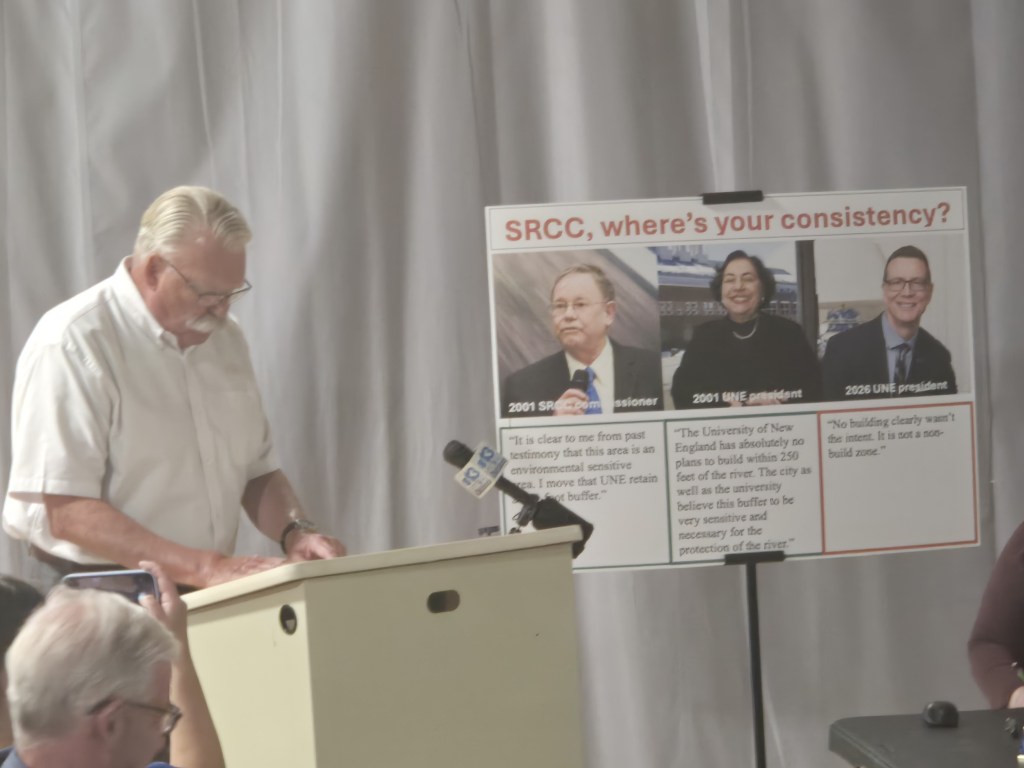
Schafer reminded commissioners that it was former Saco Mayor Mark Johnston who – 25 years ago — first pushed for the creation of a “no-development zone” within 250-feet of the river; and that former UNE President Sandra Featherman emphatically stated that the school would never build anything within the zone.
Using a visual poster that included pictures of Johnston, Featherman and current UNE President James Hebert, Schafer implored commissioners to exercise consistency in their decision making about the issue.
Nagging questions remain

. . .
Center told commissioners that the city of Biddeford is not opposed to the pier, but cannot ignore statutory language that seems to prevent the project.
“We simply want clarification,” Center said. “Is this something you intend to waive, amend, suppress or eliminate?”
“Is there or is there not a 250-foot zone?” Center asked the commission. “Is it a vegetative buffer? Does it allow for an access road and tree clearing?”
UNE officials, however, take a different view of the buffer zone, saying it does not prohibit all activity — including tree removal and road construction.
Alan Thibeault, UNE’s vice president of operations, told commissioners that some trees will be planted closest to the shoreline once the access road for the pier is constructed.
Thibeault described the buffer zone as a “restricted development” zone, not a no-development buffer, and said the SRCC has made several previous exceptions for other projects, including the construction of seasonal piers and related facilities.
The near two-hour meeting featured a few tense moments, especially when UNE attorney Ron Schneider attempted a cross-examination of testimony offered by both Schafer and Biddeford resident Kyle Noble, another Hills Beach resident who has voiced numerous concerns about the project’s review process.
Schneider asked both men if they were involved with an anonymous email account that is used to share information about UNE’s project with elected officials and members of the media.
“I receive emails from that account, but I don’t write them,” Noble quipped. Schafer angrily questioned the relevance of the email question just moments before the SRCC’s chairman interrupted the exchange and said the questions were not relevant to the application.
Shortly after the meeting, the university released a brief media statement about the public hearing.
“We believe that the testimony tonight removed any doubt that the SRCC’s initial approval of the pier was appropriate,” wrote UNE Vice President Sarah Delage. “It also demonstrated strong support for the pier in the community. Therefore, we hope that this decision addresses any concerns that a few residents had about this project. Nevertheless, we welcome this dialogue and encourage all residents to continually engage in this process.”
Local Journalism Thrives When Community Stands Behind It — If you enjoyed this story, please consider supporting local community journalism by making a donation to the Biddeford Gazette, a community-driven, non-profit news organization fueled by decades of professional experience.
.
This story was made possible by the generous support of our readers and these sponsors. Learn more about our sponsorship opportunities | CONTACT US


STAY CONNECTED | SUBSCRIBE FOR FREE TODAY
.

BIDDEFORD GAZETTE
“Keeping You Connected to Biddeford”
Editorial Standards & Policies
© 2026 Biddeford Gazette, Inc. All Rights Reserved
 BIDDEFORD GAZETTE