York County Commissioner Richard Dutremble of Biddeford was unanimously voted as chair of the five-member board during its organizational meeting Jan. 7.
Dutremble has served as a York County Commissioner for 20 years – including seven years as chair since 2007 – and said this year will be his last as a commissioner.
“I’m not running for re-election,” he said of the upcoming November vote. Noting two major projects the county has undertaken are winding down – The York County Regional Training Center which recently began offering classes to first responders and the York County Recovery Center, expected to be completed this fall – and with the county in good financial shape, he said it is time.
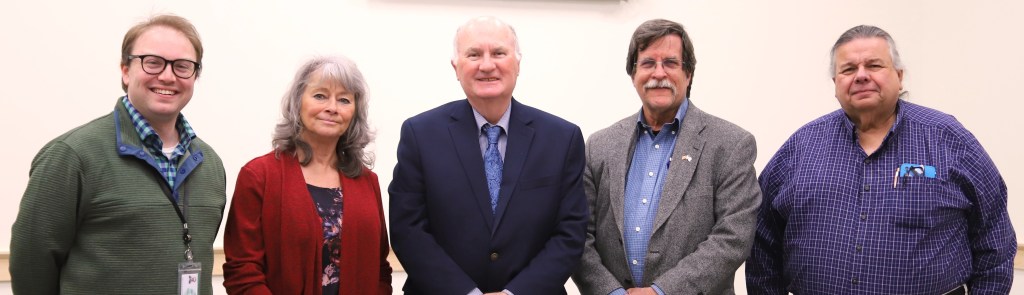
York County Commissioners Justin Chenette, Donna Ring, Chair Richard Dutremble, Vice Chair Robert Andrews, and Richard Clark. (Contributed photo)
Dutremble represents District 2, which includes Arundel, Biddeford Kennebunk and Kennebunkport.
Robert Andrews of Lebanon, currently vice chair, will serve in that position again in 2026, his fourth time in the role. He represents municipalities in District 1 – Acton, Berwick, Cornish, Lebanon, Limington, Newfield, North Berwick, Parsonsfield, Shapleigh, and South Berwick.
Commissioner Richard Clark f Wells, representing District 5 – Eliot, Kittery, York, Ogunquit and Wells – will continue as a director of Coastal Counties Workforce, Inc., a nonprofit that works to provide access to jobs, skill development and business services vital to the social and economic well-being of the communities in the six coastal counties it represents.
Commissioner Donna Ring of Alfred, who represents District 4 – Alfred, Dayton, Limerick, Lyman, Sanford and Waterboro, was voted as the board’s representative to Southern Maine Planning and Development Commission.
Commissioner Justin Chenette of Saco, who represents District 3 – Buxton, Hollis, Old Orchard Beach and Saco – was voted Maine County Commissioners Association representative as well as York County’s representative to the MCCA risk pool.
The five-member board of commissioners set fees for items ranging from mileage rates to notarization fees. For the most part, the fees remain the same as in past years, with the exception of the administration fee for serving civil papers. Currently at $10, commissioners voted to increase the civil process administrative fee by $25, as allowed by Maine statutes.
Those who need copies of accident reports will pay $20 – the same fee since 2021. Background check fees remain at the 2023 rate of $20; notarization and attestation fees are $5 and $10 respectively – the 2020 rate.
The county mileage reimbursement rate is 67 cents per mile – the same as in 2024, and meals for those on county business reimbursed $15 for breakfast, $20 for lunch and $25 for dinner, or a total of $60 per day.
The board approved a contract with Waterboro for deputy coverage. York County Manager Greg Zinser noted two changes – the contract spells out that the York County Sheriff’s Office will provide up to 80 hours a week coverage, and the county will purchase the cruiser and lease it hourly to the town. In prior contracts, the municipality purchased the vehicle. Zinser noted the county has always had the right to pull a deputy from coverage if needed elsewhere, and now the new contract spells it out with the “up to” 80 hours clause.
———–
Tammy Wells is a media specialist for York County government.
Never miss another update! Subscribe for free today!
Let me ask you something: what do you do when you feel pain?
That’s a loaded question. So, let’s stick to the responsible move: see a doctor and establish the cause.
The answer is no different when it comes to a business, a city, a state or even a nation. Identifying the causes of our malaise is the first step toward remedying it. So why are we so averse to that conversation in public? We are unable to get past “something hurts” and identify what’s hurting and what’s causing it.
Biddeford has suffered years of preventable mismanagement that has persisted without anyone naming the specific, often boring, causes.
Sam Pecor
Take our Comprehensive Plan. You don’t need a comprehensive plan to exist as a city. You do, however, need the state’s approval, a finding of consistency, if you want the full set of planning tools, if you expect the state to take your zoning seriously, and if you want Biddeford to be competitive for the grant dollars and capital investment that reward communities that plan.
According to the state’s own planning incentives list (quoted verbatim), here’s all that we’ve given up by not receiving state approval for our Comprehensive Plan:
Enact legitimate zoning, impact fee, and rate of growth ordinances;
Require state agencies to comply with local zoning standards;
Qualify for preferred status with many of the state’s competitive grant programs;
Guide state growth-related capital investment towards locally-chosen growth areas;
Qualify for Site Location of Development Act exemptions for certain growth-area developments;
Qualify for relaxed MaineDOT traffic permit standards for certain growth-area developments;
Qualify for authority to issue Natural Resources Protection Act (NRPA) permits; and
Qualify for authority to issue Site Location of Development Act permits.
For the residents living beside the York Judicial Center: in practice, without a state-approved Comprehensive Plan, our zoning standards can be merely advisory to the state, weakening our ability to protect abutters.
Failure to adopt a state-approved Comprehensive Plan does far more than erode our ability to self-govern. It affects everyone. It weakens our competitiveness for state grant opportunities. That leaves significant money on the table and pushes more of the burden onto property taxpayers.
A consistent failing among city leadership has been communicating the connections between these problems and the pain we are feeling today. When people understand these connections, they are more likely to support real solutions: funding for staff, investments in technology and increased compliance oversight, to name a few.
Citizens of Biddeford understand cause and effect; we get that investing $1 to save $2 is a good deal. Establish the cause, determine the cost and implement a strategy that saves more than it costs. That’s it, that’s the whole ball game.
Sam Pecor is a Biddeford resident and serves on the Biddeford Gazette’s Advisory Board. We welcome submitted commentary from our readers.For more information, please CONTACT US
Never miss another update! Subscribe for free today!
The newly elected members of the Biddeford City Council will be getting a comprehensive overview of the city’s past, present and future commercial development projects during a special workshop tonight (Jan. 13)
City Planner David Galbraith will walk the council through more than 30 slides that show specifics about ongoing and future development that includes everything from an expanded drive-thru lane at Burger King and a Popeye’s Fried Chicken location to major residential projects aimed for development in the downtown area.
And yes, it looks like Biddeford will get a brand-new Chick-Fil-A restaurant at the location that formerly housed Olive Garden.
For your convenience, we are providing you the opportunity to view or download Galbraith’s presentation.
Beyond the hype and speculation of new restaurants, several large projects and business expansions are also in the pipeline, including an expansion at Fiber Materials and several new affordable housing projects. Even a new parking garage is being envisioned.
The meeting begins at 5:30 p.m. in the City Council Chambers at City Hall.
This story will be updated.
View/download the presentation by clicking this link:
To answer one of our questions, Alex MacPhail patiently scrolls through a series of data on his computer monitor. He seems naturally comfortable and at ease, sitting at his desk and eagerly talking about the “unlimited potential” of the Biddeford-Saco region.
“This is the stuff I get excited about,” MacPhail explains. “This is where the rubber meets the road in terms of community engagement and growth.”
Alex MacPhail is the new executive director of the Biddeford-Saco Chamber of Commerce
MacPhail is quick to point out that the Chamber is much more than a business networking group. The membership also includes dozens of non-profit organizations, local government representatives and individuals working on a wide variety of projects.
“We’re not here to just do ribbon cuttings and after-hours social mixers,” MacPhail said. “We’re here to engage and raise awareness about so many of the incredible businesses and organizations that are the backbone of this community.”
MacPhail declined to speculate why the Chamber’s board decided to let go of Lewis. Instead, MacPhail is focused on some changes he’s planning to make.
“In some ways, I am putting things back together,” he said. “We’re working to build stronger relationships – paving the way for our members to be more engaged and more visible.”
The Chamber, MacPhail says, can advocate for area businesses on issues that affect and impact the entire community, such as workforce development and the need for affordable housing.
“Businesses rely on stable, quality employees,” he explains. “We need to partner with government officials and others to make sure that we’re not putting up barriers or ignoring the needs of the private sector.”
In terms of local government officials, MacPhail is married to Saco Mayor Jodi MacPhail.
Alex says that relationship does not present any tangible conflicts of interest.
“Sure, we talk about stuff privately,” he says. “But we do a really good job of staying in our own lanes.”
MacPhail previously worked for the Chamber in 2019 as a market specialist and volunteered at the Chamber long before his wife was elected to the Saco City Council and then later as the city’s mayor.
A native of the Boston area, MacPhail said he discovered the Biddeford-Saco region when his family would visit Old Orchard Beach in the summers.
“How can you not love this place,” he says, rattling off the region’s attributes including stunning natural resources, historical attributes and solid infrastructure.
MacPhail is a musician and plays the guitar. After high school, he wound up living in the Los Angeles area where he ended up becoming involved in the music industry and band management.
“Networking and building relationships have always come to me naturally,” he explains. “I see potential, and I get excited about it.”
The Chamber of Commerce works closely with other business advocacy groups including the Heart of Biddeford and Saco Main Street.
_________________
“I see potential, and I get excited about it.”
_________________
All three organizations receive some public funding from the cities of Biddeford and Saco.
When asked if that funding is redundant, MacPhail says there is some overlap but all three organizations have a different focus.
“The Heart of Biddeford is awesome,” MacPhail says. “But their focus is limited to just the downtown area. We represent and work with organizations all across the cities, in the industrial parks, the business parks and different neighborhoods.”
MacPhail says the Chamber offers its members a wide range of benefits, including analytical data regarding local trends and demographics.
“When you join the Chamber, you suddenly become part of a much larger organization. You are connected and have a strong advocate in your corner,” he said.
MacPhail says he is excited about some new projects and resurrecting some former projects such as publishing a regional business guidebook.
“This is the kind of job that you have to love in order to do it well,” he said. “We have a great board of directors that are fully committed. I get up every morning excited to go to work.”
________________
Randy Seaver is the editor and founder of the Biddeford Gazette. He may be reached by email: randy@randyseaver.com
c.) 2026 All Rights Reserved
Never miss another update! Subscribe for free today!
One of my primary resolutions for the new year included taking the Biddeford Gazette from a simple concept to a structured, non-profit organization.
The Gazette was formally launched on January 14, 2025. Our first story was about a proposed affordable housing project that would be built near Rotary Park.
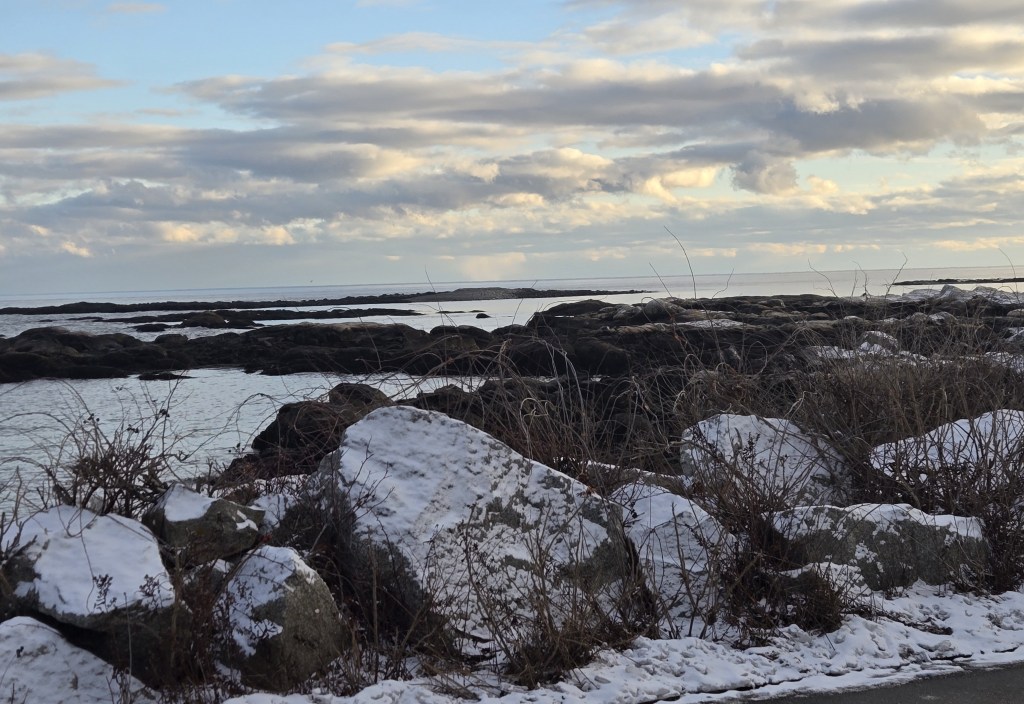
A new year beckons from the horizon of Biddeford’s coastline (Seaver photo)
Over the next several months, the Gazette became a trusted, reliable and professional news outlet.
We published more than 130 original and often exclusive news stories. We also published – at no charge — local obituaries and listings of community events.
During the last year, the Gazette also took on several enterprise stories, including our three-part series on affordable housing and our in-depth reporting of the candidates and issues connected to Biddeford’s biennial election, including organizing the only mayoral debate in October.
And we provided a resource to share and promote community-generated news and feature stories from our readers.
It’s been an amazing year that exceeded all my expectations.
Going forward
Over the next few weeks, the Gazette will become an incorporated entity. We are currently working with an attorney to determine the best path forward. We are also in the process of taking care of some household chores, including insurance, opening a business banking account, professional dues and memberships, etc.
It’s exciting to watch the Gazette grow and to see it being embraced so warmly by the community, but our mission statement remains at the core of everything we do.
Between the holidays and all the internal, behind-the-scenes activity, you have probably noticed that our news coverage has slowed a bit.
Have no fear, we have some good (and exclusive) stories in development.
In case you missed it, we had a lot of fun learning about and writing about the West Brook skating rink on Pool Street. That outdoor rink has been part of Biddeford’s history for more than 100 years.
This is the first installment of the five-part ‘Biddeford After Dark” series that was originally published in 2001 by the Biddeford-Saco-OOB Courier
ByRANDY SEAVER, Editor
[Oct. 2001] A heavy and ominous fog — the precursor of a cold and damp weekend — rolled westward over Biddeford early on Friday evening, and it remained like a blanket over the city for at least the next 48 hours.
Halfway through the weekend, near midnight on Saturday, that fog seemed to be the perfect backdrop for a lone reporter wandering the city’s streets. A reporter looking for stories — the tales of the weary and the songs of those who make the darkness their kingdom.
I didn’t have to travel far.
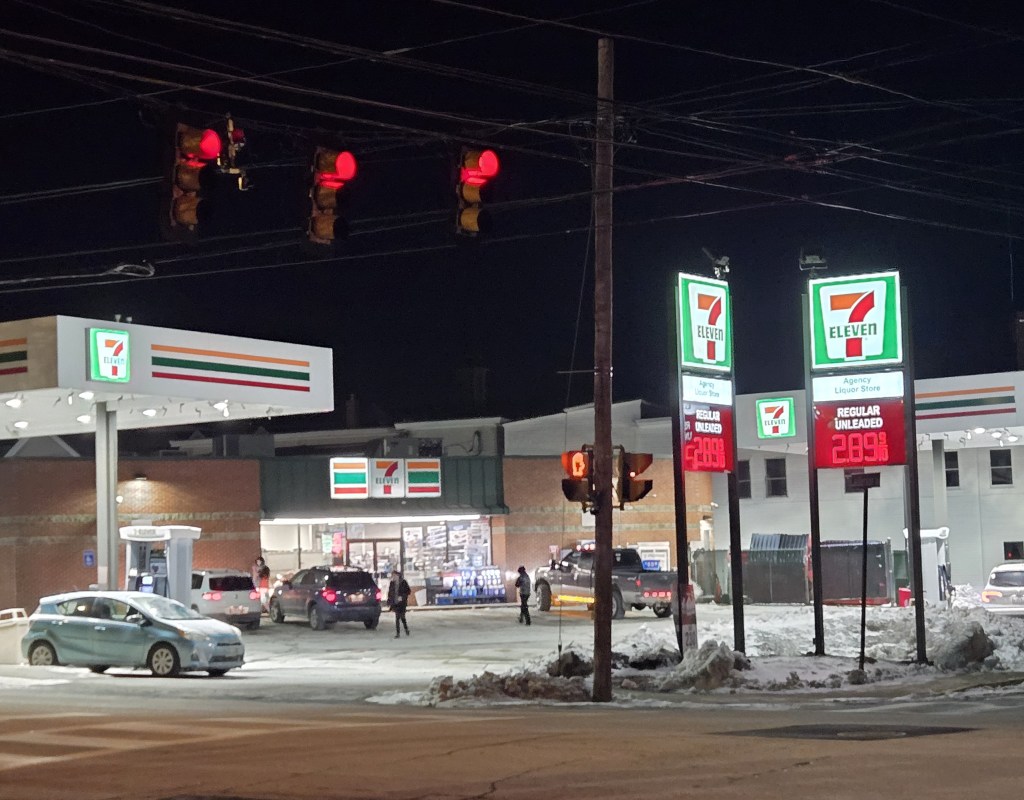
The fluorescent, unearthly glow of the 7-Eleven sign cuts through the late night fog and mist like so many shards of shrapnel. The wail of a police siren can be heard in the distance and the downtown bars are packed and rocking.
The late-night bargains are being struck over shots of tequila, and the lonely hearts are growing more and more desperate with each passing minute.
Welcome to Biddeford after dark.
The 7-11 convenience store located at the intersection of Alfred and Jefferson streets continues today to serve as the epicenter of Biddeford’s late-night activity. (Seaver photo)
A cut-rate Statue of Liberty
Perhaps by default, the 7-Eleven store, at the corner of Alfred and Jefferson streets, has become the de-facto epicenter of night life in downtown Biddeford.
It’s not hard to blend in, but my notebook and pen make me a curious commodity in a parking lot full of late-night activity. The store’s neon signs and its bright interior lighting serve collectively as a beacon for both the downtrodden and those who have nowhere else to go at this hour. It is almost akin to a cut-rate Statue of Liberty: send me your intoxicated, your restless and your lonely.
The store and its parking lot become a social scene unto themselves as wannabe gangsters, mostly teenagers, strut in and out of the store, buying Marlboros and Mountain Dew. After waiting in line for up to five minutes, many of those same customers leave the cash register only to sit in their vehicles or loiter near the store’s front door for as much as 30 more minutes.
___________________
Send me your intoxicated, your restless and your lonely.
__________________
Many of those wandering in the front door know each other, and they greet one another as if they were victims of watching way too much MTV. Suddenly, this portion of southern Maine (the way life should be) resembles an imagined life in “the hood” or some dilapidated barrio.
“Yo, G-man, what up?,” hollers a young man to an acquaintance as he jumps out of a shiny SUV. Inside that Jeep Grand Cherokee, the man’s girlfriend, obviously intoxicated, mascara dripping from her eyelids, fumbles with the stereo. The throbbing pulse of rap music fills the lot and the Jeep seems to pulsate to the beat of a song that, from only a few feet away, seems indistinguishable.
Somehow, this music seems to comfort the young woman in the Jeep. She tosses her head back and closes her eyes, silently mouthing the lyrics of a Tupac Shakur song.
There is an undercurrent of violence and uncertainty hanging in the air, lending an ironic balance to the comforting quiet of the rolling fog.
Tough guys don’t dance
Across the street, in front of the Mahaney building, I approach two young men who are wearing oversized jackets and gold necklaces.
“What’s going on?” I inquire, trying to sound hip.
The men stop and look at me, puzzled by my presence and my notebook. Paper makes these tough guys nervous.
“Why do you want to know?” the shorter man asks.
“I’m doing a series of articles about Biddeford after dark,” I respond.
“Oh yeah,” the taller man says. “Make it a love story and kiss my ass.”
I keep pressing, firing off questions and promising anonymity for honest responses.
They seem to think that I am a cop. Each of them shifts from foot to foot, making hand gestures as if to proclaim that they are not intimidated. “I’ll tell you about Biddeford after dark,” the shorter man says. “Biddeford sucks.”
“Why?” I ask.
“. . . ‘cause it just does,” he responds, carefully watching me write down his response. “Hey, do you believe this [expletive]? He’s writing down what I’m saying,” the short man tells his friend. “I’m gonna be in the newspaper. I’m gonna be famous.”
The taller man is making his way toward the ‘50s Pub on Franklin Street. He wants nothing more to do with me or my five-part series.
A few moments later, I come across another man walking along Alfred Street.
Patrick, 24, is clean-cut, wearing faded blue jeans and a maroon pull-over sweatshirt. He pauses to answer my questions, carefully contemplating his responses.
“Why does Biddeford suck,” he asks, rhetorically. “Well, they put a garbage dump [MERC] right in the middle of town. Who would think to put a waste facility right in the middle of the city?”
“Why aren’t there other businesses open late at night?” I ask.
“The downtown is lousy to look at,” he replies. “and there’s not enough parking.”
The downtown parking lots are virtually empty.
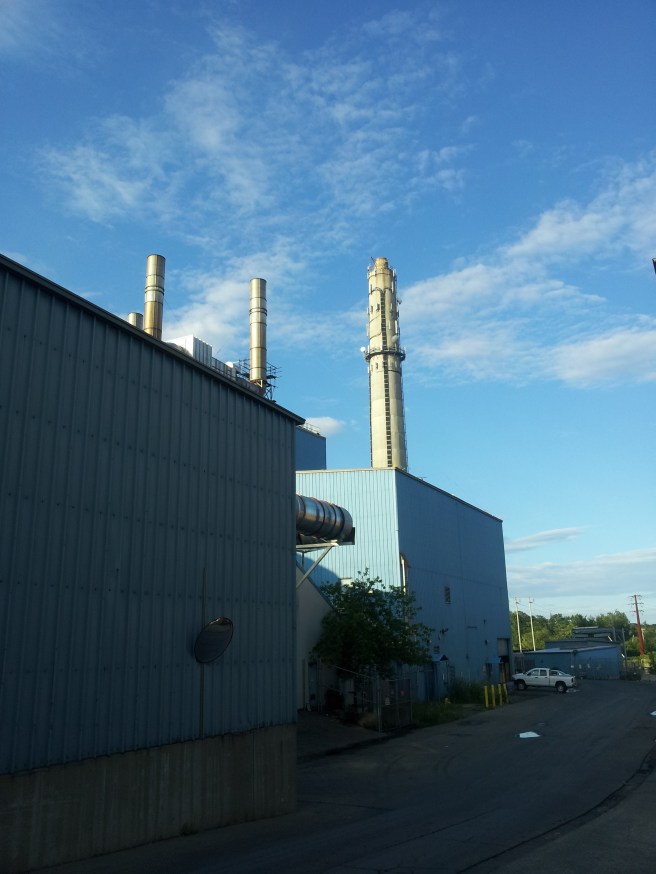
There is no question that the downtown presence of the MERC waste-to-energy incinerator stunted Biddeford’s growth for more than three decades
Twenty-four, seven—
Back at the 7-Eleven, Karen stands outside the front door, smoking a cigarette.
Karen, 30, has just returned to full-time work after a six-month hiatus. She is a third-shift clerk who says the late-night hours seem to match her sleeping habits.
“I’d rather work second shift,” she says. “But this shift is still better than first shift. I can’t get up in the mornings.”
Stewart previously worked at the store, and she gives an air of being nonchalant when talking about the things she sees while most of the city sleeps. She tells of a homeless man who waits each night for her to throw the old donuts in the garbage dumpster. She sees college students with fake ID cards and high school kids stumbling into the store, drunk or stoned.
“All of the weirdos come here because we’re the only place open,” Stewart explains between puffs of her cigarette. “Last Thursday night, we must have had 20 people waiting in line.”
What do they buy?
“Hot dogs, sandwiches and cigarettes,” Stewart says. “Once the ‘50s [Pub] closes, they all wander over here ‘cause they got the munchies.”
As for the late-night beer runs, just moments before 1 a.m., Stewart confirms what we already suspected. The store becomes a madhouse of activity.
“We lock the beer coolers at 12:45,” she explains. “That way, people who are just wandering around in the store can’t buy alcohol after one.”
Life During Wartime
Inside the store, roughly a dozen people wander aimlessly through the narrow aisles, browsing the selection of potato chips, pastries and the six hot dogs at the bottom of a steamer.
The store is brightly lit, and a bag of garbage has spilled into one of the aisles. The coffee pots are full, and Stewart rings up each customer, many of whom toss crumpled dollar bills at her from across the counter.
The song playing on the store’s radio seems fitting. The Talking Heads’ “Life During Wartime”: I got some groceries — some peanut butter — to last a couple of days — but I ain’t got no speakers, ain’t got no headphones, ain’t got no records to play. . . I sleep in the daytime, work in the nighttime . . . this ain’t no party, this ain’t no disco — this ain’t no foolin’ around.
Outside, a teenager from Thornton Academy makes a deal in the parking lot. Within moments, a young man emerges from the store with a six-pack of Budweiser beer. A quick, bleary-eyed handshake later, and the student takes the beer and returns to the car where his friends wait.
Romeo and Juliet
On the edge of the parking lot, just beyond where the police cruisers roll past on Jefferson Street, a young couple is in the middle of a hushed conversation. I dub them Romeo and Juliet.
Romeo is nervous, and Juliet bravely walks alone across the parking lot. She is all of 15 and wearing braces. She buys Romeo a Mountain Dew and walks back to greet him across the street.
Romeo is wearing a baseball cap in reverse. I approach these kids.
What are you doing out this late?
“I fell asleep at my boyfriend’s house,” she explains. “My watch broke.”
“Yeah,” Romeo chimes in. “We’re cousins.”
I’m not buying what Romeo is selling tonight.
“No, we really are,” Juliet insists.
Where are your parents?
“Ain’t got no parents,” Romeo pronounces, growing more cocky with each passing second. “I live in hotels and work on a paving crew.”
Juliet thinks her father might be inside the ‘50s Pub, and she peers through the bar’s tinted windows to confirm her suspicions.
“He’s going to be pissed if he finds out I’m not home,” Juliet says of her father.
Why don’t you go home?
“Because he might be there,” she responds.
What about your mother?
“Don’t have one,” she shrugs.
Inside the bar, a cocktail waitress weaves through the sweaty crowd and a doorman stands his post near the door, keeping a careful eye on the crowded dance floor. I look for Juliet’s dad, but he’s nowhere to be found.
Juliet is in trouble, I surmise. And then, I walk home — past the closed pawn shops, nail polish parlors and restaurants. I can’t stop thinking about Juliet and her uncertain future.
This is Biddeford After Dark. Sleep well.
______________
Randy Seaver is the editor and founder of the Biddeford Gazette. He may be reached by email: randy@randyseaver.com
c.) 2026 All Rights Reserved
Never miss another update! Subscribe for free today!
[This story has been updated to include commentary from Alexa Plotkin, chair of Biddeford’s planning board.]
By RANDY SEAVER, Editor
Biddeford Mayor Liam LaFountain won his campaign a few weeks ago by promising to prioritize transparency and accountability at City Hall.
As part of that pledge, LaFountain has been seeking and interviewing people who have expressed an interest in serving on any one of more than 20 committees, boards and commissions.
One of the most notable changes being proposed by LaFountain is a slight shakeup on the city’s planning board.
The Planning Board has seven members, including the chair and two non-voting, associate members.
Both Larry Patoine and Susan Deschambault will no longer be serving as regular members on the planning board because their terms expired in December.
Biddeford Mayor Liam LaFountain says periodic “refreshing” can be valuable,
Deschambault said she was ready to step down after more than a decade of service, but Patoine says he would have enjoyed serving another term.
Patoine joined the planning board in 2007 during the Wallace Nutting administration and has been repeatedly reappointed over the last 18 years.
“I really enjoyed it,” Patoine said of his tenure on the board. “Yes, I would have liked another term, but it’s the mayor’s prerogative about who is appointed. I think he (LaFountain) wants to be headed in a different direction.”
A few weeks before he announced his bid to become Biddeford’s next mayor, LaFountain – then city council president — was clearly troubled by the review process of several large projects that came before the planning board.
During a June 17, 2025 city council meeting, LaFountain and other councilors were visibly upset about how two major projects were being presented to the city council.
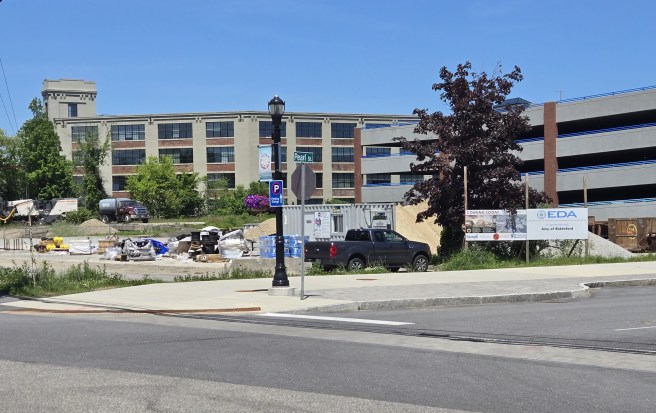
Both Fathom Development and Westbrook Development Corp. appeared before the council for final approval of credit enhancement agreements connected to two projects near the city’s Pearl Street parking garage.
After a tense, marathon council meeting that lasted until after midnight, the council was evenly split in a 4-4 tie, and credit enhancement agreements were approved after then mayor Marty Grohman broke the tie.
“This makes me ridiculously uncomfortable,” LaFountain said during the meeting, frustrated that City Planner David Galbraith appeared to be taking direction from the developers who were seated in the audience. “This is not a good look for the city.”
The site where Westbrook Development Commission wants to build 90 units of senior housing near the intersection of Lincoln and Pearl streets (Seaver photo)
Within days after winning his election, LaFountain pushed for further review of how the University of New England’s controversial pier proposal was handled.
The pier project was narrowly approved in a 3-2 vote before the planning board on August 6.
Planning board member Roch Angers appeared before the council on the previous day and said “something smells fishy” about how UNE’s application was reviewed by city officials.
Today, LaFountain says there is a benefit to having “periodic changes” on city boards and commissions.
“I think it’s good to refresh things from time to time,” the mayor said.
During his first council meeting as mayor in December, LaFountain appointed former city councilor John McCurry to the planning board.
McCurry – a former city councilor, council president and former School Committee member – said he is looking forward to serving on the planning board. “This mayor is focused on data-driven solutions,” McCurry says. “I think that’s right up my alley.”
On Tuesday, the city council will review LaFountain’s appointment of Leah Schaffer to the planning board.
LaFountain told the Gazette that he is “impressed” by Schaffer’s resume and qualifications.
According to her application, Schaffer is an architect and has a “strong interest in city planning.”
Schaffer has served on the city’s Historic Preservation Commission since 2016 and currently serves as that organization’s chair. She also serves as chair on the Citizen’s Advisory since 2023.
Schafer served as chair and member of the Heart of Biddeford’s Design Committee from 2016 to 2024.
Other members of the planning board include Chair Alexa Plotkin; voting members Roch Angers and Matt Dubois; and associate member Kayla Lewis.
Plotkin told the Gazette that the planning board has experienced a significant increase in both the pace and volume of items requiring review.
“We are seeing a big spike in the number of applications that have come before us,” Plotkin said, pointing to both large-scale housing projects and increasing rebuild/redesign applications from coastal homeowners who are either preparing for future storms or trying to repair weather-related damages to their homes.
“Being on the planning is a constant learning process,” Plotkin said, pointing to numerous policy changes and updated zoning ordinances at both the local and state level.
Plotkin said she feels “a bit sad’ that Larry Patoine will no longer be on the board. “I can see the value of a fresh set of eyes, but I also see tremendous value in having people with lots of institutional knowledge, Plotkin added.
Plotkin’s term expires in December 2027; Angers and Dubois both have terms that expire in December.
_____________
Randy Seaver is the editor and founder of the Biddeford Gazette. He may be reached by email: randy@randyseaver.com
c.) 2026 All Rights Reserved
Never miss another update! Subscribe for free today!
The West Brook skating rink in Biddeford was first opened to the public roughly four weeks before Warren G. Harding was inaugurated as the 29th president of the United States in 1921.
Although the outdoor rink has undergone some dramatic changes over the last century, the heart of its mission has remained unchanged, and it has become an embedded part of the city’s cultural heritage — kept alive by a small team of dedicated volunteers and the generosity of local businesses.
A recent photo shows a wide age range of kids enjoy the West Brook Skating Rink (Seaver photo)
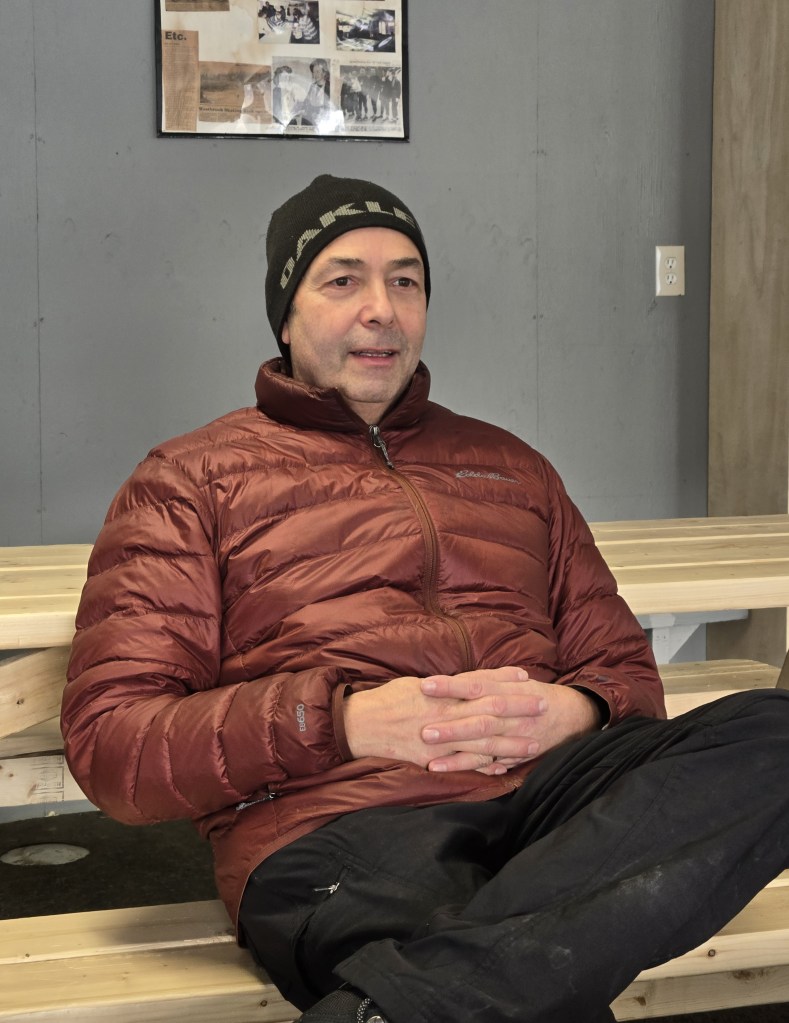
Mike Bouthillette is one of those volunteers. In fact, Bouthillette – a lifelong resident who grew up skating at West Brook – is today serving as president of the small group of older volunteers who work to keep the facility alive.
“It’s a lot of work, and we really need more volunteers,” he explains.
Bouthillette says the rink is almost part of his DNA, pausing during our interview to remember his late father, Norman who loved skating at West Brook.
“My dad was a big piece of this rink,” Bouthillette explained. “In fact, over there is the spot where he reportedly first kissed my mother,” he said pointing to the far western side of the outdoor rink.
“When I moved back here in 2018, I knew I wanted to give back to the community,” Bouthillette said. “That’s what drives our core group of volunteers. It’s the love of kids and seeing their smiles. That’s what drives us. That’s why we keep doing it.”
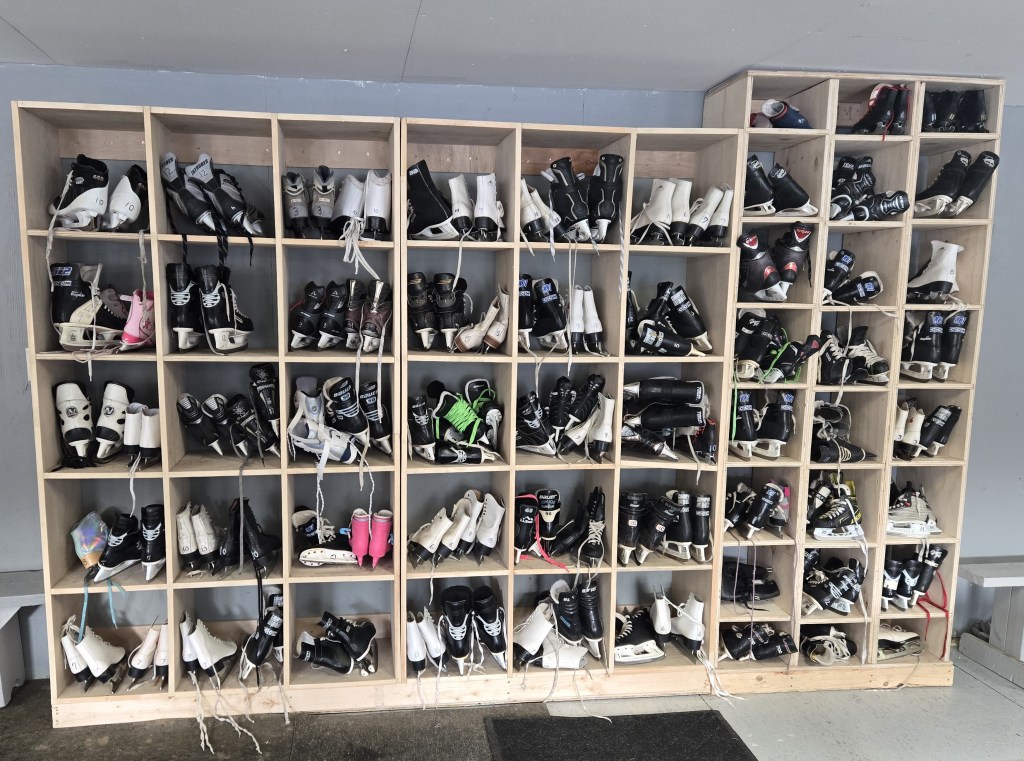
Some things have not changed since the rink first opened more than 100 years ago. There is no charge to use the rink. Ice skates – in a variety of sizes – can be borrowed for free.
The rink does accept donations but it’s the concession sales that keep the lights on and the building heated.
But even the concessions are sold with the needs of working families in mind.
“This is basically the only place in Biddeford where you can get in and out for under $10,” Bouthillette explains. “You can get a hot dog or slice of pizza, some popcorn, hot chocolate and candy all for under $10.”
During the chilly days of winter – especially on the weekends – you can expect to find anywhere from 300 to 500 people skating on the large outdoor rink.
“The rink is bigger than our parking lot, and our parking lot is pretty big,” Bouthillette laughed.
Mike Bouthillette talks about the generations of families that have enjoyed West Brook skating rink (Seaver photo)
Fond memories and a lasting legacy
Former Biddeford City Councilor Clement Fleurent has fond memories of skating at West Brook skating rink when he was a teenager in the late 1950s.
“Oh yes, it was quite the spot for young people,” he laughed during a recent interview. “That’s where the boys met the girls.”
Beyond socialization, Fleurent recalled fierce skating competitions on West Brook’s ice.
“I never won,” he laughed. “I always came in second or third. My older brothers – J.P and Jerry — would often win, but not me. They used to laugh a lot about that.”
Fleurent said he recalled hearing about another skating rink across the street from West Brook on the side of Pool Street known as Silver Skate, which was dominated by girls’ skating while the boys raced and did barrel jumping at West Brook.
Fleurent said he learned to skate the same way he learned to swim: trial and error.
“I remember skating at the airport,” he laughed. “There would be a little bit of rain, and it would glaze over. We lived just behind the woods at the airport, so I would just walk over and skate.”
Fleurent also recalled skating on Wilcox Pond near the cemetery on West Street. “We used to skate, regardless of the weather,” Fleurent said. “I remember skating as early as Thanksgiving back then. I would come home basically frozen.”
Fleurent, 90, says he still has his skates, but says his speed skating days are now behind him.
“What great memories we had there,” Fleurent explained. “I remember the parking lot was full and you would see cars parked up and down Pool Street.”
Even then, it was all volunteers who kept the rink operating,” Fleurent said, pointing out that the Laverriere family had a home near the Knights of Columbus Hall, and they would help maintain the ice.
“Kids like Danny Gagne and Henry Paradis were the local legends,” Fleurent recalled. “The only time I come in first is when I’m driving in traffic. I’m always first at the red light.”
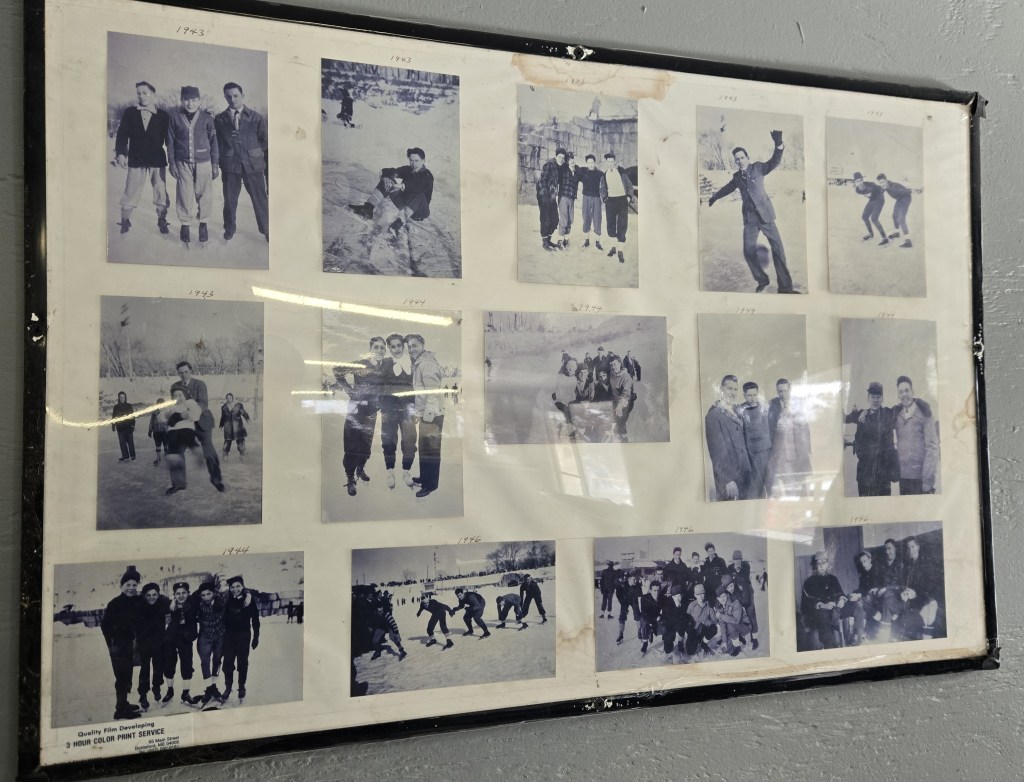
A framed collection of photos from the 1940s adorns one of the walls at the West Brook skating rink
Keeping the lights on, and the ice clear
Maintaining the property and keeping the rink open is a challenge, and Bouthillette points out that West Brook is the city’s only self-sufficient recreational facility.
Over the past few years, several improvements have been made at the facility, thanks to the generosity of some local businesses and work completed by students at Biddeford’s Regional Center of Technology (BRCOT).
Bouthillette is a master electrician and a teacher at the BRCOT. He says his students helped install new parking lot lights and a sound system at West Brook.
Students from the carpentry program helped repair the rotting floors in the concession building and built new stairs leading down from the parking lot to the ice, he said.
Jim Godbout, owner of Godbout Plumbing and Heating, donated and installed a new heat pump system. The St. Louis Alumni Association donated roughly $26,000 to obtain a tractor that can be used to clear the rink after a snow storm.
Kim Cocharane, the owner of Biddeford Painting, took care of repainting the building’s interior and never sent an invoice for the services or supplies. Jeff Brochu of Camille’s Electric also donated time and supplies for electrical upgrades.
“It’s just incredible,” Bouthillette says. “We have received so much support from the community, but there is still so much we need to do. A lot of things were put off for many years, and so we’re sort of in a catching-up phase.”
West Brook skating rink is a resource free to use for families and skating enthusiasts
A big bang for the buck
In November, Biddeford voters approved a $6.1 million bond package to be used for improvements and updates at more than a dozen recreational facilities across the city.
How and where those funds will be used has yet to be determined by the Biddeford City Council, which is planning to solicit broad-scale public comment about where and how the money will be used.
Bouthillette is keeping his fingers crossed that West Brook skating rink will get just a small sliver of that money, estimating he needs less than $50,000 to make much-needed repair to the building’s doors and windows, which are made of plexiglass.
“Right now, we’re pretty much heating the outside,” he said, pointing to a visible gap in the building’s main doorway.
While other facilities, including the Biddeford Ice Arena, the Community Center and the shuttered outdoor skate park near Rotary Park, are each asking for hundreds of thousands of dollars in needed repairs, West Brook has a rather modest funding request.
Plenty of skates — in a variety of sizes — are available for community use at West Brook skating rink
City Councilor Marc Lessard – an outspoken advocate for the city’s recreational facilities – says the city can get a “big bang for its buck” by investing a comparatively small amount at the popular skating rink.
“They are doing it all with volunteers,” Lessard said of West Brook skating rink. “When you look at how many people use that facility, it becomes quickly apparent that we can get a lot of citywide value for a pretty modest investment.”
Bouthillette says he knows there are other things that will be much more expensive to repair at West Brook including the dam under Pool Street that is used to help keep the water in the rink.
“We’re trying to be realistic,” he said. “We’re just trying to stay open to serve another generation of Biddeford families.”
____________
Randy Seaver is the editor and founder of the Biddeford Gazette. He may be reached by email: randy@randyseaver.com
c.) 2026 All Rights Reserved
Never miss another update! Subscribe for free today!




 BIDDEFORD GAZETTE