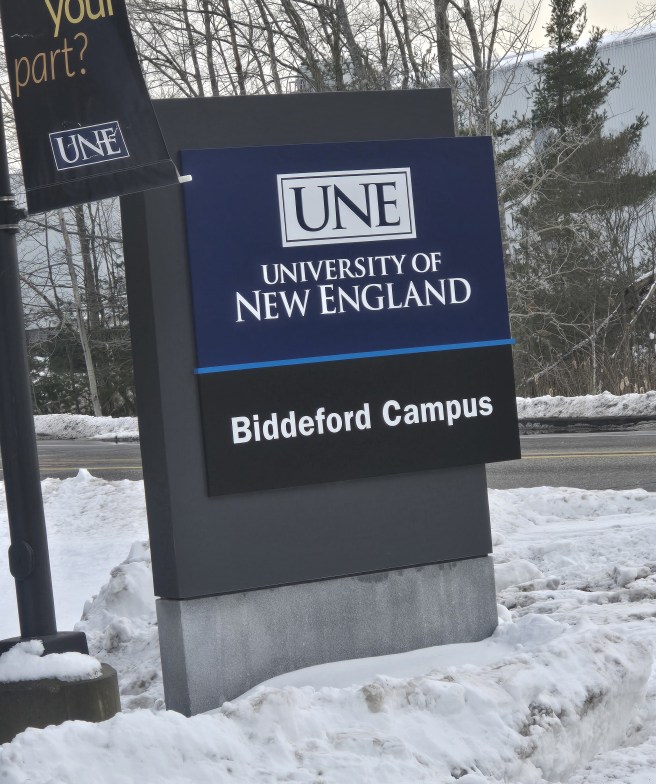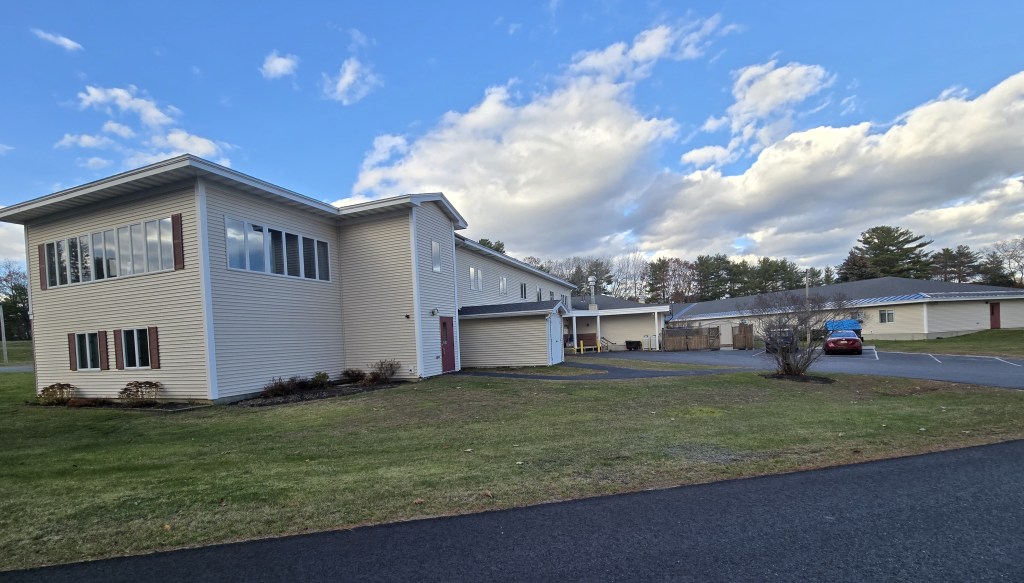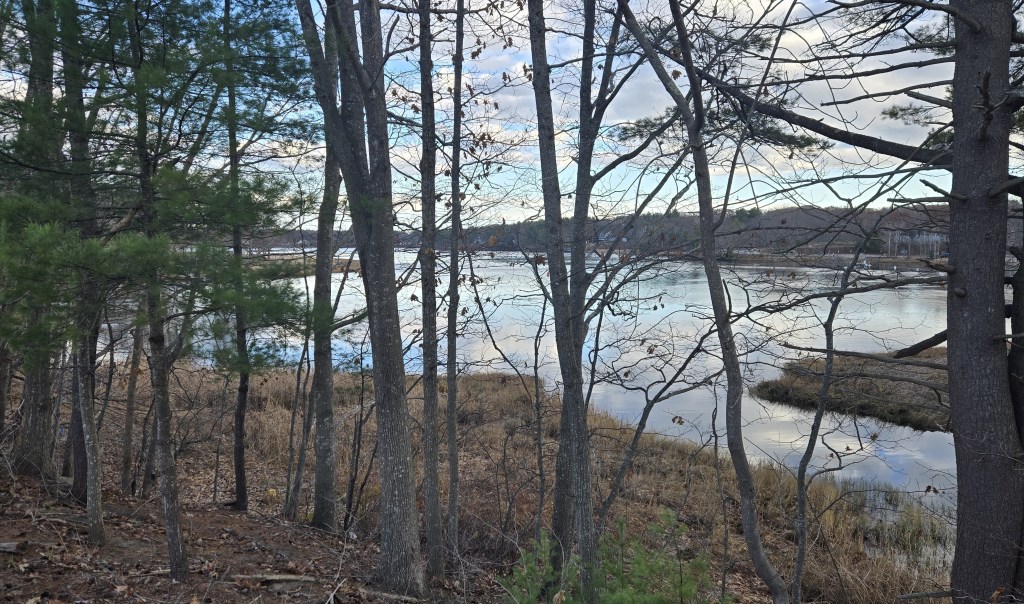
A small group of slightly more than 40 people attended a Biddeford Planning Board site walk near the location of where the University of New England wants to construct a new pier to dock its marine research vessel.
The proposed pier includes a 130-foot approach pier with an 80 by 20-foot pier head jutting out into the channel almost directly across from the Camp Ellis pier on the Saco River
UNE Vice President Alan Thibeault answers questions for planning board members (Seaver photo)
The university’s proposal has generated considerable controversy over the past several months. During a preliminary Planning Board meeting last month, several members of the public raised concerns about the proposal including its potential impact to existing moorings and impacts on navigation and recreational fishing during low tide.
No members of the public spoke in favor of the proposal at that May 22 meeting.
Monday’s site walk lasted almost 45 minutes, requiring board members and the public to hike through a wooded area behind the school’s marine sciences center.
There was no opportunity for public comment or questions, but planning board members did ask several questions about the project, including the proposed height of the pier, how river current and tides could impact the pier and how exactly the pier would be constructed.
Alan Thibeault, the university’s vice president of operations, led board members to a spot overlooking the Saco River to answer questions and point out the exact area where the university hopes to build their pier.
Ken Buechs of Biddeford made his feelings about the project known during Monday’s site walk (Seaver photo.)
Behind Thibeault, critics of the pier were sharing their own information about the project. Two small boats were anchored near the shore; one boat closest to the school’s proposed location and another boat slightly downriver where the city’s harbormaster and others say the pier should be located.
People on each of the small boats held up large placards to display the data from their depth-finding equipment. During the site walk, at low tide, the vessel closest to the school’s preferred location showed a water depth of six feet, while the other vessel showed a water depth of 12-feet.
Former City Councilor Patricia Boston was one of those who attended the site walk. Although water depth is technically not part of the criteria for the planning board, Boston said the board should pay attention to that issue.
A private boat owner holds up a placard showing a water depth of only six feet during low tide where the university hopes to build their pier. Another boat, slightly downstream, showed a water dept of 12 feet at the location where Biddeford’s harbormaster says the pier should be built. (Seaver photo)
“To me, it seems like a simple issue to objectively address,” Boston said. “This project is going to have significant impacts on the Saco River for generations to come. I’m hoping the planning board will consider all of the issues – from a planning perspective, it’s important to know all the information.”
“This project is going to have significant impacts on the Saco River for generations. I’m hoping the planning board will consider all of the issues”
— Patricia Boston, former city councilor
Boston said she is disappointed by how the university has been pushing the project forward. “Based just on what I have been reading and hearing, there seems to be some missed opportunities for collaboration, and I find that sad,” she said.
A few people from Saco also attended Monday’s site walk, including Kevin Roche, the president of SOS Saco Bay, a non-profit group focused on erosion issues in the Camp Ellis area. Roche did not return a phone call for comment, as of press time.
Matt Dubois, the newest member of the planning board, described the site walk as “informative and comprehensive.”
Former city councilor Kyle Noble — an outspoken critic of the project, holds a pole to demonstrate the height of UNE proposed pier
Susan Deschambault, another Planning Board member, said she appreciated the opportunity to see the exact location and ask questions about the project. “There are still more questions to be asked,” she said.
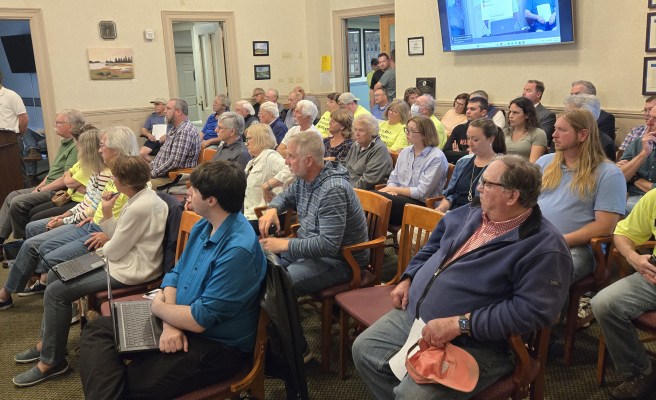
Members of the public paid close attention to UNE’s presentation during Monday’s site walk. (Seaver photo)
Earlier in the day, a group of private mooring owners who would be impacted by the proposal, issued a press release stating that they “are ready to be sued by the university” because they are unwilling to give up their mooring locations.
“I guess they don’t understand the English language over there at the college,” said Capt. Shawn Tibbetts, a commercial fisherman with a mooring location that would need to be moved. “We’re not moving. The site they want for their pier is unavailable to the University of New England.”
Planning board chair Alexa Plotkin described the site walk as somewhat unique. “This is not like driving into a parking lot and looking around,” she said. “I’m glad we had the opportunity to see the area that is not really visible on a daily basis.”
Plotkin said she was pleased by the turnout and said the university’s proposal will be back on the planning board’s agenda for its next meeting on June 18.
Randy Seaver is the editor and founder of the Biddeford Gazette. He may be contacted by email: randy@randyseaver.com
Never miss another update! Subscribe for free today!
Just a few days after hearing several negative comments from the public about their proposed research and docking pier, officials from the University of New England distributed a FAQ (Frequently Asked Questions) document with the media and community leaders.
The university (UNE) says the FAQ document is intended to clarify “a variety of misunderstandings [that] have emerged about the project” and to “clear up misinformation that has circulated about the (proposal).”
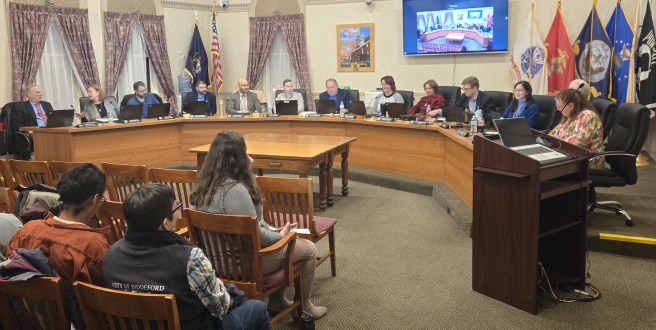
That meeting drew scores of people, filling the council chamber while several other members of the public overflowed into the hallway.
During the public comment period, several people took to the podium, raising concerns about the plan and criticizing the university. No one at the meeting spoke in support of the proposal.
Former City Councilor Michael Swanton – who previously represented the city’s coastal area on the city council – told the board that he is neutral about the proposed pier.
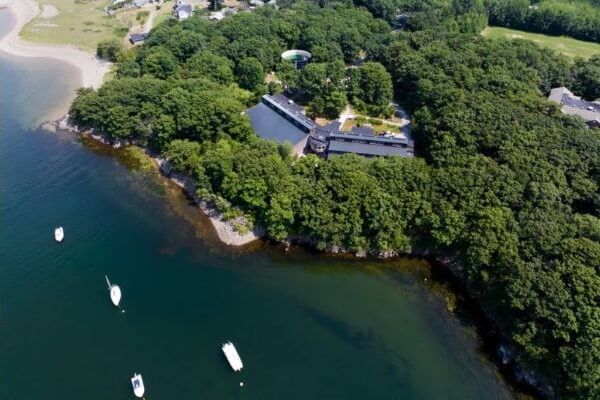
An aerial photo showing the area where the University of New England wants to construct a new research/docking pier. (UNE photo)
During a telephone interview Wednesday, Sarah Delage, a university spokesperson, reiterated that UNE wants to be proactive and follow a review process that includes addressing public concerns, listening to opponents and responding to every regulatory agency’s particular request for information.
“From our perspective, we have clearly communicated with all the regulatory agencies,” Delage said. “We are absolutely committed to working in good faith with everyone and listening to all voices.”
UNE President James Herbert did not mince words about his frustrations regarding “misinformation” in a letter he sent to community leaders on Tuesday.
“Unfortunately, a great deal of misinformation has been spread about the proposal,” Herbert wrote. “UNE cannot continue to allow the level of misinformation and, in some cases outright false statements, to go unanswered.”
Herbert told community leaders that “most, if not all, of the comments that were presented to the Planning Board [during last week’s meeting] are irrelevant to the criteria that the Planning Board must apply to UNE’s application for site plan approval.”
UNE cannot continue to allow the level of misinformation and, in some cases outright false statements, to go unanswered.”
— James Herbert, president of the University of New England
What do the critics say?
John Schafer, the former chair of Biddeford’s Harbor Commission and a retired engineer, has been an outspoken critic of the project for several months.
Schafer and other critics of the proposed pier created a Facebook page known as UNE Pier Review.
For more than a year, Schafer and others have been doggedly tracking the review process, raising concerns about “a lack of transparency” and other issues, most notably stating that the proposed pier should be located in a different location, closer to shore primarily because of water depth issues and impacts to existing moorings in the Saco River.
Schafer received a copy of the university’s FAQ document, describing it as “polished spin.”
“The public finally had an opportunity to speak at last week’s meeting, and apparently the university didn’t like what it heard,” Schafer said. “No one from the university reached out to me,” he added, saying it has been more than difficult to obtain documents from the university, including a copy of their request for $3.5 million in federal funding for the project.
“While reading this thing, my bullshit meter pegged the needle off the charts,” Schafer said.
Schafer raised several specific objections to the items listed on the university’s document, including the actual number of mooring owners who would be impacted; statements regarding whether the university has threatened to sue the city if their plan is not approved, and contrary statements issued by the university regarding the potential impact on federal funding if the review process is delayed.
“While reading this thing, my bullshit meter pegged the needle off the charts,”
— John Schafer, former chair, Biddeford Harbor Commission
“How can they with a straight face say that only two moorings will be impacted?” Schafer said. “Were they not at the same meeting as the rest of us?”
Schafer says that seven moorings will be impacted, dismissing the university’s offer to swap, purchase or relocate other moorings. “Exactly where would they be relocated?” Schafer asked. “There is not unlimited room on the river and there is a substantial waiting list of people hoping to get a mooring on the river.”
Delage, however, said the university has been making good faith efforts to identify and contact all mooring owners who may be impacted by the pier.
“The harbormaster previously indicated that only two moorings would be impacted in his communication to the (Maine Department of Environmental Protection) DEP” Delage said, adding that “there is no official record of mooring owners.”
While much of the public conversation about the proposed pier has centered upon water depth issues, the FAQ document provides more details about why the university picked their preferred site over an alternative that was offered by the city’s harbormaster.
According to the FAQ document, the university’s preferred site location (Site 7) “best meets the combined criteria (required). It is located where there is a small intertidal zone, comprised primarily of rock without sea grass, and the currents are slower because it is farther from the river channel.
“The dock’s main berth would be aligned with the current in the river and would be deep enough to provide all-tide access for the range of vessels expected to use the facility with the smallest overall footprint, thereby minimizing environmental impacts.”
Other issues
UNE’s FAQ document also addresses several other issues, including whether the university threatened to sue the city, claims about an ongoing FBI investigation and why Biddeford Harbormaster Paul Lariviere was removed from review of the proposal.
Almost exactly one year before Wednesday’s Planning Board meeting, former Biddeford City Manager James Bennett sent a letter to Lariviere, saying the harbormaster had been biased in his review of UNE’s proposal as evidenced by “several” public comments he has made outlining his steadfast objections to the project.
Schafer says that the city’s move to quash both the harbormaster and the assistant harbormaster was simply part of an effort to grease the skids for the university. “Now look at where we are,” Schafer said. “The city spent $2,800 to hire a guy without any local knowledge or previous experience as a harbormaster to simply check the box and say that UNE had filed all the right paperwork. Heck, the city clerk could have done that.
Did UNE threaten to sue the city?
Ron Schneider, the university’s chief legal counsel, did send a letter to Biddeford City Attorney Harry Center on February 13, 2024, several months before the university submitted its formal proposal to the city.
In that letter, Schneider wrote “It is our sincere hope that UNE is not forced to resort to litigation to avoid the delay and expense that will result if Mr. Lariviere were to insist on obstructing the building of the pier.”
UNE’s document describes that communication between the two attorneys as an opportunity to “raise concerns about serious due process errors” to Biddeford’s attorney. “The goal of this communication was to correct these errors to avoid having to appeal to a court.”
Another item that the university describes as misinformation, is a claim that the FBI is investigating the review process.
“After others claimed that the FBI was investigating UNE, the university reached out to the FBI and offered to meet with them, which they said was not necessary,” the university wrote in its FAQ document. “UNE has no reason to believe that the FBI is investigating the university.”
Schafer, however, said he and others were, in fact, questioned last year by the FBI about “the review process, not specifically about the university.”
Where do we go from here?
Despite some controversy, UNE’s proposal has received approval from every regulatory agency that has reviewed the project, including the Saco River Corridor Commission, the U. S. Army Corps of Engineers and the Maine Department of Environmental Protection.
The review of the project by the Biddeford Planning Board is expected to be extensive. During last week’s meeting, board members asked UNE representatives for additional information and then voted unanimously to conduct both a site walk and a “boat tour” near the proposed location.
Schafer and others have praised the Planning Board’s “obvious commitment” to fairness and transparency. He says he will continue to keep a close watch on the project.
Delage says that the university is willing to meet with critics or others who would like more information about the proposal.
“The university really appreciates any opportunity to put more information out there for the public.” Delage said. “We are acting in good faith for everyone involved, especially those who use and cherish the river like we do.”
Randy Seaver is the editor and founder of the Biddeford Gazette. He may be contacted by email: randy@randyseaver.com
Never miss another update! Subscribe for free today!
During Wednesday’s Planning Board meeting, not a single member of the public spoke in favor of the proposed location for a research-docking pier that the University of New England wants to build on the Saco River.
Although several people told the board that they supported the idea of UNE building a new pier, they also said the proposed location for the pier is a bad plan and would adversely impact public recreation, nearby mooring owners and commercial fishing operations near the mouth of the river.
During the public comment period, which lasted nearly an hour, several people also complained about what they said is “a lack of transparency” about the project and the university’s closed-ranks approach to building the pier in their preferred location.
Alan Thibeault, the university’s vice president of operations, introduced the project to the board, stressing that prior boards “approved the pier concept, design and location” as part of the university’s overall master plan.
Thibeault told the board that UNE has spent many years planning and designing the proposed pier, considering nine different locations along the shoreline near the school’s Marine Sciences Center building.
Former city councilor Kyle Noble addresses the Biddeford Planning Board about the University of New England’s proposed research pier on the Saco River (Seaver Photo)
“We are here tonight to listen,” Thibeault said during his opening remarks, pointing out that project has already been approved by the Saco River Corridor Commission, the U.S. Army Corps of Engineers and the Maine Department of Environmental Protection.
But many residents saw Wednesday’s meeting as their first opportunity for a bite at the apple for public comment and feedback of the project, which includes a 130-foot approach pier with an 80 by 20-foot pier head jutting out into the channel.
Former city councilor Kyle Noble who lives near UNE’s Biddeford campus, described UNE’s application as “incomplete.” Are you going to side with the public or UNE?” Noble asked the board. “If they were good neighbors as they so often claim, they would have designed this differently.”
Thibeault told the board that the university’s current research vessel is only 32-feet long, despite prior talk of a new, much larger vessel of more than 60-feet in length.
Dan Chadbourne, Saco’s former harbormaster, told the board, “You don’t build an 80-foot pier for a 32-foot boat.”
Chadbourne said he thinks the university has needed a more adequate pier for a long time, going back decades to when the school was St. Francis College. “The location is the issue,” he said. “Where they want it is gonna catch ice, and they’re gonna be disappointed when they are unable to turn because of inadequate depth in that area.”
Although Thibeault told the board that mooring impacts would be minimal and that the university had tried to obtain maps of private moorings, several local mooring owners approached the podium one-by-one to say that their moorings would be adversely impacted and that UNE has done nothing to contact them.
Walter Alexander of Biddeford is the son of former harbormaster Marshall Alexander who was the city’s harbormaster for 37 years before retiring a few years ago and then died late last year.
The younger Alexander told the board: “My father was the one who gave UNE what he thought was a much better plan for their pier, closer and parallel to the shore,” he said.
“The university has deep pockets, and they have threatened the city with litigation if they don’t get the location they want,” Alexander said. “There has been a lack of transparency, and this whole thing has turned into little more than a big dock contest.”
Peter Mourmouras, the owner of Saco Bay Tackle, told the board that the proposed pier would essentially close off a very popular fishing area that generates revenue for the local economy from chartered recreational fishing trips.
John Schafer, the former chair of Biddeford’s Harbor Commission, has been an outspoken critic of the project. He reminded the board that Biddeford’s former city manager “silenced both the city harbormaster and assistant harbormaster” from the review process last year. “Since then, there has been no local knowledge evaluating this proposal,” Schafer said. “The university has twice threatened to sue the city, as outlined in letters from February 2024 and again in March 2024.”
Other representatives from the university attended Wednesday’s meeting, seated together in the back row, including the school’s senior attorney and a public relations representative. None of them addressed the board.
“There has been a lack of transparency, and this whole thing has turned into little more than a big dock contest.”
— Walter Alexander
At the end of the public comment period, several board members said they felt overwhelmed by the complexity of the project, including the school’s submission that is reportedly more than 1,000 pages of information.
Board members voted unanimously to conduct a site walk of the area, and a possible boat tour of the river area at low tide, stressing that the public would be notified and invited to participate.
Board chair Alexa Plotkin asked the university to provide some more details, saying the board would appreciate more than just “four or five days” to review additional information.
Never miss another update! Subscribe for free today!
Mike Ramunno, a tuna fisherman from Biddeford, has owned his mooring in the Saco River for more than six years. He says no one from the city of Biddeford or the University of New England has contacted him about the university’s plan to build a large pier for their 60-foot research vessel.
The university’s plan is scheduled to go before the Biddeford Planning Board for review on Wednesday, May 21.
Ramunno is just one of many fishermen and recreational boaters who say they will be adversely impacted if the university is allowed to construct the pier in their preferred location near the mouth of the river.
Several mooring owners have made it clear that the University of New England will face legal battles if they keep demanding preferential treatment that will impact almost everyone who uses the Saco River for recreational and commercial use.
“If this plan goes through, they [UNE] will essentially be closing off the river to everyone else who uses the river,” Ramunno said. “When you plan to build a house and go to the planning board, you have to notify your abutters. Why doesn’t the university have to notify us about their plan?”
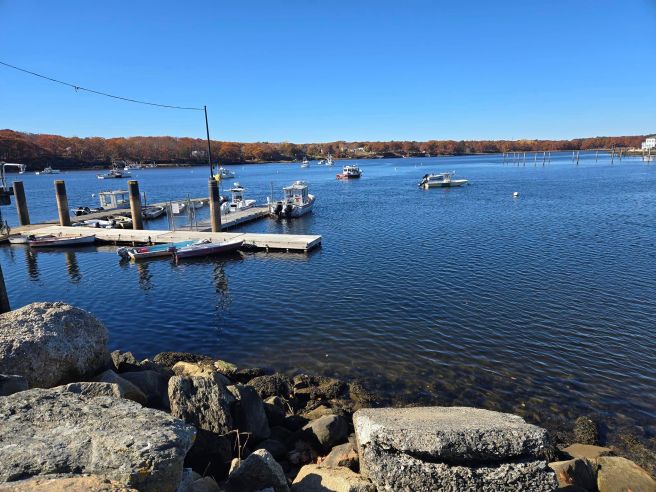
The mouth of the Saco River is a popular place for both commercial and recreational fisherman. Now a coalition of mooring owners are raising concerns about the impacts of a large pier the University of New England wants to build near its Biddeford campus (Seaver photo)
A UNE spokesperson declined an offer to comment on this story.
Ramunno is not alone in his concerns. He and six other mooring owners sent a notice of their concerns to the planning board earlier this week.
The university is hoping to construct a pier consisting of a 28-foot long by 24-foot-wide landing; a 90-foot long by 14-foot-wide approach pier; and an 80-foot long by 24-foot-long pier and a floating dock system.
UNE’s plan has already been approved by both the Saco River Corridor Commission and the U.S. Army Corps of Engineers.
The mooring owners and others – including John Schafer, former chair of the Biddeford Harbor Commission and Daniel Chadbourne, Saco’s former harbormaster – have formed an informal alliance. They adamantly maintain that “the university has no power to compel them to move.”
“This might be checkmate,” said Schafer who has been pushing for more transparency in the regulatory process. “We shall see, but I can’t imagine any scenario in which UNE is able to steamroll these mooring owners out of the way. Except possibly in a courtroom, but that would take years. Private property is private property.”
Greg McPherson keeps his 21-foot vessel at a mooring that will be impacted by the university’s plans.
“If this plan goes through, they will essentially be closing off the river to everyone else who uses the river,”
— Mike Ramunno
“It’s already a very narrow part of the river,” McPherson said. “For the life of me, I cannot figure out why no one from the city or the university has contacted me.”
In addition to impacts on mooring owners, both Ramunno and McPherson say that if UNE is allowed to build the pier as it is currently configured recreational fishermen who troll the river will also be impacted.
“That’s a very popular area for striper fishing,” Ramunno added.
“It’s very shallow where they want to put their pier,” Ramunno said. “Why are they refusing to consider the alternative location that will give the depth they actually need? I have a 34-foot boat, and I sometimes find it challenging to turn about at low tide.”
Mooring owners often have to wait years to get a private mooring on the river. They also have to pay $150 per year to the city for their mooring.
Never miss another update! Subscribe for free today!
During a sometimes terse and heated meeting, Biddeford Mayor Marty Grohman defended the way the city has acted during the review of a controversial pier that the University of New England wants to construct on the Saco River.
The nearly hour-long meeting was held at the request of John Schafer, the former chair of the Biddeford Harbor Commission and a Hills Beach resident who has been outspoken about the need for transparency during the review process.
City Attorney Harry Center also took part in the late Monday morning meeting in Grohman’s second-floor office at City Hall.
Center stressed that the meeting was strictly informal and not part of the review process. “The mayor has simply set aside some time to listen to the concerns of a constituent,” he said.
Hills Beach resident and former chair of Biddeford’s Harbor Commission John Schafer points to a diagram that shows inadequate depth where UNE is hoping to build a 177-foot pier to dock its research vessel near the mouth of the Saco River (Seaver photo)
No one from the university was at the meeting, and other media outlets declined invitations to attend, according to Schafer.
Schafer’s concerns center on three essential points: the impact and necessary removal of at least seven private moorings on the river if the project is approved; concerns about the water depth where the university wants to construct its pier; and the process that has been used to review the university’s proposal.
The permitting process for the proposed pier is complex and multi-layered, requiring the review and approval by several state, federal and local agencies.
Earlier this year, UNE cleared two major hurdles in the review process, winning approval from both the Saco River Corridor Commission and the U.S. Army Corps of Engineers.
But a very critical part of the review process is expected to begin in just a few weeks when the Biddeford Planning Board begins its formal review of the proposal.
“I don’t have any say over what the Planning Board does or doesn’t do,” Grohman said during Monday’s meeting. “I simply appoint members, and those appointments are then confirmed by the council. I think we have a really good planning board, and I have full confidence in them.”
But Schafer said he is concerned about the lack of public input during the review process and how the city has approached the project thus far. He also criticized the university for its “lack of transparency” and for “bullying those who raise questions and concerns” about the proposed pier.
“I think [UNE’s] application is both incomplete and full of misinformation,” Schafer told the mayor. “Don’t you think it’s a bit presumptuous for a private entity to dictate how the city will review its application; to show no regard for those who have private moorings in that area just so they can construct a vanity pier?”
When contacted by the Biddeford Gazette, a university spokesperson declined an opportunity to address Schafer’s remarks.
“Since this was not an open meeting and a representative from UNE was not present, it would not be appropriate to comment on the conversation that took place,” wrote Sarah Delage in an email response. “UNE will continue to follow the public regulatory process, and we look forward to presenting our application to the Planning Board.”
Schafer said he and “a growing coalition of residents” have no problem with the university building a pier to dock its 60-foot research vessel. Instead, he says, all the concerns boil down to the exact location of the pier and the dismissal of public concerns about the project.
Survey says?
Schafer roundly criticized Grohman for allowing former City Manager James Bennett to “silence” the city’s harbormaster and assistant harbormaster last year, preventing them from participating in the city’s review of the proposal simply because they voiced concerns about the pier’s location.
But Grohman shot back and said Bennett was simply trying to avoid the appearance of bias. He also reminded Schafer that the harbormaster’s role – as outlined in city ordinances – is strictly an “advisory position,” a change that was first proposed by Schafer himself last year when he was chair of the harbor commission.
Schafer said a growing number of residents have serious concerns about a review process that seems to have a pre-ordained outcome, pointing to the results and comments found in a recent public survey about the project.
Nearly 40 percent of respondents indicated that they had a “very low” level of confidence in the city’s handling of the review process, while roughly 30 percent of respondents indicated that they had “moderately low” confidence in the city’s handling of the matter.
The online survey was conducted over several days in late April on a Facebook page called “UNE Pier Review,” a group that Schafer has helped organize.
The survey asked respondents a wide range of questions about the proposed pier and the review process thus far. The survey allowed respondents to maintain their anonymity.
The multi-question survey included feedback from 156 respondents, showing an overwhelming lack of public confidence on the issues of transparency and the mayor’s handling of the issue.
Nearly 40 percent of respondents indicated that they had “very low” level of confidence in the city’s handling of the review process. And roughly 30 percent of respondents indicated that they had “moderately low” confidence in the city’s handling of the matter.
City Attorney Harry Center (left) and Mayor Marty Grohman listen as John Schafer details his concerns about UNE’s proposal
Fewer than 10 percent of respondents indicated that they had “very high” confidence in the process, while slightly less than 20 percent of respondents indicated that they are not sure.
Many respondents added comments saying the city has been “too secretive” while other questioned the motives of city officials, speculating that some members of the city seem to have a “cozy relationship” with the university.
Grohman described the survey as “interesting,” but also said it was not a professional survey conducted by a polling firm.
“An anonymous survey is not something that a public permitting process could use, as it does not include an opportunity for all parties involved to publicly comment,” Grohman wrote in a text message to the Gazette after the meeting.
Schafer told the mayor that several mooring owners have already written to regulatory authorities stating quite plainly that they have “no intentions of moving their moorings where UNE wants to build their pier.”
Schafer also said that UNE has threatened the city with litigation if its desired location for the pier is not approved, referencing a letter sent to the city by Ron Schneider, the university’s lead attorney, several months before the university had submitted its application for review.
Grohman described Schafer as a good friend, and said he was happy to hear the concerns that were raised.
In a moment of levity during the meeting, Grohman pointed out that the mayor does not vote on or control the regulatory review process. “I don’t have the authority to change what sodas are sold in the vending machines downstairs,” Grohman laughed.
After the meeting Schafer said he very much appreciated the opportunity to share his concerns with the mayor. “Nothing in the meeting surprised me,” he said. “It’s about what I expected.”
Never miss another update! Subscribe for free today!

The U.S. Army Corps of Engineers last week approved an application from the University of New England (UNE) for the construction of a controversial pier proposal on the Saco River in Biddeford.
Although UNE is still required to clear several more permitting hurdles before construction can begin, the Army Corps approval represents a significant boost for the pier project.
Earlier this year, the Saco River Corridor Commission also gave its approval for the project, which includes a permanent pier consisting of a 28-foot long by 24-foot-wide landing; a 90-foot long by 14-foot-wide approach pier; and an 80-foot long by 24-foot-long pier and a floating dock system.
The proposed pier is intended to serve and dock UNE’s 60-foot marine research vessel.
UNE Spokesperson Sarah Delage said the university is “pleased to be moving forward” through the permitting process.
Construction of the pier relies upon a $3.5 million federal grant the university received last year.
When asked about the uncertainty of federal funding created by the Trump Administration, Delage said UNE is monitoring President Trump’s executive orders, but the project is expected to stay on track.
“Like all colleges and universities, as well as other research organizations, UNE is monitoring executive orders and other federal actions closely for potential impacts on the university,” Delage said. “Having said that, we have no reason to believe the funding for the project is at risk.”
But not everyone is celebrating the Army Corps’ decision to approve the project, including John Schafer, a Hills Beach resident and former chair of Biddeford’s Harbor Commission.
“I do not know why, but in this case several ‘powers that be’ seem absolutely determined to exclude local knowledge from the permitting process. That is just wrong.”
— Dan Chadbourne, Saco’s former harbormaster
During a recent telephone interview, Schafer said he is “extremely disappointed” by the Army Corps’ decision.
Schafer — who has been doggedly seeking information about the pier and its review process for more than a year — said the Army Corps made its decision without public comment and without input of “local knowledge,” most notably from the city’s harbormaster, Paul Lariviere.
Schafer also shared several letters from people who have existing moorings that would be impacted by the pier proposal.
As of press time, the Army Corps has not responded to our request for public comment.
However, in an email response to Schafer’s questions about the lack of public comment during the Army Corps’ review, Project Manager Jana Jacobson of the Army Corps wrote that “the project was reviewed for verification under the Maine General Permit, which are issued for use on a five-year cycle. Therefore, there was no public comment period.”
Dan Chadbourne, Saco’s former harbormaster, sent a pointed letter to Jacobson, disputing UNE’s claims that the pier would only impact one existing mooring.
Chadbourne said seven moorings will be impacted if UNE is allowed to build its pier.
“There is absolutely no substitute for local knowledge when evaluating such a sizeable intrusion into a popular waterway like the Saco River,” Chadbourne wrote. “I do not know why, but in this case several ‘powers that be’ seem absolutely determined to exclude local knowledge from the permitting process. That is just wrong.”
Delage said once all regulatory approvals are received — including from the Maine Department of Environmental Protection and the Biddeford Planning Board – the university must then obtain a building permit from the Biddeford Code Enforcement Office.
Delage said UNE will continue to follow the review process, but declined to speculate about how long that process will take.
Randy Seaver is the editor of the Biddeford Gazette. He can be contacted at randy@randyseaver.com
Never miss another update! Subscribe for free today!
More than a year after a catastrophic storm decimated Biddeford’s beaches, coastal properties and roads, community organizations are calling for the city to move beyond cleanup and embrace a plan that would prepare coastal beaches and dunes for the next big storm.
Armed with fresh research on beach erosion and how best to combat it, the Biddeford Coastal Preservation Coalition (BCPC) is advocating with the city to develop a plan to restore and strengthen dunes as the best way to protect our vulnerable beaches.
The BCPC is a coalition of community groups from Hills Beach, Biddeford Pool, Middle and Fortunes Rocks beaches and Granite Point. Most of these beach communities are in the process of forming their own working groups under the BCPC umbrella. The coalition is also allied with other regional groups, notably the SOS (Save Our Shores) Saco Bay group that got its start in Camp Ellis six years ago to advocate for federal relief from damage done by the Saco Bay Jetty and has since become a clearing house for climate-related information.
In December, the BCPC presented at the Coastal Resiliency workshop with Biddeford City Council and requested that Biddeford develop a comprehensive Coastal/Beach Management Program into its 2023 Climate Action Plan. According to BPCP President Kimberly Matthews, the group is advocating that the plan prioritize resilience when restoring beaches, dunes and marshes. Local infrastructure such as roads should also include resilience measures. New beach-facing buildings, building restorations and seawalls are already governed by state regulations.
Matthews said that BCPC is advocating for what is well established as best practices for beach protection — restoration of dunes and replanting of sea grass to allow for natural regeneration of the dunes. “Dunes and beaches serve as the first lines of defense during storms, protecting coastal infrastructure from erosion and flooding, and providing critical habitat to birds and other wildlife. These areas are also vulnerable to sea level rise,” the group notes.
In response, the Biddeford City Council has established a Sustainability Commission, which met for the first time Tuesday. Commissioners agreed to take up the BCPC proposals at future meetings, along with other sustainability issues.
By good fortune, a team of researchers from the University of New England had been measuring some of the Biddeford beaches before the January 2024 storms, and their work since the storms have produced precise information on just how much damage occurred from those storms, and how much the landscape has recovered since then.
The results of the UNE research is summarized in the BPCP year-end newsletter. Among the findings are that an astonishing 28 percent destruction of dune area on the four beaches they studied in Saco, Biddeford, and Kennebunkport. But while beaches tended to replentish themselves, dunes were repaired at a much slower rate. And the UNE research made clear that dunes are the most important line of defense against further erosion or damage from storms.
Dune restoration is already under way by a few private owners, and just recently the Biddeford Pool Conservation Trust, which now owns the former Marie Joseph property in Biddeford Pool, mounted a large, all-volunteer effort at their new property.
But climate mitigation is hardly a sure thing. “The estimate to have the beach grass planted professionally came in at $148,000,” recalls Lucie Fontaine, chair of the Biddeford Pool Preservation Trust. “This seemed like an enormous amount to spend on a project that could again be wiped out by a bad storm.”
Having done a small planting the year before, she knew the cost of the stalks was relatively low and that the planning process was relatively simple. Fontaine ordered 12,000 stalks of sea grass from the supplier she had used before, and paid just $2,040. “We put out a call for volunteers, and within days we had sufficient planters to do the job.
“The community was amazing! I had expected it to take the full two weeks to get the stalks planted, but in the end we pulled it off in just three afternoons with 35 volunteers including 14 from UNE. Now we wait to see how the grass takes and if it survives the high tides. But the plan is definitely to continue the project next year!”
Dune restoration in beaches like those at Biddeford Pool and Fortunes Rocks face several obstacles. The main issue is that a significant stretch of that two-mile beach is backed by riprap or sea walls. The UNE researched highlighted what has long been known, that beaches with sea walls do not recover as quickly as beaches with dunes because of the way the waves rebound.
The second issue is the high cost of bringing in new sand to build up the dunes after a major storm. The UNE researchers reported that in the few cases where private owners scraped sand from the beach to build up their dunes, they had some success, but the beach itself was slow to recover.
One potential answer to that issue is the dredge that York County purchased in 2022, and is now awaiting its first mission, probably in Wells. The issue of the dredge and how to use it most effectively was raised at a March 17 symposium organized by SOS Saco Bay, when it was revealed that Biddeford is the only coastal municipality in the county that has not signed on to an agreement to use the dredge.
Thomas McPheeters is a former journalist and a Biddeford resident. He can be reached at tommcp@me.com
Never miss another update! Subscribe for free today!
While Michael’s cause of death was described as complications from a grand mal seizure, his struggle began roughly six years earlier when he suffered a traumatic brain injury while riding a snowmobile in northern Maine.
Although Michael was wearing a helmet, he suffered a skull fracture because the helmet was not properly fitted.
Michael was on life support for five weeks, but he defied the odds and with the help of his doctors and a team of neuro researchers at the University of New England, he returned to an almost normal lifestyle.
Brad Goulet of Saco talks about his son and his legacy
He had a girlfriend and a driver’s license, and he graduated from Thornton Academy in 2007.
But Michael developed a seizure disorder that landed him back in the hospital. He underwent a rigorous rehab treatment and began new medications.
Again, Michael left the hospital and continued living a full life, beginning classes at St. Joseph’s College where he majored in psychology. He was also very involved in community and charity work.
“It was like we found our kid again,” said Brad Goulet, Michael’s father. “He was happy and optimistic, despite all the struggles and battles he had to endure.”
Michael then suffered another seizure while alone. He was again taken to the hospital, and remained on life support with multi-organ failure for several days.
And then it was time for Brad Goulet and the rest of his family to say their final goodbye to Michael.
Moving forward
Michael was the youngest of Brad Goulet’s three children. Although it has been more than 14 years since Michael passed, his father still tears up and struggles for words when asked about his son.
“I was lost and floundering,” he said. “But I knew we had to do something to honor Michael’s life and his service to others.”
The Michael T. Goulet Traumatic Brain Injury and Epilepsy Foundation was founded to raise awareness and funding for the prevention of traumatic brain injury.
To date, the non-profit foundation has provided more than 3,500 helmets for use in outdoor recreation, including cycling, skateboarding and snowmobile riding throughout York and Cumberland counties.
“A properly fitted helmet is not a panacea if you are engaged in risky behavior,” Goulet says. “But a properly-fitted helmet can make the difference between life and death”
Goulet says that even a properly-fitted helmet has an expiration date. According to federal standards, a helmet has an expiration date of five years.
The foundation, Goulet says, also provides scholarships for those suffering from a brain injury or epilepsy.
“A properly fitted helmet is not a panacea if you are engaged in risky behavior, but a properly fitted helmet can make the difference between life and death”
— Brad Goulet
Where does the money come from?
The Michael T. Goulet Foundation is supported by volunteer students and faculty members at the University of New England.
Funding for helmets and the organization’s outreach efforts comes from a variety of sources, most notably an annual fundraising event that sets a high bar for a gala that is described as an evening “to remember.”
The eighth annual gala event will once again be held at The Landing in Pine Point on March 22, beginning at 7p.m. All the proceeds will go the Michael T. Goulet Foundation to support their ongoing advocacy and public awareness efforts.
The gala is described as an evening of sophistication and glamor.
“Prepare to be dazzled from the moment you arrive, as you make a grand entrance and have the opportunity to capture stunning photos. Step inside and be transported to a world of glamour and sophistication, surrounded by breathtaking decorations and enchanting live music that will set the perfect mood,” reads the website.
Tickets for the gala – which includes a silent auction and food from Black Tie Catering — are now available online by clicking on this link
“We work pretty hard to make it an exceptional evening,” Goulet says. “It really helps us keep moving forward as we continue to do our part in honoring Michael’s courage, optimism and generosity.”
To learn more about the Michael T. Goulet Foundation, go here
Never miss another installment. Subscribe for free today
The University of New England (UNE) is, apparently, refusing to provide information to the public and the media about a federal grant the university received to construct a new “research pier” on the banks of the Saco River.
Over the last few weeks, John Schafer, a Hills Beach resident and former chair of Biddeford’s Harbor Commission, has repeatedly tried to get documents regarding a $3.5 million federal grant that the university received from the National Institute of Standards and Technology (NIST).
In previous interviews, the university says it is planning to use those funds to build a permanent pier on the Saco River that can accommodate its 60-foot marine research vessel.
Schafer says he and other residents simply want to see documents related to the grant. “I am a big believer in transparency and accountability,” he said. “I don’t understand why the university is unwilling to release details about a grant award of public funds. What are they hiding?”
The Biddeford Gazette attempted to contact both the university’s president James Herbert and Alan Thibeault, vice president of operations, for comment. Neither Herbert nor Thibeault returned our calls as of press time.
Sarah Delage, associate vice president of communications, replied to our inquiries with a one sentence response: “The University of New England has provided, and will continue to provide, all required and relevant documentation to the regulatory agencies and governmental bodies conducting the permitting process for our proposed research pier.”
After receiving that email from Delage, we sent another email inquiry to her, asking why the university is unwilling to simply share those documents with members of the public, especially those who live in close proximity to the school’s Biddeford campus.
Delage did not respond to our second email inquiry, as of press time.
The university formally submitted its plan for a new pier to the city of Biddeford in June last year. The grant application, however, was submitted several months prior.
UNE is still facing an arduous and likely lengthy review process for their proposal. In addition to the city of Biddeford, the U.S. Army Corps of Engineers and the Maine Department of Environmental Protection will need to review the proposed project.
Schafer said he has been bending over backward to be courteous and professional with his requests, but says he feels as if he is being stonewalled by the university.
Schafer, wrote Herbert on January 21, asking the university president to release a copy of the application the university submitted to NIST.
Herbert, Schafer says, did not reply.
According to a recent press release issued by Schafer, Alan Thibeault called Schafer and told him that he did not need to see the application, while also saying that the university is “not required” to release it.
“I don’t get it. Why are they being so stubborn? There are no national security issues here.”
— John Schafer
Thibeault did not respond to our request for comment.
Schafer says that Thibeault “reluctantly agreed to ask about permission to release the application and said he’d be back in touch.”
“I never heard back from him,” Schafer said. “At first, our conversation was very cordial, but it quickly became terse.”
Schafer says that Thibeault told him there was nothing in the grant application that wasn’t already given to various regulatory agencies.
Schafer then sent a second email to Hebert a few days later. Once again, Schafer asked to see the grant application, saying the documents should be available in the interest of transparency.
The university president has also not responded to Schafer’s second email request for disclosure.
“I don’t get it,” Schafer said. “Why are they being so stubborn? There are no national security issues here. These should be public documents. The public has a right to know how UNE presented their project to the federal government.”
Schafer commended both Biddeford City Manager James Bennett and Mayor Marty Grohman for informing UNE last year that the location of the proposed pier is not in any way approved by the city.
“The application filed with NIST could very well affect Biddeford’s regulatory process, but UNE doesn’t want it released to me, Biddeford or Saco. Luckily, freedom of information laws exist to deal with this type of obstruction,” Schafer said.
Never miss another update! Subscribe for free today!