Board members get front-row view of UNE’s controversial pier proposal

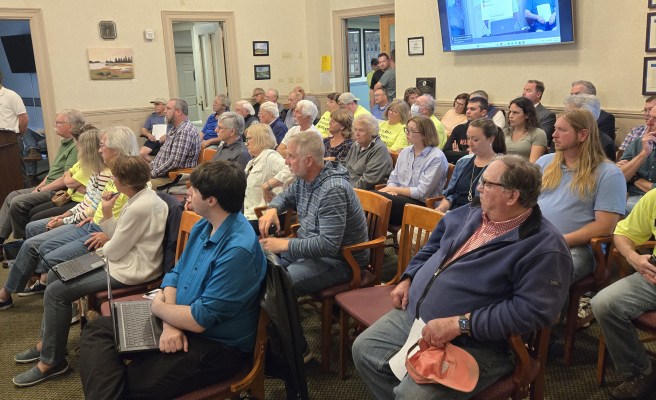
A small group of slightly more than 40 people attended a Biddeford Planning Board site walk near the location of where the University of New England wants to construct a new pier to dock its marine research vessel.

The proposed pier includes a 130-foot approach pier with an 80 by 20-foot pier head jutting out into the channel almost directly across from the Camp Ellis pier on the Saco River

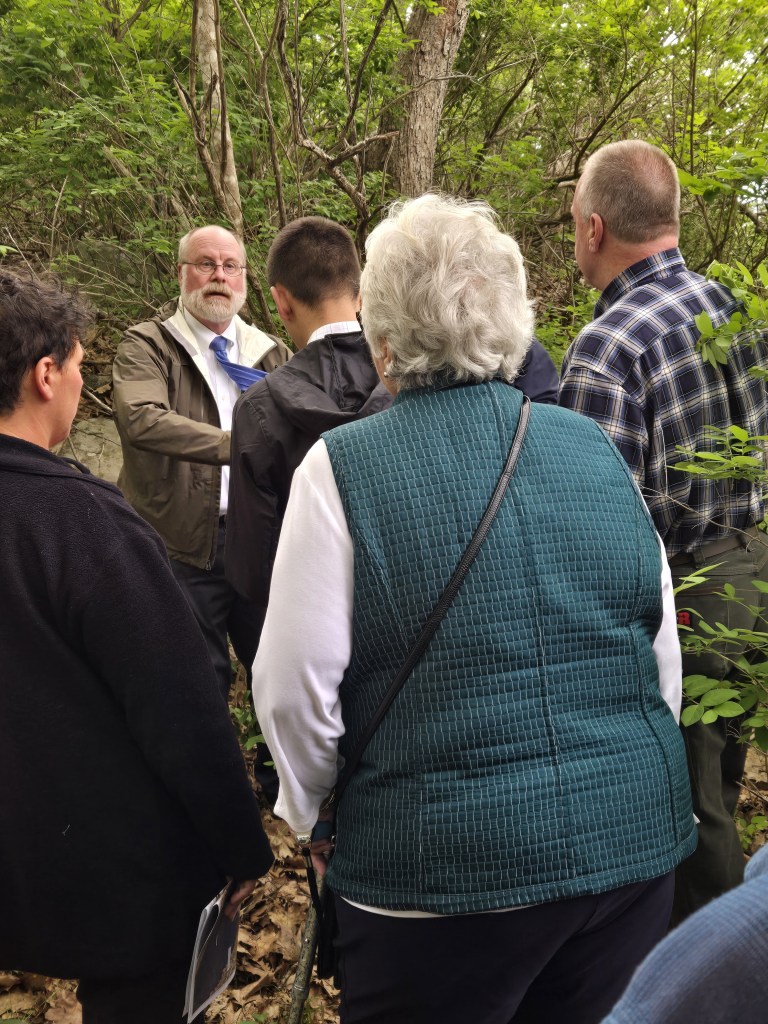
UNE Vice President Alan Thibeault answers questions for planning board members (Seaver photo)

The university’s proposal has generated considerable controversy over the past several months. During a preliminary Planning Board meeting last month, several members of the public raised concerns about the proposal including its potential impact to existing moorings and impacts on navigation and recreational fishing during low tide.

No members of the public spoke in favor of the proposal at that May 22 meeting.

Monday’s site walk lasted almost 45 minutes, requiring board members and the public to hike through a wooded area behind the school’s marine sciences center.

There was no opportunity for public comment or questions, but planning board members did ask several questions about the project, including the proposed height of the pier, how river current and tides could impact the pier and how exactly the pier would be constructed.

Alan Thibeault, the university’s vice president of operations, led board members to a spot overlooking the Saco River to answer questions and point out the exact area where the university hopes to build their pier.

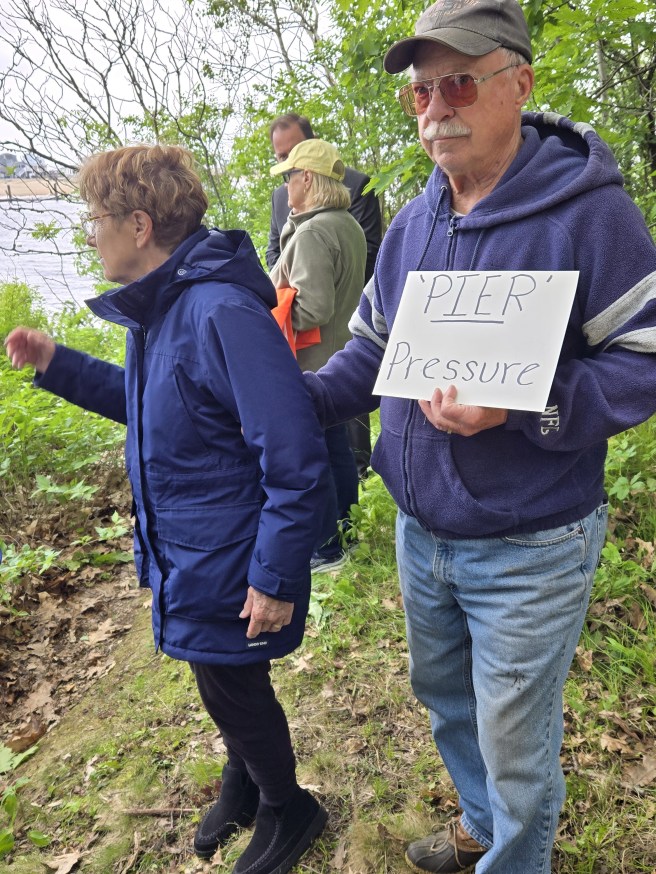
Ken Buechs of Biddeford made his feelings about the project known during Monday’s site walk (Seaver photo.)

Behind Thibeault, critics of the pier were sharing their own information about the project. Two small boats were anchored near the shore; one boat closest to the school’s proposed location and another boat slightly downriver where the city’s harbormaster and others say the pier should be located.

People on each of the small boats held up large placards to display the data from their depth-finding equipment. During the site walk, at low tide, the vessel closest to the school’s preferred location showed a water depth of six feet, while the other vessel showed a water depth of 12-feet.

Former City Councilor Patricia Boston was one of those who attended the site walk. Although water depth is technically not part of the criteria for the planning board, Boston said the board should pay attention to that issue.

A private boat owner holds up a placard showing a water depth of only six feet during low tide where the university hopes to build their pier. Another boat, slightly downstream, showed a water dept of 12 feet at the location where Biddeford’s harbormaster says the pier should be built. (Seaver photo)

“To me, it seems like a simple issue to objectively address,” Boston said. “This project is going to have significant impacts on the Saco River for generations to come. I’m hoping the planning board will consider all of the issues – from a planning perspective, it’s important to know all the information.”

“This project is going to have significant
impacts on the Saco River for
generations. I’m hoping the
planning board will consider
all of the issues”

— Patricia Boston, former city councilor

Boston said she is disappointed by how the university has been pushing the project forward. “Based just on what I have been reading and hearing, there seems to be some missed opportunities for collaboration, and I find that sad,” she said.

A few people from Saco also attended Monday’s site walk, including Kevin Roche, the president of SOS Saco Bay, a non-profit group focused on erosion issues in the Camp Ellis area. Roche did not return a phone call for comment, as of press time.

Matt Dubois, the newest member of the planning board, described the site walk as “informative and comprehensive.”

Former city councilor Kyle Noble — an outspoken critic of the project, holds a pole to demonstrate the height of UNE proposed pier

Susan Deschambault, another Planning Board member, said she appreciated the opportunity to see the exact location and ask questions about the project. “There are still more questions to be asked,” she said.

Members of the public paid close attention to UNE’s presentation during Monday’s site walk. (Seaver photo)

Earlier in the day, a group of private mooring owners who would be impacted by the proposal, issued a press release stating that they “are ready to be sued by the university” because they are unwilling to give up their mooring locations.

“I guess they don’t understand the English language over there at the college,” said Capt. Shawn Tibbetts, a commercial fisherman with a mooring location that would need to be moved. “We’re not moving. The site they want for their pier is unavailable to the University of New England.”

Planning board chair Alexa Plotkin described the site walk as somewhat unique. “This is not like driving into a parking lot and looking around,” she said. “I’m glad we had the opportunity to see the area that is not really visible on a daily basis.”

Plotkin said she was pleased by the turnout and said the university’s proposal will be back on the planning board’s agenda for its next meeting on June 18.

Randy Seaver is the editor and founder of the Biddeford Gazette. He may be contacted by email: randy@randyseaver.com

Never miss another update! Subscribe for free today!

Mayor defends city review of UNE pier proposal

During a sometimes terse and heated meeting, Biddeford Mayor Marty Grohman defended the way the city has acted during the review of a controversial pier that the University of New England wants to construct on the Saco River.

The nearly hour-long meeting was held at the request of John Schafer, the former chair of the Biddeford Harbor Commission and a Hills Beach resident who has been outspoken about the need for transparency during the review process.

City Attorney Harry Center also took part in the late Monday morning meeting in Grohman’s second-floor office at City Hall.

Center stressed that the meeting was strictly informal and not part of the review process. “The mayor has simply set aside some time to listen to the concerns of a constituent,” he said.

Hills Beach resident and former chair of Biddeford’s Harbor Commission John Schafer points to a diagram that shows inadequate depth where UNE is hoping to build a 177-foot pier to dock its research vessel near the mouth of the Saco River (Seaver photo)

No one from the university was at the meeting, and other media outlets declined invitations to attend, according to Schafer.

Schafer’s concerns center on three essential points: the impact and necessary removal of at least seven private moorings on the river if the project is approved; concerns about the water depth where the university wants to construct its pier; and the process that has been used to review the university’s proposal.

The permitting process for the proposed pier is complex and multi-layered, requiring the review and approval by several state, federal and local agencies.

Earlier this year, UNE cleared two major hurdles in the review process, winning approval from both the Saco River Corridor Commission and the U.S. Army Corps of Engineers.

But a very critical part of the review process is expected to begin in just a few weeks when the Biddeford Planning Board begins its formal review of the proposal.

“I don’t have any say over what the Planning Board does or doesn’t do,” Grohman said during Monday’s meeting. “I simply appoint members, and those appointments are then confirmed by the council. I think we have a really good planning board, and I have full confidence in them.”

But Schafer said he is concerned about the lack of public input during the review process and how the city has approached the project thus far. He also criticized the university for its “lack of transparency” and for “bullying those who raise questions and concerns” about the proposed pier.

“I think [UNE’s] application is both incomplete and full of misinformation,” Schafer told the mayor. “Don’t you think it’s a bit presumptuous for a private entity to dictate how the city will review its application; to show no regard for those who have private moorings in that area just so they can construct a vanity pier?”

When contacted by the Biddeford Gazette, a university spokesperson declined an opportunity to address Schafer’s remarks.

“Since this was not an open meeting and a representative from UNE was not present, it would not be appropriate to comment on the conversation that took place,” wrote Sarah Delage in an email response. “UNE will continue to follow the public regulatory process, and we look forward to presenting our application to the Planning Board.”

Schafer said he and “a growing coalition of residents” have no problem with the university building a pier to dock its 60-foot research vessel. Instead, he says, all the concerns boil down to the exact location of the pier and the dismissal of public concerns about the project.

Survey says?

Schafer roundly criticized Grohman for allowing former City Manager James Bennett to “silence” the city’s harbormaster and assistant harbormaster last year, preventing them from participating in the city’s review of the proposal simply because they voiced concerns about the pier’s location.

But Grohman shot back and said Bennett was simply trying to avoid the appearance of bias. He also reminded Schafer that the harbormaster’s role – as outlined in city ordinances – is strictly an “advisory position,” a change that was first proposed by Schafer himself last year when he was chair of the harbor commission.

Schafer said a growing number of residents have serious concerns about a review process that seems to have a pre-ordained outcome, pointing to the results and comments found in a recent public survey about the project.

Nearly 40 percent of respondents indicated that they had a
“very low” level of confidence in the city’s handling of the review process,
while roughly 30 percent of respondents indicated that they
had “moderately low” confidence in the city’s handling of the matter.

The online survey was conducted over several days in late April on a Facebook page called “UNE Pier Review,” a group that Schafer has helped organize.

The survey asked respondents a wide range of questions about the proposed pier and the review process thus far. The survey allowed respondents to maintain their anonymity.

The multi-question survey included feedback from 156 respondents, showing an overwhelming lack of public confidence on the issues of transparency and the mayor’s handling of the issue.

Nearly 40 percent of respondents indicated that they had “very low” level of confidence in the city’s handling of the review process. And roughly 30 percent of respondents indicated that they had “moderately low” confidence in the city’s handling of the matter.

City Attorney Harry Center (left) and Mayor Marty Grohman listen as John Schafer details his concerns about UNE’s proposal

Fewer than 10 percent of respondents indicated that they had “very high” confidence in the process, while slightly less than 20 percent of respondents indicated that they are not sure.

Many respondents added comments saying the city has been “too secretive” while other questioned the motives of city officials, speculating that some members of the city seem to have a “cozy relationship” with the university.

Grohman described the survey as “interesting,” but also said it was not a professional survey conducted by a polling firm.

“An anonymous survey is not something that a public permitting process could use, as it does not include an opportunity for all parties involved to publicly comment,” Grohman wrote in a text message to the Gazette after the meeting.

Schafer told the mayor that several mooring owners have already written to regulatory authorities stating quite plainly that they have “no intentions of moving their moorings where UNE wants to build their pier.”

Schafer also said that UNE has threatened the city with litigation if its desired location for the pier is not approved, referencing a letter sent to the city by Ron Schneider, the university’s lead attorney, several months before the university had submitted its application for review.

Grohman described Schafer as a good friend, and said he was happy to hear the concerns that were raised.

In a moment of levity during the meeting, Grohman pointed out that the mayor does not vote on or control the regulatory review process. “I don’t have the authority to change what sodas are sold in the vending machines downstairs,” Grohman laughed.

After the meeting Schafer said he very much appreciated the opportunity to share his concerns with the mayor. “Nothing in the meeting surprised me,” he said. “It’s about what I expected.”

Never miss another update! Subscribe for free today!

UNE Refuses Citizen Request for Information

The University of New England (UNE) is, apparently, refusing to provide information to the public and the media about a federal grant the university received to construct a new “research pier” on the banks of the Saco River.

Over the last few weeks, John Schafer, a Hills Beach resident and former chair of Biddeford’s Harbor Commission, has repeatedly tried to get documents regarding a $3.5 million federal grant that the university received from the National Institute of Standards and Technology (NIST).

In previous interviews, the university says it is planning to use those funds to build a permanent pier on the Saco River that can accommodate its 60-foot marine research vessel.

Schafer says he and other residents simply want to see documents related to the grant. “I am a big believer in transparency and accountability,” he said. “I don’t understand why the university is unwilling to release details about a grant award of public funds. What are they hiding?”

The Biddeford Gazette attempted to contact both the university’s president James Herbert and Alan Thibeault, vice president of operations, for comment. Neither Herbert nor Thibeault returned our calls as of press time.

Sarah Delage, associate vice president of communications, replied to our inquiries with a one sentence response: “The University of New England has provided, and will continue to provide, all required and relevant documentation to the regulatory agencies and governmental bodies conducting the permitting process for our proposed research pier.”

After receiving that email from Delage, we sent another email inquiry to her, asking why the university is unwilling to simply share those documents with members of the public, especially those who live in close proximity to the school’s Biddeford campus.

Delage did not respond to our second email inquiry, as of press time.

The university formally submitted its plan for a new pier to the city of Biddeford in June last year. The grant application, however, was submitted several months prior.

UNE is still facing an arduous and likely lengthy review process for their proposal. In addition to the city of Biddeford, the U.S. Army Corps of Engineers and the Maine Department of Environmental Protection will need to review the proposed project.

Go here to see a copy of the application that the university submitted to the city of Biddeford.

RELATED: City review of UNE project remains unclear.

Schafer said he has been bending over backward to be courteous and professional with his requests, but says he feels as if he is being stonewalled by the university.

Schafer, wrote Herbert on January 21, asking the university president to release a copy of the application the university submitted to NIST.

Herbert, Schafer says, did not reply.

According to a recent press release issued by Schafer, Alan Thibeault called Schafer and told him that he did not need to see the application, while also saying that the university is “not required” to release it.

“I don’t get it. Why are they being so stubborn? There are no national security issues here.”

John Schafer

Thibeault did not respond to our request for comment.

Schafer says that Thibeault “reluctantly agreed to ask about permission to release the application and said he’d be back in touch.”

“I never heard back from him,” Schafer said. “At first, our conversation was very cordial, but it quickly became terse.”

Schafer says that Thibeault told him there was nothing in the grant application that wasn’t already given to various regulatory agencies.

Schafer then sent a second email to Hebert a few days later. Once again, Schafer asked to see the grant application, saying the documents should be available in the interest of transparency.

The university president has also not responded to Schafer’s second email request for disclosure.

“I don’t get it,” Schafer said. “Why are they being so stubborn? There are no national security issues here. These should be public documents. The public has a right to know how UNE presented their project to the federal government.”

Schafer commended both Biddeford City Manager James Bennett and Mayor Marty Grohman for informing UNE last year that the location of the proposed pier is not in any way approved by the city.

“The application filed with NIST could very well affect Biddeford’s regulatory process, but UNE doesn’t want it released to me, Biddeford or Saco. Luckily, freedom of information laws exist to deal with this type of obstruction,” Schafer said.

Never miss another update! Subscribe for free today!