City is on the right track in its thoughtful, measured review of UNE development plans
I read the recent letter regarding the University of New England review committee with concern, but also with a sense that the issue deserves a more balanced perspective.
It is important to remember that residency alone does not disqualify someone from serving fairly or objectively. Hills Beach residents are citizens of Biddeford, just as much as anyone living downtown, in the mills district, or elsewhere in the city. Suggesting that they are inherently incapable of acting in the broader public interest risks dividing our community rather than strengthening it.
The committee’s role is to review plans and gather input — including through a public hearing — not to act as “plaintiffs” or to obstruct progress. The public hearing itself is evidence of a transparent process that invites participation from the entire community.
The University of New England is indeed an asset to Biddeford. Its educational, economic, and cultural contributions are significant. At the same time, thoughtful review of development proposals is not the same as impeding progress. Responsible growth benefits from careful consideration of environmental impact, neighborhood character, traffic, infrastructure, and long-term planning. That is not obstruction — that is governance.
________________
“Thoughtful review of development proposals
is not the same as impeding progress.”
________________
If residents are concerned about representation, the solution is engagement. Attend the hearing. Submit comments. Volunteer for boards and committees. Run for office. Democracy functions best when more voices participate — not when we question the legitimacy of neighbors simply because of where they live.
Biddeford is stronger when we work together — university community, beach residents, mill district entrepreneurs, and long-time families alike. Let’s focus on collaboration rather than division.
Mark Poirier,Biddeford
NOTE: The Biddeford Gazette strongly encourages reader feedback and public commentary regarding our coverage and issues directly related to the city of Biddeford. To submit a letter to the editor or guest column, please contact us at biddefordgazette@gmail.com
Never miss an update! Subscribe for free today!
THE BIDDEFORD GAZETTE | A Legacy of Trusted, Independent Journalism
According to blogger Mat Zucker, it is becoming more and more important for news outlets to have a pithy, clever tagline that differentiates them from an overflowing pot of news sources and media sites.
“The motto of a news organization is more than just marketing,” Zucker writes. “It’s a declaration of journalistic purpose. These short phrases encapsulate an outlet’s mission, values, and unique approach to reporting.”
Help the Gazette create a tagline, get a gift certificate to Reilly’s Bakery File photo
As the Biddeford Gazette begins its second year, I’m asking our readers for suggestions and ideas about a possible tagline for our humble, hyper-local organization.
To get your creative juices flowing, here are a couple of ideas that have been rattling around in my mind.
We could co-opt the New York Times famous tagline: “All the news that’s fit to print,” how about this?
The Biddeford Gazette — All the Biddeford news that’s fit to publish on the internet.
Or maybe we could bend this oft-mentioned piece of writing advice:
Biddeford Gazette — An economy of words; a wealth of Biddeford information
One of my favorite potential taglines came to me last year while talking with former mayor Marty Grohman:
The Biddeford Gazette — We’re free, and we’re worth it!
Of course, we could always take the serious and boring route:
The Biddeford Gazette — Your trusted source for Biddeford news and information;
According to the experts, your tagline should really describe your brand and reputation. So, how about:
The Biddeford Gazette — There’s no such thing as a day off in our newsroom?
But my all-time favorite has to be this one from a former colleague who wished to remain anonymous:
The Biddeford Gazette — Where cranky, old-school journalists go to die in southern Maine.
That story was one of the most popular pieces we have published. Dozens of people emailed me their own recollections and the stories that were passed down from generation to generation.
At first blush, I considered Malon’s proposal to be yet another example of government overreach into private affairs, but he convinced me otherwise.
In closing, a funny story about the power and benefit of local news, the flexibility of the internet and accessible reporters. Malon really liked the story, but he was a bit uncomfortable with our original headline: “Online gambling addiction troubles Biddeford lawmaker.”
When Malon texted me to ask if we could change the headline, I was more than happy to oblige. Some people were inferring that Malon was having personal problems with a gambling addiction.
One of my old editors – Harry Foote – was likely rolling in his grave. I had forgotten the most basic fundamentals of headline writing: Short, clear in subject-verb-object order.
And that’s a wrap! Stay warm and be safe!
P.S. Oh, yeah. . . . almost forgot to mention: The Biddeford Gazette is now a registered and incorporated as a non-profit entity in the state of Maine!
____________
Randy Seaver is the editor and founder of the Biddeford Gazette. He may be reached by email: randy@randyseaver.com
c.) 2026 All Rights Reserved, Biddeford Gazette, Inc.
Never miss another update! Subscribe for free today!
The University of New England (UNE) and the Saco River Corridor Commission (SRCC) are both asking the York County Superior Court to dismiss a civil complaint that was filed against them by the city of Biddeford.
The requests for dismissal were each filed earlier this month after the city formally brought its complaint to the court in December.
The city’s complaint — according to City Attorney Harry Center – was triggered by new information that came to light in an Oct. 14, 2025 story published by the Biddeford Gazette: UNE Pier approval tainted by glaring SRCC mistake.
The Superior Court has yet to hear oral arguments in Biddeford’s complaint about the University of New England and the Saco River Corridor Commission.
At the center of its complaint, the city argues that the SRCC neglected to consider its earlier ruling in 2001, which created a 250-foot no-development buffer zone between UNE’s campus and the Saco River.
Despite that 2001 ruling, the SRCC approved UNE’s request to construct a large-scale pier on the Saco River in August 2024. That pier will require construction of a paved access road through the buffer zone.
In October, SRCC Executive Director Cherie Dunning described the situation as a mistake that could not be remedied retroactively because the time frame for an appeal of the agency’s decision has expired.
“It does appear that there was an omission of relevant information provided to the commissioners before last year’s vote,” Dunning told the Gazette in October.
Only weeks after the city’s biennial election, Biddeford’s new mayor and city councilors decided that the issue warranted further review and consideration.
Center told the Gazette this week that the court has yet to hear any arguments. He also said that he – on behalf of the city – has filed a request to have the court hear oral arguments.
In their motion to dismiss, the university listed several reasons why the city’s complaint should be dismissed by the court, arguing that the “court lacks jurisdiction to consider the untimely complaint and that the city failed to exhaust any administrative remedies.”
Furthermore, UNE claims that the Saco River Corridor Commission did not fail to do its due diligence in reviewing the university’s application.
The university also says the city does not have standing to bring the complaint.
As part of his campaign promise to increase government transparency, accountability and citizen participation, newly-elected Biddeford Mayor Liam LaFountain unveiled his plan to create a new ad-hoc committee that will oversee all development on the University of New England’s Biddeford campus.
LaFountain’s plan was warmly received by both the city council and members of the public during the new city council’s first official meeting on Tuesday.
The Biddeford City Council unanimously approved to revise a new Institutional Zone Review Committee to make recommendations regarding development at UNE’s Biddeford campus.
The new committee will focus on the city’s “Institutional Zone,” which includes all of the University of New England’s Biddeford campus.
According to LaFountain, the Institutional Zone (IZ) regulates university uses and requires that all campus development must strictly follow the outlines of the university’s approved Master Plan, which is updated every five years.
“Over time, the scale of institutional activity has increased and carries significant implications for transportation systems, utilities, public safety, neighborhoods and long-range planning,” LaFountain wrote in a memo to the city council.
According to the mayor, the Institutional Zone and Institutional Master Plan ordinances – first adopted in 2001 — have not been comprehensively reviewed in more than two decades.
Recent projects have highlighted the need for the committee, LaFountain said, pointing to the university’s controversial pier project, plans to develop a fire substation near the campus and a plan to convert a former convalescent home into new dormitories for the university.
LaFountain said the new ad hoc committee will conduct a focused review and return recommendations to the city council.
The mayor said the committee will “meet frequently, solicit public input and present initial recommendations by April 2026; and final recommendations by June 2026.”
Several representatives from the University of New England — including the school’s senior attorney and its vice president of operations — attended Tuesday’s meeting.
Ed Cervone, director of external affairs at UNE, said the university is supportive of the desire to review the Institutional Zone Ordinance.
“UNE hopes that the creation of an Institutional Zone Review Committee can bring additional clarity to, understanding of, and confidence in the ordinance,” Cervone said.
Cervone reminded the council that when the IZ was first created, a similar kind of committee was organized and included a representative from the university. He also suggested that the new committee should include a Hills Beach Association representative; the city planner and Ward One Councilor Patricia Boston because of her historical knowledge about the Institutional Zone.
“UNE is in a highly competitive economic sector and must quickly adapt to meet the demands of the market,” Cervone said. “This includes maintaining and improving its infrastructure to attract and retain students.”
“UNE takes seriously its responsibility as one of the city’s largest employers. We are proud to employ many community members from Biddeford and the surrounding region, offering them good paying jobs with excellent benefits for their families,” he added.
“This is not possible without regulatory clarity, predictability and a responsive partner in the city,” he said.
Resident Mark Robinson described the new committee as a “fantastic idea” and said it will squarely address citizen concerns that have been intensifying over the last few years.
When it comes to deciding who should serve on the new committee, Robinson said he had full faith and confidence in the mayor and the council’s ability to appoint members to serve on the committee.
Former city councilor Richard Rhames said creating the new committee is “more than appropriate” and “arguably long overdue.”
_____________
Randy Seaver is the editor and founder of the Biddeford Gazette. He may be reached by email: randy@randyseaver.com
c.) 2025 All Rights Reserved
Never miss another update! Subscribe for free today!
The University of New England cleared another hurdle Thursday when the Biddeford Zoning Board of Appeals (ZBA) voted unanimously to reject an appeal of the university’s proposed research pier.
Although the Biddeford Planning Board narrowly approved the controversial pier in August, a group of private citizens – led by the former chair of the Biddeford Harbor Commission – filed an appeal of the planning board’s approval.
Thursday’s meeting lasted only a few minutes, despite an agenda packet of more than 3,000 pages of information related to the project.
The Biddeford City Council Chamber was packed for Thursday’s Zoning Board of Appeals meeting regarding the University of New England’s proposed pier. (Seaver photo)
ZBA members did not discuss specifics about the pier, its location or the city’s review process of the project. The discussion instead centered on whether the citizen appellants had legal standing to appeal the planning board’s prior approval.
Ron Schneider – the university’s senior attorney – told ZBA members that the citizen appellants had “no standing” to file an appeal because they were not injured by the planning board’s earlier approval.
Biddeford resident Matt Haas, a former UNE employee, spoke for the appellants and said the citizens group was made up of an “organic” group of citizens, including property abutters and mooring owners who will be displaced by the large pier.
Schneider rejected that argument, pointing out that only Schafer’s name was listed on the appeal filed in September.
“You cannot just add names as you go along,” Schneider argued before the ZBA, pointing out that Schafer lives more than a mile away from where the large pier will be built. “Otherwise, this just becomes a game of whack-a-mole.”
City Attorney Harry Center told the ZBA that they should send the issue back to the planning board for further review.
“New information has recently come to light,” Center said. “The appellants do have standing.”
Center previously supported the planning board’s decision but now says new information about a 250-foot, non-development buffer zone created nearly 25 years ago should trigger a reconsideration of that decision.
“This just becomes a game of whack-a-mole.”
— Ron Schneider, UNE’s senior attorney
As originally reported in the Biddeford Gazette, that buffer zone was overlooked and not raised as an issue of concern during the nearly two-year review process.
The Biddeford City Council voted unanimously last week to seek guidance and advice from the Maine Attorney General’s Office about the buffer zone and its impact on the university’s plans.
When asked for comment about Thursday’s ZBA decision, a university spokesperson said the zoning board followed the city charter’s requirements for appeals.
“These rules exist to ensure fairness and clarity in the appeals process,” said Sarah Delage, vice president of communications.
“UNE looks forward to moving ahead with this important research facility that will benefit Maine’s marine environment, economy and students for generations to come,” she added. “We remain committed to being good neighbors and responsible community partners.”
When asked about next steps for the citizen’s coalition, Haas said the group has to rely on the city council for relief.
“The city seems to understand the significance of the buffer zone, and it is heartening to see them pursue that issue with the attorney general’s office,” he said.
“This is not the end of the story,” Haas said.
______________
Randy Seaver is the editor and founder of the Biddeford Gazette. He may be reached by email: randy@randyseaver.com
c.) 2025 All Rights Reserved
Never miss another update! Subscribe for free today!
City attorney finds new info, says UNE pier should go back to planning board
By RANDY SEAVER, Editor
Biddeford City Attorney Harry Center says that the Biddeford Planning Board should reconsider its prior approval of the University of New England’s controversial research pier.
Although the planning board narrowly approved the university’s proposal in August, Center now says the Planning Board should reconsider that approval based on new information that came to light a few weeks ago.
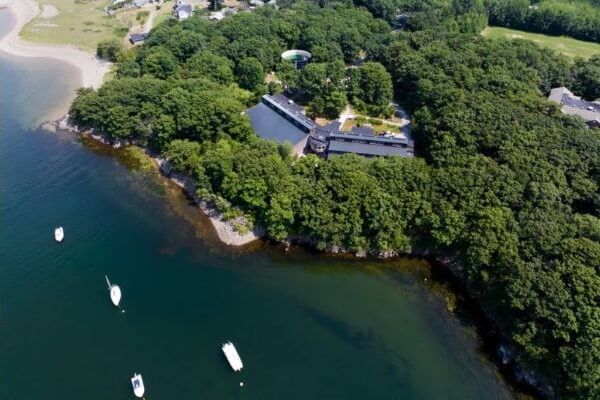
An aerial view of where UNE wants to build its research pier (Courtesy photo)
As first reported in the Biddeford Gazette, the Saco River Corridor Commission (SRCC) failed to consider a previous ruling that created a 250-foot, no-development, vegetative buffer zone on the university’s campus in 2001.
Shortly after the Planning Board approved the controversial project, a group of residents filed an appeal with the Biddeford Zoning Board of Appeals (ZBA).
The ZBA is expected to take up the matter at its next meeting on Thursday.
Center, representing the city’s Planning Board, filed a request Monday with the ZBA on behalf of the planning board and Biddeford’s planning department.
Center also discovered that the permit issued to UNE by the U.S. Army Corps of Engineers may have expired.
“In the last 10 days, far too many legal questions have been raised.”
— City Attorney Harry Center
A university spokesperson said the permit they received from the Army Corps is still in effect, and said the 250-foot no-development zone does not preclude appropriately permitted development.
Sarah Delage, vice president for communications at UNE, said the university received clarification from the U.S. Army Corps of Engineers in August that their permit remains in effect.
“The project was required to start prior to October 14, 2025, and the [Army Corps] has confirmed that the design and permitting process, which was underway well before that date, satisfies this condition.
Delage also said that “there is no inconsistency between UNE’s master plan –which was previously approved by the Biddeford Planning Board — and development within this buffer zone.
When asked about the legality of the SRCC’s permit, Delage said the SRCC’s executive director recently clarified that the approval remains valid and is neither under review nor in question at the SRCC office.
“The [SRCC] executive director sent her letter after consulting with the Maine Assistant Attorney General, who represents the SRCC,” Delage said.
“The university has carefully followed all legal and regulatory processes in permitting the project, and looks forward to continuing to do so,” she added.
Center said he has also researched prior versions of UNE’s master plan, and that those records reveal “that the University of New England’s master plan also references a 250-foot, no-development buffer.”
Red Flags Raised
Center said major red flags were then raised when Cheri Dunning, the executive director of the Saco River Corridor Commission (SRCC), wrote an unsolicited letter on October 20 to Roby Fecteau, Biddeford’s code enforcement officer.
In that letter to Fecteau, Dunning created the impression that the SRCC — while issuing UNE a permit for the pier — had deliberately overridden the 2001 order creating the buffer. She implied that present-day commissioners consciously intended to create new law. “The condition was created by, and thus can be altered by, the Commission,” she wrote.
Dunning specifically stated that the 2001 order was not discussed during the SRCC hearing. The current commissioners absolutely did not engage in any deliberative process to override the law created in 2001, according to the minutes from the August 2024 meeting.
Since the buffer was never even mentioned, the commissioners were flying blind, Center said.
“My legal analysis is that the order creating the 250-foot buffer remains in place, at least until the Attorney General’s office tells us that it has been rescinded by the commission,” Center said.
“The university has carefully followed all legal and regulatory processes in permitting the project, and looks forward to continuing to do so.”
— Sarah Delage, UNE spokesperson
Center said the ZBA has the jurisdiction to send UNE’s application back to the planning board, and given all the new information that has surfaced, it should do so.
Furthermore, Center said the city may ask a judge to overrule the SRCC’s approval of a permit for UNE’s pier, and recent statements by Dunning that the 250-foot buffer and other SRCC decisions can be ignored by regulatory authorities.
“In the last 10 days, far too many legal questions have been raised,” he said.
Center said he has the full support of Mayor Martin Grohman and the Biddeford City Council to advise the ZBA as he did today.
Last week, the Biddeford City Council unanimously voted to seek clarification and guidance from the Maine Attorney General’s office regarding the 250-foot buffer zone.
The council’s resolution stated that the city “will withhold further permitting or authorization related to the proposed UNE pier to ensure full compliance with applicable state law.”
Center says he firmly stands by his previous legal advice on other issues related to UNE’s application.
“I have one duty, and that is to properly advise my client on legal issues at all times. New information has come to light, and I’ll continue to execute my professional responsibilities accordingly,” Center said.
_______________
Randy Seaver is the editor and founder of the Biddeford Gazette. He may be reached by email: randy@randyseaver.com
c.) 2025 All Rights Reserved
Never miss another update! Subscribe for free today!
During a sometimes terse and heated meeting, Biddeford Mayor Marty Grohman defended the way the city has acted during the review of a controversial pier that the University of New England wants to construct on the Saco River.
The nearly hour-long meeting was held at the request of John Schafer, the former chair of the Biddeford Harbor Commission and a Hills Beach resident who has been outspoken about the need for transparency during the review process.
City Attorney Harry Center also took part in the late Monday morning meeting in Grohman’s second-floor office at City Hall.
Center stressed that the meeting was strictly informal and not part of the review process. “The mayor has simply set aside some time to listen to the concerns of a constituent,” he said.
Hills Beach resident and former chair of Biddeford’s Harbor Commission John Schafer points to a diagram that shows inadequate depth where UNE is hoping to build a 177-foot pier to dock its research vessel near the mouth of the Saco River (Seaver photo)
No one from the university was at the meeting, and other media outlets declined invitations to attend, according to Schafer.
Schafer’s concerns center on three essential points: the impact and necessary removal of at least seven private moorings on the river if the project is approved; concerns about the water depth where the university wants to construct its pier; and the process that has been used to review the university’s proposal.
The permitting process for the proposed pier is complex and multi-layered, requiring the review and approval by several state, federal and local agencies.
Earlier this year, UNE cleared two major hurdles in the review process, winning approval from both the Saco River Corridor Commission and the U.S. Army Corps of Engineers.
But a very critical part of the review process is expected to begin in just a few weeks when the Biddeford Planning Board begins its formal review of the proposal.
“I don’t have any say over what the Planning Board does or doesn’t do,” Grohman said during Monday’s meeting. “I simply appoint members, and those appointments are then confirmed by the council. I think we have a really good planning board, and I have full confidence in them.”
But Schafer said he is concerned about the lack of public input during the review process and how the city has approached the project thus far. He also criticized the university for its “lack of transparency” and for “bullying those who raise questions and concerns” about the proposed pier.
“I think [UNE’s] application is both incomplete and full of misinformation,” Schafer told the mayor. “Don’t you think it’s a bit presumptuous for a private entity to dictate how the city will review its application; to show no regard for those who have private moorings in that area just so they can construct a vanity pier?”
When contacted by the Biddeford Gazette, a university spokesperson declined an opportunity to address Schafer’s remarks.
“Since this was not an open meeting and a representative from UNE was not present, it would not be appropriate to comment on the conversation that took place,” wrote Sarah Delage in an email response. “UNE will continue to follow the public regulatory process, and we look forward to presenting our application to the Planning Board.”
Schafer said he and “a growing coalition of residents” have no problem with the university building a pier to dock its 60-foot research vessel. Instead, he says, all the concerns boil down to the exact location of the pier and the dismissal of public concerns about the project.
Survey says?
Schafer roundly criticized Grohman for allowing former City Manager James Bennett to “silence” the city’s harbormaster and assistant harbormaster last year, preventing them from participating in the city’s review of the proposal simply because they voiced concerns about the pier’s location.
But Grohman shot back and said Bennett was simply trying to avoid the appearance of bias. He also reminded Schafer that the harbormaster’s role – as outlined in city ordinances – is strictly an “advisory position,” a change that was first proposed by Schafer himself last year when he was chair of the harbor commission.
Schafer said a growing number of residents have serious concerns about a review process that seems to have a pre-ordained outcome, pointing to the results and comments found in a recent public survey about the project.
Nearly 40 percent of respondents indicated that they had a “very low” level of confidence in the city’s handling of the review process, while roughly 30 percent of respondents indicated that they had “moderately low” confidence in the city’s handling of the matter.
The online survey was conducted over several days in late April on a Facebook page called “UNE Pier Review,” a group that Schafer has helped organize.
The survey asked respondents a wide range of questions about the proposed pier and the review process thus far. The survey allowed respondents to maintain their anonymity.
The multi-question survey included feedback from 156 respondents, showing an overwhelming lack of public confidence on the issues of transparency and the mayor’s handling of the issue.
Nearly 40 percent of respondents indicated that they had “very low” level of confidence in the city’s handling of the review process. And roughly 30 percent of respondents indicated that they had “moderately low” confidence in the city’s handling of the matter.
City Attorney Harry Center (left) and Mayor Marty Grohman listen as John Schafer details his concerns about UNE’s proposal
Fewer than 10 percent of respondents indicated that they had “very high” confidence in the process, while slightly less than 20 percent of respondents indicated that they are not sure.
Many respondents added comments saying the city has been “too secretive” while other questioned the motives of city officials, speculating that some members of the city seem to have a “cozy relationship” with the university.
Grohman described the survey as “interesting,” but also said it was not a professional survey conducted by a polling firm.
“An anonymous survey is not something that a public permitting process could use, as it does not include an opportunity for all parties involved to publicly comment,” Grohman wrote in a text message to the Gazette after the meeting.
Schafer told the mayor that several mooring owners have already written to regulatory authorities stating quite plainly that they have “no intentions of moving their moorings where UNE wants to build their pier.”
Schafer also said that UNE has threatened the city with litigation if its desired location for the pier is not approved, referencing a letter sent to the city by Ron Schneider, the university’s lead attorney, several months before the university had submitted its application for review.
Grohman described Schafer as a good friend, and said he was happy to hear the concerns that were raised.
In a moment of levity during the meeting, Grohman pointed out that the mayor does not vote on or control the regulatory review process. “I don’t have the authority to change what sodas are sold in the vending machines downstairs,” Grohman laughed.
After the meeting Schafer said he very much appreciated the opportunity to share his concerns with the mayor. “Nothing in the meeting surprised me,” he said. “It’s about what I expected.”
Never miss another update! Subscribe for free today!








 BIDDEFORD GAZETTE