
By RANDY SEAVER, Editor
Kevin Roche — a former Saco city councilor and current member of the Saco School Board — has publicly criticized Biddeford Mayor Liam LaFountain and the Biddeford City Council for the way they are handling the review of a large pier being proposed by the University of New England.
In addition to serving on the Saco School Board, Roche is also the president of SOS Saco Bay, an organization formed to address erosion issues in Saco’s Camp Ellis neighborhood.
In a Dec. 19 email to LaFountain that was also sent to Biddeford City Manager Truc Dever and Saco Mayor Jodi MacPhail, Roche begins by suggesting that Biddeford and Saco officials should be working collaboratively on issues regarding the Saco River.
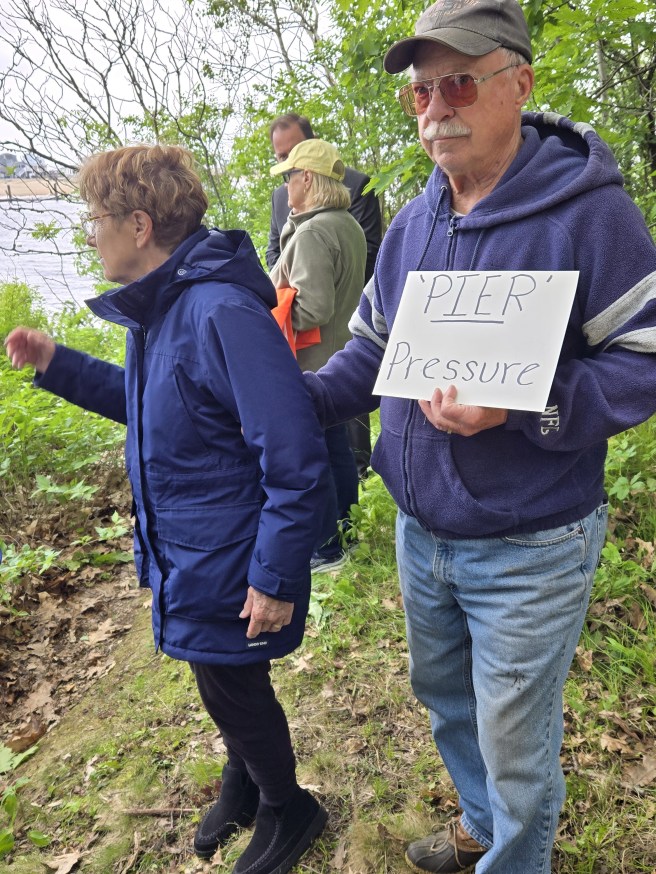
He then asserts that the city of Biddeford is being unduly influenced by a few residents who have raised concerns about UNE’s large-scaled pier project.
Specifically, Roche harshly criticized the city’s decision to file a formal complaint against the Saco River Corridor Commission (SRCC) regarding that agency’s approval of the proposed pier.
The city filed the complaint after learning that a 250-foot buffer zone was created more than 20 years ago through an agreement between UNE and the SRCC.
RELATED: City files complaint in York County Superior Court
Roche described the city’s complaint as a “fruitless endeavor” that will surely be rejected by the court.
“We are greatly troubled that the city of Biddeford has now taken the position that NO pier should be allowed due to a misreading of the 250-foot buffer zone,” Roche wrote in his email.
In his email, Roche strongly defended the university against complaints from residents who raised questions about the controversial project.

Roche pointed out that UNE students regularly volunteer to help put up holiday lights in downtown Biddeford, and how the university is involved in monitoring coastal issues as well as projects to replace dune sands on both sides of the river.
Roche describes the university as a “key partner” in a planned dredging project on the Saco River that is scheduled to begin next year.
In his email, Roche said a “larger pier research vessel is critical in providing even more benefit to our greater shoreline communities.”
Roche says the goal of those opposed to the pier project was never about the location of the pier, “they simply did not want UNE to have any presence on the river.”
It is unclear whether Roche spoke to or communicated with any of those who raised concerns about the pier project.
RELATED: Residents sound off about controversial pier project
Roche said opponents of the project “utilized slick PR guys, often posing as the press” in their attempt to derail the pier proposal.
He went on to say that the city of Biddeford has chosen to “govern based on hate and lies.” He provides no details or documentation regarding the “lies.”
Roche advised the city to do things “the right way” and should “follow facts, not fiction.” He also suggested that Biddeford should get rid of its own harbormaster and instead share Saco’s harbormaster for joint jurisdiction of river activities.
LaFountain told the Gazette that he has no plans to change the city’s current course in regard to review of UNE’s proposal or moving ahead in creating an ad-hoc Institutional Zone Review Committee to review development at UNE’s Biddeford campus.
RELATED: New committee will review development at UNE
“Our complaint with the SRCC is now before the court, so it would not be appropriate for me to comment on that matter until the court renders its decision,” LaFountain said.
“I believe we did the right thing and we are fully committed to moving forward by following criteria based upon fact, process and law, not inflammatory rhetoric.”
According to their March 20, 2025 quarterly report to their members and affiliates, SOS Saco Bay stated “We have grown our relationship with the University of New England which is doing some amazing work.”
According to that report, SOS Saco Bay was “also invited to participate in the UNE Summer Sustainability Fellowship Program, and stated that “UNE has committed to be a Platinum Supporter at our October Conference.”
Saco Mayor Jodi MacPhail told the Gazette that it would be inappropriate to comment on the views of a private organization, saying only that she is looking forward to working with Biddeford’s new mayor.
Roche did not answer any of the questions sent to him by the Biddeford Gazette. He did, however, offer a brief statement, saying “SOS Saco Bay takes no formal position on the pier location debate, but we maintain that a research pier would be a huge asset in our fight against coastal erosion.
“We feel that anyone standing in opposition to the pier is in opposition of what we are trying to do. We have not heard any arguments that a research pier will cause undue harm to our coastal waterways and shorelines.”
You can view/download a copy of Mr. Roche’s Dec. 19 email here:
_____________
Randy Seaver is the editor and founder of the Biddeford Gazette. He may be reached by email: randy@randyseaver.com
c.) 2025 All Rights Reserved
Never miss another update! Subscribe for free today!




 BIDDEFORD GAZETTE