City files court challenge for UNE pier approval

By RANDY SEAVER, Editor

Although the Biddeford Planning Board narrowly approved the University of New England’s controversial pier proposal in August, a required building permit will not be issued by the city until a decision comes down from the York County Superior Court.

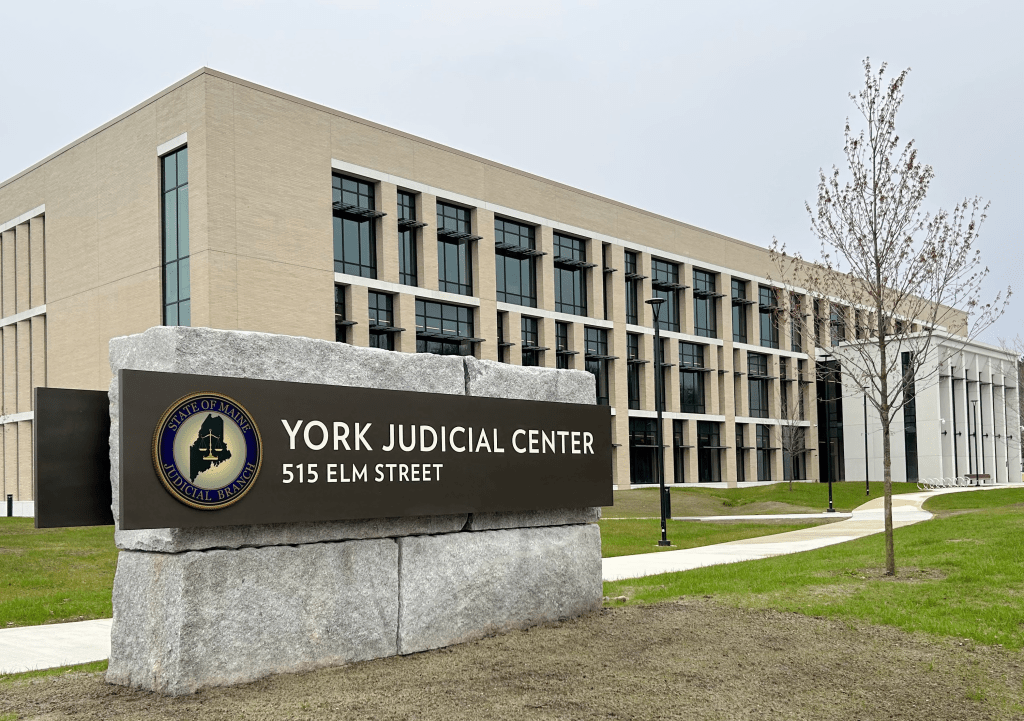
The city has filed a formal complaint against the Saco River Corridor Commission (SRCC), a quasi-state agency tasked to review and control development on the Saco River.

The city of Biddeford will not issue a building permit for UNE’s controversial pier proposal until a decision regarding the validity of the review process comes from York County Superior Court

As first reported in the Biddeford Gazette, new questions were raised in October about the review process. Specifically, the city now says that a previous decision by the SRCC — from more than 24 years ago — should have disqualified the project.

RELATED: UNE pier approval tainted by glaring mistake

In 2001, the SRCC and the university created a 250-foot, no-development zone along the shoreline of UNE’s campus. That agreement was made as a compromise to allow construction of two dormitory buildings that would exceed a 35-foot height restriction.

The university is now hoping to construct an access road for its new pier through that buffer zone.

During their review of the university’s proposal last year, the SRCC failed to consider its previous ruling. “It was a mistake,” said Cheri Dunning, executive director of the SRCC during an October interview with the Gazette.

Dunning described the mistake as an “omission of information.” Because the agency’s approval happened more than 30 days ago, Dunning said there was nothing the SRCC could do to remedy the error.

“Our staff is working hard to prevent this type of error in the future,” Dunning said.

A few days later, Dunning sent an email to Roby Fecteau, the city’s code enforcement officer. In that email, she opined that the SRCC can alter any decision it makes. She also denied saying that the decision was a mistake on the part of the SRCC.

“The condition was created by, and thus can be altered by, the Commission,” Dunning wrote in her email to Fecteau.

When contacted Wednesday, Dunning refused to answer any questions that were not submitted to her in writing.

The Gazette sent Dunning an email, asking for comments and clarification. She did not respond to our inquiry, as of press time.

City Attorney Harry Center said the formal complaint was filed because the city wants to “maintain the integrity of the review process.”

“We’re not seeking money nor damages,” Center said. “We’re simply asking the court to instruct the SRCC to reconsider the permit.”

In early November, the Biddeford City Council voted unanimously to seek “guidance about the permit” from the Maine Attorney General’s office.

RELATED: Back to the drawing board for UNE?

The AG’s office declined the city’s request for intervention, citing the fact that the city has its own legal counsel and that the attorney general’s office would likely represent the SRCC in any legal action.

“Municipalities rely on consistent, lawful application of state permitting standards,” said Biddeford Mayor Liam LaFountain.

“When a statutory buffer required by a prior permit is overlooked, it is essential for the matter to be properly reviewed,” LaFountain said. “Our goal is to ensure that decisions affecting the Saco River comply fully with applicable law and long-standing environmental protections.”

Donald Furman serves as Biddeford’s representative on the Saco River Corridor Commission.

Furman, an attorney, said he had “no knowledge” of the city’s complaint, which was filed nearly two weeks ago.

“This is news to me,” Furman said when contacted by the Gazette.

In the city’s complaint to the court, the University of New England is listed as an interested party.

UNE spokesperson Sarah Delage said the university “respectfully disagrees” with the city’s position.

Delage said the permit issued in 2001 for new dormitory building does not preclude the building of an access road within the 250-foot vegetative buffer along the river.

“It allows for development within that zone if the SRCC reviews the plan and finds that it adequately maintains appropriate vegetation levels,” Delage wrote in a statement to the media. “During the SRCC approval process for this project, the SRCC provided feedback on UNE’s re-vegetation plan. The project that was ultimately approved reflects that feedback.  

Delage also said the university never claimed that the University would never propose any activity within the vegetative buffer.

“The research pier is an important educational and scientific asset that will support UNE’s marine science programs and contribute to environmental research benefiting our coastal community,” Delage wrote. “UNE is committed to responsible development and environmental stewardship of our waterfront campus.”

______________

Randy Seaver is the editor and founder of the Biddeford Gazette. He may be reached by email: randy@randyseaver.com

c.) 2025 All Rights Reserved

Never miss another update! Subscribe for free today!

Zoning Board sides with UNE

The University of New England cleared another hurdle Thursday when the Biddeford Zoning Board of Appeals (ZBA) voted unanimously to reject an appeal of the university’s proposed research pier.

Although the Biddeford Planning Board narrowly approved the controversial pier in August, a group of private citizens – led by the former chair of the Biddeford Harbor Commission – filed an appeal of the planning board’s approval.

Thursday’s meeting lasted only a few minutes, despite an agenda packet of more than 3,000 pages of information related to the project.

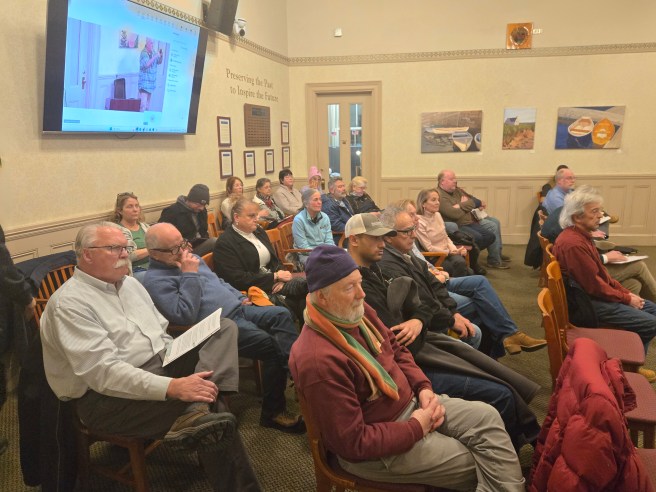
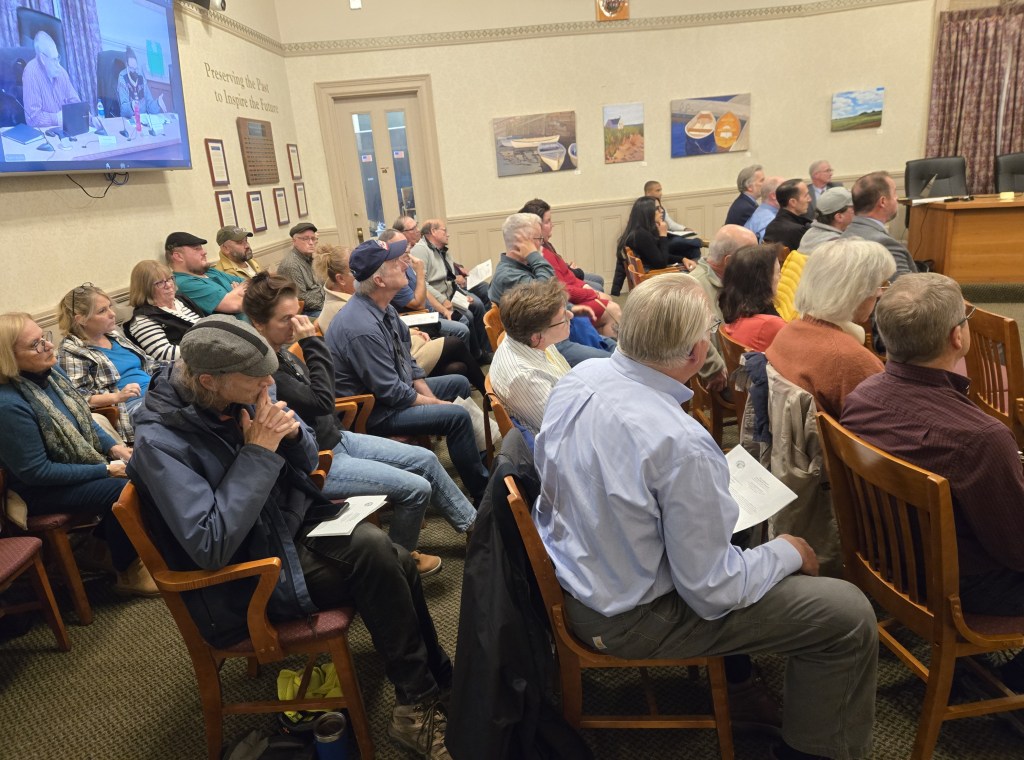
The Biddeford City Council Chamber was packed for Thursday’s Zoning Board of Appeals meeting regarding the University of New England’s proposed pier. (Seaver photo)

ZBA members did not discuss specifics about the pier, its location or the city’s review process of the project. The discussion instead centered on whether the citizen appellants had legal standing to appeal the planning board’s prior approval.

Ron Schneider – the university’s senior attorney – told ZBA members that the citizen appellants had “no standing” to file an appeal because they were not injured by the planning board’s earlier approval.

Biddeford resident Matt Haas, a former UNE employee, spoke for the appellants and said the citizens group was made up of an “organic” group of citizens, including property abutters and mooring owners who will be displaced by the large pier.

Schneider rejected that argument, pointing out that only Schafer’s name was listed on the appeal filed in September.

“You cannot just add names as you go along,” Schneider argued before the ZBA, pointing out that Schafer lives more than a mile away from where the large pier will be built. “Otherwise, this just becomes a game of whack-a-mole.”

City Attorney Harry Center told the ZBA that they should send the issue back to the planning board for further review.

“New information has recently come to light,” Center said. “The appellants do have standing.”

Center previously supported the planning board’s decision but now says new information about a 250-foot, non-development buffer zone created nearly 25 years ago should trigger a reconsideration of that decision.

“This just becomes a game
of whack-a-mole.”

— Ron Schneider, UNE’s senior attorney

As originally reported in the Biddeford Gazette, that buffer zone was overlooked and not raised as an issue of concern during the nearly two-year review process.

RELATED: UNE approval tainted by agency error

The Biddeford City Council voted unanimously last week to seek guidance and advice from the Maine Attorney General’s Office about the buffer zone and its impact on the university’s plans.

When asked for comment about Thursday’s ZBA decision, a university spokesperson said the zoning board followed the city charter’s requirements for appeals.

“These rules exist to ensure fairness and clarity in the appeals process,” said Sarah Delage, vice president of communications.

“UNE looks forward to moving ahead with this important research facility that will benefit Maine’s marine environment, economy and students for generations to come,” she added. “We remain committed to being good neighbors and responsible community partners.”

When asked about next steps for the citizen’s coalition, Haas said the group has to rely on the city council for relief.

“The city seems to understand the significance of the buffer zone, and it is heartening to see them pursue that issue with the attorney general’s office,” he said.

“This is not the end of the story,” Haas said.

______________

Randy Seaver is the editor and founder of the Biddeford Gazette. He may be reached by email: randy@randyseaver.com

c.) 2025 All Rights Reserved

Never miss another update! Subscribe for free today!

Back to the drawing board for UNE?

City attorney finds new info, says UNE pier should go back to planning board

By RANDY SEAVER, Editor

Biddeford City Attorney Harry Center says that the Biddeford Planning Board should reconsider its prior approval of the University of New England’s controversial research pier.

Although the planning board narrowly approved the university’s proposal in August, Center now says the Planning Board should reconsider that approval based on new information that came to light a few weeks ago.

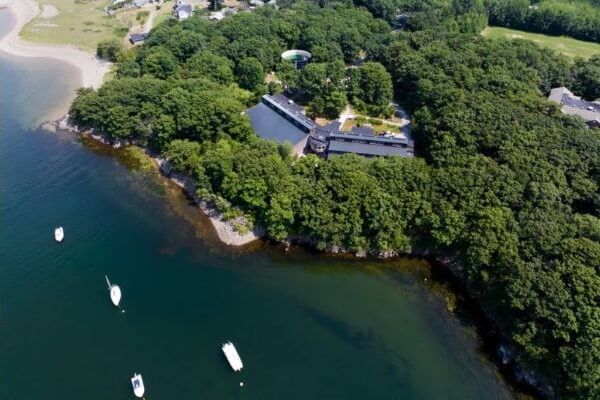
An aerial view of where UNE wants to build its research pier (Courtesy photo)

As first reported in the Biddeford Gazette, the Saco River Corridor Commission (SRCC) failed to consider a previous ruling that created a 250-foot, no-development, vegetative buffer zone on the university’s campus in 2001.

The SRCC described the error as “an oversight” and said nothing could be done to rectify that agency’s decision to approve the project last year.

Shortly after the Planning Board approved the controversial project, a group of residents filed an appeal with the Biddeford Zoning Board of Appeals (ZBA).

The ZBA is expected to take up the matter at its next meeting on Thursday.

Center, representing the city’s Planning Board, filed a request Monday with the ZBA on behalf of the planning board and Biddeford’s planning department.

Center also discovered that the permit issued to UNE by the U.S. Army Corps of Engineers may have expired.

“In the last 10 days, far too many
legal questions have been raised.”

— City Attorney Harry Center

A university spokesperson said the permit they received from the Army Corps is still in effect, and said the 250-foot no-development zone does not preclude appropriately permitted development.

Sarah Delage, vice president for communications at UNE, said the university received clarification from the U.S. Army Corps of Engineers in August that their permit remains in effect.

“The project was required to start prior to October 14, 2025, and the [Army Corps] has confirmed that the design and permitting process, which was underway well before that date, satisfies this condition.

Delage also said that “there is no inconsistency between UNE’s master plan –which was previously approved by the Biddeford Planning Board — and development within this buffer zone.

When asked about the legality of the SRCC’s permit, Delage said the SRCC’s executive director recently clarified that the approval remains valid and is neither under review nor in question at the SRCC office.

“The [SRCC] executive director sent her letter after consulting with the Maine Assistant Attorney General, who represents the SRCC,” Delage said.

“The university has carefully followed all legal and regulatory processes in permitting the project, and looks forward to continuing to do so,” she added.

Center said he has also researched prior versions of UNE’s master plan, and that those records reveal “that the University of New England’s master plan also references a 250-foot, no-development buffer.”

Red Flags Raised

Center said major red flags were then raised when Cheri Dunning, the executive director of the Saco River Corridor Commission (SRCC), wrote an unsolicited letter on October 20 to Roby Fecteau, Biddeford’s code enforcement officer.

In that letter to Fecteau, Dunning created the impression that the SRCC — while issuing UNE a permit for the pier — had deliberately overridden the 2001 order creating the buffer. She implied that present-day commissioners consciously intended to create new law. “The condition was created by, and thus can be altered by, the Commission,” she wrote.

Dunning specifically stated that the 2001 order was not discussed during the SRCC hearing. The current commissioners absolutely did not engage in any deliberative process to override the law created in 2001, according to the minutes from the August 2024 meeting.

Since the buffer was never even mentioned, the commissioners were flying blind, Center said.

“My legal analysis is that the order creating the 250-foot buffer remains in place, at least until the Attorney General’s office tells us that it has been rescinded by the commission,” Center said.

“The university has carefully followed
all legal and regulatory processes
in permitting the project, and
looks forward to continuing to do so.”

— Sarah Delage, UNE spokesperson

Center said the ZBA has the jurisdiction to send UNE’s application back to the planning board, and given all the new information that has surfaced, it should do so.

Furthermore, Center said the city may ask a judge to overrule the SRCC’s approval of a permit for UNE’s pier, and recent statements by Dunning that the 250-foot buffer and other SRCC decisions can be ignored by regulatory authorities.

 “In the last 10 days, far too many legal questions have been raised,” he said.

Center said he has the full support of Mayor Martin Grohman and the Biddeford City Council to advise the ZBA as he did today.

Last week, the Biddeford City Council unanimously voted to seek clarification and guidance from the Maine Attorney General’s office regarding the 250-foot buffer zone.

The council’s resolution stated that the city “will withhold further permitting or authorization related to the proposed UNE pier to ensure full compliance with applicable state law.”

Center says he firmly stands by his previous legal advice on other issues related to UNE’s application.

“I have one duty, and that is to properly advise my client on legal issues at all times. New information has come to light, and I’ll continue to execute my professional responsibilities accordingly,” Center said.

_______________

Randy Seaver is the editor and founder of the Biddeford Gazette. He may be reached by email: randy@randyseaver.com

c.) 2025 All Rights Reserved

Never miss another update! Subscribe for free today!

City will seek Attorney General’s advice about UNE pier

By RANDY SEAVER, Editor

The Biddeford City Council voted unanimously Thursday to seek guidance from the Maine Attorney General’s office about a new wrinkle that was recently discovered in the University of New England’s proposal to build a large, research pier on the Saco River.

In order to build their pier, the university needed approvals from multiple agencies, including the Saco River Corridor Commission, a quasi-state agency that has jurisdiction regarding development along the length of the river’s shoreline.

The Saco River Corridor Commission (SRCC) approved UNE’s project on Sept. 13, 2024. Biddeford’s representative on the SRCC abstained from the vote.

As the Biddeford Gazette first reported in October,  the SRCC’s approval appears to contradict an earlier decision by that same agency.

In 2001, the university agreed to the creation of a 250-foot buffer zone as a compromise to build two dormitory buildings that would exceed a 35-foot height limit.

The university’s current proposal requires the construction of an access road for the pier. That road needs to accommodate large trucks, including rescue vehicles. The road would cut through the 250-foot vegetative buffer.

When contacted by the Biddeford Gazette in October, the SRCC’s executive director said the contradiction was an oversight.

“It does appear that there was an omission of relevant information provided to the commissioners before last year’s vote,” said Cherie Dunning, the SRCC’s executive director.

Following the Gazette’s story — Just two weeks before local elections — several city councilors said they want the advice of the state attorney general before the city issues any construction permits for the project.

“We want to make sure that we have done our due diligence” said Council President Liam LaFountain during a previous interview.

LaFountain won his bid Tuesday to become the city’s next mayor. His core campaign message focused on transparency and accountability.

Thursday’s resolution passed without any discussion or comments by council members.

LaFountain and Councilor Marc Lessard tried unsuccessfully to have an agenda item about the university’s proposal discussed at the Oct. 21 council meeting,

Mayor Marty Grohman said he did not realize the item was not on the agenda for that meeting.

A portion of Thursday’s resolve reads as follows:

“Questions have arisen as to whether the SRCC’s Permit #20-491 approval is consistent with, or in conflict with the SRCC Permit #20-209, and whether the existence of a vegetative buffer zone may affect the legal validity of the current pier permit.”

“This situation has created uncertainty for the city, the university, and the public regarding the . . . the city’s obligations under state law.”

Sarah Delage, a university spokesperson, said the school “does not oppose the council’s pursuit of clarification from the AG’s office.”

The full text of the council’s resolution may be viewed or downloaded here:

___________________

Randy Seaver is the editor and founder of the Biddeford Gazette. He may be reached by email: randy@randyseaver.com

c.) 2025 All Rights Reserved

Never miss another update! Subscribe for free today!

UNE pier opponents ramp up their efforts

Even as the University of New England begins construction of its controversial research pier, opponents of the project are ramping up their own efforts and raising new concerns about how the City of Biddeford handled its review of the project.

A group of Biddeford residents are now circulating a petition to require the mayor and city council members to host a citizens’ grievance meeting.

This aerial photo from UNE shows where the university is planning to construct its new research pier

According to the city’s charter, any Biddeford resident can force the council to publicly hear their concerns during a meeting in which only the citizens are allowed to speak if they can collect at least 100 signatures from registered voters.

Carole Alexander is one of the key organizers of the proposed Citizen Grievance meeting.

Alexander is the wife of the late Marshall Alexander who served as the city’s harbor master for 37 years. She says her husband proposed an alternate location for UNE’s pier more than 10 years ago.

“I’m angry,” Alexander said. “The city has bungled the entire process and the truth has been distorted. First, they removed our harbormaster, and now they are going after a planning board member who raised concerns. It’s time for citizens to stand up.”

RELATED: Planning Board member: ‘Something Smells Fishy”

Alexander says she is more than confident that her group can collect more than 100 signatures in order to force the meeting.

Meanwhile, questions are now being raised about the law firm that the city hired to represent the Zoning Board of Appeals and some potential conflict of interest issues.

Following the Planning Board’s approval of the university’s pier project, John Schafer – one of the project’s most vocal opponents — filed an appeal of that decision with the city’s Zoning Board of Appeals.

Schafer said that he and several other residents are appealing the planning board’s decision because it hinges largely on one central point: whether the university’s plan required the expressed approval of a harbor master.

“All I can hope for is that the zoning board will send this item back to the planning board,” Schafer said. “The planning board got bad information about whether a harbormaster approved the project.”

During the planning board’s review of the proposed pier, City Attorney Harry Center repeatedly told the board that the project had been approved by a harbormaster.

This audio clip of a discussion between Planning Board Chair Alexa Plotkin and Center during one of the Planning Board’s meetings shows that the role and definition of the harbormaster was a central issue of the board’s review.

RELATED: Planning Board approves UNE pier proposal

But Schafer and others point to the city’s own ordinances and say the private engineer who was hired to replace the city’s harbormaster does not meet the definition of a harbormaster from both city and state regulations.

According to city ordinances, a harbormaster must meet specific requirements to hold that title, including being a “city resident for no less than five years; must have five years of marine experience and must attend annual Maine Harbormasters Association training.”

Center, however, argues that the engineer hired by the city only needs to “facilitate” the review process and ensure that other local, state and federal agencies have approved the project.

But opponents say the city’s ordinances are crystal clear in what defines a ‘harbormaster’ and what his or her responsibilities are.

Section 74-35 of Biddeford’s ordinances reads: “Permission for the construction of any new wharf or pier within the jurisdictional limits of the city shall not be granted without approval of the Harbormaster, along with federal, state and local governing authorities.”

“The planning board never heard from an actual harbormaster,” Schafer said. “That’s a big oversight that needs to be addressed.”

More conflicts of interest?

Earlier this month, the city hired Archipelago Law, a small Portland-based law firm to represent the Zoning Board of Appeals.

Former city councilor Kyle Noble says that particular firm has several conflicts of interest issues because four of the firm’s 12 employees graduated from the University of New England’s Marine Sciences program.

Keith Richard, the attorney who will be representing the Zoning Board, refused to comment for this story.

Mayor Marty Grohman declined to comment on the matter because it is a pending legal issue for the city.

Council President Liam LaFountain also said he could not comment directly on the story, but did indicate that he is hoping to learn more about the firm and why they were chosen.

In an email response to Schafer, City Manager Truc Dever wrote: “While I cannot speak to your assertions regarding potential conflicts of interest, I will be looking into this in advance of the appeals hearing to ensure there is, in fact, no conflict.”

Next steps?

A UNE spokesperson said the university is currently searching for a contractor and has initiated a bid process for the project.

Sarah Delage, Associate Vice President of Communications, said an actual construction schedule has not yet been established and that the university will need a building permit from the city’s code enforcement officer.

“The total work can be done in six to eight months,” Delage said, pointing out that both the land portion of the project and the water portion can be done in phases, as opposed to concurrently.

Delage said the university has not reached out to mooring owners who may be impacted by the project, saying that responsibility rests with city officials.

Delage also said the university will periodically update construction information on the school’s website.

The Zoning Board of Appeals hearing has been set for October 9 and residents who are now gathering signatures for a Grievance meeting with the council say they expect to have more than the required number of signatures they need within a few days.

Editor’s Note: A copy of the citizens petition may be viewed or downloaded using the link below:

___________________

Randy Seaver is the editor and founder of the Biddeford Gazette. He may be reached by email at randy@randyseaver.com

Never miss another update! Subscribe for free today!

Tensions run high during Planning Board review of UNE’s proposed pier

Following a rather tense and emotionally-charged discussion, the Biddeford Planning Board voted 3-2 Wednesday to give preliminary site approval for the University of New England’s proposed research pier.

The controversial pier proposal has generated widespread public discourse for more than a year, even before the application was formally submitted in June 2024.

This aerial photograph shows the proposed location of the University of New England’s proposed research pier (UNE Photo)

Opponents – including area fishermen, private mooring owners and neighbors – have consistently said they wanted the university to consider an alternative location that was proposed by Harbormaster Paul Lariviere nearly two years ago.

City Attorney Harry Center, however, told board members that the so-called “alternative location” was not part of UNE’s application and thus, not subject to review and/or approval by the board.

City Planner David Galbraith began the discussion with an emotional statement, saying he has been vilified by project opponents and that “personal attacks” have called into question both his integrity and professionalism.

“I have been doing this for 30 years, and I have never been subjected to such malicious comments,” Galbraith told the board. “I and others involved in the review of this proposal have gone out of our way to be open, transparent and accommodating.”

Galbraith told the board that he was especially angry about a recent YouTube video that was posted by a anonymous Facebook page known as “UNE Pier Review.”

“Frankly, I am appalled,” Galbraith said. “I assure you that my integrity is worth much more than what any developer could offer me.”

“I have been doing this for 30 years,
and I have never been subjected
to such malicious comments.”

— City Planner David Galbraith

Planning Board Member Susan Deschambault reminded her fellow board members that the university’s proposal has already been reviewed and approved by several other agencies, including the Saco River Corridor Commission, the Maine Department of Environmental Protection and the U.S, Army Corps of Engineers.

RELATED: Mayor defends city review of UNE proposal

But alternate board member Kayla Lewis said she could understand why opponents and other members of the public were feeling angry and frustrated.

“UNE did exactly what they were supposed to do in submitting their application to us,” Lewis said. “But we also have to acknowledge and recognize that this review process has had a shaky foundation. Somewhere along the line, things got very blurred.”

Roch Angers was one of the two board members who voted against approval of the project.

“I have a lot of mixed feelings about the process,” Angers said. “But that has nothing to do with our city planner, who I think has done an outstanding job.”

Center told the board that the city’s ordinances are clear and that there is no legal basis for consideration of potential impacts to mooring owners or fishermen in the Shoreland Zoning Ordinance. Center also told the board that any concerns about the harbormaster being removed from the review process were also not relevant for the board’s consideration.

RELATED: City manager quashes harbormaster

Resident Kyle Noble questioned why the Planning Board was even considering the application after what he described as a “faulty review process.”

“This is a once in a lifetime project,” Noble told the board. “And it’s forever.”

A UNE spokesperson said the university was pleased about the board’s preliminary vote.

“We were also encouraged by the comments made by city staff and planning board members correcting a number of false statements that have been made about the project,” said Sarah Delage, associate vice president of communications for the university. “We look forward to a final vote at the next meeting.”

John Schafer, the former chair of Biddeford’s Harbor Commission, has been a leading opponent of the university’s proposal.

“Obviously, I am very disappointed,” Shafer said during a brief interview Thursday. “There was a lot of misinformation thrown at the board and they acted mostly in lock-step. From my perspective, it seems that their decision was already made before the meeting started.”

NOTE: Board members Roch Angers and Matt Dubois voted in opposition to the application; Board Members Larry Patoine and Susan Deschambault voted in favor of the application. Board Chair Alexa Plotkin broke the tie, voting in the affirmative for the applicant (UNE). Kayla Lewis is an alternate, non-voting member of the board.


Randy Seaver is the editor and founder of the Biddeford Gazette. He may be contacted by email: randy@randyseaver.com

NEVER MISS ANOTHER UPDATE! Subscribe for free today!

Board members get front-row view of UNE’s controversial pier proposal

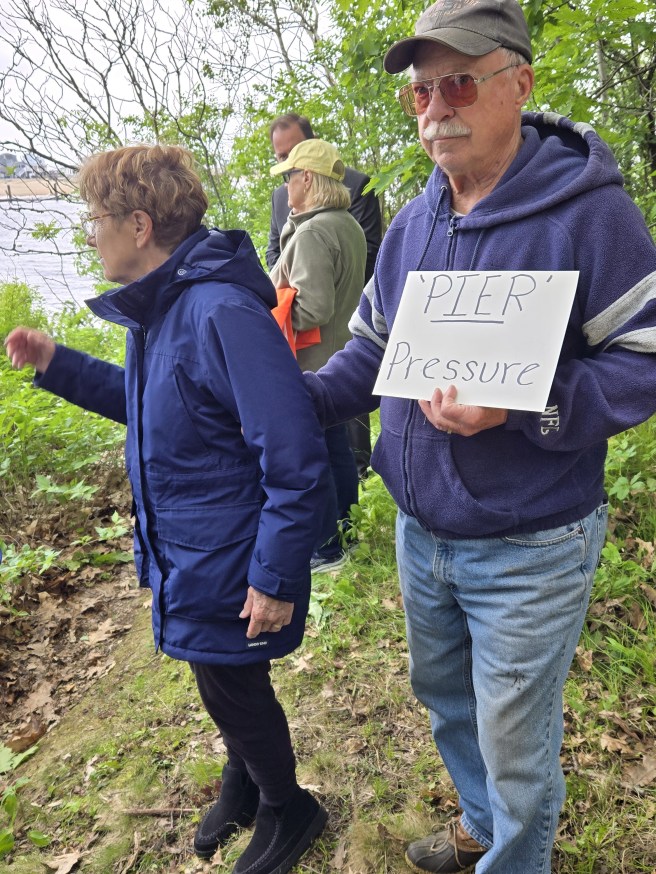
A small group of slightly more than 40 people attended a Biddeford Planning Board site walk near the location of where the University of New England wants to construct a new pier to dock its marine research vessel.

The proposed pier includes a 130-foot approach pier with an 80 by 20-foot pier head jutting out into the channel almost directly across from the Camp Ellis pier on the Saco River

UNE Vice President Alan Thibeault answers questions for planning board members (Seaver photo)

The university’s proposal has generated considerable controversy over the past several months. During a preliminary Planning Board meeting last month, several members of the public raised concerns about the proposal including its potential impact to existing moorings and impacts on navigation and recreational fishing during low tide.

No members of the public spoke in favor of the proposal at that May 22 meeting.

Monday’s site walk lasted almost 45 minutes, requiring board members and the public to hike through a wooded area behind the school’s marine sciences center.

There was no opportunity for public comment or questions, but planning board members did ask several questions about the project, including the proposed height of the pier, how river current and tides could impact the pier and how exactly the pier would be constructed.

Alan Thibeault, the university’s vice president of operations, led board members to a spot overlooking the Saco River to answer questions and point out the exact area where the university hopes to build their pier.

Ken Buechs of Biddeford made his feelings about the project known during Monday’s site walk (Seaver photo.)

Behind Thibeault, critics of the pier were sharing their own information about the project. Two small boats were anchored near the shore; one boat closest to the school’s proposed location and another boat slightly downriver where the city’s harbormaster and others say the pier should be located.

People on each of the small boats held up large placards to display the data from their depth-finding equipment. During the site walk, at low tide, the vessel closest to the school’s preferred location showed a water depth of six feet, while the other vessel showed a water depth of 12-feet.

Former City Councilor Patricia Boston was one of those who attended the site walk. Although water depth is technically not part of the criteria for the planning board, Boston said the board should pay attention to that issue.

A private boat owner holds up a placard showing a water depth of only six feet during low tide where the university hopes to build their pier. Another boat, slightly downstream, showed a water dept of 12 feet at the location where Biddeford’s harbormaster says the pier should be built. (Seaver photo)

“To me, it seems like a simple issue to objectively address,” Boston said. “This project is going to have significant impacts on the Saco River for generations to come. I’m hoping the planning board will consider all of the issues – from a planning perspective, it’s important to know all the information.”

“This project is going to have significant
impacts on the Saco River for
generations. I’m hoping the
planning board will consider
all of the issues”

— Patricia Boston, former city councilor

Boston said she is disappointed by how the university has been pushing the project forward. “Based just on what I have been reading and hearing, there seems to be some missed opportunities for collaboration, and I find that sad,” she said.

A few people from Saco also attended Monday’s site walk, including Kevin Roche, the president of SOS Saco Bay, a non-profit group focused on erosion issues in the Camp Ellis area. Roche did not return a phone call for comment, as of press time.

Matt Dubois, the newest member of the planning board, described the site walk as “informative and comprehensive.”

Former city councilor Kyle Noble — an outspoken critic of the project, holds a pole to demonstrate the height of UNE proposed pier

Susan Deschambault, another Planning Board member, said she appreciated the opportunity to see the exact location and ask questions about the project. “There are still more questions to be asked,” she said.

Members of the public paid close attention to UNE’s presentation during Monday’s site walk. (Seaver photo)

Earlier in the day, a group of private mooring owners who would be impacted by the proposal, issued a press release stating that they “are ready to be sued by the university” because they are unwilling to give up their mooring locations.

“I guess they don’t understand the English language over there at the college,” said Capt. Shawn Tibbetts, a commercial fisherman with a mooring location that would need to be moved. “We’re not moving. The site they want for their pier is unavailable to the University of New England.”

Planning board chair Alexa Plotkin described the site walk as somewhat unique. “This is not like driving into a parking lot and looking around,” she said. “I’m glad we had the opportunity to see the area that is not really visible on a daily basis.”

Plotkin said she was pleased by the turnout and said the university’s proposal will be back on the planning board’s agenda for its next meeting on June 18.

Randy Seaver is the editor and founder of the Biddeford Gazette. He may be contacted by email: randy@randyseaver.com

Never miss another update! Subscribe for free today!

UNE hopes to correct ‘misinformation’

Just a few days after hearing several negative comments from the public about their proposed research and docking pier, officials from the University of New England distributed a FAQ (Frequently Asked Questions) document with the media and community leaders.

The university (UNE) says the FAQ document is intended to clarify “a variety of misunderstandings [that] have emerged about the project” and to “clear up misinformation that has circulated about the (proposal).”

CLICK HERE TO VIEW/DOWNLAD UNE’s FAQ Document

Last week, UNE officials appeared before the Biddeford Planning Board to present an outline of their plan during a preliminary sketch review meeting.

That meeting drew scores of people, filling the council chamber while several other members of the public overflowed into the hallway.

During the public comment period, several people took to the podium, raising concerns about the plan and criticizing the university. No one at the meeting spoke in support of the proposal.

Former City Councilor Michael Swanton – who previously represented the city’s coastal area on the city council – told the board that he is neutral about the proposed pier.

An aerial photo showing the area where the University of New England wants to construct a new research/docking pier. (UNE photo)

During a telephone interview Wednesday, Sarah Delage, a university spokesperson, reiterated that UNE wants to be proactive and follow a review process that includes addressing public concerns, listening to opponents and responding to every regulatory agency’s particular request for information.

“From our perspective, we have clearly communicated with all the regulatory agencies,” Delage said. “We are absolutely committed to working in good faith with everyone and listening to all voices.”

UNE President James Herbert did not mince words about his frustrations regarding “misinformation” in a letter he sent to community leaders on Tuesday.

“Unfortunately, a great deal of misinformation has been spread about the proposal,” Herbert wrote. “UNE cannot continue to allow the level of misinformation and, in some cases outright false statements, to go unanswered.”

Herbert told community leaders that “most, if not all, of the comments that were presented to the Planning Board [during last week’s meeting] are irrelevant to the criteria that the Planning Board must apply to UNE’s application for site plan approval.”

UNE cannot continue to allow
the level of misinformation
and, in some cases outright false
statements, to go unanswered.”

— James Herbert, president of the University of New England

What do the critics say?

John Schafer, the former chair of Biddeford’s Harbor Commission and a retired engineer, has been an outspoken critic of the project for several months.

Schafer and other critics of the proposed pier created a Facebook page known as UNE Pier Review.

For more than a year, Schafer and others have been doggedly tracking the review process, raising concerns about “a lack of transparency” and other issues, most notably stating that the proposed pier should be located in a different location, closer to shore primarily because of water depth issues and impacts to existing moorings in the Saco River.

Schafer received a copy of the university’s FAQ document, describing it as “polished spin.”

“The public finally had an opportunity to speak at last week’s meeting, and apparently the university didn’t like what it heard,” Schafer said. “No one from the university reached out to me,” he added, saying it has been more than difficult to obtain documents from the university, including a copy of their request for $3.5 million in federal funding for the project.

“While reading this thing, my bullshit meter pegged the needle off the charts,” Schafer said.

Schafer raised several specific objections to the items listed on the university’s document, including the actual number of mooring owners who would be impacted; statements regarding whether the university has threatened to sue the city if their plan is not approved, and contrary statements issued by the university regarding the potential impact on federal funding if the review process is delayed.

“While reading this thing,
my bullshit meter pegged
the needle off the charts,”

— John Schafer, former chair, Biddeford Harbor Commission

“How can they with a straight face say that only two moorings will be impacted?” Schafer said. “Were they not at the same meeting as the rest of us?”

Schafer says that seven moorings will be impacted, dismissing the university’s offer to swap, purchase or relocate other moorings. “Exactly where would they be relocated?” Schafer asked. “There is not unlimited room on the river and there is a substantial waiting list of people hoping to get a mooring on the river.”

Delage, however, said the university has been making good faith efforts to identify and contact all mooring owners who may be impacted by the pier.

“The harbormaster previously indicated that only two moorings would be impacted in his communication to the (Maine Department of Environmental Protection) DEP” Delage said, adding that “there is no official record of mooring owners.”

While much of the public conversation about the proposed pier has centered upon water depth issues, the FAQ document provides more details about why the university picked their preferred site over an alternative that was offered by the city’s harbormaster.

According to the FAQ document, the university’s preferred site location (Site 7) “best meets the combined criteria (required). It is located where there is a small intertidal zone, comprised primarily of rock without sea grass, and the currents are slower because it is farther from the river channel.

“The dock’s main berth would be aligned with the current in the river and would be deep enough to provide all-tide access for the range of vessels expected to use the facility with the smallest overall footprint, thereby minimizing environmental impacts.”

Other issues

UNE’s FAQ document also addresses several other issues, including whether the university threatened to sue the city, claims about an ongoing FBI investigation and why Biddeford Harbormaster Paul Lariviere was removed from review of the proposal.

Almost exactly one year before Wednesday’s Planning Board meeting, former Biddeford City Manager James Bennett sent a letter to Lariviere, saying the harbormaster had been biased in his review of UNE’s proposal as evidenced by “several” public comments he has made outlining his steadfast objections to the project.

In its attempts to quell public misinformation about that subject, the university is encouraging members of the public to review a separate FAQ document that was released by the city of Biddeford last year.

Schafer says that the city’s move to quash both the harbormaster and the assistant harbormaster was simply part of an effort to grease the skids for the university. “Now look at where we are,” Schafer said. “The city spent $2,800 to hire a guy without any local knowledge or previous experience as a harbormaster to simply check the box and say that UNE had filed all the right paperwork. Heck, the city clerk could have done that.

Did UNE threaten to sue the city?

Ron Schneider, the university’s chief legal counsel, did send a letter to Biddeford City Attorney Harry Center on February 13, 2024, several months before the university submitted its formal proposal to the city.

 In that letter, Schneider wrote “It is our sincere hope that UNE is not forced to resort to litigation to avoid the delay and expense that will result if Mr. Lariviere were to insist on obstructing the building of the pier.”

UNE’s document describes that communication between the two attorneys as an opportunity to “raise concerns about serious due process errors” to Biddeford’s attorney. “The goal of this communication was to correct these errors to avoid having to appeal to a court.”

Another item that the university describes as misinformation, is a claim that the FBI is investigating the review process.

“After others claimed that the FBI was investigating UNE, the university reached out to the FBI and offered to meet with them, which they said was not necessary,” the university wrote in its FAQ document. “UNE has no reason to believe that the FBI is investigating the university.”

Schafer, however, said he and others were, in fact, questioned last year by the FBI about “the review process, not specifically about the university.”

Where do we go from here?

Despite some controversy, UNE’s proposal has received approval from every regulatory agency that has reviewed the project, including the Saco River Corridor Commission, the U. S. Army Corps of Engineers and the Maine Department of Environmental Protection.

The review of the project by the Biddeford Planning Board is expected to be extensive. During last week’s meeting, board members asked UNE representatives for additional information and then voted unanimously to conduct both a site walk and a “boat tour” near the proposed location.

Schafer and others have praised the Planning Board’s “obvious commitment” to fairness and transparency. He says he will continue to keep a close watch on the project.

Delage says that the university is willing to meet with critics or others who would like more information about the proposal.

“The university really appreciates any opportunity to put more information out there for the public.” Delage said. “We are acting in good faith for everyone involved, especially those who use and cherish the river like we do.”

Randy Seaver is the editor and founder of the Biddeford Gazette. He may be contacted by email: randy@randyseaver.com

Never miss another update! Subscribe for free today!

Mayor defends city review of UNE pier proposal

During a sometimes terse and heated meeting, Biddeford Mayor Marty Grohman defended the way the city has acted during the review of a controversial pier that the University of New England wants to construct on the Saco River.

The nearly hour-long meeting was held at the request of John Schafer, the former chair of the Biddeford Harbor Commission and a Hills Beach resident who has been outspoken about the need for transparency during the review process.

City Attorney Harry Center also took part in the late Monday morning meeting in Grohman’s second-floor office at City Hall.

Center stressed that the meeting was strictly informal and not part of the review process. “The mayor has simply set aside some time to listen to the concerns of a constituent,” he said.

Hills Beach resident and former chair of Biddeford’s Harbor Commission John Schafer points to a diagram that shows inadequate depth where UNE is hoping to build a 177-foot pier to dock its research vessel near the mouth of the Saco River (Seaver photo)

No one from the university was at the meeting, and other media outlets declined invitations to attend, according to Schafer.

Schafer’s concerns center on three essential points: the impact and necessary removal of at least seven private moorings on the river if the project is approved; concerns about the water depth where the university wants to construct its pier; and the process that has been used to review the university’s proposal.

The permitting process for the proposed pier is complex and multi-layered, requiring the review and approval by several state, federal and local agencies.

Earlier this year, UNE cleared two major hurdles in the review process, winning approval from both the Saco River Corridor Commission and the U.S. Army Corps of Engineers.

But a very critical part of the review process is expected to begin in just a few weeks when the Biddeford Planning Board begins its formal review of the proposal.

“I don’t have any say over what the Planning Board does or doesn’t do,” Grohman said during Monday’s meeting. “I simply appoint members, and those appointments are then confirmed by the council. I think we have a really good planning board, and I have full confidence in them.”

But Schafer said he is concerned about the lack of public input during the review process and how the city has approached the project thus far. He also criticized the university for its “lack of transparency” and for “bullying those who raise questions and concerns” about the proposed pier.

“I think [UNE’s] application is both incomplete and full of misinformation,” Schafer told the mayor. “Don’t you think it’s a bit presumptuous for a private entity to dictate how the city will review its application; to show no regard for those who have private moorings in that area just so they can construct a vanity pier?”

When contacted by the Biddeford Gazette, a university spokesperson declined an opportunity to address Schafer’s remarks.

“Since this was not an open meeting and a representative from UNE was not present, it would not be appropriate to comment on the conversation that took place,” wrote Sarah Delage in an email response. “UNE will continue to follow the public regulatory process, and we look forward to presenting our application to the Planning Board.”

Schafer said he and “a growing coalition of residents” have no problem with the university building a pier to dock its 60-foot research vessel. Instead, he says, all the concerns boil down to the exact location of the pier and the dismissal of public concerns about the project.

Survey says?

Schafer roundly criticized Grohman for allowing former City Manager James Bennett to “silence” the city’s harbormaster and assistant harbormaster last year, preventing them from participating in the city’s review of the proposal simply because they voiced concerns about the pier’s location.

But Grohman shot back and said Bennett was simply trying to avoid the appearance of bias. He also reminded Schafer that the harbormaster’s role – as outlined in city ordinances – is strictly an “advisory position,” a change that was first proposed by Schafer himself last year when he was chair of the harbor commission.

Schafer said a growing number of residents have serious concerns about a review process that seems to have a pre-ordained outcome, pointing to the results and comments found in a recent public survey about the project.

Nearly 40 percent of respondents indicated that they had a
“very low” level of confidence in the city’s handling of the review process,
while roughly 30 percent of respondents indicated that they
had “moderately low” confidence in the city’s handling of the matter.

The online survey was conducted over several days in late April on a Facebook page called “UNE Pier Review,” a group that Schafer has helped organize.

The survey asked respondents a wide range of questions about the proposed pier and the review process thus far. The survey allowed respondents to maintain their anonymity.

The multi-question survey included feedback from 156 respondents, showing an overwhelming lack of public confidence on the issues of transparency and the mayor’s handling of the issue.

Nearly 40 percent of respondents indicated that they had “very low” level of confidence in the city’s handling of the review process. And roughly 30 percent of respondents indicated that they had “moderately low” confidence in the city’s handling of the matter.

City Attorney Harry Center (left) and Mayor Marty Grohman listen as John Schafer details his concerns about UNE’s proposal

Fewer than 10 percent of respondents indicated that they had “very high” confidence in the process, while slightly less than 20 percent of respondents indicated that they are not sure.

Many respondents added comments saying the city has been “too secretive” while other questioned the motives of city officials, speculating that some members of the city seem to have a “cozy relationship” with the university.

Grohman described the survey as “interesting,” but also said it was not a professional survey conducted by a polling firm.

“An anonymous survey is not something that a public permitting process could use, as it does not include an opportunity for all parties involved to publicly comment,” Grohman wrote in a text message to the Gazette after the meeting.

Schafer told the mayor that several mooring owners have already written to regulatory authorities stating quite plainly that they have “no intentions of moving their moorings where UNE wants to build their pier.”

Schafer also said that UNE has threatened the city with litigation if its desired location for the pier is not approved, referencing a letter sent to the city by Ron Schneider, the university’s lead attorney, several months before the university had submitted its application for review.

Grohman described Schafer as a good friend, and said he was happy to hear the concerns that were raised.

In a moment of levity during the meeting, Grohman pointed out that the mayor does not vote on or control the regulatory review process. “I don’t have the authority to change what sodas are sold in the vending machines downstairs,” Grohman laughed.

After the meeting Schafer said he very much appreciated the opportunity to share his concerns with the mayor. “Nothing in the meeting surprised me,” he said. “It’s about what I expected.”

Never miss another update! Subscribe for free today!

UNE Refuses Citizen Request for Information

The University of New England (UNE) is, apparently, refusing to provide information to the public and the media about a federal grant the university received to construct a new “research pier” on the banks of the Saco River.

Over the last few weeks, John Schafer, a Hills Beach resident and former chair of Biddeford’s Harbor Commission, has repeatedly tried to get documents regarding a $3.5 million federal grant that the university received from the National Institute of Standards and Technology (NIST).

In previous interviews, the university says it is planning to use those funds to build a permanent pier on the Saco River that can accommodate its 60-foot marine research vessel.

Schafer says he and other residents simply want to see documents related to the grant. “I am a big believer in transparency and accountability,” he said. “I don’t understand why the university is unwilling to release details about a grant award of public funds. What are they hiding?”

The Biddeford Gazette attempted to contact both the university’s president James Herbert and Alan Thibeault, vice president of operations, for comment. Neither Herbert nor Thibeault returned our calls as of press time.

Sarah Delage, associate vice president of communications, replied to our inquiries with a one sentence response: “The University of New England has provided, and will continue to provide, all required and relevant documentation to the regulatory agencies and governmental bodies conducting the permitting process for our proposed research pier.”

After receiving that email from Delage, we sent another email inquiry to her, asking why the university is unwilling to simply share those documents with members of the public, especially those who live in close proximity to the school’s Biddeford campus.

Delage did not respond to our second email inquiry, as of press time.

The university formally submitted its plan for a new pier to the city of Biddeford in June last year. The grant application, however, was submitted several months prior.

UNE is still facing an arduous and likely lengthy review process for their proposal. In addition to the city of Biddeford, the U.S. Army Corps of Engineers and the Maine Department of Environmental Protection will need to review the proposed project.

Go here to see a copy of the application that the university submitted to the city of Biddeford.

RELATED: City review of UNE project remains unclear.

Schafer said he has been bending over backward to be courteous and professional with his requests, but says he feels as if he is being stonewalled by the university.

Schafer, wrote Herbert on January 21, asking the university president to release a copy of the application the university submitted to NIST.

Herbert, Schafer says, did not reply.

According to a recent press release issued by Schafer, Alan Thibeault called Schafer and told him that he did not need to see the application, while also saying that the university is “not required” to release it.

“I don’t get it. Why are they being so stubborn? There are no national security issues here.”

John Schafer

Thibeault did not respond to our request for comment.

Schafer says that Thibeault “reluctantly agreed to ask about permission to release the application and said he’d be back in touch.”

“I never heard back from him,” Schafer said. “At first, our conversation was very cordial, but it quickly became terse.”

Schafer says that Thibeault told him there was nothing in the grant application that wasn’t already given to various regulatory agencies.

Schafer then sent a second email to Hebert a few days later. Once again, Schafer asked to see the grant application, saying the documents should be available in the interest of transparency.

The university president has also not responded to Schafer’s second email request for disclosure.

“I don’t get it,” Schafer said. “Why are they being so stubborn? There are no national security issues here. These should be public documents. The public has a right to know how UNE presented their project to the federal government.”

Schafer commended both Biddeford City Manager James Bennett and Mayor Marty Grohman for informing UNE last year that the location of the proposed pier is not in any way approved by the city.

“The application filed with NIST could very well affect Biddeford’s regulatory process, but UNE doesn’t want it released to me, Biddeford or Saco. Luckily, freedom of information laws exist to deal with this type of obstruction,” Schafer said.

Never miss another update! Subscribe for free today!