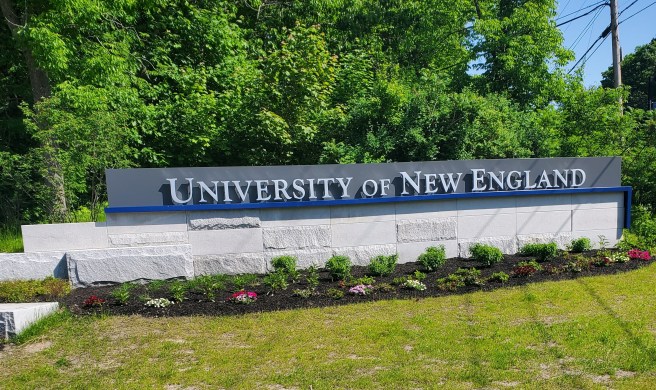
The Saco River Corridor Commission (SRCC) voted 9-2 Monday to approve a plan that will allow the University of New England to transform a former convent on the Saco River into a student dormitory.
The Biddeford convent was built in 1986 and features a 57-bed nursing home on a 21.4-acre parcel along the banks of the Saco River.
According to a university representative, only upper-class students will be housed at that site, which is roughly 1-1/2 miles northwest from UNE’s Biddeford campus. Their plan is to provide housing for 126 students.
Andrew Philippe, UNE’s director of campus planning addresses members of the Saco River Corridor Commission on Monday (Seaver photo)
According to the SRCC, the Pool Road facility is located within a Limited Residential District.
At least one property abutter has raised concerns about the plan, noting a likely increase in noise and traffic that would fundamentally alter the character of the area.
“The resulting noise, traffic and parking pressures would meaningfully alter the character of this quiet, residential and rural stretch of the corridor,” wrote Carla Ouellette in her objection to the plan.
Andrew Philippe, UNE’s director of campus planning, told commissioners Monday that the school will plant several trees along the river frontage to augment the vegetative buffer that is now somewhat sparse.
A prior review of the project last month resulted in commissioners voting to table the plan, asking university officials to provide more detailed information about the capacity of the existing septic system and a current lack of vegetation.
Commissioner Amy Safford raised concerns about erosion and noted that location includes swift river currents. “I see this as over-crowding and altering the character of the neighborhood. Putting that many people so close to the river is not a good idea. I am not convinced.”
Other commissioners asked questions about parking at the facility. The facility currently has 55 parking spaces, and Philippe said there is no plan to increase the parking footprint.
The St. Joseph’s nursing facility in Biddeford could soon become student housing for UNE students near the banks of the Saco River (Seaver photo)
Philippe said the school will provide a “shuttle” service between the complex and the university’s Biddeford campus in order to reduce traffic and the need for more parking.
Philippe told commissioners that on-campus housing is at capacity. He said the university was approached by the convent roughly two years ago.
Their operation, he said, was struggling to remain financially feasible.
In a prior interview with the Gazette, newly appointed Biddeford Commissioner Jim LaBelle described the project as a win-win scenario.
“We’re basically switching one housing facility to another housing facility,” LaBelle said.
LaBelle voted with the majority to approve the plan. Donald Furman, Biddeford’s other representative, was absent.
Saco representative Amy Safford was one of only two commissioners who voted against the proposal. Don Pilon, Saco’s other SRCC commissioner, was also absent.
_______________
Randy Seaver is the editor and founder of the Biddeford Gazette. He may be reached by email: randy@randyseaver.com
c.) 2025 All Rights Reserved
Never miss another update! Subscribe for free today!
The University of New England cleared another hurdle Thursday when the Biddeford Zoning Board of Appeals (ZBA) voted unanimously to reject an appeal of the university’s proposed research pier.
Although the Biddeford Planning Board narrowly approved the controversial pier in August, a group of private citizens – led by the former chair of the Biddeford Harbor Commission – filed an appeal of the planning board’s approval.
Thursday’s meeting lasted only a few minutes, despite an agenda packet of more than 3,000 pages of information related to the project.
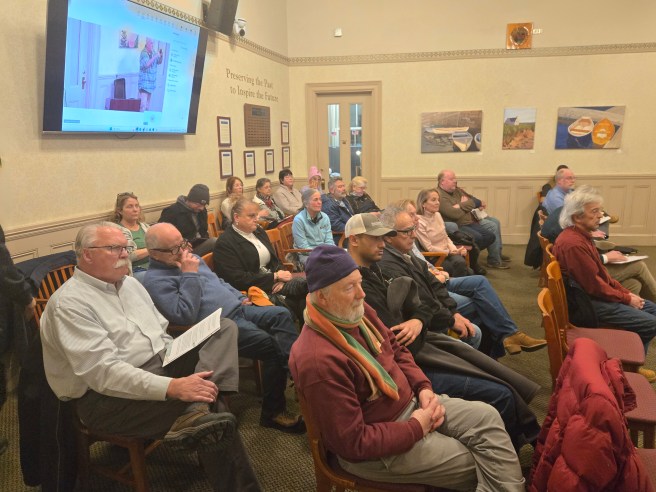
The Biddeford City Council Chamber was packed for Thursday’s Zoning Board of Appeals meeting regarding the University of New England’s proposed pier. (Seaver photo)
ZBA members did not discuss specifics about the pier, its location or the city’s review process of the project. The discussion instead centered on whether the citizen appellants had legal standing to appeal the planning board’s prior approval.
Ron Schneider – the university’s senior attorney – told ZBA members that the citizen appellants had “no standing” to file an appeal because they were not injured by the planning board’s earlier approval.
Biddeford resident Matt Haas, a former UNE employee, spoke for the appellants and said the citizens group was made up of an “organic” group of citizens, including property abutters and mooring owners who will be displaced by the large pier.
Schneider rejected that argument, pointing out that only Schafer’s name was listed on the appeal filed in September.
“You cannot just add names as you go along,” Schneider argued before the ZBA, pointing out that Schafer lives more than a mile away from where the large pier will be built. “Otherwise, this just becomes a game of whack-a-mole.”
City Attorney Harry Center told the ZBA that they should send the issue back to the planning board for further review.
“New information has recently come to light,” Center said. “The appellants do have standing.”
Center previously supported the planning board’s decision but now says new information about a 250-foot, non-development buffer zone created nearly 25 years ago should trigger a reconsideration of that decision.
“This just becomes a game of whack-a-mole.”
— Ron Schneider, UNE’s senior attorney
As originally reported in the Biddeford Gazette, that buffer zone was overlooked and not raised as an issue of concern during the nearly two-year review process.
The Biddeford City Council voted unanimously last week to seek guidance and advice from the Maine Attorney General’s Office about the buffer zone and its impact on the university’s plans.
When asked for comment about Thursday’s ZBA decision, a university spokesperson said the zoning board followed the city charter’s requirements for appeals.
“These rules exist to ensure fairness and clarity in the appeals process,” said Sarah Delage, vice president of communications.
“UNE looks forward to moving ahead with this important research facility that will benefit Maine’s marine environment, economy and students for generations to come,” she added. “We remain committed to being good neighbors and responsible community partners.”
When asked about next steps for the citizen’s coalition, Haas said the group has to rely on the city council for relief.
“The city seems to understand the significance of the buffer zone, and it is heartening to see them pursue that issue with the attorney general’s office,” he said.
“This is not the end of the story,” Haas said.
______________
Randy Seaver is the editor and founder of the Biddeford Gazette. He may be reached by email: randy@randyseaver.com
c.) 2025 All Rights Reserved
Never miss another update! Subscribe for free today!
In a surprise move, Roch Angers — a former Biddeford city councilor and current member of the city’s planning board – told members of the city council Tuesday that he has serious concerns about the University of New England’s plans to construct a large pier on the Saco River.
“Something about this whole mess doesn’t feel right to me,” Angers told the council. “The way I see it, something seems fishy about this.”
The Biddeford Planning Board voted 3-2 on July 16 to give UNE preliminary site plan approval for their proposed pier, a project that has stirred considerable controversy in the community.
The Planning Board is scheduled to make a final vote on the project at their next meeting later tonight (August 6).
Angers is one of two planning board members who voted against the project during the board’s July 21 meeting.
Although the city council and mayor have no oversight or control over the Planning Board, Angers told the Gazette he thinks everyone should “be made aware of what is happening.”
Planning Board member Roch Angers told the Biddeford City Council that he has serious concerns about how the city has handled the review process of UNE’s controversial proposal to build a large pier on the Saco River(Seaver photo)
Angers addressed the council during the “public comment” portion of Tuesday’s council meeting. During this time, members of the public can address the council on any topic for up to three minutes.
Following his remarks, Angers said he was still feeling frustrated about the issue, especially after Mayor Marty Grohman told Angers that he had exceeded his three-minute limit for public comment.
“I couldn’t finish what I wanted to say,” he said while standing outside the council chambers.
Angers says he has no animosity toward the university, but does have “serious concerns” about how the application has been handled by the city.
“There are rules, laws and procedures we have to follow,” Angers said. “We can’t just pick and choose the ordinances or laws that we want to follow.”
Angers said he is going to make a motion during tonight’s planning board meeting to table further discussion of the university’s proposal until he “can get some answers.”
Specifically, Angers said he is troubled by a noticeable lack of public input during a complex review process that involved both state and federal agencies.
“Why was everything so quiet during their presentation to the U.S. Army Corps of Engineers?” he asked, pointing out the fact that the federal agency did not hold any public hearings nor seek public input, despite the fact that university was able to secure a $3.5 million federal grant for the project from Senator Susan Collins.
We can’t just pick and choose the ordinances or laws that we want to follow.”
— Roch Angers
Angers said the Maine Department of Environmental Protection also gave its approval for the project without holding any public hearings, nor did they seek public input before making their decision.
During a previous interview with the Gazette, a UNE spokesperson said the university has followed all state, federal and local requirements when submitting their application.
“The University of New England has provided, and will continue to provide, all required and relevant documentation to the regulatory agencies and governmental bodies conducting the permitting process for our proposed research pier, said Sarah Delage, assistant vice president of communications.
During his commentary before the council, Angers also criticized former city manager James Bennett for removing both the city’s harbormaster and assistant harbor master from the review process of UNE’s application last year.
“Well, lo, and behold, he [Bennett] then appointed a railroad engineer with no local knowledge of the river to approve the plan,” Angers said.
Angers declined to speculate if he will be able to find support from his fellow planning board members to table the university’s application.
“I just did what I thought needed to be done,” Angers said. “The people of Biddeford need to know how the city is handling this affair.”
Angers said he was not able to complete his remarks, but offered a strong suggestion for Mayor Marty Grohman and members of the council.
“If this passes at the Planning Board, the mayor and city council should take a hard look at this project and ask themselves if they think everything is on the up and up,” Angers said. “All that matters to me is that we have transparency and a willingness to consider the impacts on mooring owners and other people in that area.”
“We’ll see how it goes tomorrow,” he said. “This is just my opinion.”
_____________
Randy Seaver is the editor and founder of the Biddeford Gazette. He may be contacted by email: randy@randyseaver.com
NEVER MISS ANOTHER UPDATE!Subscribe for free today!
Several private mooring owners in Biddeford say they are being ignored by city leaders and will not move their moorings on the Saco River to accommodate the University of New England’s proposal to build a new pier for its research vessel.
The proposed pier would extend from UNE’s riverfront Biddeford campus toward the center of the river near the mouth of Saco Bay. The pier is designed to be roughly 130-foot-long with an 80 by 23-foot pier head section, a floating dock and gangway.
The pier’s location would displace at least two private moorings. But Paul Lariviere, the city’s harbormaster, says the university’s proposal would also adversely impact at least five other private moorings.
A view from the Saco side of the river where UNE wants to construct a large pier.
The mooring owners say they are frustrated and feeling as if they are being steamrolled by the city and other regulatory agencies.
“Nobody – no one – has talked to us about the impacts we’re going to be facing,” said Capt. Shawn Tibbetts, a commercial fisherman who has owned his mooring on the Saco River for 14 years. “No one will return my calls. No one is answering my questions or telling me what my next steps should be.”
Tibbets and others say they have tried contacting Mayor Marty Grohman, city officials including the former city manager and planning department personnel.
“We even called Senator [Susan] Collins’ office, and no one has even returned our calls,” Tibbets said.
Last week Tibbets and other mooring owners distributed a press release, essentially informing the city and the university that they will not move their mooring locations.
Biddeford Mayor Marty Grohman refused to answer any questions about the mooring owners who could be impacted by the university’s proposal.
Grohman sent the Gazette a terse email statement on Thursday.
“Based on the advice of the City Solicitor, Harry B. Center, I cannot respond to your question at this time,” Grohman wrote. “There is a pending application before the Planning Board. Following any final determination, the city will act in accordance with the law with regard to any subsequent steps.”
The university has indicated that they would like to begin construction of the new pier later this year, but it remains unclear about how they can proceed if the impacted moorings are not relocated.
Lariviere told the Gazette that he is the only person legally authorized to relocate moorings issued by the city of Biddeford. Lariviere also said he understands the concerns of the mooring owners and that he will not remove or relocate those moorings.
“There is no legal basis to remove those moorings,” Lariviere said, pointing to city ordinances, state law and long-standing maritime rules that have been in place for nearly 300 years.
“Unless the annual fees are not paid, or if the mooring is in disrepair; or preventing public access for fishing, fowling and navigation, my hands are tied,” Lariviere said. “I don’t care what the city manager says. I don’t report to the city manager. I report to the city council.”
AN ABSENCE OF LEADERSHIP?
The mooring stalemate comes at a time when new city manager Truc Dever is expected to begin her work on August 11; and while several city council and mayoral candidates are beginning their bi annual political campaigns.
Former city manager James Bennett – who is now suing the city – removed Lariviere from the review process of UNE’s proposal last year. At the time, Bennett said Lariviere was biased against UNE and that the city could face litigation if the pier proposal was denied.
“This whole thing has become a big cluster,” said John Shaefer, the former chair of Biddeford’s harbor commission. “Much of this would not be an issue and could have been resolved if city leaders had just stuck to a review process that is based in transparency and public engagement.”
Shafer said he was pleased by how the Planning Board has handled its review of the proposal.
“They [the planning board] did an awesome job,” Shafer said. “I was not happy with their decision, but they did an awfully good job and provided plenty of opportunity for public input.”
Shafer, however, also said he believes that the mayor has missed an opportunity to “be a leader and to advocate for all citizens.”
He [Mayor Grohman] is either too afraid or unable to lead.”
— John Schafer
A spokesperson for the university said it would not be appropriate for the university to comment on a matter regarding city policies and procedures.
“[We are] aware of two moorings that would need to be relocated if the pier is approved,” said Sarah Delage, associate vice president of communications for the university.
Delage said university officials met with the owners of one of the moorings in August 2024 but have not met with the owner of the second mooring because they have not been able to confirm that individual’s identity with any official information from the city.
“If the project is approved, the relocation of the impacted moorings would be the city’s responsibility, and it would not be appropriate for the university to speak on the city’s behalf about that process,” Delage added.
Lariviere said there is currently a list of more than 15 people waiting for an appropriate mooring location. “Even if I was willing to move them, where would I put them?” he asked.
Tom Hatch is a mooring owner who would be directly impacted by UNE’s proposal.
“Moving a mooring is not as easy as it might look,” Hatch explained. “Different vessels need different moorings. The size of the vessel, tide changes and many other factors impact moorings.”
Hatch also said he is frustrated by a lack of communication from the city. “We are being left in the dark,” he said.
Hatch owns a 29-foot vessel that requires a mooring location with a 65-foot diameter. He has owned his current mooring for a little more than four years. “Nobody from the city has reached out to me,” he said. “Nobody seems to care.”
________
Randy Seaver is the editor and founder of the Biddeford Gazette. He may be contacted by email: randy@randyseaver.com
NEVER MISS ANOTHER UPDATE!Subscribe for free today!
During Wednesday’s Planning Board meeting, not a single member of the public spoke in favor of the proposed location for a research-docking pier that the University of New England wants to build on the Saco River.
Although several people told the board that they supported the idea of UNE building a new pier, they also said the proposed location for the pier is a bad plan and would adversely impact public recreation, nearby mooring owners and commercial fishing operations near the mouth of the river.
During the public comment period, which lasted nearly an hour, several people also complained about what they said is “a lack of transparency” about the project and the university’s closed-ranks approach to building the pier in their preferred location.
Alan Thibeault, the university’s vice president of operations, introduced the project to the board, stressing that prior boards “approved the pier concept, design and location” as part of the university’s overall master plan.
Thibeault told the board that UNE has spent many years planning and designing the proposed pier, considering nine different locations along the shoreline near the school’s Marine Sciences Center building.
Former city councilor Kyle Noble addresses the Biddeford Planning Board about the University of New England’s proposed research pier on the Saco River (Seaver Photo)
“We are here tonight to listen,” Thibeault said during his opening remarks, pointing out that project has already been approved by the Saco River Corridor Commission, the U.S. Army Corps of Engineers and the Maine Department of Environmental Protection.
But many residents saw Wednesday’s meeting as their first opportunity for a bite at the apple for public comment and feedback of the project, which includes a 130-foot approach pier with an 80 by 20-foot pier head jutting out into the channel.
Former city councilor Kyle Noble who lives near UNE’s Biddeford campus, described UNE’s application as “incomplete.” Are you going to side with the public or UNE?” Noble asked the board. “If they were good neighbors as they so often claim, they would have designed this differently.”
Thibeault told the board that the university’s current research vessel is only 32-feet long, despite prior talk of a new, much larger vessel of more than 60-feet in length.
Dan Chadbourne, Saco’s former harbormaster, told the board, “You don’t build an 80-foot pier for a 32-foot boat.”
Chadbourne said he thinks the university has needed a more adequate pier for a long time, going back decades to when the school was St. Francis College. “The location is the issue,” he said. “Where they want it is gonna catch ice, and they’re gonna be disappointed when they are unable to turn because of inadequate depth in that area.”
Although Thibeault told the board that mooring impacts would be minimal and that the university had tried to obtain maps of private moorings, several local mooring owners approached the podium one-by-one to say that their moorings would be adversely impacted and that UNE has done nothing to contact them.
Walter Alexander of Biddeford is the son of former harbormaster Marshall Alexander who was the city’s harbormaster for 37 years before retiring a few years ago and then died late last year.
The younger Alexander told the board: “My father was the one who gave UNE what he thought was a much better plan for their pier, closer and parallel to the shore,” he said.
“The university has deep pockets, and they have threatened the city with litigation if they don’t get the location they want,” Alexander said. “There has been a lack of transparency, and this whole thing has turned into little more than a big dock contest.”
Peter Mourmouras, the owner of Saco Bay Tackle, told the board that the proposed pier would essentially close off a very popular fishing area that generates revenue for the local economy from chartered recreational fishing trips.
John Schafer, the former chair of Biddeford’s Harbor Commission, has been an outspoken critic of the project. He reminded the board that Biddeford’s former city manager “silenced both the city harbormaster and assistant harbormaster” from the review process last year. “Since then, there has been no local knowledge evaluating this proposal,” Schafer said. “The university has twice threatened to sue the city, as outlined in letters from February 2024 and again in March 2024.”
Other representatives from the university attended Wednesday’s meeting, seated together in the back row, including the school’s senior attorney and a public relations representative. None of them addressed the board.
“There has been a lack of transparency, and this whole thing has turned into little more than a big dock contest.”
— Walter Alexander
At the end of the public comment period, several board members said they felt overwhelmed by the complexity of the project, including the school’s submission that is reportedly more than 1,000 pages of information.
Board members voted unanimously to conduct a site walk of the area, and a possible boat tour of the river area at low tide, stressing that the public would be notified and invited to participate.
Board chair Alexa Plotkin asked the university to provide some more details, saying the board would appreciate more than just “four or five days” to review additional information.
Never miss another update! Subscribe for free today!
Mike Ramunno, a tuna fisherman from Biddeford, has owned his mooring in the Saco River for more than six years. He says no one from the city of Biddeford or the University of New England has contacted him about the university’s plan to build a large pier for their 60-foot research vessel.
The university’s plan is scheduled to go before the Biddeford Planning Board for review on Wednesday, May 21.
Ramunno is just one of many fishermen and recreational boaters who say they will be adversely impacted if the university is allowed to construct the pier in their preferred location near the mouth of the river.
Several mooring owners have made it clear that the University of New England will face legal battles if they keep demanding preferential treatment that will impact almost everyone who uses the Saco River for recreational and commercial use.
“If this plan goes through, they [UNE] will essentially be closing off the river to everyone else who uses the river,” Ramunno said. “When you plan to build a house and go to the planning board, you have to notify your abutters. Why doesn’t the university have to notify us about their plan?”
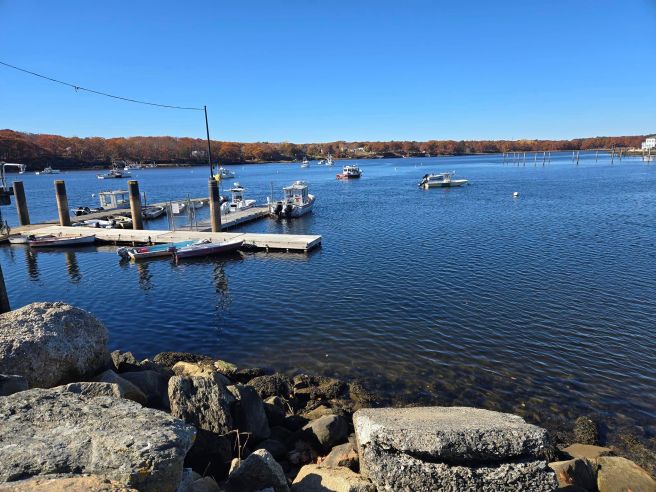
The mouth of the Saco River is a popular place for both commercial and recreational fisherman. Now a coalition of mooring owners are raising concerns about the impacts of a large pier the University of New England wants to build near its Biddeford campus (Seaver photo)
A UNE spokesperson declined an offer to comment on this story.
Ramunno is not alone in his concerns. He and six other mooring owners sent a notice of their concerns to the planning board earlier this week.
The university is hoping to construct a pier consisting of a 28-foot long by 24-foot-wide landing; a 90-foot long by 14-foot-wide approach pier; and an 80-foot long by 24-foot-long pier and a floating dock system.
UNE’s plan has already been approved by both the Saco River Corridor Commission and the U.S. Army Corps of Engineers.
The mooring owners and others – including John Schafer, former chair of the Biddeford Harbor Commission and Daniel Chadbourne, Saco’s former harbormaster – have formed an informal alliance. They adamantly maintain that “the university has no power to compel them to move.”
“This might be checkmate,” said Schafer who has been pushing for more transparency in the regulatory process. “We shall see, but I can’t imagine any scenario in which UNE is able to steamroll these mooring owners out of the way. Except possibly in a courtroom, but that would take years. Private property is private property.”
Greg McPherson keeps his 21-foot vessel at a mooring that will be impacted by the university’s plans.
“If this plan goes through, they will essentially be closing off the river to everyone else who uses the river,”
— Mike Ramunno
“It’s already a very narrow part of the river,” McPherson said. “For the life of me, I cannot figure out why no one from the city or the university has contacted me.”
In addition to impacts on mooring owners, both Ramunno and McPherson say that if UNE is allowed to build the pier as it is currently configured recreational fishermen who troll the river will also be impacted.
“That’s a very popular area for striper fishing,” Ramunno added.
“It’s very shallow where they want to put their pier,” Ramunno said. “Why are they refusing to consider the alternative location that will give the depth they actually need? I have a 34-foot boat, and I sometimes find it challenging to turn about at low tide.”
Mooring owners often have to wait years to get a private mooring on the river. They also have to pay $150 per year to the city for their mooring.
Never miss another update! Subscribe for free today!
The U.S. Army Corps of Engineers last week approved an application from the University of New England (UNE) for the construction of a controversial pier proposal on the Saco River in Biddeford.
Although UNE is still required to clear several more permitting hurdles before construction can begin, the Army Corps approval represents a significant boost for the pier project.
Earlier this year, the Saco River Corridor Commission also gave its approval for the project, which includes a permanent pier consisting of a 28-foot long by 24-foot-wide landing; a 90-foot long by 14-foot-wide approach pier; and an 80-foot long by 24-foot-long pier and a floating dock system.
The proposed pier is intended to serve and dock UNE’s 60-foot marine research vessel.
UNE Spokesperson Sarah Delage said the university is “pleased to be moving forward” through the permitting process.
Construction of the pier relies upon a $3.5 million federal grant the university received last year.
When asked about the uncertainty of federal funding created by the Trump Administration, Delage said UNE is monitoring President Trump’s executive orders, but the project is expected to stay on track.
“Like all colleges and universities, as well as other research organizations, UNE is monitoring executive orders and other federal actions closely for potential impacts on the university,” Delage said. “Having said that, we have no reason to believe the funding for the project is at risk.”
But not everyone is celebrating the Army Corps’ decision to approve the project, including John Schafer, a Hills Beach resident and former chair of Biddeford’s Harbor Commission.
“I do not know why, but in this case several ‘powers that be’ seem absolutely determined to exclude local knowledge from the permitting process. That is just wrong.”
— Dan Chadbourne, Saco’s former harbormaster
During a recent telephone interview, Schafer said he is “extremely disappointed” by the Army Corps’ decision.
Schafer — who has been doggedly seeking information about the pier and its review process for more than a year — said the Army Corps made its decision without public comment and without input of “local knowledge,” most notably from the city’s harbormaster, Paul Lariviere.
Schafer also shared several letters from people who have existing moorings that would be impacted by the pier proposal.
As of press time, the Army Corps has not responded to our request for public comment.
However, in an email response to Schafer’s questions about the lack of public comment during the Army Corps’ review, Project Manager Jana Jacobson of the Army Corps wrote that “the project was reviewed for verification under the Maine General Permit, which are issued for use on a five-year cycle. Therefore, there was no public comment period.”
Dan Chadbourne, Saco’s former harbormaster, sent a pointed letter to Jacobson, disputing UNE’s claims that the pier would only impact one existing mooring.
Chadbourne said seven moorings will be impacted if UNE is allowed to build its pier.
“There is absolutely no substitute for local knowledge when evaluating such a sizeable intrusion into a popular waterway like the Saco River,” Chadbourne wrote. “I do not know why, but in this case several ‘powers that be’ seem absolutely determined to exclude local knowledge from the permitting process. That is just wrong.”
Delage said once all regulatory approvals are received — including from the Maine Department of Environmental Protection and the Biddeford Planning Board – the university must then obtain a building permit from the Biddeford Code Enforcement Office.
Delage said UNE will continue to follow the review process, but declined to speculate about how long that process will take.
Randy Seaver is the editor of the Biddeford Gazette. He can be contacted at randy@randyseaver.com
Never miss another update! Subscribe for free today!
The University of New England (UNE) is, apparently, refusing to provide information to the public and the media about a federal grant the university received to construct a new “research pier” on the banks of the Saco River.
Over the last few weeks, John Schafer, a Hills Beach resident and former chair of Biddeford’s Harbor Commission, has repeatedly tried to get documents regarding a $3.5 million federal grant that the university received from the National Institute of Standards and Technology (NIST).
In previous interviews, the university says it is planning to use those funds to build a permanent pier on the Saco River that can accommodate its 60-foot marine research vessel.
Schafer says he and other residents simply want to see documents related to the grant. “I am a big believer in transparency and accountability,” he said. “I don’t understand why the university is unwilling to release details about a grant award of public funds. What are they hiding?”
The Biddeford Gazette attempted to contact both the university’s president James Herbert and Alan Thibeault, vice president of operations, for comment. Neither Herbert nor Thibeault returned our calls as of press time.
Sarah Delage, associate vice president of communications, replied to our inquiries with a one sentence response: “The University of New England has provided, and will continue to provide, all required and relevant documentation to the regulatory agencies and governmental bodies conducting the permitting process for our proposed research pier.”
After receiving that email from Delage, we sent another email inquiry to her, asking why the university is unwilling to simply share those documents with members of the public, especially those who live in close proximity to the school’s Biddeford campus.
Delage did not respond to our second email inquiry, as of press time.
The university formally submitted its plan for a new pier to the city of Biddeford in June last year. The grant application, however, was submitted several months prior.
UNE is still facing an arduous and likely lengthy review process for their proposal. In addition to the city of Biddeford, the U.S. Army Corps of Engineers and the Maine Department of Environmental Protection will need to review the proposed project.
Schafer said he has been bending over backward to be courteous and professional with his requests, but says he feels as if he is being stonewalled by the university.
Schafer, wrote Herbert on January 21, asking the university president to release a copy of the application the university submitted to NIST.
Herbert, Schafer says, did not reply.
According to a recent press release issued by Schafer, Alan Thibeault called Schafer and told him that he did not need to see the application, while also saying that the university is “not required” to release it.
“I don’t get it. Why are they being so stubborn? There are no national security issues here.”
— John Schafer
Thibeault did not respond to our request for comment.
Schafer says that Thibeault “reluctantly agreed to ask about permission to release the application and said he’d be back in touch.”
“I never heard back from him,” Schafer said. “At first, our conversation was very cordial, but it quickly became terse.”
Schafer says that Thibeault told him there was nothing in the grant application that wasn’t already given to various regulatory agencies.
Schafer then sent a second email to Hebert a few days later. Once again, Schafer asked to see the grant application, saying the documents should be available in the interest of transparency.
The university president has also not responded to Schafer’s second email request for disclosure.
“I don’t get it,” Schafer said. “Why are they being so stubborn? There are no national security issues here. These should be public documents. The public has a right to know how UNE presented their project to the federal government.”
Schafer commended both Biddeford City Manager James Bennett and Mayor Marty Grohman for informing UNE last year that the location of the proposed pier is not in any way approved by the city.
“The application filed with NIST could very well affect Biddeford’s regulatory process, but UNE doesn’t want it released to me, Biddeford or Saco. Luckily, freedom of information laws exist to deal with this type of obstruction,” Schafer said.
Never miss another update! Subscribe for free today!