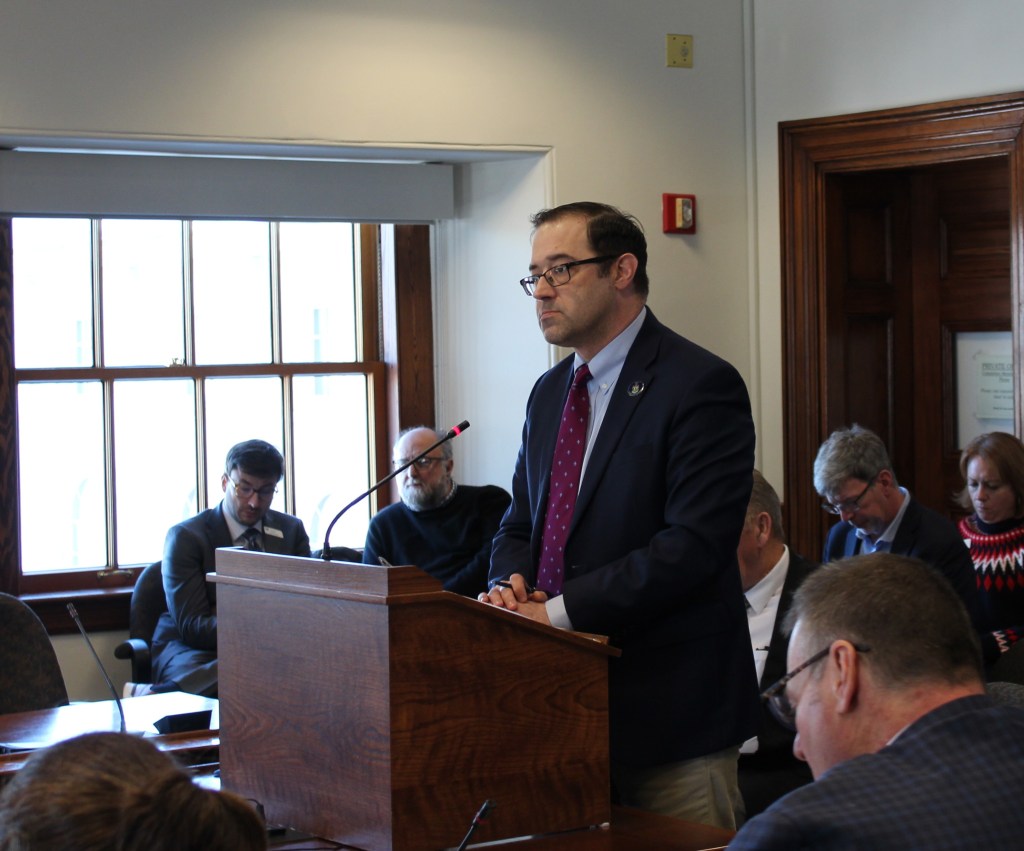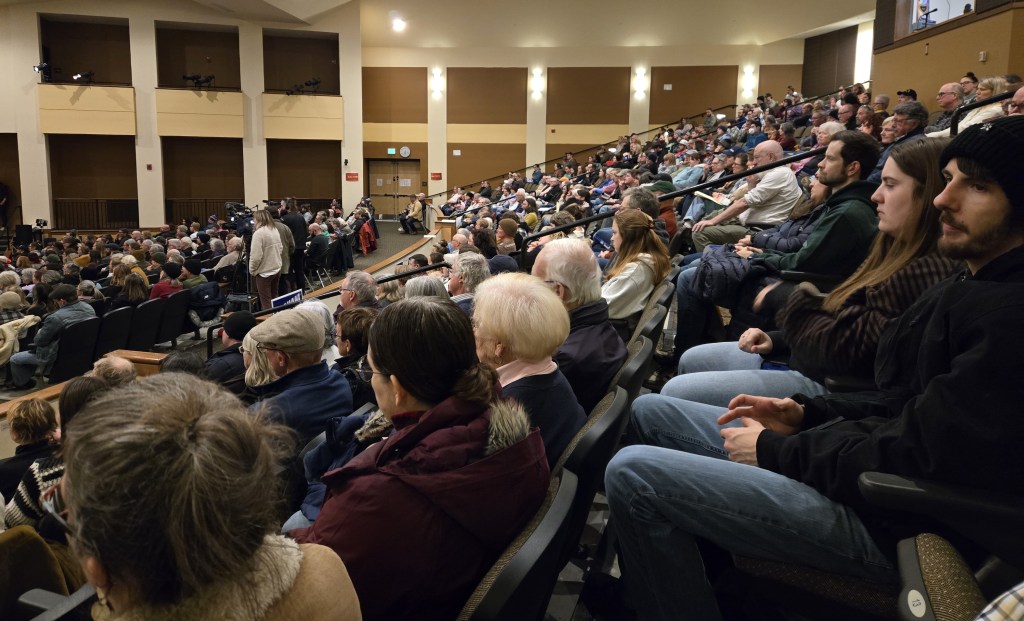
More than 1,000 people gathered Wednesday at Biddeford Middle School to see and hear U.S. Senate candidate Graham Platner, and to learn more about his campaign to replace incumbent Republican Susan Collins.
Platner, 40, took the stage wearing blue jeans and a flannel shirt, He was warmly received by a diverse crowd of supporters and onlookers.
U.S. Senate candidate Graham Platner was warmly received during a town hall campaign stop in Biddeford. (Seaver photo)
His message relied on current populist ideas from the left flank of the Democratic Party.
Maine Gov. Janet Mills is also seeking her party’s nomination to replace Collins, and she is widely viewed as a more moderate member of the party. Platner has been endorsed by Vermont Senator Bernie Sanders, an independent who has long embraced being described as “a socialist.”
Although Platner has found himself at the center of controversy about his past statements on social media, none of those issues were raised Wednesday.
Instead, the former combat marine and current oyster farmer stuck to a message about empowering people who have “no voice” within the hallways of Washington D.C.
“The system isn’t broken,” Platner told the crowd. “It’s working exactly how it was designed; to keep the power reserved for the few.”
A diverse crowd of roughly 1,000 people attended Graham Platner’s campaign stop in Biddeford
Before taking questions from the audience, Platner spent nearly 30 minutes introducing himself and outlining the core messages of his campaign.
His speech centered mostly upon a core principle of his campaign: to make life better for Maine’s working-class citizens.
Platner drew rousing applause when he talked about making wealthy Americans “pay their fair share.”
“Every single person in this state knows in their bones that they are getting screwed,” Platner said. “Things will not change until the Democratic Party stops serving the very same interests served by the Republicans.
“The only way we will see change is from the ground up. No one is coming to save us. We need an organized working class.”
Platner said he is planning several more town hall meetings across the state. He also pledged that, if elected, he will continue holding town hall meetings in order to increase “public access” for the working class, jabbing at Collins for her poor performance in meeting with “everyday Mainers’
“Every single person in this state knows in their bones that they are getting screwed,”
— Graham Platner, U.S. Senate candidate
He described himself as a “New Deal” Democrat and invoked the legacy of Frances Perkins, a Maine native who became the first female cabinet member.
Perkins served as Secretary of Labor under President Franklin D. Roosevelt. She is credited for drafting the creation of Social Security among many other programs aimed at improving the lives of working Americans.
“I’m not just asking for your vote,” Platner told the audience. “I’m asking for your time, your energy and even your discomfort as you share our message with your friends and neighbors.”
_____________
Randy Seaver is the editor and founder of the Biddeford Gazette. He may be reached by email: randy@randyseaver.com
c.) 2025 All Rights Reserved
Never miss another update! Subscribe for free today!
All across Maine, people are scrambling to help those who may be facing increased food insecurity as a result of the federal government shutdown.
Typically, Maine’s SNAP (Supplemental Nutrition Assistance Program) benefits are distributed near the middle of the month. The program relies on federal funding.
According to state officials, nearly 170,000 people receive SNAP benefits in Maine.
Food pantry workers across the United States brace for impact from government shutdown. (Photo: Tri-State Community Food Bank)
In response to the looming crisis, state officials, community leaders, social service workers and volunteers are now scrambling to fill a potentially big hole if the government shutdown continues past Nov. 15.
“The concern is that local resources are already strained,” said Vassie Fowler, executive director of the Seeds of Hope Neighborhood Resource Center in Biddeford.
“Our government is dropping the ball,” Fowler said. “So, now we all have to ask ourselves what we can do that will be impactful.”
Fowler announced this week that her organization will be trying to fill the gap by hosting free community dinners on Saturday and Sunday nights over the next few weeks, beginning Nov. 8.
The sit-down dinners will be available to anyone who needs a meal.
“I would love to have it be a neighborhood event,” Fowler said. “It’s what this agency was built upon. We want everyone to feel welcome. No one should have to eat alone.”
Currently, Seeds of Hope offers an average of 35 dinners to those who visit or sleep at the warming center. Fowler said she expects that number to spike in mid-November.
Vassie Fowler, executive director, Seeds of Hope
“We cannot ignore this,” Fowler said. “We have to do something.”
Gov. Janet Mills announced Wednesday that $1.25 million will be provided to help fund Maine food pantries and anti-hunger programs.
Those funds consist of $1 million from the governor’s contingency account and $250,000 from the John T. Gorman Foundation, according to WMTW-TV.
The Good Shepherd Food Bank will receive $650,000 to support food pantries and anti-hunger initiatives throughout Maine.
Community rallies in support of the less fortunate
In the Biddeford-Saco area, scores of people are stepping forward to make sure that no one will go hungry.
Earlier this week, local school students launched their Spare Change Fills Plates campaign to raise money for local food pantries.
Others have flooded community social media sites to organize and motivate people to volunteer and donate to food pantries.
Isn’t this what we are supposed to do?
— Vassie Fowler
In fact, the Gazette learned Thursday that several Biddeford political candidates are working to organize a food drive on Election Day, asking voters to consider donating a non-perishable food item when they go to vote at Biddeford High School.
The Biddeford Food Pantry is also hoping that they will see an uptick in both donations and volunteers. The Biddeford Food Pantry serves residents in Biddeford and several neighboring towns.
During a previous interview with this reporter, Don Bisson, the pantry’s executive director, said his pantry served 2,558 adults; 1,295 children and 1,228 families in just one month.
Looking ahead
When the Maine Legislature reconvenes in January, State Sen. Henry Ingwersen (D-Biddeford) says he plans to submit legislation to “ensure that Maine’s nutrition incentive programs, like Harvest Bucks and SNAP, are not solely dependent upon federal match funding.”
“Among the worst impacts of the federal government shutdown is the impending loss of SNAP benefits for the entire month of November,” Ingwersen said.
State Sen. Henry Ingwersen
“When Washington is consumed by its own dysfunction and gridlock, we have to look out for our neighbors and ensure that Mainers can continue to feed Mainers,” he said.
“This bill would take a step toward protecting Mainers from going hungry when politicians play games,” Ingwersen said.
Ingwersen also drafted a bill (LD 468) to provide an additional $1.2 million per year to the Fund to Address Food Insecurity and Provide Nutritional Incentives.
As part of the budget negotiation process, $600,000 of on-going funding was included in the state’s two-year budget.
Ingwersen pointed out that nearly 1,300 Biddeford households will be impacted by the loss of SNAP benefits.
Strong community support is evident
Vassie Fowler says she has been “blown away” by the support her non-profit organization has been receiving since announcing the free weekend dinners.
“I expected it to be positive, but I never imagined the reaction to our plan would be this positive,” she said.
Although Seeds of Hope is already spread thin in both funding and volunteers, Fowler says she has confidence in her volunteers and supporters.
“Sometimes, you just have to take a leap of faith,” Fowler said. “Isn’t this what we’re supposed to do?
“When I see someone in need, there is no other choice for me.”
———-
Disclosure: Vassie Fowler serves on the Biddeford Gazette’s volunteer advisory board.
Randy Seaver is the editor and founder of the Biddeford Gazette. He may be reached by email: randy@randyseaver.com
c.) 2025 All Rights Reserved
Never miss another update! Subscribe for free today!
Do you know anyone currently suffering from polio?
My guess is you probably don’t. But polio has existed throughout recorded human history, and the worst outbreak in the United States killed more than 3,000 people in 1952. It left countless others with lifelong health consequences.
Photo credit: South Dakota Department of Health
Finally, after years of research, Dr. Jonas Salk was able to develop the first effective polio vaccine. By 1961, only 161 cases in the U.S. remained. Salk was committed to ensuring that the vaccine was available to all, famously saying, “There is no patent. Could you patent the sun?”
Life-saving vaccines have helped to all but eradicate some of the most dangerous diseases that affect humans. Now this progress, and the decades-long progress made against diseases like polio, measles and mumps is in serious peril due to recent actions from the federal government.
Unfortunately, alongside the successful track record of vaccines, the anti-vaccine industry has sprouted up and flourished in recent years as a result of misinformation shared widely online. The unscientific views of anti-vaccine advocates gained an even stronger foothold due to the significant social disruption of the pandemic and the corrosive effect of social media. What was once an overwhelming bipartisan and nonpartisan societal agreement that vaccines are a good thing has sadly become polarized.
Alongside the successful track record of vaccines, the anti-vaccine industry has sprouted up and flourished in recent years as a result of misinformation shared widely online.
And the groups that push these beliefs are profiting from their lies. In 2023, the Informed Consent Action Network, an anti-vaccine group run by Del Bigtree, who is an ally of Health and Human Services Secretary Robert F. Kennedy, Jr., reported $23 million in revenue. Kennedy’s own organization, Children’s Health Defense, has also raked in millions through the years. They push lies blaming vaccines for autism and various other maladies, use it to sell products and propaganda, and get rich off vulnerable people getting sick.
This is why it is so distressing to witness Kennedy’s actions to gut the federal CDC and to stack vaccine advisory boards with anti-science skeptics, which will make it more difficult to effectively investigate rare but real cases of vaccine injury, and stifle necessary research and development. Right now, the federal CDC is attempting to restrict access to the COVID-19 vaccine for folks 65 and older and for younger people who have preexisting medical conditions, in contradiction to the fact-based guidance of experienced medical professionals.
So, what are we doing about it in Maine? Thankfully, we have strong vaccine protections in place. Certain vaccines are mandatory for children to attend Maine schools, with exemptions only allowed for medical reasons. This helps preserve the herd immunity necessary to prevent the spread of life-threatening diseases. The weakening of standards in other parts of the country like Florida is still alarming. But that gives us more reasons to do everything we can to protect ourselves and our communities.
Rep. Marc Malon says Maine is leading the way in ensuring public access for vaccinations
For the 2025-2026 COVID-19 vaccine, the Mills Administration has issued a standing order to ensure that every Mainer who wants a vaccine can get one. The standing order essentially serves as a prescription for all Maine people, and it will allow them to get the shot at local pharmacies, clinics and health care offices.
It also requires state-regulated health insurance carriers, including those with MaineCare, to provide full coverage of the cost of the vaccine. The shot is recommended for all children from ages six months to 23 months, all individuals ages 18 and older, and children two to 18 years old based on risk factors – check with your children’s medical provider. If you want a vaccine, you should be able to receive your COVID-19 booster at your local pharmacy. I encourage folks to do so. I did it this week.
Vaccine opponents like to paint the decision to vaccinate as purely a personal choice. The problem is that these personal decisions can impact other families and broader communities. The miracle of vaccination is a miracle of community, and when communities need action, our history shows us that we take it because we care about not only our families, but those around us.
So, let’s band together once again, roll up our sleeves, literally, and not take for granted the hard work, sacrifices and medical advancements that have actually made America healthier for decades.
______
Rep. Marc Malon is serving his second term in the Maine House, representing a portion of Biddeford. He serves as a member of the Veterans and Legal Affairs Committee and the Housing and Economic Development Committee. He can be reached via email at marc.malon@legislature.maine.gov.
Never miss another update! Subscribe for free today!
As Maine lawmakers gear up for what is expected to be a grueling session, there are two topics that both Democrats and Republicans agree should be a top priority.
The 132nd Legislature will consider several bills aimed at tackling the state’s housing crisis while also addressing a projected $450 million budget shortfall and a new budget proposal that represents a 10 percent increase in state spending.
When it comes to issues of housing, Biddeford’s delegation is well poised and ready to tackle the complex issues of homelessness, the need for affordable rental units, protections for mobile home residents and the rather stagnant supply of workforce housing options, which includes starter homes for Maine’s families.
“There is a lot for us to do on these issues,” said State Rep. Traci Gere (D-Biddeford) “We’re just getting started, but I am optimistic that folks on both sides of the aisle are ready to roll up their sleeves.”
Gere was just elected to her third term. She represents coastal Biddeford and Kennebunkport, and was just appointed as the House Chair for the Joint Standing Committee on Housing and Economic Development.
Rep. Marc Malon (D-Biddeford) has also been appointed to serve on that same committee.
Though Gere’s coastal district is rich in land and real estate values, it is also home to an aging population – seniors who are wondering how they can remain in homes they have owned for generations while struggling to keep pace with rising property taxes.
“Our housing problems also adversely impact people who already have stable housing
— Rep. Traci Gere
“There are so many facets that fit under the umbrella of housing issues,” Gere said, pointing out that roughly eight percent of Maine homeowners occupy manufactured housing.
Gere is hoping the Legislature will be able to help cities and towns across the state in revising zoning standards and cutting bureaucratic red tape.
“Our housing problems also adversely impact people who already have stable housing,” Gere said, pointing out that both businesses and consumers are impacted when front-line workers cannot afford to live in the same community where they work.
Speaker Ryan Fecteau of Biddeford is very familiar with housing issues. In addition to his legislative service, Fecteau is employed as a senior officer of policy and planning for Avesta Housing, a non-profit affordable housing developer that operates throughout New England.
Like Gere, Fecteau believes the state can help municipalities by cutting some of the red tape that often slows housing development.
“There are more than 200 towns in Maine that don’t have any zoning regulations or designated growth areas for new housing,” Fecteau said. “That’s almost half of all municipalities.”
Fecteau said the Legislature can find an appropriate balance in working with communities without overstepping on the bounds of local, home rule.
State Rep. Traci Gere (Photo: Maine House)
“There is an appropriate role the state can play in these local discussions,” Fecteau said. “We can bring resources to the table and help our municipal partners without stepping on their toes.”
The looming budget battle
A few days ago, Gov. Janet Mills (D) submitted her proposal for the state’s next biennial budget.
Mills $11 billion budget request represents a roughly 10 percent increase over the current budget.
To support her proposed spending increases, Mills has suggested increasing taxes on a wide range of products and services, including a 50 percent increase on cigarette taxes and more modest increases on things such as streaming services, cannabis and ambulance fees.
Local lawmakers say they are still treading through the massive budget documents that were released less than two weeks ago, but say declining federal revenues that were available to states during the Covid pandemic are no longer available.
State Rep. Wayne Parry (R-Arundel) is back in Augusta for a third consecutive term. He previously served in the Maine House for four terms before taking a two-year hiatus because of Maine’s term limit laws.
Parry will once again serve on the Legislature’s Transportation Committee. When asked about the budget, Parry said he is not feeling very optimistic.
While a majority of Democrats, including Fecteau, say the state needs to increase revenues, Parry say he favors a spending freeze.
‘I know a lot of Republicans are going into this with a mantra of cut, cut and cut, I prefer that we do our best to freeze spending at its current level,” Parry said. “Lots of people talk about the federal monies we received during Covid. Well, I have news, the pandemic is over.
“It just becomes a never-ending cycle of spend, spend, spend.”
Although a new state program designed to help seniors stay in their homes fell flat on its face last year because of huge demand and flaws in its implementation, Parry says there are still many opportunities to help seniors deal with crippling property tax increases.
“I find it really frustrating,” Parry said. “We’re not taking care of our seniors and veterans. The focus is all about people who have lived in Maine for about five minutes.
“I support programs to help people out and lend a hand, but how can we keep inviting people who need financial assistance into our state when we can’t properly take care of the people who already live here?’
When asked about the budget shortfall and looming increase, Fecteau and Gere say that many of the newer programs the Legislature passed have wide and strong support among voters.
“When you look at some of the things we accomplished – as our commitment to fund 55 percent of local school budgets to help local property taxpayers, or the universal free me program for all students, I don’t think there would be much support for cutting those programs,” Fecteau said.
“But the cost for those programs does not stay flat. We have to consider inflationary impacts and shrinking federal funds.”
Parry criticized Mills for not recognizing the importance of Maine’s transportation needs, saying 100 percent of all revenue from the state’s vehicle sales tax should be used to support a vital part of Maine’s infrastructure.
State Rep. Wayne Parry (Courtesy photo)
Currently, Parry says, only about 40 percent of vehicle sales tax revenues are being used for transportation.
“It’s really frustrating,” Parry said. “Our transportation infrastructure, including bridges, highways and roads is essential for everything from day-to-day commerce to tourism.”
“It feels like we don’t have our priorities straight.” he added.
Editor’s Note: This is a corrected version of the story. In a previous version, we misquoted State Rep. Wayne Parry in reference to gasoline taxes, which should have read vehicle sales tax. We apologize for the error.
Never miss another update! Enter your email and subscribe for free today!