Considering it was the first birthday I was dreading; it turned to be the best birthday week I can remember.
As we age, we are all reminded to focus on friends, family and doing what we love.
Because I love writing news about Biddeford, I was able to accomplish all three of those goals this week.
The Gazette featured some pretty interesting and exclusive content this week, including ourin-depth examination about a so-called buffer zonethat has found the city of Biddeford and the University of New England battling in York County Superior Court.
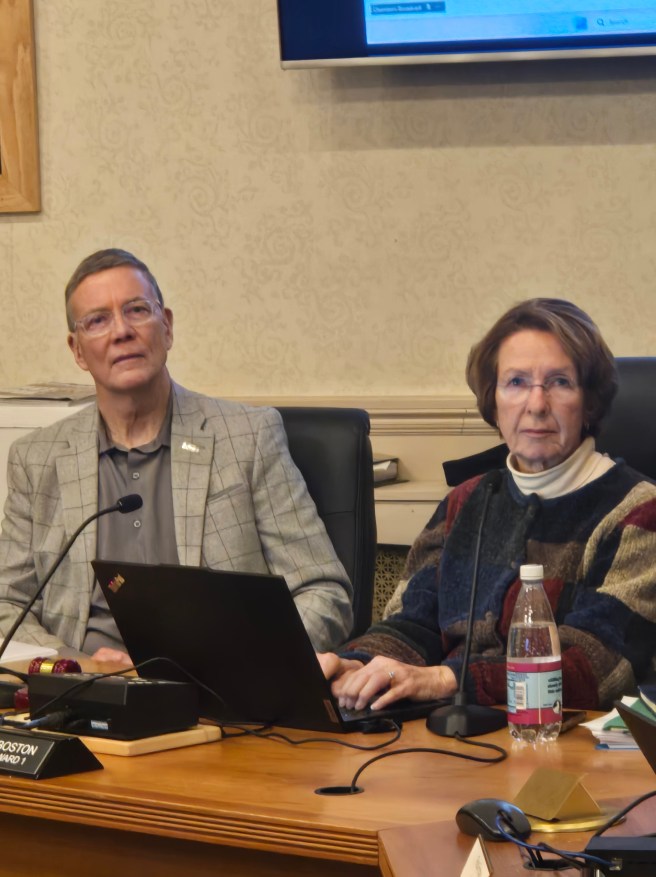
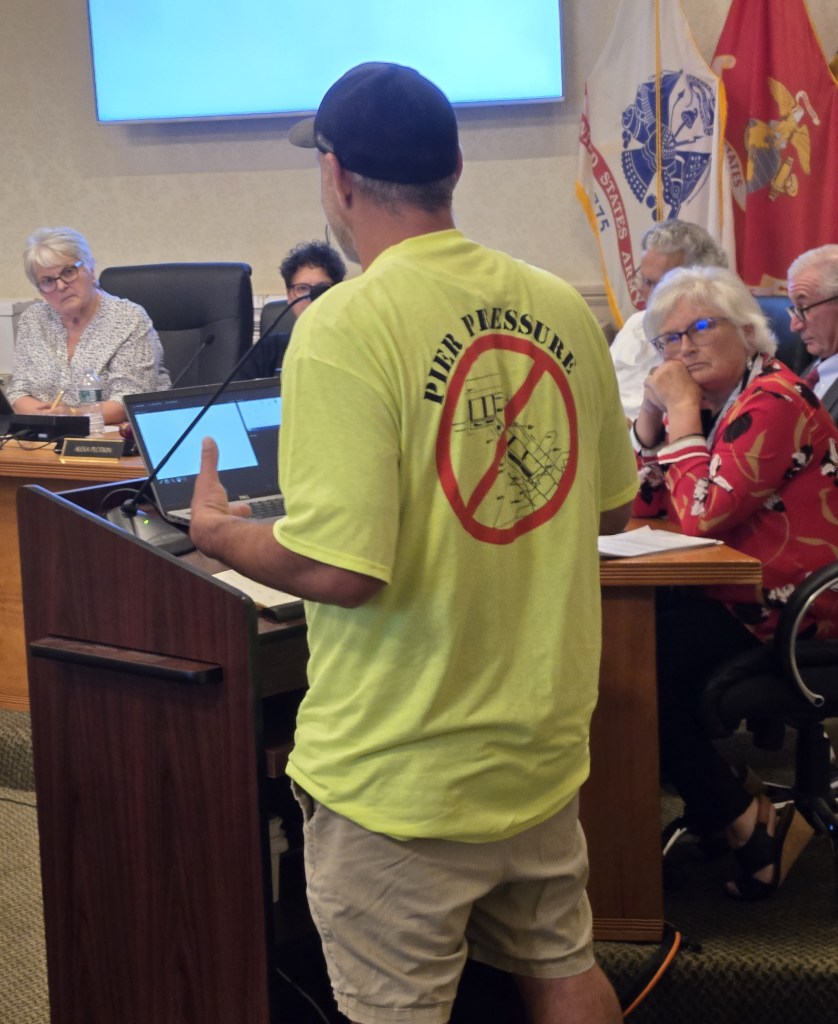
UNE President Dr, James Herbert and City Councilor Pat Boston listen to several angry residents who expressed frustration during Monday’s public hearing about development at UNE;s Biddeford campus (Seaver photo)
Our contributing writer Jim Krause also offered Gazette readers a carefully researched story that explains what you need to know when a door-to-door solicitor comes knocking on your door.
As an added treat, we had a blast providing video and print reporting of the first Coffee With A Copevent that was held Wednesday at the Community Center in Biddeford. Nice work by the Biddeford Recreation Department in organizing the event!
Joy to sorrow
The very best part of my week was being invited back to the Biddeford Primary School to read to some second-grade students in Jillian Palladino’s class on Monday. The kids surprised me with a special rendition of Happy Birthday to celebrate both my birthday and that of Dr. Seuss (also Jon Bon Jovi and writer John Irving).
But this week ended on a bittersweet note when I learned of Curtis Robinson’s passing while working on this week’s local obituaries.
I did not know Curtis. He was only a few years older than me, but he was a notable, old-school journalist who got to hang around with my idol Hunter S. Thompson.
‘One of the last great newspapermen” | Curtis Robinson (Aspen Daily News photo)
According to a recent feature story in the Aspen Daily News, Robinson was a journalist’s journalist: “dogged and irreverent kind of journalist — the type who wouldn’t take BS if it was served on a silver platter and knew a government meeting was good material if you could write about it with verve.”
Robinson’s sister lives in South Portland. Our condolences to his family and friends
And that’s a wrap for this week! Some good stuff on the horizon, so keep reading and checking back for the latest updates.
Better yet, subscribe to the Biddeford Gazette today! It’s free and certainly worth it.
CORRECTION | In the first photo caption above, one of our readers alerted us that we mistakenly identified Biddeford City Councilor Pat Boston as “Bat’ Boston. It was a typographical error, and we apologize for the mistake.
THE BIDDEFORD GAZETTE | A Legacy of Trusted, Independent Journalism
Even as a lawsuit filed by the city of Biddeford against both the University of New England and the Saco River Corridor Commission continues winding its way through York County Superior Court, a Biddeford resident is ramping up his own efforts to raise awareness about the issue.
John Schafer, the former chair of Biddeford’s Harbor Commission, claims the university misled the public during the application review process of a large-scale and somewhat controversial research pier that UNE is hoping to construct on the Saco River.
Moreover, Schafer is also raising questions about a $3.5 million grant that UNE secured through the efforts of U.S. Senator Susan Collins (R-Maine), chair of the Senate Appropriations Committee.
U.S. Senator Collins (R-Maine) ,chair of the Senate Appropriations Committee
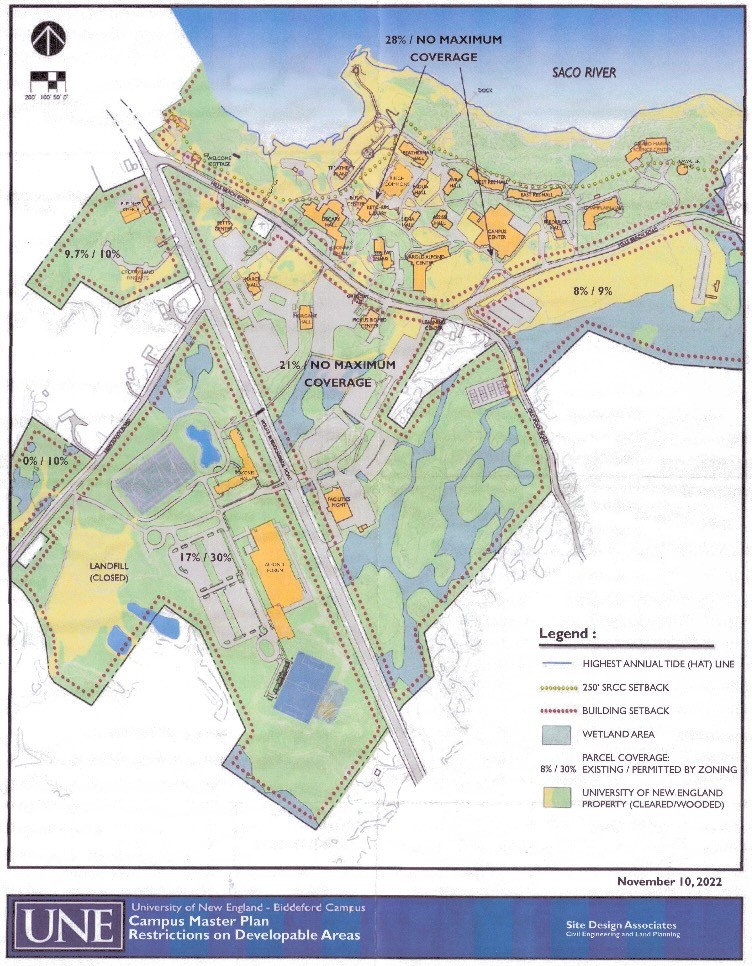
Schafer points out that more than three years ago, UNE released a map called “Restrictions on Developable Areas.”
While Schafer says that map clearly shows where construction on the UNE campus was “illegal,” UNE representatives adamantly denied those claims, saying that it is Schafer who is misleading the public.
“The suggestion that we deliberately misled anyone is simply untrue,” said Sarah Delage, a university spokesperson. “UNE has been open and honest with all government agencies throughout this process, including Senator Collins’ office and the federal agency that awarded the grant.”
Buffer Zone | A matter of semantics?
Schafer and others – including Biddeford’s city attorney Harry Center – say the 250-foot buffer zone shown on the map illustrates an agreement that UNE made with the SRCC in 2001 when it wanted to build two new dormitories.
In fact, the so-called buffer zone is a central argument in the city’s lawsuit against UNE and the SRCC.
The map provided by the University of New England
Delage and other UNE officials describe the buffer zone as a “vegetative buffer” that does not preclude certain activities, such as the need to construct a paved access for the proposed pier.
“This type of buffer is not a “No-Build” buffer,” Delage told the Gazette during a March 4 telephone interview. “It designates an area where additional permits and oversight are required for approval to build anything new.
“It is not prohibited to build within a buffer, provided you obtain the proper permits,” Delage added. “This is standard practice under Maine’s shoreland zoning rules and is not unique to UNE’s property.”
Center, speaking as Biddeford’s chief legal counsel, told the Gazette that the buffer has indeed become a matter of semantics.
“What’s the point of a ‘vegetative buffer’ if it doesn’t preclude development within that area?” Center asked.
“They [UNE] admitted and acknowledged the existence of that buffer as recently as 2022,” Center said. “It’s an issue that the SRCC ignored in their own review of the proposed pier project.”
_____________
“What’s the point of a ‘vegetative buffer’ if it doesn’t preclude development within that area?”
— Harry Center, Biddeford’s attorney
________________
Center says the issue will be a statutory matter for a Superior Court judge to decide later this year.
For his part, Schafer points to an Oct. 14, 2025 Biddeford Gazette story and the comments then offered by Delage, saying that the Saco River Corridor Commission did not impose a ‘no-build’ or ‘no construction’ zone within a 250-foot zone from the river.”
“Well, I guess at least now the university is finally admitting that there actually is a buffer zone,” Schafer said, pointing to the university’s own map.
Federal law | Was Collins wrong to provide funding?
Schafer said he is troubled by the fact that Senator Collins’ office announced a $3.5 million grant for the research pier roughly one month after the university released its own map clearly showing the buffer zone.
“Federal grants typically take many months or even years to secure,” Schafer says.
“Two scenarios are possible,” he added. “Either Susan Collins and federal authorities are incompetent, or UNE deliberately withheld information from Collins and the feds as the university chased taxpayer funding.”
Phoebe Keller, a spokesperson for Senator Collins, told the Gazette today that the senator’s office would be unable to provide any “on-the-record” comments regarding this story.
Schafer says he does not believe that Collins or any other member of Congress did anything wrong in supporting the university’s funding request.
Instead, Schafer says he believes the university withheld information about the buffer zone when applying for the federal grants.
Delage, however, says there was no deliberate plan to omit any factual information during the federal application process.
“We did not get into any of those types of specifics because it’s not part of the process of seeking funding for a project,” Delage said. “The use of grant funds for any project is predicated on securing required local and regulatory approvals and securing a grant does not circumvent or negate the need for securing approvals.”
Furthermore, Delage said that “singling out” the SRCC misses the point that the project also required approvals from the Biddeford Planning Board, the Maine Department of Environmental Protection and the U.S. Army Corps of Engineers.
Each of those review agencies, Delage noted, approved the university’s proposed pier project.
And Delage said that the map now being circulated by Schafer and others concerned about the project is not a smoking gun.
“It simply shows standard environmental zoning boundaries routinely used by the city of Biddeford, the SRCC and the Maine Department of Environmental Protection,” Delage said.
_________________
“We did not get into any of those types of specifics because it’s not part of the process of seeking funding for a project,”
— Sarah Delage, UNE spokesperson
Schafer says he will continue raising concerns and asking “tough questions” about the university’s pier project.
“I’ve asked the president of UNE [Dr. James Herbert] three times to release the application they filed with the feds,” Schafer said. “The Biddeford Planning Board also asked them to release an exact copy of that application. They [UNE] have consistently refused to answer that question.”
Schafer says that UNE’s consistent refusal to discuss whether they specifically included mention of the buffer zone likely explains how the project received a $3.5 million federal grant.
“Senator Collins is not incompetent, nor is the federal agency that issued the grant, but they were intentionally deceived,” Schafer said.
UPDATE | Phoebe Keller, a spokesperson from Sen. Susan Collins’ Washinton, DC office, contacted the Gazette following the publication of this story, asking to provide updated information .
““Sen. Collins and Sen. King secured $3.5 million for the University of New England to construct a coastal research deployment facility to be located somewhere in Biddeford, Maine,” Keller wrote. “ The senators do not determine the specific location of the project, which is set by the grantee in coordination with all relevant local and state authorities.”
ABOUT THE AUTHOR | Randy Seaver is the editor and founder of the Biddeford Gazette. He has been covering Biddeford news and politics for nearly three decades. He may be reached by email: randy@randyseaver.com
The University of New England (UNE) and the Saco River Corridor Commission (SRCC) are both asking the York County Superior Court to dismiss a civil complaint that was filed against them by the city of Biddeford.
The requests for dismissal were each filed earlier this month after the city formally brought its complaint to the court in December.
The city’s complaint — according to City Attorney Harry Center – was triggered by new information that came to light in an Oct. 14, 2025 story published by the Biddeford Gazette: UNE Pier approval tainted by glaring SRCC mistake.
The Superior Court has yet to hear oral arguments in Biddeford’s complaint about the University of New England and the Saco River Corridor Commission.
At the center of its complaint, the city argues that the SRCC neglected to consider its earlier ruling in 2001, which created a 250-foot no-development buffer zone between UNE’s campus and the Saco River.
Despite that 2001 ruling, the SRCC approved UNE’s request to construct a large-scale pier on the Saco River in August 2024. That pier will require construction of a paved access road through the buffer zone.
In October, SRCC Executive Director Cherie Dunning described the situation as a mistake that could not be remedied retroactively because the time frame for an appeal of the agency’s decision has expired.
“It does appear that there was an omission of relevant information provided to the commissioners before last year’s vote,” Dunning told the Gazette in October.
Only weeks after the city’s biennial election, Biddeford’s new mayor and city councilors decided that the issue warranted further review and consideration.
Center told the Gazette this week that the court has yet to hear any arguments. He also said that he – on behalf of the city – has filed a request to have the court hear oral arguments.
In their motion to dismiss, the university listed several reasons why the city’s complaint should be dismissed by the court, arguing that the “court lacks jurisdiction to consider the untimely complaint and that the city failed to exhaust any administrative remedies.”
Furthermore, UNE claims that the Saco River Corridor Commission did not fail to do its due diligence in reviewing the university’s application.
The university also says the city does not have standing to bring the complaint.
According to documents obtained by the Biddeford Gazette, the city of Biddeford is now investigating why more than $16,000 was spent on a downtown parking plan that was never reviewed or authorized by the city council or its Finance Committee.
At Mayor Liam LaFountain’s request, City Attorney Harry B. Center was asked to investigate questions about a temporary program that used various budget lines to fund a free parking program for downtown merchants during last year’s downtown sewer construction project.
The parking project, according to Center’s memo, was allegedly initiated by former Mayor Marty Grohman roughly 90 days before the city’s biennial election. The program was disbanded in mid-November just days after Grohman lost his reelection bid.
The municipal parking garage on Pearl Street (City photo)
When contacted by the Biddeford Gazette on Sunday, LaFountain confirmed that neither he nor any other elected official was told about the parking program.
LaFountain said he asked Center to investigate how the parking program was launched, operated and funded.
“It appears that it was kept within a small circle of people,” the mayor said. “Unfortunately, no one bothered to tell the council or the Finance Committee.”
LaFountain said he only found out about the project when City Manager Truc Dever asked if he wanted the program to continue.
“I didn’t even know the program existed,” LaFountain said. “It’s certainly troubling. The public expects us to be diligent and careful with public monies. Any major expenditures should be approved by the Finance Committee and then the full city council.”
______________
“It appears that it was kept within a small circle of people”
— Mayor Liam LaFountain
_____________
According to Center’s memo, the parking plan was initiated just weeks before City Manager Truc Dever began her new position with the city.
As part of his investigation, Center spoke with Finance Director Gerry Matherne.
“There was no council approval,” Matherne told Center. “Marty [Grohman] just did it.”
According to Center, Matherne confirmed that the funding source came from the Route 111 TIF (Tax Increment Finance) fund. under a line item known as “Other Professional Consulting Services.”
The funds were disbursed to Premium Parking, the private company that operates the city’s parking garage and several surface lots throughout the downtown area.
The funds were used to offset the cost of parking for vehicles with certain license plate numbers and designed to make street parking downtown much easier during the sewer construction project.
_____________
“There was no council approval. Marty just did it.”
— Finance Director Gerry Matherne
_____________
LaFountain told the Gazette that he was “troubled” by the situation, and said it only further erodes public confidence in City Hall.
Last year, during a review of the city’s FY 2023 audit, the city received a blistering report from its professional auditors who raised concerns about possible mismanagement of federal grant funds and a sloppy cash reconciliation process.
Matherne was hired in February and is continuing her work to address prior problems in the city’s Finance Department.
“Director Matherne is being asked to clean up and reconcile numerous issues that took place before she was hired,” said LaFountain. “Her professionalism and hard work are exactly what the city needs as we try to sort things out.”
Former mayor defends program
Former Biddeford mayor Marty Grohman told the Gazette that he was “unaware” that the city was giving money to Premium Parking to offset costs and provide free parking for certain downtown merchants and their employees.
Grohman said the plan was intended to be “revenue neutral,” and said he never authorized any extra payments to Premium Parking.
Grohman says the paid parking plan came from an idea first discussed during his weekly meetings with downtown merchants and others who were struggling with snarled traffic.
“I didn’t set it up,” Grohman said. “It was Brad Favreau (from the city’s economic development office) who set it up.”
Because of the holiday weekend, City Hall was closed and Favreau was unavailable for comment.
Although Grohman said he thought the program would be revenue neutral, he later said he did “not recall the source of the funding” that would be used.
Grohman said the idea behind his plan was to simply reconfigure spaces and designations of certain downtown parking lots.
Grohman described the plan as a “goodwill agreement” between the city and Premium Parking.
“They (Premium Parking) must have misunderstood the intent of the program,” Grohman said, when asked why the company billed the city an extra $3,170 every month between August and November 2025.
More than two years ago, Grohman was a city councilor and hoping to become the city’s mayor.
Grohman pledged then to “get tough” on the privately operated garage that is still subsidized by the city.
During a May 21, 2023 interview with this reporter, Grohman said the city should not be using TIF funds to make its subsidy payments to Premium Parking.
Grohman then said he considered the use of TIF funds to continue funding revenue shortfalls at the garage as “galling.”
“Our debt service is more than $4 million a year,” Grohman said during that 2023 interview. “I don’t think this [funding of garage revenue shortfalls] is the best use for the TIF funds.”
Next steps
Center’s memo about the parking plan is expected to be addressed during Tuesday’s Finance Committee meeting, which begins at 5 p.m. in the council chambers.
From Center’s memo: “In summary, the former mayor on his own initiative –without City Council or Finance Committee vote — directed that the payments be made to Premium Parking for private downtown business employees to park in the parking garage as well as surface lots during the Elm Street sewer construction project.
“Following an initial payment on August 26, 2025, in the amount of $3,690, four additional monthly payments of $3,170 were made from the “Route 111 TIF Fund” totaling $16,370. The payments were for parking but were made from a line item designated “Other Professional/Consulting Service Expense.”
The Gazette has filed a Freedom of Information request for emails that were circulated between July and October between the mayor’s office, Favreau’s office and Delilah Poupore, executive director of Heart of Biddeford.
“This situation is outrageous,” said At-Large Councilor Marc Lessard. “You can’t just spend taxpayer dollars to make people feel warm and fuzzy. Our ordinances spell out a process.
“Citizens expect us to adhere to those processes and follow the city charter,” Lessard added.
This story will be updated.
Editor’s Note: The Biddeford Gazette has filed a FOIA request related to this developing story. You may view/download our request by clicking on the link below:
Although the Biddeford Planning Board narrowly approved the University of New England’s controversial pier proposal in August, a required building permit will not be issued by the city until a decision comes down from the York County Superior Court.
The city has filed a formal complaint against the Saco River Corridor Commission (SRCC), a quasi-state agency tasked to review and control development on the Saco River.
The city of Biddeford will not issue a building permit for UNE’s controversial pier proposal until a decision regarding the validity of the review process comes from York County SuperiorCourt
As first reported in the Biddeford Gazette, new questions were raised in October about the review process. Specifically, the city now says that a previous decision by the SRCC — from more than 24 years ago — should have disqualified the project.
In 2001, the SRCC and the university created a 250-foot, no-development zone along the shoreline of UNE’s campus. That agreement was made as a compromise to allow construction of two dormitory buildings that would exceed a 35-foot height restriction.
The university is now hoping to construct an access road for its new pier through that buffer zone.
During their review of the university’s proposal last year, the SRCC failed to consider its previous ruling. “It was a mistake,” said Cheri Dunning, executive director of the SRCC during an October interview with the Gazette.
Dunning described the mistake as an “omission of information.” Because the agency’s approval happened more than 30 days ago, Dunning said there was nothing the SRCC could do to remedy the error.
“Our staff is working hard to prevent this type of error in the future,” Dunning said.
A few days later, Dunning sent an email to Roby Fecteau, the city’s code enforcement officer. In that email, she opined that the SRCC can alter any decision it makes. She also denied saying that the decision was a mistake on the part of the SRCC.
“The condition was created by, and thus can be altered by, the Commission,” Dunning wrote in her email to Fecteau.
When contacted Wednesday, Dunning refused to answer any questions that were not submitted to her in writing.
The Gazette sent Dunning an email, asking for comments and clarification. She did not respond to our inquiry, as of press time.
City Attorney Harry Center said the formal complaint was filed because the city wants to “maintain the integrity of the review process.”
“We’re not seeking money nor damages,” Center said. “We’re simply asking the court to instruct the SRCC to reconsider the permit.”
In early November, the Biddeford City Council voted unanimously to seek “guidance about the permit” from the Maine Attorney General’s office.
The AG’s office declined the city’s request for intervention, citing the fact that the city has its own legal counsel and that the attorney general’s office would likely represent the SRCC in any legal action.
“Municipalities rely on consistent, lawful application of state permitting standards,” said Biddeford Mayor Liam LaFountain.
“When a statutory buffer required by a prior permit is overlooked, it is essential for the matter to be properly reviewed,” LaFountain said. “Our goal is to ensure that decisions affecting the Saco River comply fully with applicable law and long-standing environmental protections.”
Donald Furman serves as Biddeford’s representative on the Saco River Corridor Commission.
Furman, an attorney, said he had “no knowledge” of the city’s complaint, which was filed nearly two weeks ago.
“This is news to me,” Furman said when contacted by the Gazette.
In the city’s complaint to the court, the University of New England is listed as an interested party.
UNE spokesperson Sarah Delage said the university “respectfully disagrees” with the city’s position.
Delage said the permit issued in 2001 for new dormitory building does not preclude the building of an access road within the 250-foot vegetative buffer along the river.
“It allows for development within that zone if the SRCC reviews the plan and finds that it adequately maintains appropriate vegetation levels,” Delage wrote in a statement to the media. “During the SRCC approval process for this project, the SRCC provided feedback on UNE’s re-vegetation plan. The project that was ultimately approved reflects that feedback.
Delage also said the university never claimed that the University would never propose any activity within the vegetative buffer.
“The research pier is an important educational and scientific asset that will support UNE’s marine science programs and contribute to environmental research benefiting our coastal community,” Delage wrote. “UNE is committed to responsible development and environmental stewardship of our waterfront campus.”
______________
Randy Seaver is the editor and founder of the Biddeford Gazette. He may be reached by email: randy@randyseaver.com
c.) 2025 All Rights Reserved
Never miss another update! Subscribe for free today!
City attorney finds new info, says UNE pier should go back to planning board
By RANDY SEAVER, Editor
Biddeford City Attorney Harry Center says that the Biddeford Planning Board should reconsider its prior approval of the University of New England’s controversial research pier.
Although the planning board narrowly approved the university’s proposal in August, Center now says the Planning Board should reconsider that approval based on new information that came to light a few weeks ago.
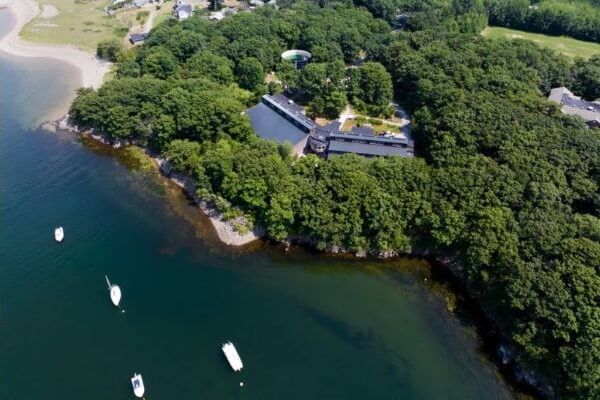
An aerial view of where UNE wants to build its research pier (Courtesy photo)
As first reported in the Biddeford Gazette, the Saco River Corridor Commission (SRCC) failed to consider a previous ruling that created a 250-foot, no-development, vegetative buffer zone on the university’s campus in 2001.
Shortly after the Planning Board approved the controversial project, a group of residents filed an appeal with the Biddeford Zoning Board of Appeals (ZBA).
The ZBA is expected to take up the matter at its next meeting on Thursday.
Center, representing the city’s Planning Board, filed a request Monday with the ZBA on behalf of the planning board and Biddeford’s planning department.
Center also discovered that the permit issued to UNE by the U.S. Army Corps of Engineers may have expired.
“In the last 10 days, far too many legal questions have been raised.”
— City Attorney Harry Center
A university spokesperson said the permit they received from the Army Corps is still in effect, and said the 250-foot no-development zone does not preclude appropriately permitted development.
Sarah Delage, vice president for communications at UNE, said the university received clarification from the U.S. Army Corps of Engineers in August that their permit remains in effect.
“The project was required to start prior to October 14, 2025, and the [Army Corps] has confirmed that the design and permitting process, which was underway well before that date, satisfies this condition.
Delage also said that “there is no inconsistency between UNE’s master plan –which was previously approved by the Biddeford Planning Board — and development within this buffer zone.
When asked about the legality of the SRCC’s permit, Delage said the SRCC’s executive director recently clarified that the approval remains valid and is neither under review nor in question at the SRCC office.
“The [SRCC] executive director sent her letter after consulting with the Maine Assistant Attorney General, who represents the SRCC,” Delage said.
“The university has carefully followed all legal and regulatory processes in permitting the project, and looks forward to continuing to do so,” she added.
Center said he has also researched prior versions of UNE’s master plan, and that those records reveal “that the University of New England’s master plan also references a 250-foot, no-development buffer.”
Red Flags Raised
Center said major red flags were then raised when Cheri Dunning, the executive director of the Saco River Corridor Commission (SRCC), wrote an unsolicited letter on October 20 to Roby Fecteau, Biddeford’s code enforcement officer.
In that letter to Fecteau, Dunning created the impression that the SRCC — while issuing UNE a permit for the pier — had deliberately overridden the 2001 order creating the buffer. She implied that present-day commissioners consciously intended to create new law. “The condition was created by, and thus can be altered by, the Commission,” she wrote.
Dunning specifically stated that the 2001 order was not discussed during the SRCC hearing. The current commissioners absolutely did not engage in any deliberative process to override the law created in 2001, according to the minutes from the August 2024 meeting.
Since the buffer was never even mentioned, the commissioners were flying blind, Center said.
“My legal analysis is that the order creating the 250-foot buffer remains in place, at least until the Attorney General’s office tells us that it has been rescinded by the commission,” Center said.
“The university has carefully followed all legal and regulatory processes in permitting the project, and looks forward to continuing to do so.”
— Sarah Delage, UNE spokesperson
Center said the ZBA has the jurisdiction to send UNE’s application back to the planning board, and given all the new information that has surfaced, it should do so.
Furthermore, Center said the city may ask a judge to overrule the SRCC’s approval of a permit for UNE’s pier, and recent statements by Dunning that the 250-foot buffer and other SRCC decisions can be ignored by regulatory authorities.
“In the last 10 days, far too many legal questions have been raised,” he said.
Center said he has the full support of Mayor Martin Grohman and the Biddeford City Council to advise the ZBA as he did today.
Last week, the Biddeford City Council unanimously voted to seek clarification and guidance from the Maine Attorney General’s office regarding the 250-foot buffer zone.
The council’s resolution stated that the city “will withhold further permitting or authorization related to the proposed UNE pier to ensure full compliance with applicable state law.”
Center says he firmly stands by his previous legal advice on other issues related to UNE’s application.
“I have one duty, and that is to properly advise my client on legal issues at all times. New information has come to light, and I’ll continue to execute my professional responsibilities accordingly,” Center said.
_______________
Randy Seaver is the editor and founder of the Biddeford Gazette. He may be reached by email: randy@randyseaver.com
c.) 2025 All Rights Reserved
Never miss another update! Subscribe for free today!
Following a rather tense and emotionally-charged discussion, the Biddeford Planning Board voted 3-2 Wednesday to give preliminary site approval for the University of New England’s proposed research pier.
The controversial pier proposal has generated widespread public discourse for more than a year, even before the application was formally submitted in June 2024.
This aerial photograph shows the proposed location of the University of New England’s proposed research pier (UNE Photo)
This aerial photograph shows the proposed location of the University of New England’s proposed research pier (UNE Photo)
Opponents – including area fishermen, private mooring owners and neighbors – have consistently said they wanted the university to consider an alternative location that was proposed by Harbormaster Paul Lariviere nearly two years ago.
City Attorney Harry Center, however, told board members that the so-called “alternative location” was not part of UNE’s application and thus, not subject to review and/or approval by the board.
City Planner David Galbraith began the discussion with an emotional statement, saying he has been vilified by project opponents and that “personal attacks” have called into question both his integrity and professionalism.
“I have been doing this for 30 years, and I have never been subjected to such malicious comments,” Galbraith told the board. “I and others involved in the review of this proposal have gone out of our way to be open, transparent and accommodating.”
Galbraith told the board that he was especially angry about a recent YouTube video that was posted by a anonymous Facebook page known as “UNE Pier Review.”
“Frankly, I am appalled,” Galbraith said. “I assure you that my integrity is worth much more than what any developer could offer me.”
“I have been doing this for 30 years, and I have never been subjected to such malicious comments.”
— City Planner David Galbraith
Planning Board Member Susan Deschambault reminded her fellow board members that the university’s proposal has already been reviewed and approved by several other agencies, including the Saco River Corridor Commission, the Maine Department of Environmental Protection and the U.S, Army Corps of Engineers.
But alternate board member Kayla Lewis said she could understand why opponents and other members of the public were feeling angry and frustrated.
“UNE did exactly what they were supposed to do in submitting their application to us,” Lewis said. “But we also have to acknowledge and recognize that this review process has had a shaky foundation. Somewhere along the line, things got very blurred.”
Roch Angers was one of the two board members who voted against approval of the project.
“I have a lot of mixed feelings about the process,” Angers said. “But that has nothing to do with our city planner, who I think has done an outstanding job.”
Center told the board that the city’s ordinances are clear and that there is no legal basis for consideration of potential impacts to mooring owners or fishermen in the Shoreland Zoning Ordinance. Center also told the board that any concerns about the harbormaster being removed from the review process were also not relevant for the board’s consideration.
Resident Kyle Noble questioned why the Planning Board was even considering the application after what he described as a “faulty review process.”
“This is a once in a lifetime project,” Noble told the board. “And it’s forever.”
A UNE spokesperson said the university was pleased about the board’s preliminary vote.
“We were also encouraged by the comments made by city staff and planning board members correcting a number of false statements that have been made about the project,” said Sarah Delage, associate vice president of communications for the university. “We look forward to a final vote at the next meeting.”
John Schafer, the former chair of Biddeford’s Harbor Commission, has been a leading opponent of the university’s proposal.
“Obviously, I am very disappointed,” Shafer said during a brief interview Thursday. “There was a lot of misinformation thrown at the board and they acted mostly in lock-step. From my perspective, it seems that their decision was already made before the meeting started.”
NOTE: Board members Roch Angers and Matt Dubois voted in opposition to the application; Board Members Larry Patoine and Susan Deschambault voted in favor of the application. Board Chair Alexa Plotkin broke the tie, voting in the affirmative for the applicant (UNE). Kayla Lewis is an alternate, non-voting member of the board.
Randy Seaver is the editor and founder of the Biddeford Gazette. He may be contacted by email: randy@randyseaver.com
NEVER MISS ANOTHER UPDATE!Subscribe for free today!
Following more than an hour of impassioned public testimony, the Biddeford Planning Board voted unanimously Wednesday to table further review of UNE’s controversial pier proposal until all board members can participate in a site walk.
Although the Planning Board conducted a site walk at the university on June 9, board member Roch Angers was unable to attend. Alternate, non-voting board members Kayla Lewis and Stephen Beaudette were also not able to attend the prior site walk.
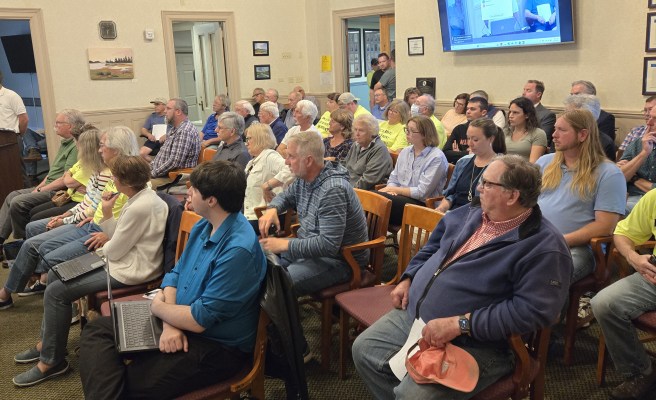
A large crowd turned out Wednesday to hear about and comment upon UNE’s controversial pier proposal during a Planning Board Meeting(Seaver photo)
Unlike the planning board’s previous meeting in May – in which all public comment came from those concerned with the pier’s planned location — a half dozen people – mostly UNE students, staff, faculty and board trustees – spoke in favor of the proposal.
But residents concerned about the impacts of the project still outnumbered supporters by more than a 2-1 margin.
“It seems that this review process has somehow morphed into a PR event for the university,” quipped Chris Stone, a Hills Beach resident.
City Attorney Harry Center has been providing the board with legal advice and updates regarding relevant criteria for their ongoing consideration of the proposal.
Center has previously told the board that issues such as water depth and river current are not relevant factors for the board’s consideration.
Despite questions from some community members about why the city’s former city manager sidelined the city’s harbormaster – Paul Lariviere – from review of the project last year, Center still defends that decision, saying the harbormaster was clearly biased against the university.
Center also maintains that the city has been in full compliance within its own ordinances even though the person hired to review UNE’s application is not a trained or certified harbor master.
In fact, in a June 11 memo to the planning board, Center points out that it was John Schaeffer – the former chair of the city’s harbor commission – who suggested the ordinance should be updated almost two years ago.
Schaeffer has been an outspoken critic of UNE’s proposal and resigned his seat from the harbor commission last year, citing concerns about transparency and government process.
Although the person who the city hired to ‘sign-off’ on UNE’s application is not a trained harbormaster, Center says that fact is irrelevant, especially since the city updated the ordinance at Schaeffer’s request in 2023.
Impassioned testimony from both sides
Although not relevant to the planning board’s criteria for approval, several people told the Planning Board that the university provides the city with numerous benefits and the proposed pier will only augment those benefits.
Tim Black, a retired federal judge who became a full time Biddeford Pool resident three years ago, told the board that they should listen to and follow [Center’s] advice.
“We have learned that power dictates the outcome. Powerful, well-connected interests are always able to get their way.”
— Richard Rhames
“UNE is one of the top-10 institutions in the United States for marine research,” Black said. “They also provide a substantial economic impact and benefit to the city of Biddeford. The moment is upon us.”
Nearly all those who raised concerns about the proposal shared a common message with the planning board.
“A lot of this has been examples in misdirection and obfuscation,” said Mike Gerstner of Biddeford. “We all agree that UNE should have a pier, our only issue is where that pier should be located.”
Skip Irving said he is a member of the university’s board of trustees. “I cannot simply stand by and listen to the rhetoric,” he said. “Our mission is to train students for important work that is critical to our future.”
UNE Assistant Professor Will Kochtitzky told the planning board that UNE offers several tangible benefits to the city and that their pier proposal should be approved. (Seaver photo)
Former city councilor Richard Rhames told the board that they should consider how much work volunteers put into serving on subordinate boards and committees.
“These volunteers, these people with no real power, are often ignored or worse,” Rhames said. “We have learned that power dictates the outcome. Powerful, well-connected interests are always able to get their way.”
Another resident said the pier controversy reminded him of a prior Planning Board’s decision to locate the MERC trash incinerator in downtown Biddeford nearly 40 years ago.
UNE Marine Sciences professor Will Kochtitzky told the board that “our world is constantly changing, and we owe it to our students to be prepared for the future by giving them the ability to conduct year-round critical research regarding marine ecosystems.”
Kochtitzky – who moved to Biddeford three years ago — also told the board that he is frustrated and angry about some of the “rhetoric” he has heard and read about from those who want to see the pier built in a different location, approximately 200 feet downriver.
“We cannot afford to let a toxic political climate trickle down from Washington and impact Biddeford,” he added.
Carol Alexander told the board: “The pier is not the problem. Its proposed location is the problem. This will affect and impact future generations.”
Former UNE student Mike Ramunno told the board that he will be adversely impacted if UNE is allowed to build its pier in their preferred location (Seaver photo)
Mike Ramunno, a former UNE student and nearby mooring owner, said he doesn’t know anyone opposed to the idea of UNE building a new pier. He reiterated a common theme: “It’s about the location,” he said. “UNE simply cares about the aesthetic appeal of this.”
_____________________
Randy Seaver is the editor and founder of the Biddeford Gazette. He may be contacted by email: randy@randyseaver.com
NEVER MISS ANOTHER UPDATE!Subscribe for free today!
During a sometimes terse and heated meeting, Biddeford Mayor Marty Grohman defended the way the city has acted during the review of a controversial pier that the University of New England wants to construct on the Saco River.
The nearly hour-long meeting was held at the request of John Schafer, the former chair of the Biddeford Harbor Commission and a Hills Beach resident who has been outspoken about the need for transparency during the review process.
City Attorney Harry Center also took part in the late Monday morning meeting in Grohman’s second-floor office at City Hall.
Center stressed that the meeting was strictly informal and not part of the review process. “The mayor has simply set aside some time to listen to the concerns of a constituent,” he said.
Hills Beach resident and former chair of Biddeford’s Harbor Commission John Schafer points to a diagram that shows inadequate depth where UNE is hoping to build a 177-foot pier to dock its research vessel near the mouth of the Saco River (Seaver photo)
No one from the university was at the meeting, and other media outlets declined invitations to attend, according to Schafer.
Schafer’s concerns center on three essential points: the impact and necessary removal of at least seven private moorings on the river if the project is approved; concerns about the water depth where the university wants to construct its pier; and the process that has been used to review the university’s proposal.
The permitting process for the proposed pier is complex and multi-layered, requiring the review and approval by several state, federal and local agencies.
Earlier this year, UNE cleared two major hurdles in the review process, winning approval from both the Saco River Corridor Commission and the U.S. Army Corps of Engineers.
But a very critical part of the review process is expected to begin in just a few weeks when the Biddeford Planning Board begins its formal review of the proposal.
“I don’t have any say over what the Planning Board does or doesn’t do,” Grohman said during Monday’s meeting. “I simply appoint members, and those appointments are then confirmed by the council. I think we have a really good planning board, and I have full confidence in them.”
But Schafer said he is concerned about the lack of public input during the review process and how the city has approached the project thus far. He also criticized the university for its “lack of transparency” and for “bullying those who raise questions and concerns” about the proposed pier.
“I think [UNE’s] application is both incomplete and full of misinformation,” Schafer told the mayor. “Don’t you think it’s a bit presumptuous for a private entity to dictate how the city will review its application; to show no regard for those who have private moorings in that area just so they can construct a vanity pier?”
When contacted by the Biddeford Gazette, a university spokesperson declined an opportunity to address Schafer’s remarks.
“Since this was not an open meeting and a representative from UNE was not present, it would not be appropriate to comment on the conversation that took place,” wrote Sarah Delage in an email response. “UNE will continue to follow the public regulatory process, and we look forward to presenting our application to the Planning Board.”
Schafer said he and “a growing coalition of residents” have no problem with the university building a pier to dock its 60-foot research vessel. Instead, he says, all the concerns boil down to the exact location of the pier and the dismissal of public concerns about the project.
Survey says?
Schafer roundly criticized Grohman for allowing former City Manager James Bennett to “silence” the city’s harbormaster and assistant harbormaster last year, preventing them from participating in the city’s review of the proposal simply because they voiced concerns about the pier’s location.
But Grohman shot back and said Bennett was simply trying to avoid the appearance of bias. He also reminded Schafer that the harbormaster’s role – as outlined in city ordinances – is strictly an “advisory position,” a change that was first proposed by Schafer himself last year when he was chair of the harbor commission.
Schafer said a growing number of residents have serious concerns about a review process that seems to have a pre-ordained outcome, pointing to the results and comments found in a recent public survey about the project.
Nearly 40 percent of respondents indicated that they had a “very low” level of confidence in the city’s handling of the review process, while roughly 30 percent of respondents indicated that they had “moderately low” confidence in the city’s handling of the matter.
The online survey was conducted over several days in late April on a Facebook page called “UNE Pier Review,” a group that Schafer has helped organize.
The survey asked respondents a wide range of questions about the proposed pier and the review process thus far. The survey allowed respondents to maintain their anonymity.
The multi-question survey included feedback from 156 respondents, showing an overwhelming lack of public confidence on the issues of transparency and the mayor’s handling of the issue.
Nearly 40 percent of respondents indicated that they had “very low” level of confidence in the city’s handling of the review process. And roughly 30 percent of respondents indicated that they had “moderately low” confidence in the city’s handling of the matter.
City Attorney Harry Center (left) and Mayor Marty Grohman listen as John Schafer details his concerns about UNE’s proposal
Fewer than 10 percent of respondents indicated that they had “very high” confidence in the process, while slightly less than 20 percent of respondents indicated that they are not sure.
Many respondents added comments saying the city has been “too secretive” while other questioned the motives of city officials, speculating that some members of the city seem to have a “cozy relationship” with the university.
Grohman described the survey as “interesting,” but also said it was not a professional survey conducted by a polling firm.
“An anonymous survey is not something that a public permitting process could use, as it does not include an opportunity for all parties involved to publicly comment,” Grohman wrote in a text message to the Gazette after the meeting.
Schafer told the mayor that several mooring owners have already written to regulatory authorities stating quite plainly that they have “no intentions of moving their moorings where UNE wants to build their pier.”
Schafer also said that UNE has threatened the city with litigation if its desired location for the pier is not approved, referencing a letter sent to the city by Ron Schneider, the university’s lead attorney, several months before the university had submitted its application for review.
Grohman described Schafer as a good friend, and said he was happy to hear the concerns that were raised.
In a moment of levity during the meeting, Grohman pointed out that the mayor does not vote on or control the regulatory review process. “I don’t have the authority to change what sodas are sold in the vending machines downstairs,” Grohman laughed.
After the meeting Schafer said he very much appreciated the opportunity to share his concerns with the mayor. “Nothing in the meeting surprised me,” he said. “It’s about what I expected.”
Never miss another update! Subscribe for free today!










 BIDDEFORD GAZETTE