It’s been an interesting, busy and somewhat exhausting week here at the Biddeford Gazette.
In fact, I was moving in some many directions that I forgot to send out this newsletter on Saturday.
My former boss David Flood always used to say there’s a lot more to running a newspaper than just writing and publishing news stories. I never appreciated that fact until I decided to launch my own publication.
Spreadsheets, meeting with our attorney, tracking expenses, insurance, content distribution, reviewing analytics and coordinating other people’s work.
It’s a lot. And I’m not getting any younger. More about that in a moment.
Running a news organization involves a lot more than writing news,
Beyond all the tedious business stuff (all of which is well outside of my comfort zone), our news and editorial content is growing by leaps and bounds.
Consider this: In February 2025 – about three months after the Gazette was created – we published 14 items on our website, not including our weekly obituaries.
Flash forward one year, and we have seen an increase of more than 300 percent! During the month of February 2026, we published 49 items on the Gazette’s site.
The good news is that nearly 40 percent of that material was generated by the community, not by us.
These community contributions include several letters to the editor, guest columns and high-quality news and feature pieces, such as last week’s story from Tammy Wells about a new partnership between the Catholic Church and the York County Jail, allowing inmates to celebrate weekly Mass.
State Rep. Marc Malon and State Sen. Henry Ingweresen also publish their regular monthly columns in the Gazette. Former mayor Marty Grohman submitted his own op-ed last month in the Gazette.
We are honored that so many people in the community regard the Gazette as a reliable and trusted source for community news and information.
Getting older; Biddeford Primary School Fun
On a personal note, this is my last day of being 61, and tomorrow (March 2) will be the first birthday that I wanted to avoid.
Every Sunday morning for the past 14 months, I spend a few hours editing, formatting and publishing local obituary notifications.
With increasing frequency, I am posting the obituaries of people who were younger than me at the time of their passing.
Statistically speaking, the average life expectancy of an American man is 76 years.
That means I likely have only 14 years or fewer remaining — for the rest of my life.
I remember clearly where I was 14 years ago today. It goes by really fast. Really fast.
All the advice from my friends, family and the expert gurus suggests that you should live each day to its fullest and focus on the things that make you happy.
So, I am pleased to announce that I have once again been invited to read to students in Ms. Jillian Palladino’s second-grade class at Biddeford Primary School. It’s the one part of my upcoming birthday that I am actually excited about.
Coincidentally, March 2 is also the birthday of Theodore Geisel, more commonly known as Dr. Seuss . . . what a wonderful confluence of events!
Quick recap and preview
Ward Five City Councilor David Kurtz (Seaver photo)
My favorite story this week comes from my thoroughly enjoyable interview with City Councilor David Kurtz. I will be doing similar interviews with each member of the city council over the next few weeks. (Chatting with City Councilors)
Our goal is to peel back the perfunctory layers to give our readers some deeper context about the men and women running our city.
Our most popular story this week – by far –was our exclusive coverage and tour of the Adams Point Family Housing project that is scheduled to open in April. That story blew up our email and social media accounts, underscoring Biddeford’s pressing need for more affordable housing.
What’s coming up?
I will cap off my birthday celebration tomorrow (March 2) by attending the first public hearing for the Institutional Zone Review Committee, which will be making recommendations about ongoing development at the University of New England’s Biddeford campus.
That meeting begins at 6 p.m. in the Council Chamber at Biddeford City Hall.
Hope to see you there! Have a great week!
_________________
ABOUT THE AUTHOR: Randy Seaver is the editor and founder of the Biddeford Gazette. He has been covering Biddeford news and politics for nearly three decades. He may be reached by email: randy@randyseaver.com
Never miss an update! Subscribe for free today!
THE BIDDEFORD GAZETTE | A Legacy of Trusted, Independent Journalism
Guy Gagnon has been excited about this particular project for several years.
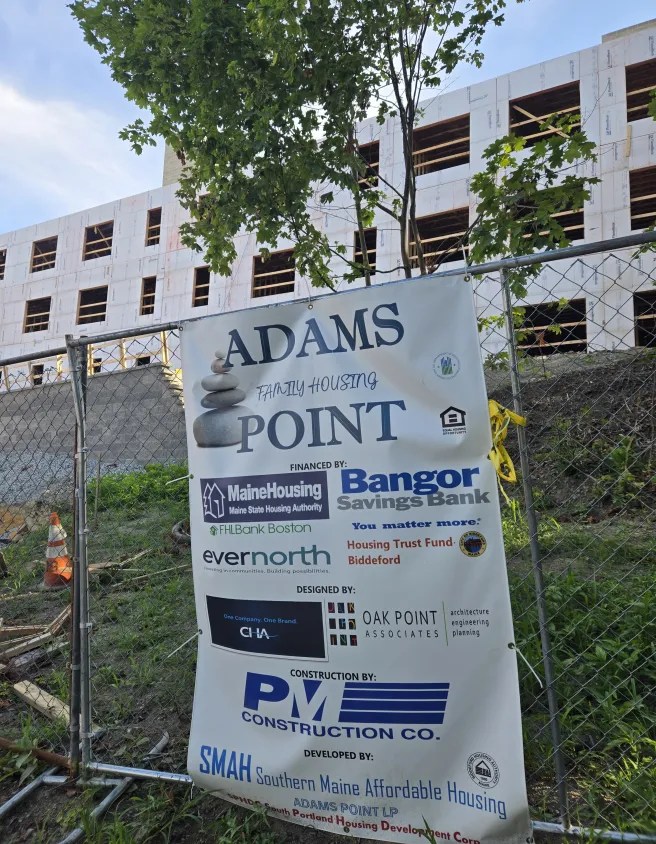
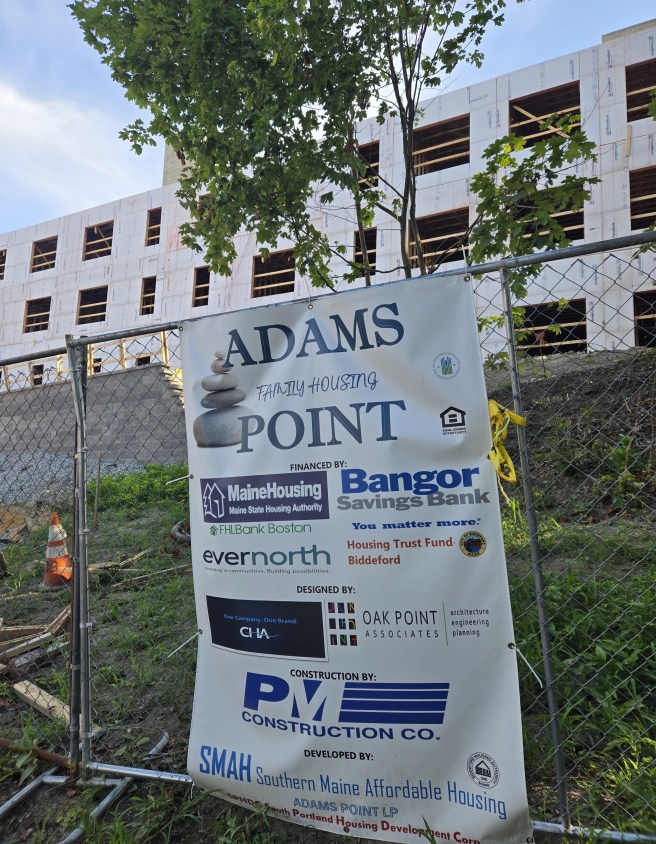
The project is Adams Point, a 39-unit affordable family housing project on the upper end of Adams Street in Biddeford.
Following more than three years of planning and construction, Adams Point is expected to finally open in April.
The four-story building will feature one, two, three and even four-bedroom apartments — all with competitive rental rates below current, average rental prices in Biddeford.
The Adams Point family housing project is expected to open in April (Seaver photo)
“This is huge for Biddeford,” Gagnon explains. “Our population is the youngest in Maine, but we don’t have a lot of housing opportunities for young families. True family housing hasn’t been built in Biddeford for many years.”
A native of Biddeford, Gagnon has served as executive director of the Biddeford Housing Authority (BHA) since 2010.
The BHA is a non-profit organization with a mission “to provide lower income families, including the elderly, disabled and unhoused, the opportunity to live in decent, safe and sanitary housing within the community.”
According to Gagnon, the rental rates at Adams Point will be “extremely competitive,” and each unit will include all utilities and free internet service.
For example, a two-bedroom unit will range between $1,200 and $1,500 per month. A three-bedroom unit will rent between $1,400 and $1,600 per month.
One- bedroom apartments will start at $1,000 per month.
“When you consider the fact that all utilities – heat, water and electricity — are included, it becomes really affordable,” Gagnon said.
Gagnon points out that providing affordable housing is not just a Biddeford problem.
Since 2018, the rental cost burden across the state has increased sharply for most households, especially for those with household incomes between $35,000 and $75,000 in total household income.
A Community Comes Together
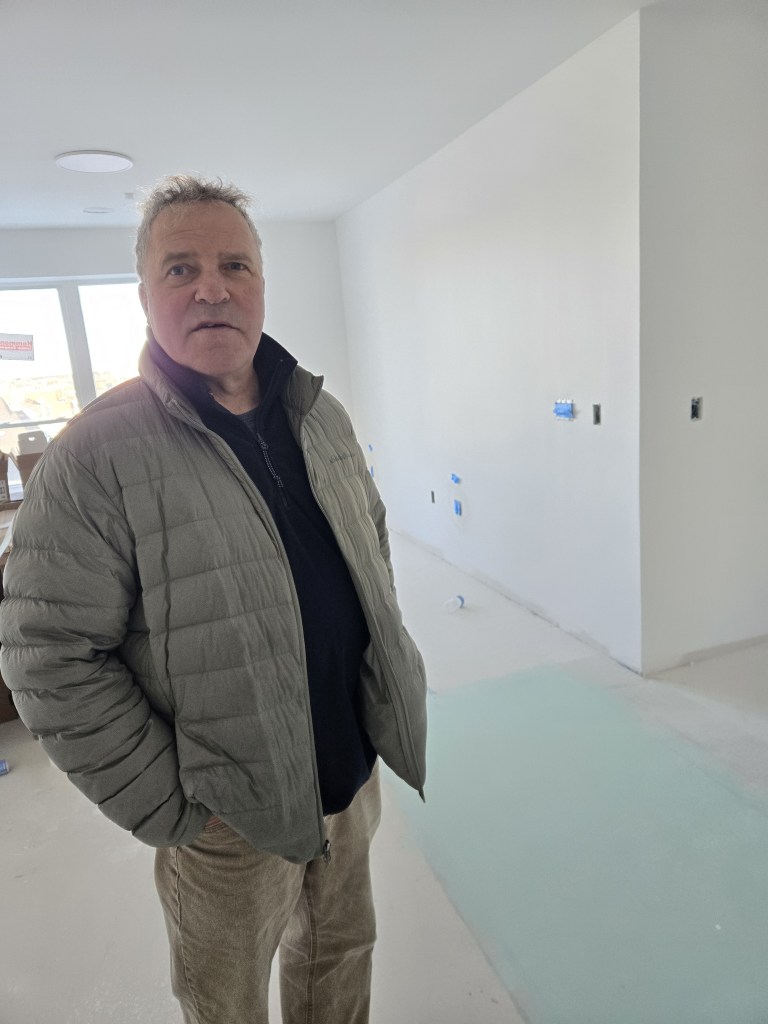
Guy Gagnon, executive director of Biddeford’s Housing Authority, provided the Gazette with a preview tour of the Adams Point family housing project
The Adams Point project, Gagnon said, is the result of collaboration with private banks and contractors willing to offer competitive financing and rates. The project is also supported by the Maine Housing Authority and received some funding from the city of Biddeford’s Affordable Housing Trust Fund.
The city’s Affordable Housing Trust Fund is supported from required donations by private real estate developers.
When Gagnon requested a financial commitment from the city, he told the council that the BHA would refund any monies that were not used or left over from the project’s construction.
“I’m happy to report that it looks like we came in under budget on this project,” Gagnon said.
Residents at Adams Point will not only enjoy the convenience of included utility services, they will also have access to free internet services being provided by a grant from GoNetSpeed.
“This is a really exciting project for Biddeford,” Gagnon said.
Editor’s Note: For more information about availability and income guidelines, please contact theBiddeford Housing Authority.
______________________
ABOUT THE AUTHOR: Randy Seaver is the editor and founder of the Biddeford Gazette. He has been covering Biddeford news and politics for nearly three decades. He may be reached by email: randy@randyseaver.com
Never miss an update! Subscribe to the Gazette for free today!
THE BIDDEFORD GAZETTE | A Legacy of Trusted, Independent Journalism
Whenever elected officials or media outlets use the words “affordable housing,” there is often an almost immediate pushback from people who say those housing units are not really “affordable.”
This is especially true in the city of Biddeford, the latest community to join southern Maine’s so-called “gold coast.”
Until just a few years ago, Biddeford was an anomaly among coastal communities in southern Maine. It was a mill town. Its demographics were dominated by working-class families.
The city’s downtown struggled throughout the 1990s, as the mills began closing. The city’s biggest downtown asset and largest overall taxpayer was the MERC trash incinerator that produced foul odors while burning trash from all over Maine.
That’s all changed over the last few years. Today, Biddeford is a desirable community and has the state’s highest number of younger adults. Biddeford is now a “cool place” to live, and people from all over New England and beyond are moving here for a better quality of life.
That positive change, however, has a big impact on regional housing costs.
So, what is “affordable” housing?
“A lot of this is subjective,” said Mayor Marty Grohman during a previous interview. “What is affordable for one person may not be affordable for another person.”
So, who decides if a housing unit is “affordable?”
Federal, state and local rules
State Rep. Ryan Fecteau (D-Biddeford) is also a senior development officer for Avesta Housing, Maine’s largest, non-profit housing development firms.
“The term ‘affordable’ really depends on the family or the individual.”
— State Rep. Ryan Fecteau (D-Biddeford)
“There is no state or county in the United States where a renter working full-time at minimum wage can afford a two-bedroom apartment,” according to Avesta’s website. “Housing availability has shrunk to record lows while rental costs have increased dramatically. The magnitude of the affordable housing crisis we are currently facing calls for bold and innovative solutions.”
Fecteau says that he and other legislators view the need for affordable housing in Maine as a top priority.
“The term ‘affordable’ really depends on the family or the individual,” Fecteau said. “But we do have state and federal requirements that developers need to follow if they want tax credits or other incentives to build housing projects.”
Fecteau says the city of Biddeford has made significant strides in addressing a wide range of housing needs, including low-income projects, senior housing and affordable housing.
For most of York County, Fecteau said, low-income is considered to be 60 percent or below of the area’s median income (AMI).
Today only a person earning $44,900 or less qualifies for low-income housing. Low-income housing (usually including basic utilities) is targeted to cost 30 percent of the household’s net income.
The Adams Point project in Biddeford is expected to open in March 2026, offering 39 low-income rental units. (Seaver photo)
Guy Gagnon, executive director of the Biddeford Housing Authority, says his non-profit organization caps their low-income rental costs at $1,350 for a one-bedroom apartment; and $2,125 for a three-bedroom unit.
Fecteau and Gagnon both point out that there is sometimes a big difference between low-income housing and other housing that is described as “affordable.”
Missing puzzle pieces
Gagnon points out that providing affordable housing is not just a Biddeford problem.
Since 2018, the rental cost burden across the state has increased sharply for most households, especially for those with household incomes between $35,000 and $75,000 in total household income.
According to George Gervais — Biddeford’s Director of Community and Economic Development — the city had 10,576 housing units at the beginning of March this year.
In just the last few months, several new housing units have been added to the mix, including projects such as The Levee and The Eddy, both of which are described as “affordable housing.”
More low-income housing is also being added to the mix. Within a few months, the Adams Street project will offer 39 new units for low-income renters.
Gervais said rental units make up slightly more than 53 percent of the city’s occupied housing.
Despite the increasing supply of housing, average monthly rents in Biddeford remain steep, ranging between $1,700 and $3,200, from studio apartments to three-bedroom units.
City Council President Liam LaFountain said he is feeling a bit discouraged because the increasing amount of housing is not doing much to drive down rental costs or the cost of a single-family home.
The average home values in Biddeford are continuing to rise, outpacing employment earning gains. The average home value in the city is slightly more than $478,000.
Earlier this year, Gervais told the city council that more than 2,100 units of housing are currently in some form of development.
Of those 2,100 new housing units, only 319 units are planned as affordable housing units in which rental costs are calculated by the area’s median income.
Grohman said that he and the city council set a goal last year to create 180 units of ‘affordable” housing every year for the next five years.
But can Biddeford residents keep up with rising housing costs?
Gagnon and LaFountain said they and others are doing everything possible to address the issue, at least on the local level.
“Our mission is to touch as many demographics as we can,” said Gagnon. “From our unhoused population to affordable apartments and homes for families and seniors.”
Gagnon said he is particularly concerned about families of two or more people being able to find an affordable living solution.
“You hear a lot of talk about one and two-bedroom apartments, but you don’t see much about three or four-bedroom units,” Gagnon said.
The Biddeford Housing Authority was responsible for the development of 47 “market-rate” units that range from $925 a month for a one-bedroom unit to $1,100 for a two-bedroom unit.
“We were able to pull that off because a lot of things went right for us,” Gagnon said. “We got our financing from a local lender with a very competitive interest rate and term. We were then able to pass those savings on to the renters.”
Gagnon said it is difficult for both non-profit and private developers to offer “affordable housing.”
“You have to consider interest rates, material and labor costs and lots of other factors,” Gagnon explained. “Typically, you don’t begin to see a return on your investment for 15 years or more.”
Gagnon said many people might be surprised to learn that it was President Ronald Reagan – a staunch fiscal conservative – who helped create federal tax credits for developers willing to build affordable housing for lower income families.
Gagnon says he would like to see the city and state move from a focus on creating more units and instead use that extra funding to develop fewer units that could be less expensive.
“People are generally impatient,” said Gagnon. “They want it fixed now, but the reality is that this is not just a Biddeford problem.”
Gagnon does, however, acknowledge that the city has some unique challenges.
“There are two very different groups of people in Biddeford,” Gagnon explained. “There is the old Biddeford and the new Biddeford. The new Biddeford people have access to higher regional incomes and can live here while tele-commuting.
“Meanwhile, the old Biddeford people are still relying on traditional incomes. I had a friend recently tell me that if Portland is Manhattan, then Biddeford is Brooklyn.”
The median household income in Biddeford is $69,794. For comparison purposes, the median household income in Saco is $84,328; and $93,167 in Kennebunk.
How do city officials define ‘affordable’ housing?
LaFountain says the city of Biddeford is using a diverse set of tools to address the costs of housing, including creating Inclusionary Zoning (IZ) rules that require any developer proposing to build more than eight units to offer at least 10 percent of those units within AMI guidelines.
“There should be housing that is attainable for all Biddeford residents,” LaFountain said. “That is the goal, but it’s going to take time, money, effort and a lot of other things beyond the city’s control to make that happen.”
The city of Biddeford describes affordable housing in the following ways:
Low-income: A development in which a household whose income does not exceed 70 percent of AMI as defined by the U.S. Department of Housing and Urban Development (HUD) stipulating that rental costs cannot exceed 30 percent of the household’s monthly income.
Owned housing: A development in which a household whose income does not exceed 120 percent of AMI;
Affordable housing: Housing for which the percentage of income a household is charged in rent and other housing expenses or must pay in monthly mortgage payments and does not exceed 30 percent of a household income.
Workforce housing: Housing where the rent is affordable to a household earning 80 percent or less than AMI, and where the units are rented to a household earning 80 percent or less than AMI.
“I understand why some people balk when we talk about affordable housing,” LaFountain said. “It is a subjective issue, but is also a very important issue.”
_____________
Randy Seaver is the editor and founder of the Biddeford Gazette. He may be contacted by email: randy@randyseaver.com
NEVER MISS ANOTHER UPDATE!Subscribe for free today!
Editor’s Note: This is the second installment of our three-part series regarding Biddeford’s housing crisis.
A panel of experts offered their perspectives and guidance regarding Biddeford’s housing crisis during a special city council workshop meeting earlier this week.
For more than two hours, the nine panelists each offered their professional insights and took questions from both councilors and members of the public Tuesday evening.
Biddeford Mayor Marty Grohman described the workshop as a necessary “first step” for city officials who are trying to find innovative solutions for a problem that shows no signs of going away.
While Biddeford has seen recent success in attracting development of market-rate housing units, the city is still struggling with “affordable housing” options and a low inventory of single-family homes for young families, often described as “starter homes.”
“We have a beautiful, dynamic and growing city,” Grohman said as he kicked off the discussion. “We’re in our 12th straight year of enrollment growth in schools. It’s immensely positive that we’re growing, and seeing this type of pressure on housing, but it’s also immensely challenging.”
George Gervais, the city’s director of economic and community development, started the meeting by providing an overview of the city’s current housing status.
According to Gervais, the city today has 10,576 housing units. Of those units, 9,431 are occupied, according to data from the 2020 Census.
Gervais said rental units make up slightly more than 52 percent of the city’s occupied housing.
Average monthly rents in Biddeford range between $1,700 and $3,200, ranging from studio apartments to three-bedroom units, Gervais said.
The average home values in Biddeford have risen by roughly five percent during the last year. The average home value in the city is slightly more than $478,000.
One of the city’s biggest challenges, however, is that area wages are not keeping pace with increasing housing costs.
“We have quite a bit coming at Biddeford,” Gervais said outlining the horizon in which more than 2,100 units of housing are currently in some form of development. “That’s a pretty impressive number,” he added.
The new development numbers include projects that are either under construction, under review by permitting agencies or projects that are conceived but have not yet gone through the permitting process.
Gervais said 319 of those units are planned as affordable housing units in which rental costs are calculated by the area’s median income (AMI).
During an earlier interview, Grohman said the city council has set a goal of creating 180 units of affordable housing each year over the next five years.
What the experts say
The panelists were broken into three main groups, focused on affordable housing; market-rate housing and a housing finance development panel. The panel also included a presentation regarding state government housing resources from Benjamin Averill, Housing Opportunity Program coordinator for the Maine Department of Economic and Community Development.
“Today, Biddeford is the place to be. “It’s the cool place. That’s great but it also poses problems.”
–Guy Gagnon, Biddeford Housing Authority
Guy Gagnon, executive director of the Biddeford Housing Authority, said Biddeford has undergone some dramatic changes in the last 15 years, pointing out that he joined the quasi-governmental agency in 2010.
Gagnon, a Biddeford native, said he is especially troubled by the fact that so many kids who grew up in Biddeford can no longer afford to live here. “I see my friends’ kids and even my own children being forced to look elsewhere for housing,” Gagnon said.
“It used to be that Biddeford was the second, third, fourth or even fifth choice when people were looking for homes,” Gagnon said. “Today, however, Biddeford is the place to be. It’s the cool place. That’s great but it also poses problems.”
Gagnon said the city needs to be creative and willing to look at alternatives that include modular housing and mobile home parks.
“It may not be for everyone,” Gagnon said, “but it may be for some people. Biddeford should be the community that thinks outside of the box.”
Kevin Bunker of Developers Collaborative said the city needs to stay aware of what is happening at the Legislature, especially in regard to statewide housing policies and assistance for affordable housing development.
“Those resources are limited and the state is facing a challenging budget,” Bunker said. “You need to remember that they are also trying to keep up with a huge demand.”
John Laliberte, the CEO of Reveler Development, provided an overview of his company’s projects in Biddeford, including 73 apartments at Riverdam, Phases One and Two of The Levee project and the recently offered market-rate units at The Eddy on Barra Road.
“We have had a lot of success in Biddeford,” Laliberte said. “There is a big demand for this type of housing, but our main challenge remains being able to attract the private capital necessary to get these projects off the ground.”
A common theme throughout the evening was centered upon the need to make the development process more streamlined and efficient to reduce costs for both renters and buyers.
Although not members of the expert panel, local real estate developers Chico Potvin and Matt Chamberlain both spoke during the public comment period, detailing how hard it is to get a project from design to out of the gate development.
Potvin, 61, said he has been building “starter homes” in the Biddeford area since 1987.
He said the city’s shortage of available single-family homes is “forcing people into apartments and making it harder for people to find apartments. “It’s a vicious cycle,” he said.
Potvin said his biggest challenges include skyrocketing labor costs and a growing myriad of red tape that cause time delays and increases building costs.
“Every year, the regulations increase,” Potvin said, questioning why the council chose to fund needed city-wide sewer improvements on the backs of new homebuyers.
“Almost every day I get calls from friends and other people asking what I can do for them,” he said. “They don’t want to wait two years for a project to get approved. I feel bad. The city needs to buckle down and treat housing the same way as you treated land for industrial parks.”
Potvin also said he is nervous about all the high-end apartments being built in Biddeford. “It scares me,” he said. “I’m not sure if it’s sustainable.”
Cat Bates said he grew up in Kennebunk and moved to Biddeford almost five years ago. He said he would like to see the city do a better job in streamlining the approval process for Accessory Dwelling Units and said it should be easier to get bank financing for that type of development.
City Councilor Doris Ortiz previously chaired the council’s affordable housing task force, and said she would like to see the city be creative in its approach to creating housing, including co-ops and micro developments.






 BIDDEFORD GAZETTE