The city of Biddeford is poised to hire Denise Clavette as its next director of Planning and Economic Development, a position that has been vacant since July.
If approved by the city council on Tuesday, Clavette will fill the void left by the sudden resignation of George Gervais who held the job for only 18 months.
According to her proposed employment contract, Clavette will be paid $125,000 per year as a salaried employee with four weeks of paid vacation time.
Clavette has worked in several Maine communities, including serving as Saco’s director of economic development for nearly four years, 2018-2022.
According to her resume, Clavette previously served as assistant city manager in Auburn; two years as economic development director for the town of South Berwick.
Clavette is today the economic development director for the Town of Gray, Maine, a position she started 11 months ago.
On her resume, Clavette describes herself as a “professional, ethical and innovative leader with excellent communication skills.”
_________
Randy Seaver is the editor and founder of the Biddeford Gazette. He may be reached by email: randy@randyseaver.com
c.) 2025 All Rights Reserved
Never miss another update! Subscribe for free today!
Following a two-year period of tumultuous staffing turnovers at Biddeford City Hall, another department head has announced his resignation.
The Biddeford Gazette was able to confirm today that George Gervais– the city’s director of economic and community development — has resigned his position, a little less than 18 months after he was hired by the city.
Gervais was unavailable for comment as of press time. Acting city manager Brian Phinney said Gervais’ last day will be July 31. Phinney said he was not sure what prompted Gervais to offer his resignation.
George Gervais (LinkedIn)
Gervais previously worked at the Maine Department of Economic and Community Development beginning in 2008. Three years later, he was appointed by then Governor Paul LePage to become the department’s commissioner, a role he served until 2018.
Gervais was hired by the city of Biddeford on Jan. 16, 2024.
Former city manager James Bennett lauded Gervais as “the best possible candidate” to replace former director Greg Mitchell last year. “I don’t think we could have done much better,” Bennett wrote in a press release announcing the hiring of Gervais.
After being hired in 2024, Gervais described Biddeford as a “dynamic community that is making significant progress.”
Biddeford Mayor Marty Grohman was unavailable for comment at press time.
Over the last three years, Biddeford has experienced a significant amount of turnover in several key departments, including the finance and planning departments.
This story will be updated as more information becomes available.
CORRECTION: A previous version of this story contained a factual error, stating that Mr. Gervais was the commissioner of the Maine Department of Community and Economic Development from 2008- 2018. Although Gervais began working for the agency in 2008, he was not appointed as commissioner until 2011. We apologize for the error.
Randy Seaver is the editor and founder of the Biddeford Gazette. He may be contacted by email: randy@randyseaver.com
NEVER MISS ANOTHER UPDATE!Subscribe for free today!
Several members of the Biddeford City Council expressed significant and pointed concerns during Tuesday’s council meeting about a proposed affordable housing project near the corner of Lincoln and Pearl streets.
Westbrook Development Corp. is hoping to construct approximately 90 units of affordable housing for residents over the age of 55. The developers say the monthly rent would range between $1,100 and $1,300, including all utilities.
Mayor Marty Grohman described the two-phase project as a “large and complex” deal that will finally culminate the end of an era when that site was the home of the MERC waste incinerator, which was closed in 2012.
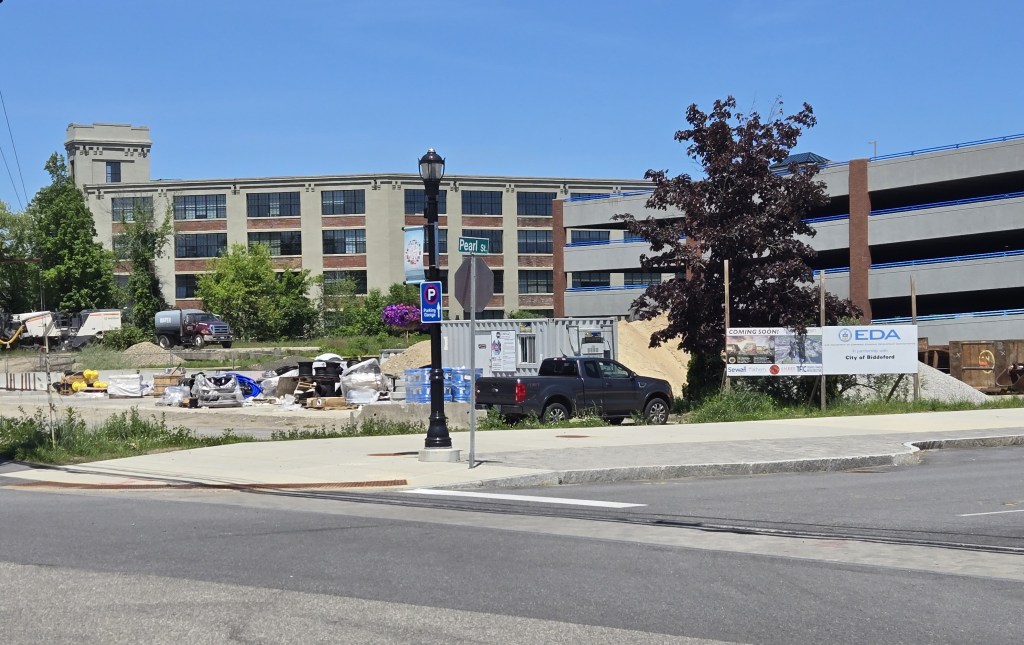
Another proposed development project that would offer market-rate apartments, retail and other commercial spaces is being proposed in the same area. The two projects would essentially wrap around the Pearl Street parking garage.
Tyler Norod of Westbrook Development Corporation addresses the Biddeford City Council Tuesday about his company’s hopes to build an affordable housing complex adjacent to the city’s Pearl Street parking garage. (Seaver photo)
The developer is proposing to give the city roughly $680,000 to secure needed parking spaces in the parking garage and is required to make an $840,000 contribution to help fund sewer upgrades throughout the city,
George Gervais, the city’s economic development director, told the council that the project would bring more than $30 million in direct and indirect benefits to the city, including a $200,000 contribution to the city’s Affordable Housing Trust fund.
Despite those benefits, several councilors said they are not yet ready to pull the trigger.
Because the city currently owns the 1.6-acre parcel, councilors expressed concerns about parking, the project’s timing and what might happen if the project falls through.
Tyler Norod of Westbrook Development told the council that his company is facing a tight timeline because they are hoping to secure project funding from the Maine State Housing Authority (MSHA) in order to make the project viable.
“I hate to have a gun held to my head,” said Councilor Marc Lessard. “That type of approach never leaves us in a good position.”
Though Lessard said he supports the need for more affordable housing, he says taxpayers expected the city to replace the former MERC site with commercial development that would create jobs and tax revenue.
Lessard said the city “cannot afford any more credit enhancement agreements. “We need to be more focused on generating more money on the tax rolls to ease pressure on taxpayers,” he said.
Councilor Norman Belanger, however, said the development landscape has changed significantly since MERC was closed 13 years ago.
“This project would be a tremendous win for the city. There’s so much benefit if this passes, and so much to lose if it fails.”
— George Gervais, economic development director
“We had a plan and a vision for that space,” Belanger said. “But then COVID hit, and the world as we know it changed.”
Belanger expressed frustration about a mixed message coming from the city council, saying he feels bad for city staff who put a lot of time and effort in bringing projects forward.
“This council is acting in a schizophrenic manner,” Belanger said. “We say we want affordable housing here, but not there. We’re sending a mixed message.”
Councilor Doris Ortiz said she supports the development of more affordable housing, but also expressed some concerns about the proposal. “The parking garage has been a thorn in the city’s side for a very long time,” she said. “Overall, I think it’s a good project, but there is a lot to work through. It’s not an easy lift for us.”
Citing the need for more information, the council voted 8-1 to table the proposal until the next council meeting on June 17.
The site where Westbrook Development Corp. wants to build 90 units of affordable housing for residents over the age of 55. (Seaver photo)
Following the meeting, Norod said he appreciated the council’s diligence and its commitment to develop more affordable housing.
“We feel as if we are partners with the city,” Norod said. “It’s clear that the council really wants more affordable housing. We have some homework to do before the next meeting, but we are happy to do it.”
For his part, Gervais said he was feeling a bit disappointed about the delay, pointing out that he and other city staffers have been working on this project for more than a year. He also said he has repeatedly offered to meet with individual councilors to answer any questions about the proposal.
“This project would be a tremendous win for the city,” Gervais said. “There’s so much benefit if this passes. and so much to lose if it fails.”
RELATED: Click here to view or download the project’s executive summary:
Editor’s Note: This is the second installment of our three-part series regarding Biddeford’s housing crisis.
A panel of experts offered their perspectives and guidance regarding Biddeford’s housing crisis during a special city council workshop meeting earlier this week.
For more than two hours, the nine panelists each offered their professional insights and took questions from both councilors and members of the public Tuesday evening.
Biddeford Mayor Marty Grohman described the workshop as a necessary “first step” for city officials who are trying to find innovative solutions for a problem that shows no signs of going away.
While Biddeford has seen recent success in attracting development of market-rate housing units, the city is still struggling with “affordable housing” options and a low inventory of single-family homes for young families, often described as “starter homes.”
“We have a beautiful, dynamic and growing city,” Grohman said as he kicked off the discussion. “We’re in our 12th straight year of enrollment growth in schools. It’s immensely positive that we’re growing, and seeing this type of pressure on housing, but it’s also immensely challenging.”
George Gervais, the city’s director of economic and community development, started the meeting by providing an overview of the city’s current housing status.
According to Gervais, the city today has 10,576 housing units. Of those units, 9,431 are occupied, according to data from the 2020 Census.
Gervais said rental units make up slightly more than 52 percent of the city’s occupied housing.
Average monthly rents in Biddeford range between $1,700 and $3,200, ranging from studio apartments to three-bedroom units, Gervais said.
The average home values in Biddeford have risen by roughly five percent during the last year. The average home value in the city is slightly more than $478,000.
One of the city’s biggest challenges, however, is that area wages are not keeping pace with increasing housing costs.
“We have quite a bit coming at Biddeford,” Gervais said outlining the horizon in which more than 2,100 units of housing are currently in some form of development. “That’s a pretty impressive number,” he added.
The new development numbers include projects that are either under construction, under review by permitting agencies or projects that are conceived but have not yet gone through the permitting process.
Gervais said 319 of those units are planned as affordable housing units in which rental costs are calculated by the area’s median income (AMI).
During an earlier interview, Grohman said the city council has set a goal of creating 180 units of affordable housing each year over the next five years.
What the experts say
The panelists were broken into three main groups, focused on affordable housing; market-rate housing and a housing finance development panel. The panel also included a presentation regarding state government housing resources from Benjamin Averill, Housing Opportunity Program coordinator for the Maine Department of Economic and Community Development.
“Today, Biddeford is the place to be. “It’s the cool place. That’s great but it also poses problems.”
–Guy Gagnon, Biddeford Housing Authority
Guy Gagnon, executive director of the Biddeford Housing Authority, said Biddeford has undergone some dramatic changes in the last 15 years, pointing out that he joined the quasi-governmental agency in 2010.
Gagnon, a Biddeford native, said he is especially troubled by the fact that so many kids who grew up in Biddeford can no longer afford to live here. “I see my friends’ kids and even my own children being forced to look elsewhere for housing,” Gagnon said.
“It used to be that Biddeford was the second, third, fourth or even fifth choice when people were looking for homes,” Gagnon said. “Today, however, Biddeford is the place to be. It’s the cool place. That’s great but it also poses problems.”
Gagnon said the city needs to be creative and willing to look at alternatives that include modular housing and mobile home parks.
“It may not be for everyone,” Gagnon said, “but it may be for some people. Biddeford should be the community that thinks outside of the box.”
Kevin Bunker of Developers Collaborative said the city needs to stay aware of what is happening at the Legislature, especially in regard to statewide housing policies and assistance for affordable housing development.
“Those resources are limited and the state is facing a challenging budget,” Bunker said. “You need to remember that they are also trying to keep up with a huge demand.”
John Laliberte, the CEO of Reveler Development, provided an overview of his company’s projects in Biddeford, including 73 apartments at Riverdam, Phases One and Two of The Levee project and the recently offered market-rate units at The Eddy on Barra Road.
“We have had a lot of success in Biddeford,” Laliberte said. “There is a big demand for this type of housing, but our main challenge remains being able to attract the private capital necessary to get these projects off the ground.”
A common theme throughout the evening was centered upon the need to make the development process more streamlined and efficient to reduce costs for both renters and buyers.
Although not members of the expert panel, local real estate developers Chico Potvin and Matt Chamberlain both spoke during the public comment period, detailing how hard it is to get a project from design to out of the gate development.
Potvin, 61, said he has been building “starter homes” in the Biddeford area since 1987.
He said the city’s shortage of available single-family homes is “forcing people into apartments and making it harder for people to find apartments. “It’s a vicious cycle,” he said.
Potvin said his biggest challenges include skyrocketing labor costs and a growing myriad of red tape that cause time delays and increases building costs.
“Every year, the regulations increase,” Potvin said, questioning why the council chose to fund needed city-wide sewer improvements on the backs of new homebuyers.
“Almost every day I get calls from friends and other people asking what I can do for them,” he said. “They don’t want to wait two years for a project to get approved. I feel bad. The city needs to buckle down and treat housing the same way as you treated land for industrial parks.”
Potvin also said he is nervous about all the high-end apartments being built in Biddeford. “It scares me,” he said. “I’m not sure if it’s sustainable.”
Cat Bates said he grew up in Kennebunk and moved to Biddeford almost five years ago. He said he would like to see the city do a better job in streamlining the approval process for Accessory Dwelling Units and said it should be easier to get bank financing for that type of development.
City Councilor Doris Ortiz previously chaired the council’s affordable housing task force, and said she would like to see the city be creative in its approach to creating housing, including co-ops and micro developments.





 BIDDEFORD GAZETTE