
FEATURE: Glory Days; they will pass you by

Yesterday was “Career Day” at the Biddeford Intermediate School, an annual event that gives third, fourth and fifth-graders an opportunity to explore various career fields.

I was asked to be one of the many presenters, but I knew that I was in trouble as soon as I walked through the front-door, clutching a stack of old newspapers, a reporter’s notebook and two pens (always two).

The other presenters were so much cooler and interesting. The police K-9 officer and her dog showed up, a firefighter arrived wearing his helmet with a large oxygen tank on his back. There was a nurse with a stethoscope draped around her neck.

For Pete’s sake, Graig Morin of Brown Dog Trucking even brought one of his 18-wheeler trucks for the kids to explore.

Admittedly, I was a bit nervous as I waited for my first of three-groups of students to arrive in my designated classroom. It’s been a while since I have been grilled by a group of nine and ten-year-olds.
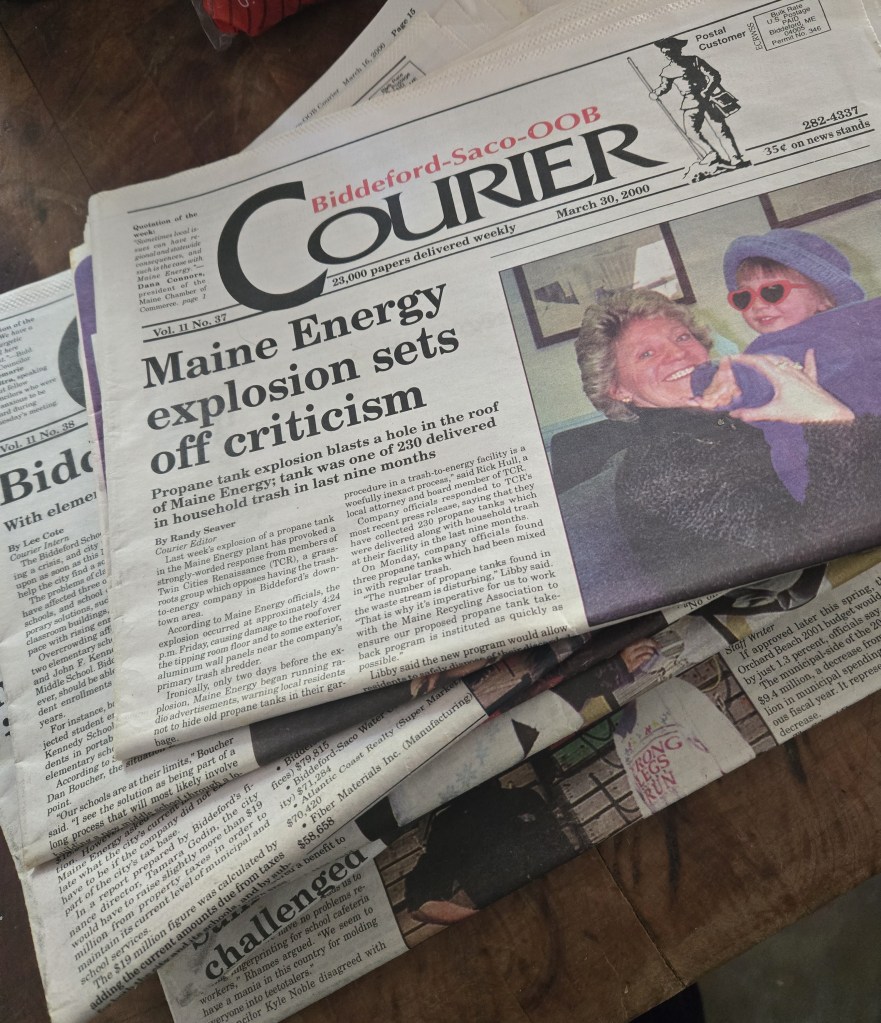
Tempus Fugit: Lessons learned from a stack of old newspapers

If you’re not careful, they can really get into your psyche and throw off your whole game. For example, during one of the Q & A sessions, one young lady asked me if I was afraid of heights. I quickly admitted that I am terrified of heights.

“What about snakes?” was her follow-up question. “Yes,” I responded, I am also very afraid of snakes.”

A quarter century? Really?

On the night before the event, I ventured into my basement and hauled out an old-cargo chest that holds scores of old copies of the weekly Biddeford-Saco-OOB Courier. I was in a rush, so I just reached in and grabbed five copies, paying no particular attention to the dates or the stories.

I have worked for several newspapers, but most people ‘round here equate me to my fun-filled days as the Courier’s editor (1997-2006) and my infamous weekly column, All Along the Watchtower.

As I was waiting for the kids to arrive, I started flipping through the old papers. Yes, I know that all past issues of the Courier are available on microfiche at the McArthur Library, but this seemed like a more practical way to make my presentation.

As luck would have it, the papers I grabbed were all from April of 2000, exactly 25 years ago. It seems like yesterday, but it was a quarter-century ago. A quarter century.

Just a few weeks ago, the Courier’s new owners (the Portland Press Herald’s parent company) abruptly announced that they will no longer offer print versions of the paper that had been delivered to every household in the Biddeford-Saco area since 1989.

When I heard that news, I didn’t realize how deeply that weekly paper was connected to the community. A wave of nostalgia washed over me as I flipped through the pages of yesteryear.

As luck would have it, the papers I grabbed
were all from April of 2000, exactly 25 years
ago. It seems like yesterday,
but it was a quarter-century ago.

Time may change me. But I can’t trace time.

The kids were eager to pore through old copies of the Courier. Sure, I still write news and opinion, but I can’t imagine 25 years from now that a bunch of kids would be so excited about reviewing a web site.

It was interesting to see what caught their eyes and their imagination. Each of the newspapers had a full back-page ad from Marc Motors. Apparently, in April of 2000, you could buy a 1998 Pontiac Sunfire for $10,995 or a weekly payment of $38. Or you could get a 1997 Ford F-150 for $17,995 (or $65 per week).

In April [2000], we ran a contest: Find the Mistakes in the Courier. The person who found the most verifiable mistakes each week got a free lunch at the Wonderbar. We were all glad when that contest ended.

A lot of the names have changed, but the news back then was not much different than it is today.  Ironically, one of the headlines told readers that Biddeford voters may soon be asked to approve construction of a new school to address overcrowding. That school? Yup, the Biddeford Intermediate School, where I was sitting yesterday morning.

The Old Orchard Beach School budget was up $500,000. There was an explosion of a propane tank at the former Maine Energy trash incinerator in downtown Biddeford. Another story explained how Biddeford’s tax rate would increase $1.50 if MERC left town. The top five taxpayers then were MERC, IBC (Nissen Bakeries), Central Maine Power, Walmart and D.K. Associates Limited.

Saco residents were faced with a possible pay-per-bag trash disposal fee, a downtown landlord in Biddeford found himself in hot water with the city’s code enforcement office.

On and on. Into infinity and beyond.

I asked the kids if any of them remember the Yellow Pages. They were stumped; their brows furrowed with intrigue. It’s quite likely that someday the same fate that killed the Yellow Pages will finally overcome print newspapers.

I don’t look forward to that day.

Never Miss Another Update! Subscribe for free today!

OPINION | The Times, They Are A Changin’

The news was inevitable, but still sad.

We learned yesterday that the weekly Biddeford-Saco-OOB Courier will no longer be printed and now accessible only in digital form, online.

This is just part of a global trend in the newspaper industry. Let’s face facts. The cost of printing and distribution are significant.

But while technology marches onward, there are still many painful consequences. Nearly 50 employees got layoff notices yesterday from the Courier’s parent company, the Maine Trust for Local News.

Regardless of how you feel about evolving technology, we are entering an era that is making human workers more irrelevant with each passing day.

It’s not just newspapers. There are no more phone books. No more encyclopedia salesmen. EZ Pass reduces the need for human toll booth workers. Self-checkout at the grocery store, shopping online and using ATM cards are all part of the equation.

For older people who may be a bit skittish about apps, streaming television and AI (artificial intelligence), many of these changes (advancements?) are uncomfortable, if not downright terrifying.

When my children were growing up, I often told them: “Your environment does not adapt to you. You must adapt to your environment.” It’s a matter of survival.

Video Killed the Radio Star

I have written several columns about the media, advancing technology and consumer trends when it comes to news distribution, including this rather recent post: Pour Some Sugar on Me

But this latest news about the Courier leaves me feeling a bit nostalgic and a bit sad.

I am personally connected to this story nine ways from Sunday.

Let’s backup for a second. For more than 50 years, newspapers have been part of my life, first as a paperboy for the York County Coast Star, the Journal Tribune and the Portland Press Herald.

I dreaded Sundays because the weight of those Maine Sunday Telegram issues were more than twice as thick as their daily counterparts and quite heavy. I had to break my route up on Sundays simply because I could not fit all of the papers into my over-the-shoulder sack.

Even as a young boy, I had a fascination with news and politics. In high school, I even landed a short gig as an intern in the Journal Tribune’s newsroom.

Over the years, I wrote for a few different publications, but it was the Courier where I made my mark.

It was the Courier that launched my connection to the same exact communities where I grew up. The Courier became my life. Had I not been the Courier’s editor for a few years, I would not have met my wife.

Today, I own and operate an online-only “newspaper.”

I was lucky enough to work for the Courier back in the good ol’ days, when the paper was still locally owned and operated.

I very much doubt that the Courier’s current owners have even visited Biddeford, but still, they have the audacity to promote the paper by describing its coverage as “hyper-local.”

Ummm . . . not really hyper-local . . . . whatever that is supposed to mean.

It’s been a long time since I have seen a Courier reporter cover City Hall. I did not see a reporter from the Courier at this year’s Winterfest festival.

When Biddeford Mayor Marty Grohman scheduled a community event to support the family of a fallen police officer, the Courier was not there to cover it, but did publish a story a few days later. Liz Gotthelf from Saco Bay News was there. I was there, representing the Biddeford Gazette but that was it for media coverage during the actual event.

Make no mistake. It’s not the reporter’s fault. It is a situation playing out in newsrooms all over the country, where ad revenue trumps news coverage.

I very much doubt that the Courier’s current owners have even visited Biddeford, but still, they have the audacity to promote the paper by describing its coverage as “hyper-local.”

I Want To Be Sedated

Sydney Richelieu is today the primary reporter for the Courier. Her editors expect her to cover six communities every single week. Think about that for a minute.

Richelieu is responsible for covering news in Biddeford, Saco, Old Orchard Beach, Arundel, Kennebunk and Kennebunkport. I don’t care who you are or how hard you work, that beat is a really big nut to crack.

Consider this. When I left the Courier in 2006, we had four full-time reporters (including me) covering the same geographic area.

Today, the Maine Trust for Local News expects one reporter to cover the same beat that was previously covered by four reporters. The Maine Trust for Local News has set Sydney up for failure even before she inherited the beat last year.

The folks at the Maine Trust for Local News love to bloviate about their dedication to “local journalism,” but maybe they should put some of their money into the newsroom, you know? Local journalism?

The Courier and the Portland Press Herald are both owned and operated by the same company, so don’t expect the state’s largest daily newspaper to step in and fill in the cracks. The way they see it, Biddeford and Saco are already covered.

Newspapers – including both tabs (tabloids) and broadsheets — are printed in four-page increments. In order to cover costs, roughly 60 percent of the newspaper needs to be covered by paid advertisements.

When I left the Courier, we were consistently publishing 44-page papers. Today, the Courier is merely a shadow of itself, hovering around 16 pages (not including advertising inserts).

I’ll close with some good news for the Courier. This move by their parent company removes their handcuffs of being published just once a week. Now they can more effectively compete with the other digital publications in this area, Saco Bay News and the Biddeford Gazette.

Being online allows journalists to be nimbler, to be in a better position to scoop some breaking news. Something that hasn’t happened at the Courier in a long time.

As a Biddeford resident who appreciates and values local news from a variety of sources, I hope that this recent transition returns the Courier to its rightful position as a competitive, local news source.

We’ll see.

Never miss another installment | Subscribe for free today!

Biddeford-Saco Courier will no longer be printed, online only

According to its parent company, the Biddeford-Saco Courier — and several other weekly publications — will no longer be printed and will only be available online.

The Courier and many other newspapers throughout southern Maine, including daily and weekly publications, are owned by the Maine Trust for Local News.

Carolyn Fox, executive editor of the Maine Trust for Local News, said the decision was “difficult,” but pointed out that a dwindling number of people rely on printed publications as their primary news source.

“To sustain and grow impactful journalism in Maine, we have to meet our readers where they are,” Fox said. “Our digital expansion creates a stronger foundation for the Maine Trust, and we’re excited to build on that in partnership with the communities we serve.”

The move to a digital platform will result in 49 layoffs of employees who print and distribute the newspapers. Fox said her company is planning to add employees to its newsrooms later this year.

The Biddeford-Saco Courier — a free weekly publication — was created and launched by David and Carolyn Flood of Saco in 1989. The paper was distributed in residential neighborhoods and available on newstands.

The Floods — who now live in Delaware — sold the Courier and several of its sister publications to the publishers of the Journal Tribune in 2007. The daily Journal Tribune newspaper closed its doors in 2019.

Flood said he was surprised by the announcement but acknowledged the industry trend. “Personally, I think printed papers are easier to read,” Flood said.

Liz Gotthelf, the publisher of Saco Bay News — another online news source in the Biddeford-Saco area — said she was not surprised by the announcement.

“To sustain and grow impactful journalism in Maine,
we have to meet our readers where they are,”

– Carolyn Fox, executive editor, Maine Trust for Local News

“I think publishing local news online is a way to reach a wider range of readers,” Gotthelf said. “By focusing on a digital platform, it makes things so much easier and less expensive. Also, there are not many places that have a printing press.”

Currently, the Courier’s online presence is connected to its parent company’s web site, which can only be accessed with a paid subscription. The Courier has always been a free publication, so it remains unclear if readers will be able to access the publication without a subscription.

Both Flood and Gotthelf say they will be closely watching the Courier’s transition.

People seeking local news and information in the Biddeford-Saco area will now have three online media outlets to choose from, including the Biddeford Gazette and Saco Bay News.

Laura Seaver, publisher of the Biddeford Gazette, said the announcement was expected for a long time. “This puts everyone on a level playing field,” she said.

Never miss another installment! Subscribe for free today!

OPINION: Some notable changes in local media outlets

(Originally published on the Lessons In Mediocrity site)

There’s no denying it. This is not your father’s news industry anymore. That’s good news, but it’s also very bad news.

I’m writing this because there were three significant local changes in the news industry that happened in just the last two weeks.

More about that in just a moment.

Traditional, legacy media outlets are no longer the sole guardians of truth and justice, and that fact — like it or not – will impact you — and it might even hurt you.

For centuries, newspapers, (and then later) radio and television news operations kept an immeasurable amount of gravitas in their pants’ pocket, like so many nickels and dimes. The publishers, editors (and oftentimes the reporters) took your trust in them for granted.

Nearly 300 years ago, Edmund Burke, a member of British Parliament, reportedly coined the term “Fourth Estate” to describe the press, pointing out its obligations as a check in government oversight and its responsibility to frame political issues as well as to be an advocate for the general public.

Pretty big responsibility, eh?

The industry that was once the trusted and almost sole gatekeeper of vital public news and information is now scrambling, desperately trying to find a way to remain relevant or at least financially solvent.

So, what are the threats and challenges facing both you as a news consumer and traditional media outlets?

First and foremost, social media platforms are taking over the distribution of news and information. There are no more paperboys and even newsrooms are shifting away from brick-and-mortar structures.

In survey after survey; in poll after poll, one fact becomes abundantly clear. Consumers want their news on their schedule (on demand). Readers also try to skirt paywalls, no longer seeing the value of paid news subscriptions.

Readers today gravitate toward click-bait headlines and “news” websites that match their own political ideology.

Photo: The Death of the Newspaper Industry | John W. Hayes)

Never-ending competition, a 24-7 news cycle and the disturbing rise of AI (artificial intelligence) all remain as threats to established and not-so-established news outlets.

And to top it off, reader trust in traditional news outlets is plummeting faster than shares of K-Mart stock.

In his Nov. 29, 2022 opinion column, Boston Globe columnist Jeff Jacoby pointed to a recent Gallup report, which revealed that just one out of three Americans claimed to have a “great deal” or a “fair amount” of confidence in the media.

We could talk all day about the national news scene and the spiraling demise of legacy media, but let’s take a deeper look at the news on a local level, right here where it hurts the most.

Today, almost everyone is a journalist – or so they believe. All you need is a keyboard and an internet connection and its off to the races.

While I love certain aspects of “citizen journalism” it does sort of invite a Wild, Wild West approach in reporting news.

These citizens journalists typically do not have editors or the resources of an editorial board. They have no professional training. Ethics and objectivity are now electives, no longer requirements.

In other ways, however, these pesky citizen journalists and their social media followers do keep some much needed pressure on those Fourth Estate guys, the traditional legacy media outlets.

We’re not in Kansas anymore

Speaking of legacy, traditional media, the Bangor Daily News (BDN) – Maine’s preeminent source of political news – decided last week to shut down its editorial board. The paper will no longer have an Op-Ed (Opinion-Editorial) section.

I found that news strange. It struck me as counter-intuitive, especially since so many people are saying that readers are flocking toward opinion and away from objective news reporting.

While I love certain aspects of “citizen journalism” it does sort of invite
a Wild, Wild West approach in reporting news.

In a Jan. 24 columnthe BDN described the move as “the end of an era.”

Susan Young, the paper’s opinion editor, said the news was “bittersweet.”

“Far too few people read opinion content, so we have to try different things,” Young told me during an online conversation, saying the decision was influenced by the paper’s digital analytics.

The BDN’s decision will also mean the end of rigorous and highly regarded opinion columns from people like Amy Fried on the political left to Matt Gagnon on the political right.

Still closer to home, the publishers of the Biddeford-Saco Courier announced on Wednesday that they will now offer their subscribers a digital weekly update via email.

That “announcement” dropped exactly two weeks after I formally launched the Biddeford Gazette, a free digital newspaper dedicated to covering Biddeford news, opinion and events.

For more than 30 years, the Courier has relied upon free delivery of its print publication at newsstands or tossed into the driveways of private homes.

The Courier was founded and locally owned by David and Carolyn Flood. A few years ago, the paper was then sold to the owner of the now defunct Journal Tribune, a daily newspaper that was later acquired by the daily Portland Press Herald. Today, the Press Herald owners also contributor several weekly and daily publications throughout central and southern Maine.

Courier reporter Sydney Richelieu announced the “inaugural edition” of “Biddeford-Saco | Now” in an email sent to subscribers. The move, she said, is designed to offer readers another option in finding out what is happening in their community.

I have some unsolicited advice for Sydney and the Courier’s editors, please stop printing press releases and then labeling them with a byline of “Staff Reports.”

Otherwise, I am quite pleased that you guys finally want to step up your game in covering local news.

To be honest, I have a bit of an advantage over the other guys. I’m a Biddeford native and resident, and I have been covering Biddeford for nearly three decades. I have a stockpile of sources and lots of time on my hands.

Just a few days ago, a close friend of mine remarked that other local publications are now starting to pay more attention (deservedly so) to the city of Biddeford, since I launched the Gazette.

That’s actually really good news, especially for the people of Biddeford.

The other guys may not like the fact that I am now in the mix, but they should remember the folks at the Journal Tribune were none too happy when the Courier was launched in 1989; and the folks at the Courier were none too happy that Saco Bay News came along in 2019 and showed off the nimble advantages of being a digital publication.

Increased competition does not help the Courier, Saco Bay News or the Biddeford Gazette, but it does keep a fire lit under our asses; and that is good news for readers.

The people of Biddeford should not have to rely upon just one reporter for the news that matters to them.

Competition keeps reporters motivated, but more importantly – it keeps them in check.

The Biddeford Gazette is not trying to put anyone else out of business. In fact, the opposite is true.

The Biddeford Gazette uses its own social media pages on Facebook, BlueSky and X to round up and share local news stories from other media companies. No one else does that.

You read that right. We take the time to share news from the other guys on our social media pages. And when you click to read those stories, you are not directed to our website, instead all the postings will link automatically to whatever source produced the news, whether it’s Saco Bay News, the Courier or WGME-TV.

Please visit our new Facebook page and follow us to experience a new level of local news coverage.

Whenever or wherever news about Biddeford is published, we will be there to make sure you know about it.

That’s my mission. That’s my passion.

I value your trust.

I will not stop.

Editor’s Note: This is a corrected version of an earlier story. The Biddeford-Saco Courier was originally acquired by the publisher of the Journal Tribune, not the Portland Press Herald. We regret the error and apologize for any confusion it may have caused.