Guy Gagnon has been excited about this particular project for several years.
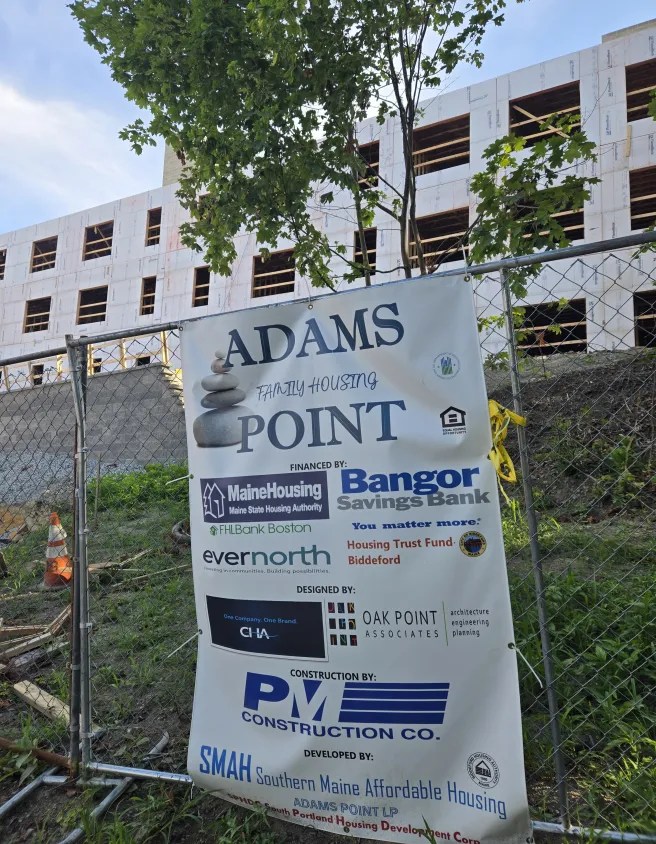
The project is Adams Point, a 39-unit affordable family housing project on the upper end of Adams Street in Biddeford.
Following more than three years of planning and construction, Adams Point is expected to finally open in April.
The four-story building will feature one, two, three and even four-bedroom apartments — all with competitive rental rates below current, average rental prices in Biddeford.
The Adams Point family housing project is expected to open in April (Seaver photo)
“This is huge for Biddeford,” Gagnon explains. “Our population is the youngest in Maine, but we don’t have a lot of housing opportunities for young families. True family housing hasn’t been built in Biddeford for many years.”
A native of Biddeford, Gagnon has served as executive director of the Biddeford Housing Authority (BHA) since 2010.
The BHA is a non-profit organization with a mission “to provide lower income families, including the elderly, disabled and unhoused, the opportunity to live in decent, safe and sanitary housing within the community.”
According to Gagnon, the rental rates at Adams Point will be “extremely competitive,” and each unit will include all utilities and free internet service.
For example, a two-bedroom unit will range between $1,200 and $1,500 per month. A three-bedroom unit will rent between $1,400 and $1,600 per month.
One- bedroom apartments will start at $1,000 per month.
“When you consider the fact that all utilities – heat, water and electricity — are included, it becomes really affordable,” Gagnon said.
Gagnon points out that providing affordable housing is not just a Biddeford problem.
Since 2018, the rental cost burden across the state has increased sharply for most households, especially for those with household incomes between $35,000 and $75,000 in total household income.
A Community Comes Together
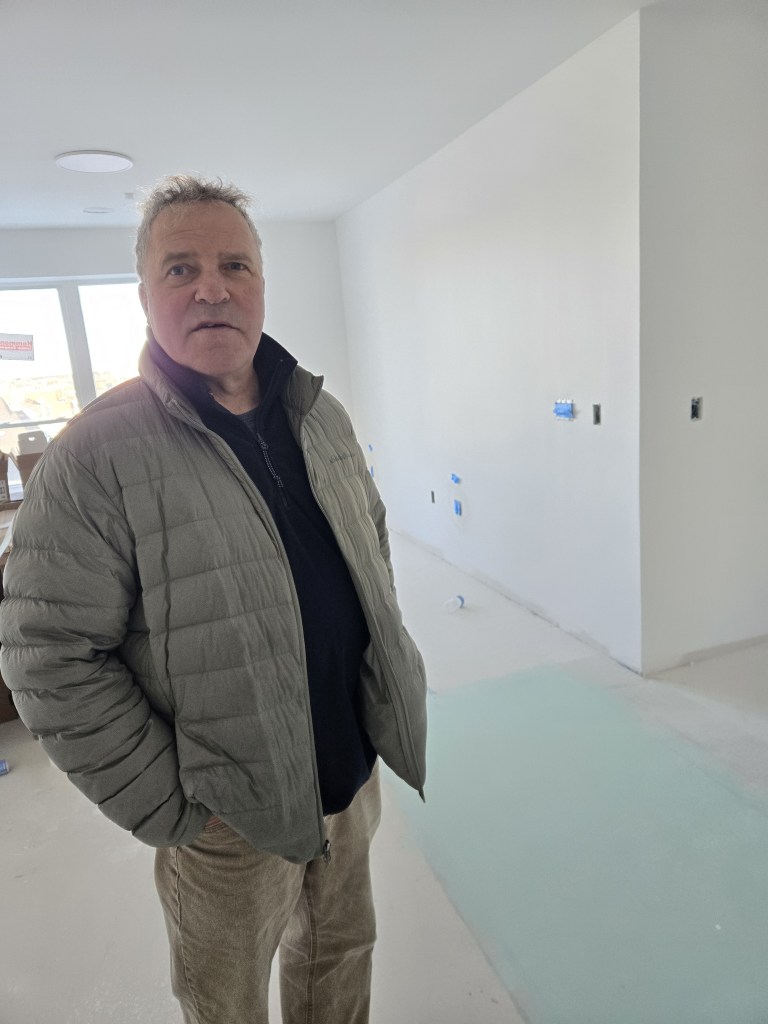
Guy Gagnon, executive director of Biddeford’s Housing Authority, provided the Gazette with a preview tour of the Adams Point family housing project
The Adams Point project, Gagnon said, is the result of collaboration with private banks and contractors willing to offer competitive financing and rates. The project is also supported by the Maine Housing Authority and received some funding from the city of Biddeford’s Affordable Housing Trust Fund.
The city’s Affordable Housing Trust Fund is supported from required donations by private real estate developers.
When Gagnon requested a financial commitment from the city, he told the council that the BHA would refund any monies that were not used or left over from the project’s construction.
“I’m happy to report that it looks like we came in under budget on this project,” Gagnon said.
Residents at Adams Point will not only enjoy the convenience of included utility services, they will also have access to free internet services being provided by a grant from GoNetSpeed.
“This is a really exciting project for Biddeford,” Gagnon said.
Editor’s Note: For more information about availability and income guidelines, please contact theBiddeford Housing Authority.
______________________
ABOUT THE AUTHOR: Randy Seaver is the editor and founder of the Biddeford Gazette. He has been covering Biddeford news and politics for nearly three decades. He may be reached by email: randy@randyseaver.com
Never miss an update! Subscribe to the Gazette for free today!
THE BIDDEFORD GAZETTE | A Legacy of Trusted, Independent Journalism
Editor’s Note: This is the first installment of a three-part series that examines Biddeford’s housing crisis.
A large conference table takes up the center of Biddeford Mayor Marty Grohman’s second-floor office at City Hall. On that table is a large aerial photo of the city’s downtown area, where several new housing projects are either under construction or in development.
Grohman can’t help but to get excited when talking about the city’s potential for growth and prosperity, but he is also mindful of the struggles the city still faces in terms of increasing rental costs, home prices and the lack of affordable housing.
“It’s a big mix,” said Grohman during a recent interview with the Biddeford Gazette. “There are a lot of moving parts and they are all connected.”
All across Maine, cities and towns are struggling to keep pace with their community’s housing needs.
Mayor Marty Grohman points to several housing projects that are in development throughout the city’s downtown area.
“It’s not just Biddeford,” Grohman explains. “It’s virtually everywhere, and we – as elected leaders – have a responsibility to be part of the solution for this problem.”
In his search for creative solutions, Grohman is convening a special workshop meeting of the Biddeford City Council to address housing issues on Tuesday, Feb. 11.
At that workshop meeting, which will include an opportunity for public commentary, councilors and city officials will review the city’s goals and progress in meeting the various housing demands throughout the city.
For example, Grohman says the city council last year set a goal of creating 180 units of “affordable housing” each year over the next five years.
But even the term “affordable housing” creates confusion and resentment.
“A lot of this is subjective,” Grohman said. “What is affordable for one person may not be affordable for another person.”
In order to qualify for state and federal tax credits, affordable housing rental costs are based upon the region’s Area Median Income (AMI). The federal department of Housing and Urban Development (HUD) uses a formula that calculates rental rates at 80 percent of AMI.
According to the most recent statistics from the U.S. Census Bureau, Biddeford’s median income is $63, 261 per household or $32,763 for an individual.
For comparison purposes, the AMI in Saco is $81,326 per household or $44,596 for an individual.
Both the federal and state government use AMI data (and other measurements, such as total assessed property values) to determine a community’s need for federal grants and school funding.
“Our housing problems also adversely impact people who already have stable housing,”
State Rep. Traci Gere
While some people say that Biddeford’s population growth is creating an unsustainable spike in demand for housing, data from the U.S. Census Bureau shows only modest gains in the city’s population over the last 10 years.
Today, the city of Biddeford is listed with a population of 22,367 people, the largest of any of York County’s 46 municipalities. In 2000, the city’s population was 20,942. In fact, Biddeford’s population has actually decreased by 0.5 percent in just the last two years.
Like other urban centers throughout Maine, Biddeford has a notable population of unhoused residents, a problem Grohman says the city is fighting every day.
But the city is also facing some other serious housing issues, including a lack of so-called “work-force” housing options.
“If you talk with any of our department heads, whether it’s the school superintendent, the police chief or the fire chief, they will all tell you how hard it is to hire and retain new employees,” Grohman says. “We’re not going to get new teachers or police officers in our community if those people cannot afford to live here. It’s a big problem.”
Members of Biddeford’s legislative delegation all agree with Grohman’s assessment that housing is a big part of a growing problem in attracting workers and private businesses to the city.
Local legislative delegation rolling up its sleeves to tackle housing
“There are so many facets that fit under the umbrella of housing issues,” said State Rep. Traci Gere during a previous interview with the Gazette. This issue runs the gamut, she said, pointing out that roughly eight percent of Maine homeowners occupy manufactured housing.
Gere and other local lawmakers are hoping the Legislature will be able to help cities and towns across the state in revising zoning standards and cutting bureaucratic red tape, a problem that many developers say drives up the cost of housing.
“Our housing problems also adversely impact people who already have stable housing,” Gere said. “If we want a sustainable local tax base — and relief for homeowners — we have to find a way to help businesses maintain a stable pool of employees. For example, a hospital cannot function without support personnel, such as custodians or clerical workers.”
House Speaker Ryan Fecteau of Biddeford is very familiar with housing issues. In addition to his legislative service, Fecteau is employed as a senior officer of policy and planning for Avesta Housing, a non-profit affordable housing developer that operates throughout New England.
“There is an appropriate role the state can play in these local discussions,” Fecteau said. “We can certainly work harder in bringing resources to the table and help our municipal partners without stepping on their toes.”
A recent report issued by the Maine State Housing Authority (MSHA), says the state agency was able to complete 775 affordable housing units in 2024, and that 1,005 units of affordable housing are now in the process of being built.
The agency also points out that the average production costs of building those units is finally beginning to level off following three straight years of rising production costs.
Other factors pointed out in the report’s executive summary is that interest rates have leveled off and that MaineHousing’s “First Home” program is now maintaining rates well below the market average to a rate to 5.375 percent prior to the end of 2024.
But there are still many challenges that lie ahead for Maine’s housing landscape.
Although some recent “leveling off,” in home prices has helped cool the market, rising home prices continue to be a primary concern for homeownership access, according to the MSHA’s report.
From 2020 to 2024, the median home price in Maine grew by more than 50 percent, far outpacing a 33.3 percent increase in wages and salaries of Maine workers during the same period.
Other things such as utility and heating costs play big factors in housing affordability. For example, heating fuel prices have recently stabilized after record high prices in 2022 and 2023. According to the MSHA, heating fuel costs have now been trending downward since April 2024.
Since 2018, the rental cost burden across the state has increased sharply for most households, especially for those with household incomes between $35,000 and $75,000 in total household income.
NEXT:Housing developers discuss their challenges and opportunities.
Never miss another update! Subscribe for free today!



 BIDDEFORD GAZETTE