Councilor offers inside view of Biddeford’s budget

Editor’s note: The following is a response that Biddeford City Council President Liam LaFountain sent to a resident who expressed concerns about this year’s municipal budget.

By Liam LaFountain

Thank you for taking the time to write and for your thoughtful engagement with this year’s city budget. Your questions about affordability, sustainability, and fiscal discipline are essential. I appreciate the opportunity to respond and provide additional context on this year’s proposed budget.

Your recognition of the value that organizations like Heart of Biddeford, McArthur Library, and our food security and cultural institutions bring to the city is deeply appreciated. These organizations stretch every dollar and are actively engaged in fundraising and collaboration. They are not resting on municipal support alone.

RELATED: How about some tax relief?

For example, Heart of Biddeford, to which the Budget Committee awarded $110,000 this year (a 10% increase from last year), operates on a total budget of $270,500—meaning the City’s share is approximately 41%. In return, they run 16 community events (many spanning multiple days or weeks), manage the Art of Biddeford initiative, conduct business training, and support downtown vibrancy year-round.

Biddeford City Councilor Liam LaFountain

McArthur Library, a private nonprofit that functions as Biddeford’s public library, requested $1.25 million, and the Budget Committee awarded $1 million (a 33% increase from last year). That represents 48% of its $2.081 million annual budget. With 4,825 active cardholders and 6,500 in-person visits each month from Biddeford residents, it remains one of our city’s most widely used public services.

While the library holds a $6 million endowment, it’s my understanding that they are only able to draw down 4–5% annually per the terms of Robert McArthur’s will, and those funds are restricted in their use. I recognize the City’s contribution is substantial, but so is the library’s role in our city’s physical and social infrastructure.

Particularly in times of economic strain, the library’s value as one of the few free and welcoming places to access books, the internet, programming, and essential public services becomes even more critical. Every time I reflect on its role and its municipal funding, I am reminded of both childhood memories of the library and a quote from President Franklin D. Roosevelt: “I have an unshaken conviction that democracy can never be undermined if we maintain our library resources and a national intelligence capable of utilizing them.” With reduced federal and state support for libraries, Biddeford is fortunate to have one so deeply rooted in public service. Without the McArthur Library, Biddeford would need to build, staff, and maintain a municipal library from the ground up—a much more expensive alternative.

On the question of duplication and collaboration in food services, I believe the three food-related nonprofits supported by the City provide distinct, highly targeted services and collaborate extensively:

  • In-A-Pinch Non-Food Pantry: The Budget Committee awarded $4,500 (18% of their total budget). 100% of funding goes to supplies and services, and there is no paid staff.
  • Bon Appétit Community Meal Program: the Budget Committee awarded $24,000 (40% of their budget); volunteer-run, serving 26,000 hot meals in 2024—about 92 cents per meal for the City’s contribution.
  • Youth Full Maine: the Budget Committee awarded $10,000 (3% of their budget), supporting food distributions at Rotary Park and downtown, and direct deliveries to school pantries and teen programs. They served over 600 Biddeford residents last year—about $16 per person served in City funds.

Altogether, the Budget Committee awarded $38,500 to these these three organization and their food security efforts this year. I wish we did not have to allocate a single dollar to these programs. But the alternative—letting people go hungry—is not one I can support.

Biddeford Community Gardens, which the Budget Committee awarded $17,871 (28% of their budget), served over 500 residents in 2024. They operate in city parks and Housing Authority properties, charge no fees (but require a work service component for beneficiaries), and provide Bon Appétit Community Meal Program and Youth Full Maine with fresh produce (another key example of their collaborations). They also collaborate with over a dozen organizations across Biddeford and help maintain and beautify portions of Biddeford parks and public spaces.

Regarding holiday lighting, the Budget Committee awarded $5,000, not $20,000. These funds allow Heart of Biddeford and La Kermesse to install battery-powered lights in areas without electric access, helping create a welcoming winter atmosphere throughout the downtown without drawing on City staff time.

On local history and cultural preservation, the Budget Committee awarded:

  • $7,875 to the Biddeford Cultural and Heritage Center (29% of their budget), which maintains archives and offers year-round programming.
  • $7,500 to the Biddeford Historical Society (33% of their budget), which maintains our area’s oldest meetinghouse (7 Meetinghouse Road) and several historic cemeteries.
  • $2,625 to the Biddeford Mills Museum (6% of their budget). The museum is entirely volunteer-run and has no paid staff. In 2024, the Museum logged 1,213 volunteer hours, welcomed 525 museum visitors, led 438 standard tours, 16 special tours, and provided guided educational tours to 418 students about Biddeford’s industrial history.

The Budget Committee awarded $18,000 in total to preserve and promote Biddeford’s history through these three organizations—about 78 cents per resident.

In summary:
The Budget Committee received $1,974,957 in funding requests from social service and nonprofit partners and awarded $1,376,486.50—about 69.7% of what was requested. Some requests were partially funded, and others not funded at all.

These awards make up 2.9% of the City’s $47,821,494 municipal appropriation. In contrast, the largest cost drivers of the municipal budget and use of tax dollars remain Public Safety ($14,773,566) and Public Works ( $6,051,410)—with $20,824,976 budgeted this year across Police, Fire, EMS, Public Works, sanitation, and city infrastructure. The largest portion of those costs is for salaries and wages for the essential staff who protect public safety, plow and maintain roads, pick up trash, and keep the city’s systems functioning year-round.

On the education side, while the overall budget increased by 5.84%4.18% of that growth comes from the School Department. The City’s portion rose 1.44%, and County expenses increased 0.22%. Education costs are rising due to higher wages for teachers and support staff, increased needs for student services, and a sharp reduction in state funding. 

With 60% of students economically disadvantaged and 21% qualifying for special education, the state covers just 37% of Biddeford’s total school budget—leaving 63% to local taxpayers. At the same time, Biddeford educates students at a cost of $15,273 per pupil, below the state average of $17,028 and significantly less than South Portland ($19,592) and Saco ($17,347).

That efficiency also means we are investing less per student than many of our peers—not necessarily a point of pride, but a reflection of the financial constraints the School Committee and City Council must navigate. While local taxpayers may experience some relief from lower education spending per student compared to the state average and our peers, the consequences are borne by our students and educators through reduced resources and increased strain. These students are not only learners today—they are the future leaders, workers, and contributors to the strength of this city tomorrow.

Through more than 10 public meetings,
several other councilors and I proposed
dozens of amendments to the budget to
improve efficiency and reduce the tax commitment.

I’d be remiss if I did not also mention that over the past nine weeks, through more than 10 public meetings, several other councilors and I proposed dozens of amendments to the budget to improve efficiency and reduce the tax commitment. Some succeeded—such as reducing expenses for conferences and training, dues and memberships, user licenses, advertising, and cutting a transfer that subsidized the mooring program. Others, like adjusting development-related fees, were partially successful.

Efforts to raise dispatch service fees charged to other municipalities did not gain traction. I also advocated for increased funding for municipal building maintenance and capital investments—a line item that decreased this year despite growing need—but that, too, was not adopted. Unfortunately, the consequence of underfunding this area is often deferred maintenance that becomes more expensive to address later and can disrupt basic services if not resolved in time.

These were difficult calls. None of us entered this process expecting it to be easy. But every amendment offered reflected an attempt to balance long-term responsibility with today’s fiscal realities.

I understand the concern that the continued growth of the city budget is not sustainable for many Biddeford residents. That is why I believe it is critical that both City government and the organizations we support continue to ask tough questions, pursue efficiencies, and seek out alternative funding sources. This year’s process included many of those conversations.

While the final outcome is not perfect, it reflects real attempts to prioritize essential services while holding the line where we could. The choices ahead will continue to be difficult, and the pressure to do more with less is real. But I believe that preserving affordability and maintaining the services that support our city’s well-being are not mutually exclusive goals—both are part of what it means to meet these fiscal challenges head-on.

In closing, thank you again for raising these questions and for participating in this process. Thoughtful public input like yours plays a meaningful role in shaping how our city is governed and funded. I hope the information I’ve shared helps clarify how and why certain allocations were made, even if not everyone agrees with every outcome. I don’t agree with every allocation in this budget either.

The full Budget Packet [https://biddefordme.portal.civicclerk.com/event/735/files/agenda/1086] contains most of the details I referenced, and summary information is available in the City Council packet for tonight’s meeting [https://biddefordme.portal.civicclerk.com/event/841/files/agenda/2462].

I apologize for the length of this reply—it is difficult to capture two months of Budget Committee work, and the many hours of staff time that went into crafting this document. This year’s budget, like everyone I’ve been part of, is imperfect, but it reflects an earnest effort to balance what we value with what we can realistically sustain.

Thank you again for writing. Please reach out at any time.

__________________

NOTE: If you would like to submit a column to the Biddeford Gazette, please contact us

Never miss another update! Subscribe for free today!
OPINION: What is community? How much does it cost?

Former Biddeford Mayor Alan Casavant — now the vice president of the non-profit Biddeford Cultural and Heritage Center — appeared before the Biddeford City Council Thursday to present his organization’s annual funding request.

Before the meeting started, Casavant was seated next to me in the back row of the council chamber. We made some small talk as we were waiting for the meeting to begin.

We both agreed that this is going to be a brutal year for budget making in Biddeford. We both agreed that we were glad that neither of us were sitting on the other side of the council dais.

We both listened as presenter after presenter approached the podium to make their various pitches for some municipal funding. Representatives from McArthur Library, the Heart of Biddeford, the Biddeford Mills Museum, Seeds of Hope, Biddeford Community Gardens, La Kermesse and so many others each waited for their turn to explain why they should receive some modest funding from the city.

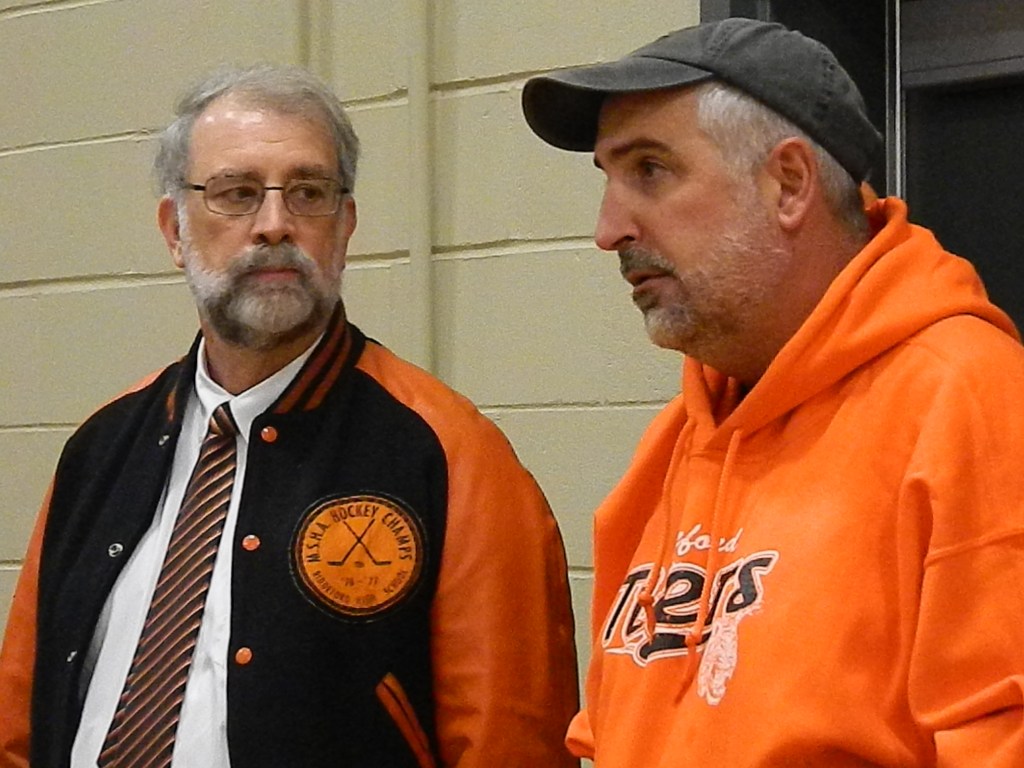
Casavant (left) and I chatting during his 2011 mayoral campaign

This part of the annual budget process is called the “social services” portion of the budget. These are organizations that are not part of city government or operations. These are all non-profits struggling to keep pace with inflation in an uncertain economy.

” “I also believe it is important — critical — that city government
try to find ways to bring people together . . .
to chat, to laugh and to find commonality.

— Alan Casavant

It’s easy to say we cannot afford these things, but ask yourself: can we afford to lose these things?

Laura and I are feeling the same economic pinch as many other families are feeling all across the country. We are in the process of trimming some fat from our own household budget. We really don’t have much of a choice in the matter, but there are some things that may look like fluff but are actually essential to our quality of life.

When it was his turn to speak, Casavant approached the podium with a certain amount of gravitas. He is the second-longest serving mayor in Biddeford’s history, first elected in 2011 and then re-elected five more times before stepping down last year,

Casavant reviewed details of his organization’s request, but it was his summary that caught me off guard and left me wondering if maybe I should reconsider some of my own thoughts about this year’s city budget.

“I realize you are facing a very difficult budget year,” Casavant said. “”But I also believe it is important — critical — that city government try to find ways to bring people together . . . to chat, to laugh and to find commonality.

“They’re not gonna find that from social media. They’re not gonna find that from their cellphones.

“People need things like festivals, musical events, historic awareness and social interaction to bring everyone together; to build community, which is also the responsibility of this council,” Casavant added.

The room erupted with vigorous applause, and I saw a glimpse that made me think: Biddeford is much more than a city. It is a community. So the question becomes, what is the value of community?

I honestly don’t know, but it’s something worth thinking about.

Disclosure: I served as Casavant’s campaign manager in 2011 and 2013.

Randy Seaver is the editor of the Biddeford Gazette. He can be reached at randy@randyseaver.com

Never miss another installment! Subscribe for free today!

Biddeford budget: ‘Saltines & Cauliflower’

The Biddeford City Council was presented Tuesday with preliminary budget proposals from both the School Department and the acting city manager.

There were a lot of grim faces in the room after both acting City Manager Brian Phinney and School Superintendent Jeremy Ray reviewed their budget projections with the council.

Because of a technical glitch, Phinney was unable to provide detailed information regarding salaries, but said that information should be available by early next week.

Ray described the annual budget process as a “Superbowl event” for those who have to develop public budgets.

Much later in the meeting, Biddeford City Councilor Norm Belanger said he felt like he was being served “saltines and cauliflower” instead of chicken wings for this ‘Superbowl.”

The largest number of the evening came from the School Department, which is requesting an 11.6 percent increase over last year.

Acting City Manager Brian Phinney (center) presents the council some grim budget realities (Seaver photo)

Though the city does not have its municipal budget finalized, Councilor Marc Lessard predicted a bleak outlook for the public and his fellow councilors.

Lessard, who has served on the council since 1993, said the upcoming budget review is going to be a “monumental task,” which will require plenty of pain and needed belt-tightening.

“The city council has never been able to shrink a budget request by more than two or three percent,” Lessard said. “Although we don’t yet have the numbers, I wouldn’t be surprised to see a seven to eight percent increase [on the city side of the budget]”

According to Lessard, the city’s combined budgets (School and City) have increased by roughly 20 percent over the last three years.

“This may be the year when we zero fund some social services,” Lessard said.

The social service budget includes funding for non-municipal services and programs, including things such as the library, the Heart of Biddeford, the Biddeford Housing Authority, Seeds of Hope, La Kermesse and the Biddeford Mills Museum.

A few highlights and details

Supt. Ray gave the council an impassioned presentation, pointing out the biggest factor for the school budget was directly tied to dwindling reductions in state subsidies because of the city’s skyrocketing valuation.

“This is the real picture and it’s going to involve some tough conversations,” Ray said. “But I firmly believe that our conversation should be about what is right, not what is on the spreadsheet.”

Ray said the school department is “hanging on” with its proposed budget and operating with minimum staffing levels and supports for students.

While student enrollment has risen only risen slightly since last year, Ray said an increasing number of students are facing significant challenges, including food insecurity and homelessness.

“I firmly believe that our conversation
should be about what is right,
not what is on the spreadsheet.”

— School Supt. Jeremy Ray

Ray told the council that between 100 and 150 Biddeford students are homeless, and that the large majority of students are living in poverty.

“Roughly two-thirds of our kids are living below the federal poverty line,” Ray said.

Ray told councilors that the school department has also seen a spike in students who need English as a Second Language services, up more than 100 from last year’s total of 300 students needing those same services.

Ray said looming concerns about federal funding for education along with changes in state funding are creating an extraordinary set of challenges, asking councilors and members of the public to show support for two bills now being reviewed by the Maine Legislature.

LD 501 would slightly increase the weighted count in the school funding formula for economically disadvantaged students under the Essential Programs and Services Funding Act, from 0.15 to 0.25 beginning next year.

LD 193 would amend the school funding formula to provide an additional .50 weight to a school administrative unit’s per-pupil count for each student experiencing homelessness.

On the municipal side of the budget, Phinney said he and his staff are presenting a “needs-based” budget.”

Phinney listed five new positions including a deputy fire chief, a fire inspector and a part-time administrative assistant in the fire department. The Recreation Department is requesting a part-time custodian, and the Assessing Department is requesting a “field lister” position.

Of those five new positions, Phinney said he was only recommending the field lister position.

Phinney said the council may want to look at reducing staff and building operations for the city’s public-access television studio that is now located on Pool Street near the West Brook skating park.

The budget process will continue Thursday, beginning at 5:30 p.m. as the council hears directly from those requesting social service funding from the city, including City Theater, the My Place Teen Center, Caring Unlimited, Biddeford Community Gardens and several others.

Randy Seaver is the editor of the Biddeford Gazette, He can be reached at: randy@randyseaver.com

Never miss another update! Subscribe for free today!

Councilor explains Biddeford budget process

By Liam LaFountain

Every year, the city makes difficult choices about where to invest tax dollars — from public safety and road repairs to parks and essential services. Budget season is when those decisions take shape.

The city budget is more than numbers — it’s a fiscal statement of what Biddeford values and how much we value it. It determines funding for schools, emergency services, infrastructure, and other priorities. Every dollar spent reflects a choice about the kind of city we want and the future we are building together.

Biddeford’s fiscal year runs from July 1 to June 30, meaning we are currently operating under the Fiscal Year 2025 budget. The budget now under review will determine spending for FY2026, which begins July 1, 2025.

Biddeford City Council President Liam LaFountain (Courtesy photo)

Over the next few months, elected officials will balance priorities and make difficult choices. This process is one of the most comprehensive and consequential in local government, and understanding it empowers residents to engage effectively.

How the Budget Process Works

Each department submits a budget based on projected needs for the next fiscal year. Department heads submitted their requests in January. For example, Public Works must estimate how much salt will be needed for winter storms, a costly but essential factor. The Fire Department may request new life-saving equipment for emergency response. Other departments, from Police to Recreation, have needs ranging from staffing to facility maintenance, utility costs, and programming that must be balanced with competing needs and limited resources.

These requests go to the City Manager’s Office and Finance Department, which review and adjust them to balance needs with available revenues. This process, completed in February, ensures the proposed budget reflects department expertise and fiscal oversight before being submitted to the City Council in March.

How the City Council Reviews the Budget

Once submitted, the City Council forms the Budget Committee, which includes all councilors, to review the budget in depth. The committee meets regularly — typically on Monday and Thursday evenings for several months — to refine the budget.

The first few meetings provide an overview of each department’s budget, where department heads present their proposals and answer questions. These meetings, held in Council Chambers, are open to the public. The city’s website will provide a calendar of meetings, public hearings, and deadlines, ensuring residents have multiple opportunities to follow the process and provide input.

Every budget should reflect the values of the people it serves.
This is your money, your city, and your budget.

— Councilor Liam LaFountain

Key Cost Drivers: Why Costs Rise

The FY2025 municipal budget totaled $44.8 million, with the largest shares allocated to Public Safety ($14.2M) and Public Works ($5.9M). This does not include the $47.3 million school budget, which is managed separately by the School Committee.

Property taxes remain the primary funding source for municipal operations, as other revenue sources do not fully account for the level and quantity of services the city provides. While Biddeford also relies on state revenue sharing, tax programs like Homestead and BETE, and other revenue such as building permits and user fees, these sources covered only 35% of municipal expenses in FY2025, leaving property taxes to fund the remaining 65%.

As state revenue sharing and school funding formulas shift costs to municipalities like ours, Biddeford taxpayers have absorbed a greater financial share. Rising wages, energy expenses, and infrastructure needs continue to drive costs higher annually.

Additionally, unfunded state and federal mandates require municipalities to cover new expenses without additional funding, adding to financial pressures. Balancing rising costs while maintaining essential services is a key challenge.

How to Engage in the Process

Public input is crucial. Residents can participate by:

  • Attending public hearings and Budget Committee meetings (dates available on the city’s website).
  • Reviewing budget documents, available on the city’s website.
  • Contacting city councilors with questions or concerns.
  • Following updates through city communications and local media.

Every budget should reflect the values of the people it serves. This is your money, your city, and your budget. The choices made in this municipal budget will help shape Biddeford’s services, infrastructure, and priorities. Your engagement ensures a more informed and responsive budget.

If you have thoughts on priorities or questions about the budget process, please contact your city councilor. These discussions help shape the decisions that will impact our city’s future.

The views expressed in this column are my own and do not necessarily reflect those of the Biddeford City Council.

Liam LaFountain serves as president of the Biddeford City Council. He can be contacted at liam.lafountain@biddefordmaine.org

Editor’s note: This column is not exclusive to the Gazette. It was also published in the Biddeford-Saco Courier

Never miss another update! Subscribe for free today!