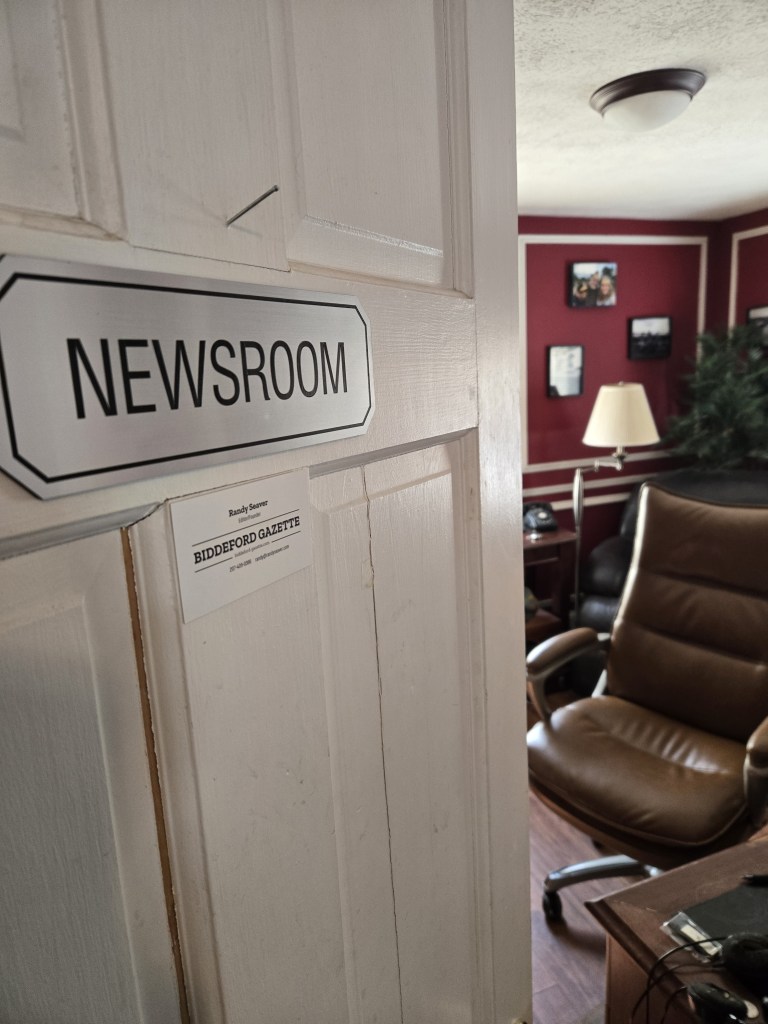
It’s been an interesting, busy and somewhat exhausting week here at the Biddeford Gazette.
In fact, I was moving in some many directions that I forgot to send out this newsletter on Saturday.
My former boss David Flood always used to say there’s a lot more to running a newspaper than just writing and publishing news stories. I never appreciated that fact until I decided to launch my own publication.
Spreadsheets, meeting with our attorney, tracking expenses, insurance, content distribution, reviewing analytics and coordinating other people’s work.
It’s a lot. And I’m not getting any younger. More about that in a moment.
Running a news organization involves a lot more than writing news,
Beyond all the tedious business stuff (all of which is well outside of my comfort zone), our news and editorial content is growing by leaps and bounds.
Consider this: In February 2025 – about three months after the Gazette was created – we published 14 items on our website, not including our weekly obituaries.
Flash forward one year, and we have seen an increase of more than 300 percent! During the month of February 2026, we published 49 items on the Gazette’s site.
The good news is that nearly 40 percent of that material was generated by the community, not by us.
These community contributions include several letters to the editor, guest columns and high-quality news and feature pieces, such as last week’s story from Tammy Wells about a new partnership between the Catholic Church and the York County Jail, allowing inmates to celebrate weekly Mass.
State Rep. Marc Malon and State Sen. Henry Ingweresen also publish their regular monthly columns in the Gazette. Former mayor Marty Grohman submitted his own op-ed last month in the Gazette.
We are honored that so many people in the community regard the Gazette as a reliable and trusted source for community news and information.
Getting older; Biddeford Primary School Fun
On a personal note, this is my last day of being 61, and tomorrow (March 2) will be the first birthday that I wanted to avoid.
Every Sunday morning for the past 14 months, I spend a few hours editing, formatting and publishing local obituary notifications.
With increasing frequency, I am posting the obituaries of people who were younger than me at the time of their passing.
Statistically speaking, the average life expectancy of an American man is 76 years.
That means I likely have only 14 years or fewer remaining — for the rest of my life.
I remember clearly where I was 14 years ago today. It goes by really fast. Really fast.
All the advice from my friends, family and the expert gurus suggests that you should live each day to its fullest and focus on the things that make you happy.
So, I am pleased to announce that I have once again been invited to read to students in Ms. Jillian Palladino’s second-grade class at Biddeford Primary School. It’s the one part of my upcoming birthday that I am actually excited about.
Coincidentally, March 2 is also the birthday of Theodore Geisel, more commonly known as Dr. Seuss . . . what a wonderful confluence of events!
Quick recap and preview
Ward Five City Councilor David Kurtz (Seaver photo)
My favorite story this week comes from my thoroughly enjoyable interview with City Councilor David Kurtz. I will be doing similar interviews with each member of the city council over the next few weeks. (Chatting with City Councilors)
Our goal is to peel back the perfunctory layers to give our readers some deeper context about the men and women running our city.
Our most popular story this week – by far –was our exclusive coverage and tour of the Adams Point Family Housing project that is scheduled to open in April. That story blew up our email and social media accounts, underscoring Biddeford’s pressing need for more affordable housing.
What’s coming up?
I will cap off my birthday celebration tomorrow (March 2) by attending the first public hearing for the Institutional Zone Review Committee, which will be making recommendations about ongoing development at the University of New England’s Biddeford campus.
That meeting begins at 6 p.m. in the Council Chamber at Biddeford City Hall.
Hope to see you there! Have a great week!
_________________
ABOUT THE AUTHOR: Randy Seaver is the editor and founder of the Biddeford Gazette. He has been covering Biddeford news and politics for nearly three decades. He may be reached by email: randy@randyseaver.com
Never miss an update! Subscribe for free today!
THE BIDDEFORD GAZETTE | A Legacy of Trusted, Independent Journalism
Several members of the Biddeford City Council expressed significant and pointed concerns during Tuesday’s council meeting about a proposed affordable housing project near the corner of Lincoln and Pearl streets.
Westbrook Development Corp. is hoping to construct approximately 90 units of affordable housing for residents over the age of 55. The developers say the monthly rent would range between $1,100 and $1,300, including all utilities.
Mayor Marty Grohman described the two-phase project as a “large and complex” deal that will finally culminate the end of an era when that site was the home of the MERC waste incinerator, which was closed in 2012.
Another proposed development project that would offer market-rate apartments, retail and other commercial spaces is being proposed in the same area. The two projects would essentially wrap around the Pearl Street parking garage.
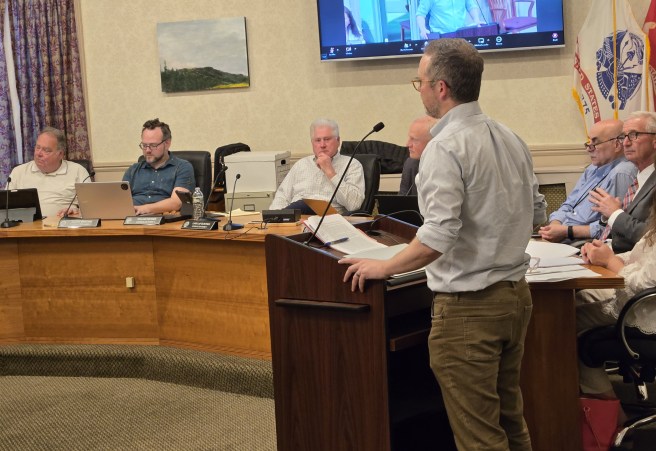
Tyler Norod of Westbrook Development Corporation addresses the Biddeford City Council Tuesday about his company’s hopes to build an affordable housing complex adjacent to the city’s Pearl Street parking garage. (Seaver photo)
The developer is proposing to give the city roughly $680,000 to secure needed parking spaces in the parking garage and is required to make an $840,000 contribution to help fund sewer upgrades throughout the city,
George Gervais, the city’s economic development director, told the council that the project would bring more than $30 million in direct and indirect benefits to the city, including a $200,000 contribution to the city’s Affordable Housing Trust fund.
Despite those benefits, several councilors said they are not yet ready to pull the trigger.
Because the city currently owns the 1.6-acre parcel, councilors expressed concerns about parking, the project’s timing and what might happen if the project falls through.
Tyler Norod of Westbrook Development told the council that his company is facing a tight timeline because they are hoping to secure project funding from the Maine State Housing Authority (MSHA) in order to make the project viable.
“I hate to have a gun held to my head,” said Councilor Marc Lessard. “That type of approach never leaves us in a good position.”
Though Lessard said he supports the need for more affordable housing, he says taxpayers expected the city to replace the former MERC site with commercial development that would create jobs and tax revenue.
Lessard said the city “cannot afford any more credit enhancement agreements. “We need to be more focused on generating more money on the tax rolls to ease pressure on taxpayers,” he said.
Councilor Norman Belanger, however, said the development landscape has changed significantly since MERC was closed 13 years ago.
“This project would be a tremendous win for the city. There’s so much benefit if this passes, and so much to lose if it fails.”
— George Gervais, economic development director
“We had a plan and a vision for that space,” Belanger said. “But then COVID hit, and the world as we know it changed.”
Belanger expressed frustration about a mixed message coming from the city council, saying he feels bad for city staff who put a lot of time and effort in bringing projects forward.
“This council is acting in a schizophrenic manner,” Belanger said. “We say we want affordable housing here, but not there. We’re sending a mixed message.”
Councilor Doris Ortiz said she supports the development of more affordable housing, but also expressed some concerns about the proposal. “The parking garage has been a thorn in the city’s side for a very long time,” she said. “Overall, I think it’s a good project, but there is a lot to work through. It’s not an easy lift for us.”
Citing the need for more information, the council voted 8-1 to table the proposal until the next council meeting on June 17.
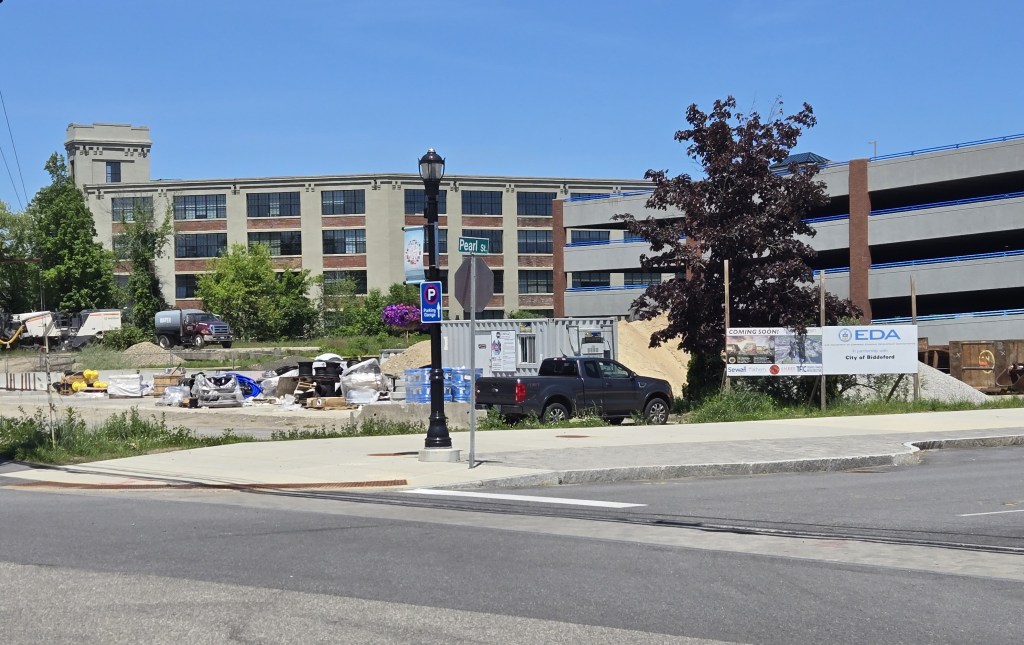
The site where Westbrook Development Corp. wants to build 90 units of affordable housing for residents over the age of 55. (Seaver photo)
Following the meeting, Norod said he appreciated the council’s diligence and its commitment to develop more affordable housing.
“We feel as if we are partners with the city,” Norod said. “It’s clear that the council really wants more affordable housing. We have some homework to do before the next meeting, but we are happy to do it.”
For his part, Gervais said he was feeling a bit disappointed about the delay, pointing out that he and other city staffers have been working on this project for more than a year. He also said he has repeatedly offered to meet with individual councilors to answer any questions about the proposal.
“This project would be a tremendous win for the city,” Gervais said. “There’s so much benefit if this passes. and so much to lose if it fails.”
RELATED: Click here to view or download the project’s executive summary:
Editor’s note:This is the third and final installment of our three-part series regarding Biddeford’s housing crisis.
When discussing Biddeford’s housing crisis, the bulk of the conversation often settles upon issues of homelessness, low-income housing or so-called “affordable” housing projects.
But there is another important piece to the puzzle.
Over the last few years, pricing for single-family homes has been skyrocketing as the demand for housing continues to soar throughout southern Maine.
According to a recent report by the Westbrook Development Corporation, the average age of first-time home buyers has substantially increased: from people in their mid-twenties in the 1980s to an average age of 38 years old in 2024.
During a Feb. 11 Biddeford city council workshop meeting about housing, George Gervais, the city’s director of economic development, told the council that the housing issue is somewhat “cyclical.”
According to Gervais’ report, almost half of households 55 and older have no retirement savings, and that the median cost of a semi-private room in a nursing home was roughly $93,000/year in 2020. Thus, many senior residents simply cannot afford to leave their current homes. That dynamic, Gervais said, clogs the market for available single-family homes for younger buyers.
A somewhat stagnant supply of single-family homes – combined with a skyrocketing demand for housing – creates a perfect storm scenario.
If young adults are not transitioning from their apartments to homeownership, the availability of apartments decreases, which increases average rental costs.
If someone cannot keep pace with rising rental costs, they are at risk of being homeless or forced to move to a more rural community. That scenario impacts local business owners who struggle with workforce challenges because employees simply cannot afford to live near their work place.
Biddeford Mayor Marty Grohman said he and the city council are committed to tackling this complicated issue.
“It’s a very complicated and complex problem,” Grohman said during a prior interview. “There are a lot of moving pieces.”
The average market rate rent for a one-bedroom apartment in Biddeford is $1,450. While that cost is lower than prices in Portland, Portsmouth or Boston, it leaves generational residents wondering how much longer they can live in the same town where they were raised and attended school.
According to local real estate agents, homebuilders and developers, the housing crisis is directly connected to the “Three I’s” Inventory, Interest Rates and Investors.
The local real estate market
Scott Thibeau of Biddeford is a well-known real estate agent who hosts a regular podcast about southern Maine’s real estate market.
A native of Saco, Thibeau jumped into the real estate business in 2013 when he began a partnership with Doug Sanford, perhaps the region’s most well-known real estate developer.
It was Doug Sanford who had the vision to begin turning vacant and deteriorating mill buildings in downtown Biddeford into residential apartments and micro-businesses.
Thibeau says the local real estate has cooled a bit over the last few months, but said southern Maine real estate is still a very hot market that is very attractive to people from other parts of the country.
“The secret of Maine is out, and that has consequences, mainly gentrification. That’s a tough dynamic for people who have lived here for generations.”
— Scott Thibeau
“If you really think about it was social media that changed the whole dynamic about Maine and our quality of life,” Thibeau said. “Suddenly, people from all over started being exposed to everything we offer, shattering myths and misconceptions about life in Maine.”
The new “awareness” of Maine was also fueled by climate change, Thibeau said.
“We offer a phenomenal quality of life in southern Maine,” Thibeau said. “And a lot of people are coming here to escape extreme heat in southern states. Climate migration is a real thing.”
Those people moving to Biddeford for a better quality of life bring with them greater financial resources and the ability to work remotely from anywhere in the country, Thibeau says.
“The secret of Maine is out, and that has consequences, mainly gentrification,” Thibeau said. “That’s a tough dynamic for people who have lived here for generations.”
In addition to being a real estate agent, Thibeau is currently the president of the Heart of Biddeford’s board of directors. The Heart of Biddeford was created several years ago to help improve and promote the city’s downtown area making it more attractive for investment.
“We’ve seen a lot of success in making our city more attractive and desirable, but I don’t think anyone wants to go back to the days when MERC was still burning trash downtown just to bring prices down,” Thibeau says.
Thibeau says the average rent for a three-bedroom apartment ranges from $2,200 to $2,500 per month. In order to get a home at that same income level, the home price cannot be more than $332,000, factoring interest rates on a 30-year mortgage.
“You’re going to have a hard time finding a $332,000 home in southern Maine,” Thibeau said. “There are only 17 houses currently listed for $332,000 or less in York and Cumberland counties, most of them are in Sanford.
The problem of rising housing costs is impacted by the harsh realities of low incomes that makes it nearly impossible to pay no more than 1/3 of your income in housing.
“Maine is still the most affordable state in New England, but we’re the 17th most costly state to live in nationally,” Thibeau said.
A homebuilder’s perspective
Richard ‘Chico’ Potvin has been building homes in the Biddeford-Saco area for nearly 40 years.
A Biddeford native, Potvin says he has seen dramatic changes in the housing market, including more stringent governmental guidelines, higher labor costs and a much higher expectation of what a starter home should include.
“It used to be that a starter home was something like a two-bedroom, one bath ranch-style home,” Potvin said. “Today, buyers are much more demanding. They want everything from granite countertops and recessed lighting to an attached garage, three bedrooms and 2 bathrooms.
“Expectations are literally through the roof,” Potvin said.
Potvin says he and one of his partners spent more than four years trying to get approval for a project known as South Street Village, a proposal that included up to 50 single-family homes, a few duplexes and a commercial core for small businesses on outer South Street.
“They [the city] kept changing standards and requirements,” Potvin said. “Every time we felt like we had scored a touch-down, they just moved the goal post further back.”
According to Potvin, roughly 58 percent of Biddeford is zoned as rural farmland (RF). “If the city truly wants more housing inventory, they will need to be very creative,” he said, pointing to the city’s industrial parks and other land the city already owns.
“We need a balance,” Potvin said. “But we also need a more streamlined review process. Every new regulation and requirement adds additional costs to that new home. If you really want affordable, you have to manage your expectations.”
A developer’s perspective
Nathan Bateman literally grew up in the world of real estate development. His grandfather, an architect, formed a partnership to create a real estate development company in the early 1970s
“My brother (Aaron) and I literally grew up in the development world,” he laughed. “I was eight years old and boots on the ground.”
Over the last 40 years, Bateman Partners, LLC has developed properties worth more than $210 million, and currently has more than $140 million worth of projects in development or under construction, according to their website.
Bateman says he is proud of his company’s legacy and its commitment to working collaboratively with communities, but also said developing any kind of significant project is not an endeavor for the faint of heart.
“It’s a very competitive world, even in the affordable housing market,” Bateman said. “It’s almost a bloodsport. “Every project is basically a business unto itself.”
Bateman said some projects are safer than other more ambitious projects, but there are many outside forces that create challenges to creating quality housing that is also affordable.
“Fortunately, we have the experience and know how to get things done,” Bateman said. “But there are lots of factors beyond our control, including interest rates and a limited pool of state funding assistance for affordable housing development.”
Bateman said increasing labor and material costs also put pressure on the costs of any housing project, not to mention rigorous reviews by both local and state regulatory agencies.”
“Safe, affordable housing is always our goal,” Bateman said. “We certainly understand the importance and need for local and state standards and review, but it’s not always the model of efficiency. We literally need to use every tool in our toolbox.”
Bateman said one of the largest challenges in developing affordable housing projects is often created by neighbors and abutters of the proposed project.
“We see it all the time,” Bateman said. “People want affordable housing but not in my backyard. NIMBYism is a big hurdle to clear.”
Editor’s Note: This is the second installment of our three-part series regarding Biddeford’s housing crisis.
A panel of experts offered their perspectives and guidance regarding Biddeford’s housing crisis during a special city council workshop meeting earlier this week.
For more than two hours, the nine panelists each offered their professional insights and took questions from both councilors and members of the public Tuesday evening.
Biddeford Mayor Marty Grohman described the workshop as a necessary “first step” for city officials who are trying to find innovative solutions for a problem that shows no signs of going away.
While Biddeford has seen recent success in attracting development of market-rate housing units, the city is still struggling with “affordable housing” options and a low inventory of single-family homes for young families, often described as “starter homes.”
“We have a beautiful, dynamic and growing city,” Grohman said as he kicked off the discussion. “We’re in our 12th straight year of enrollment growth in schools. It’s immensely positive that we’re growing, and seeing this type of pressure on housing, but it’s also immensely challenging.”
George Gervais, the city’s director of economic and community development, started the meeting by providing an overview of the city’s current housing status.
According to Gervais, the city today has 10,576 housing units. Of those units, 9,431 are occupied, according to data from the 2020 Census.
Gervais said rental units make up slightly more than 52 percent of the city’s occupied housing.
Average monthly rents in Biddeford range between $1,700 and $3,200, ranging from studio apartments to three-bedroom units, Gervais said.
The average home values in Biddeford have risen by roughly five percent during the last year. The average home value in the city is slightly more than $478,000.
One of the city’s biggest challenges, however, is that area wages are not keeping pace with increasing housing costs.
“We have quite a bit coming at Biddeford,” Gervais said outlining the horizon in which more than 2,100 units of housing are currently in some form of development. “That’s a pretty impressive number,” he added.
The new development numbers include projects that are either under construction, under review by permitting agencies or projects that are conceived but have not yet gone through the permitting process.
Gervais said 319 of those units are planned as affordable housing units in which rental costs are calculated by the area’s median income (AMI).
During an earlier interview, Grohman said the city council has set a goal of creating 180 units of affordable housing each year over the next five years.
What the experts say
The panelists were broken into three main groups, focused on affordable housing; market-rate housing and a housing finance development panel. The panel also included a presentation regarding state government housing resources from Benjamin Averill, Housing Opportunity Program coordinator for the Maine Department of Economic and Community Development.
“Today, Biddeford is the place to be. “It’s the cool place. That’s great but it also poses problems.”
–Guy Gagnon, Biddeford Housing Authority
Guy Gagnon, executive director of the Biddeford Housing Authority, said Biddeford has undergone some dramatic changes in the last 15 years, pointing out that he joined the quasi-governmental agency in 2010.
Gagnon, a Biddeford native, said he is especially troubled by the fact that so many kids who grew up in Biddeford can no longer afford to live here. “I see my friends’ kids and even my own children being forced to look elsewhere for housing,” Gagnon said.
“It used to be that Biddeford was the second, third, fourth or even fifth choice when people were looking for homes,” Gagnon said. “Today, however, Biddeford is the place to be. It’s the cool place. That’s great but it also poses problems.”
Gagnon said the city needs to be creative and willing to look at alternatives that include modular housing and mobile home parks.
“It may not be for everyone,” Gagnon said, “but it may be for some people. Biddeford should be the community that thinks outside of the box.”
Kevin Bunker of Developers Collaborative said the city needs to stay aware of what is happening at the Legislature, especially in regard to statewide housing policies and assistance for affordable housing development.
“Those resources are limited and the state is facing a challenging budget,” Bunker said. “You need to remember that they are also trying to keep up with a huge demand.”
John Laliberte, the CEO of Reveler Development, provided an overview of his company’s projects in Biddeford, including 73 apartments at Riverdam, Phases One and Two of The Levee project and the recently offered market-rate units at The Eddy on Barra Road.
“We have had a lot of success in Biddeford,” Laliberte said. “There is a big demand for this type of housing, but our main challenge remains being able to attract the private capital necessary to get these projects off the ground.”
A common theme throughout the evening was centered upon the need to make the development process more streamlined and efficient to reduce costs for both renters and buyers.
Although not members of the expert panel, local real estate developers Chico Potvin and Matt Chamberlain both spoke during the public comment period, detailing how hard it is to get a project from design to out of the gate development.
Potvin, 61, said he has been building “starter homes” in the Biddeford area since 1987.
He said the city’s shortage of available single-family homes is “forcing people into apartments and making it harder for people to find apartments. “It’s a vicious cycle,” he said.
Potvin said his biggest challenges include skyrocketing labor costs and a growing myriad of red tape that cause time delays and increases building costs.
“Every year, the regulations increase,” Potvin said, questioning why the council chose to fund needed city-wide sewer improvements on the backs of new homebuyers.
“Almost every day I get calls from friends and other people asking what I can do for them,” he said. “They don’t want to wait two years for a project to get approved. I feel bad. The city needs to buckle down and treat housing the same way as you treated land for industrial parks.”
Potvin also said he is nervous about all the high-end apartments being built in Biddeford. “It scares me,” he said. “I’m not sure if it’s sustainable.”
Cat Bates said he grew up in Kennebunk and moved to Biddeford almost five years ago. He said he would like to see the city do a better job in streamlining the approval process for Accessory Dwelling Units and said it should be easier to get bank financing for that type of development.
City Councilor Doris Ortiz previously chaired the council’s affordable housing task force, and said she would like to see the city be creative in its approach to creating housing, including co-ops and micro developments.






 BIDDEFORD GAZETTE