OPINION | Why History Matters

By RANDY SEAVER | Editor

One of the coolest things about doing something for more than 30 years is the memories you make along the way.

As a political junkie – especially in regards to the city of Biddeford – it is extremely rewarding for me to have an archive of local political news that dates back nearly 30 years to the mid-1990s.

Today, I have a 31-year-old neighbor who is super excited about possibly serving on Biddeford’s upcoming Charter Review Commission.

______________

DISCLOSURE | Because he is now a political candidate in Biddeford, Sam Pecor no longer serves on the Biddeford Gazette’s Community Advisory Board.

_____________

I am the only active reporter who remembers another young man who was also very excited about serving on Biddeford’s Charter Review Commission more than 10 years ago.

That young man won his election to the Charter Review Commission and used that opportunity to launch a successful political career. Today, that once enthusiastic teenager is the Speaker of the Maine House of Representatives.

In fairness, Ryan Fecteau actually started his political career as a student representative on the Biddeford School Committee while attending Biddeford High School.


My wife, Laura – the Gazette’s publisher – was serving on the school committee at that time, and she was designated to be Fecteau’s coach and advisor.

That is one of our strengths at the Biddeford Gazette. We have unmatched institutional knowledge about the city of Biddeford, its politics and its people.

The Gazette can use and rely on that knowledge to offer our readers valuable context to important stories that impact our community.

I got thinking about all of this because the Gazette is still working on a feature story about Chuck Cote of Biddeford and his dedication to building and maintaining a fascinating archive of Biddeford’s sports and political history, especially when it comes to the former St. Louis High School.

The working title of that upcoming story is Taking A Walk Down Biddeford’s Memory Lane.

We interviewed Chuck last week. Why is it taking so long to publish a story that we know is being highly anticipated by many of our readers?

Primarily, because that story is complex and we consider it to be very important. Moreover, we care much more about doing a good job rather than doing a quick job.

What a long, strange trip it’s been

The Gazette’s historical archive comes primarily from my days as a reporter and editor for the Biddeford-Saco-OOB Courier from 1997 to 2006; as a freelance reporter for Saco Bay News (2023-2024) and from my personal blog, All Along the Watchtower that started in 1999 as a weekly column in the Courier and continued until I launched the Biddeford Gazette in Nov. 2024

Today, All Along the Watchtower is just an archive collecting dust on my personal website Lessons In Mediocrity | Outlaw Journalist.

CAUTION | My personal website is somewhat messy and in the process of being revamped, so please temper your expectations. It also contains coarse language.
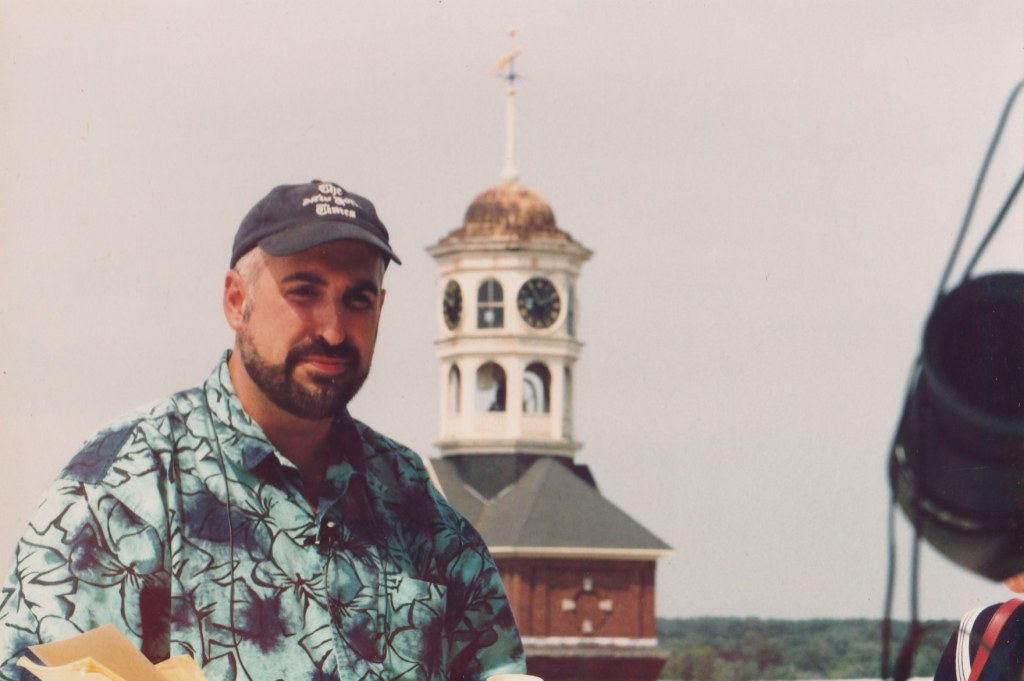
A MUCH YOUNGER EDITOR | Randy Seaver reports from the roof of Biddeford City Hall in 2000 about the efforts to save the Lincoln Mill Clocktower that has been now wiped away from the city’s skyline

There is other stuff on my website, dating back to the early 1980s when I was working as a temporary, non-paid, student intern at the Journal Tribune, Biddeford’s former daily newspaper.

There is also stuff there from my days as collaborative research reporter and communications director for the Northwest Atlantic Marine Alliance, a non-profit that covered fisheries in the Gulf of Maine and my time as senior associate at Barton & Gingold, one of Maine’s most respected political and public policy consulting firms.

While working at Barton & Gingold, I really enjoyed playing a role in shaping public policy issues that were sometimes controversial.
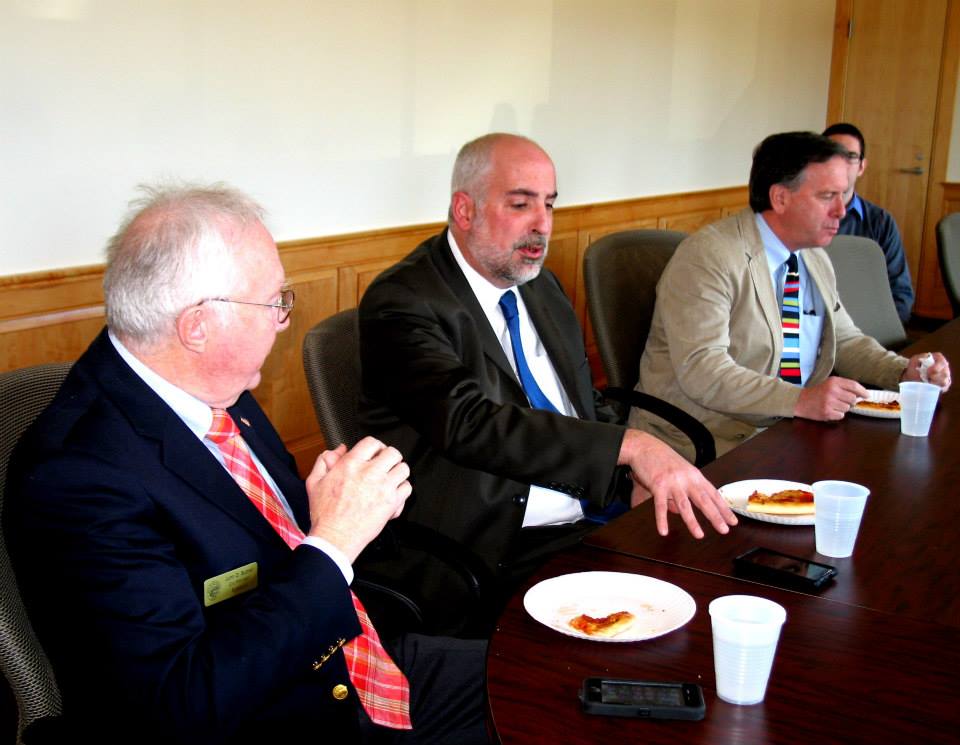
CONSULTANT RANDY SEAVER is flanked by former Biddeford City Manager John Bubier (left) and David Flood, publisher of Mainely Media (right) during a meeting at the Biddeford Saco Chamber of Commerce about a new federal health insurance tax proposal in 2015.

Shortly after Barton & Gingold was sold in 2014, I launched my own political consulting firm, Randy Seaver Consulting.

I still operate my own consulting practice, but I do not work for any clients or projects that could be connected to the city of Biddeford. That would be a glaring and unacceptable conflict of interest.

In closing, if you so desire you can find my installment of my Then & Now updates (Ryan Fecteau) at this link | All The Young Dudes, Redux

CORRECTION | Though it is grossly ironic and thus difficult to admit, this story contained a typographical error regarding its own historical context. I worked as a freelance reporter at Saco Bay News from 2023 to 2024, not starting in 2003, before Saco Bay News even existed. I am fortunate and grateful that I can still rely on my former editor Liz Gotthelf and her eagle-eye and penchant for accuracy. In retrospect, perhaps it’s time for this old geezer to be put out to pasture. We sincerely apologize for the error.

____________

That’s our opinion, and we welcome yours. You may submit either a guest column of the same length or a letter to the editor by contacting us at biddefordgazette@gmail.com.

Never miss an update | Subscribe for free today!

THE BIDDEFORD GAZETTE | Biddeford’s trusted, professional news source

Our editorial standards and policies: Biddeford Gazette | Standards & Policies

© 2026 Biddeford Gazette, Inc. All Rights Reserved

Saco has lost a former mayor; I have lost a friend

OPINION | RANDY SEAVER

I am feeling so sad.

I just learned from a reading a story in Saco Bay News that Bill Johnson – a former Saco mayor and city councilor — recently passed away at the age of 92.

This news leaves a gaping hole. I regret losing touch with Bill.

He was such a kind and wise man, and he always offered sage and measured advice. I first met him almost 30 years ago after he had just been elected to transition from serving as a Ward One councilor to becoming the city’s mayor in 1997.

He was a new mayor, and I was a new reporter in Saco, despite having grown up in that city.

Bill took me under his wing and offered me advice with his warm grin and elder-statesmen sense of discipline. He was always quick to smile and had a deep laugh.

He said he was happy to be working with a reporter who had a long and personal connection to the city.

We reporters are trained to not become personally connected to the government officials they cover, but I could not help myself.

Bill was just so decent, kind and patient — a perfect grandfather of sorts. He leaves behind a legacy of public service, a love for his community and a reputation for hard work and dedication to his family.

Bill was one of a kind; a man equally comfortable in a suit and tie at some government function; or wearing a flannel shirt and wandering Saco’s northwestern rural and pastoral neighborhoods.

Bill was just so decent, kind and patient —
a perfect grandfather of sorts

The late 1990s were not the best of times for Saco. There was plenty of political tension, and Bill’s job as mayor was anything but easy.

The city was still rebounding from serious and consequential financial difficulties, but Bill was the right leader at the right time. He was quiet, measured and thoughtful. He never spoke an unkind word about anyone.

Bill Johnson will be missed . . . by me and by everyone who ever had the good fortune to cross paths with him.

Godspeed, Mr. Mayor.

May you eternally rest in peace, and may your memory never be forgotten, especially in the city you loved.

________________

ABOUT THE AUTHOR | Randy Seaver is the editor of the Biddeford Gazette. He also was a reporter who covered the city of Saco from 1997 to 2006 for the Biddeford-Saco-OOB Courier and as a freelance reporter for Saco Bay News from 2023 to 2024.

NOTE: Some photos in this story were used without expressed permission. Those photos are attributed to their original source, but may be removed, if necessary.

DISCLOSUSURE | Randy Seaver’s stepsister, Jodi MacPhail, currently serves as mayor of Saco.

OPINION | Biddeford should tie taxes to inflation

By BEN NEVEUX | Biddeford

Over the past decade, Biddeford’s property taxes have steadily climbed. In 2013 the city’s total tax rate was $16.54 per $1,000 of valuation. By 2022 it had reached $18.23, with several years above $19 and even $20 along the way.

That may not sound dramatic at first glance, but it represents roughly a 10 percent increase in the tax rate over ten years—and that figure doesn’t include the dramatic rise in property valuations that has pushed many homeowners’ actual tax bills much higher.

At the same time, many Biddeford residents are facing the same reality as everyone else: inflation, rising insurance costs, and household budgets that do not grow automatically each year.

That is why this moment—when the next Biddeford Charter Commission is being considered—is the right time to discuss a structural reform: tying property-tax increases to inflation.

Across the country, municipalities are experimenting with tax caps or inflation-indexed limits to ensure government grows at roughly the same pace as the economy that supports it. The principle is simple. If inflation is 3 percent, the default growth of government should not exceed 3 percent unless voters explicitly approve it.

Such a rule does not prevent the city from funding important priorities. If voters want expanded services, new schools, or large infrastructure projects, they can approve overrides at the ballot box. But it does create an important discipline: government must justify spending increases rather than assuming taxpayers will absorb them.

An inflation-linked property-tax cap would also force difficult—but healthy—budget conversations. When revenue growth is limited, cities must prioritize core services, reduce waste, and rethink programs that may no longer be essential.  In other words, government must make the same choices that Biddeford families make every day.

“. . . growth should not automatically translate into ever-rising tax burdens for the people who built this community. . .”

Biddeford is in a period of remarkable growth. Downtown investment has surged, property values have increased, and new residents are discovering the city’s character and potential. But growth should not automatically translate into ever-rising tax burdens for the people who built this community long before the boom.

The upcoming Charter Commission presents a rare opportunity to place long-term guardrails on municipal finance. A charter provision tying property-tax increases to inflation—unless voters approve otherwise—would create predictability for homeowners, discipline for city government, and transparency for taxpayers.

Biddeford’s future is bright. The question now is whether the city will adopt policies that ensure prosperity growth does not come at the expense of affordability.  The next Charter Commission should seize this moment and put a sensible inflation-based tax limit before the voters.

ABOUT THE AUTHOR | Ben Neveux is a Biddeford resident. He is also a member of the Biddeford Gazette’s Advisory Board.

__________________

NOTE: The Biddeford Gazette strongly encourages reader feedback and public commentary regarding our coverage and issues directly related to the city of Biddeford. To submit a letter to the editor or guest column, please contact us at biddefordgazette@gmail.com

Never miss an update! Subscribe to the Gazette for free today!

THE BIDDEFORD GAZETTE |A Legacy of Trusted, Independent Journalism

Our editorial standards and policies: Biddeford Gazette | Standards & Policies

© 2026 Biddeford Gazette, Inc. All Rights Reserved

LETTER | Mayor’s column raises concerns

By DIANE SNOW | Cumberland, Maine

Biddeford Mayor Liam LaFountain’s recent op-ed regarding the city’s new Institutional Zone Review Committee (Biddeford Gazette, Feb. 28, 2026) is very interesting.   

The mayor mentions that it is time to review the zone ordinance since it has not been updated in nearly 25 years.  He refers to a need for clarity on “what is permitted, how impacts are evaluated, and how decisions are made.”

LaFountain adds that the “recently appointed institutional zone review committee will `review the ordinance, gather public input, and recommend whether revisions are warranted.”

Biddeford Mayor Liam LaFountain

The committee, according to the mayor’s piece, was formed through a “regular public appointment process” and describes the background of the appointees.  

His column refers to the possible need to update the ordinance, based [upon] infrastructure influence, traffic patterns, public safety demands and neighborhood character.

While the above is interesting, of greater interest, is what was not mentioned.

Given that this committee Is largely composed of Hills Beach residents, what exactly has been the “regular public appointment process” by which they were nominated? This is not just between Hills Beach and the university; this involves the entire city.

The mayor suggests the need for a comprehensive update referring to infrastructure influence, traffic patterns, public safety demands, and neighborhood character. 

Largely missing is mention of the services of a professional city planner with the necessary expertise to balance the needs of the residents, the university and the city at large.

Finally, since it is time to update ordinances to accommodate the needs of our citizens, isn’t it also time to review the accessibility of our beautiful beaches to the residents at large?   

All city residents pay taxes not just Hills Beach. These taxes pay for streets and public areas and should be accessible to all.

Those with homes in the most desirable areas of public interest should accommodate the need to share reasonable accessibility with others. The deliberate exclusion of available parking for beach access is reprehensible.  It is time to correct this.

[Editor’s Note The city of Biddeford has been working on and deliberating the need to expand public parking opportunities in the city’s coastal neighborhoods over the last several weeks.]

Remove the no parking signs. Provide more public parking for beach accessibility.

If our city government is truly representative of the city at large, this can be done. Do our politicians really represent us?  –  or is it heavily weighed in favor of a particular group?

Diane Snow, Cumberland, Maine

______________

The Biddeford Gazette strongly encourages reader feedback and public commentary regarding our coverage and issues directly related to the city of Biddeford. To submit a letter to the editor or guest column, please contact us at biddefordgazette@gmail.com

Don’t miss an update! Subscribe for free today

THE BIDDEFORD GAZETTE | A Legacy of Trusted, Independent Journalism

Our editorial standards and policies: Biddeford Gazette | Standards & Policies

© 2026 Biddeford Gazette, Inc. All Rights Reserved

Is the Gazette biased against UNE?

By RANDY SEAVER, Editor

A former Biddeford resident who now lives in Ada, Mich., recently sent an email to the Gazette complaining that we have been “unfair and biased” toward the University of New England.

In his March 6 email, Bernard Roy – a 1971 Biddeford High School graduate – expressed disappointment regarding the Gazette’s coverage of issues connected to UNE.

Roy specifically raised concerns about our March 5 story | Was Sen. Collins misled by UNE?

Roy also expressed outrage that the Gazette “ignored” a letter-to-the-editor he sent to us on Feb. 28, somehow missing the fact that his letter was actually published by the Biddeford Gazette three days later, on March 2, 2026.  LETTER | City is Treating UNE Unfairly

Is the Gazette’s coverage of UNE biased?

The Gazette regularly and frequently publishes a high volume of news focused on the city of Biddeford. Thus, it is understandable how Roy could have missed seeing his letter published on our site.

The Gazette strongly encourages and promotes transparency and reader feedback regarding our coverage. Go here to submit your own letter

In the interests of transparency and full disclosure, the Gazette is sharing its unedited emailed response to Mr. Roy today, March 7.

__________

Dear Mr. Roy,

I would advise you to tread carefully before you accuse me and/or the Biddeford Gazette of any negative “bias” toward the University of New England.

1.) We did, in fact, publish your letter to the editor on Monday, March 2, which coincidentally was my birthday and a very busy news day. Here is the link to your piece in the Gazette: LETTER: City is treating UNE unfairly – BIDDEFORD GAZETTE

2.) I did feel compelled to attach an “editor’s note” to your submission. I know that you grew up in Biddeford and graduated from Biddeford High School (Class of 1971) so I was quite surprised that you would complain about how poorly your sister was treated by parking enforcement at Goose Rocks Beach. Most Biddeford folks know that Goose Rocks Beach is located in the town of Kennebunkport, not in the city of Biddeford. I also was left scratching my head, trying to figure how that particular incident has any bearing on the issue at hand.

Numerous Biddeford residents shared concerns about development at UNE during a March 2, public hearing, the same day that the Gazette published Mr. Roy’s letter to the editor.

3.) Not only did I publish your letter, I also published your sister’s letter — and another guest column from someone else who is equally upset about how “unfairly the city is handling issues connected to UNE.” If you visit the Gazette’s website and simply use the “Search” function, you will find everything we have ever published about the university.

No Apologies

4.) I make absolutely no apologies for being a reporter and for rigorously covering this issue, which has been almost virtually ignored by every other media outlet in southern Maine. In fact, I am often the only reporter covering meetings about UNE, including the very first meeting of the newly formed Institutional Zone Review Committee on February 19, coincidentally my mother’s birthday. New UNE oversight committee begins work – BIDDEFORD GAZETTE

UNE Is a Big Part of Biddeford

5.) Frankly, I do not understand why issues connected to UNE do not receive more attention from other media outlets, besides the Biddeford Gazette. As you, your sister and others have pointed out — the University is a major and vibrant part of the Biddeford community.

The university is one of the city’s largest employers and offers numerous and quite tangible economic benefits to its neighbors throughout the city. Development on UNE’s campus — most notably its proposed and controversial research pier — will have numerous impacts (positive and negative) on the community, from environmental impacts to public recreation on the Saco River and impacts to commercial fishermen who now lease moorings in proximity to the proposed pier. No one from the university has seen fit to return calls or answer questions from these mooring owners. They remain consistently ignored.

Criticism With a Familiar Theme

6.) Your recent letter has somewhat familiar fingerprints. The same recurring themes — and almost verbatim language — have been used repeatedly to criticize the city. It almost feels as if it’s part of a coordinated attack. You, your sister and others should relax. Despite being told repeatedly that the recent, temporary moratorium on development at UNE’s Biddeford campus has absolutely no bearing on the St. Joseph’s Convent — located roughly two miles away from the campus main entrance — that issue has become a red herring that you and others are trying to exploit. As a Catholic, I find such a move to be offensive.

City of Biddeford is Being Fair to UNE

7.) When he decided to establish a new committee to comprehensively review and evaluate potential changes to UNE’s master plan (last updated nearly a quarter century ago), Mayor Liam LaFountain took great pains to be fair. In fact, his first pick for the committee was Dr. James Herbert, the university’s president. All of the IZ Review meetings are held publicly, televised, and available to watch online. The media and all citizens have complete and unfettered access to the committee’s work and comments. Does this really strike you as unfair, or somehow nefarious?

The Gazette’s Real Relationship with UNE

8.) It should be noted that I have a friendly, cordial and cooperative relationship with UNE, including its leadership team and members of its communications department including both Vice President Alan Thibeault and Sarah Delage, the university’s senior spokesperson. Over the past few weeks, the Gazette has published several “news releases” sent to us by the university, including a recent announcement about students helping to restore dune grass: COMMUNITY NEWS – BIDDEFORD GAZETTE

9.) I was recently invited to have lunch on UNE’s campus by Dr. Michael Cripps, a professor at UNE’s School of Arts and Humanities. Dr. Cripps and I had a thoroughly enjoyable discussion that culminated with a conversation about having UNE students who are interested in journalism and communications serve as unpaid interns with the Biddeford Gazette. Do you suppose Dr. Cripps was aware of my horrific bias toward the university when he bought me lunch? (In fairness, I only had a salad).

UNE President Dr. James Herbert was appointed by Mayor LaFountain to serve on a new committee tasked with reviewing development on the Biddeford campus

News, Not Public Relations

10.) Yes, I have covered UNE rigorously. There is absolutely no question that the Gazette has taken a leadership role in ensuring rigorous public conversation and overview of these important issues in our community. I am aware that my reporting has perhaps made some folks connected to UNE feel disquieted or otherwise uncomfortable. Tough cookies. I am a journalist, not a PR hack for the university. You may be interested to know that my reporting on these issues has earned accolades and praise from many of colleagues across the state of Maine.

Shoreline Buffer Concerns Are Not Random

Mayor Liam LaFountain is bending over backward to be fair to UNE

11.) Concerns about the “buffer” that will be impacted by the pier have been shared by Mayor LaFountain and each and every member of the Biddeford City Council who voted unanimously to seek relief on that issue in York County Superior Court, an argument supported by City Attorney Harry B. Center, esq. Hardly “random grievances” from one man, who happens to be the former chair of Biddeford’s Harbor Commission

As with everything I publish on the Biddeford Gazette website, I am completely comfortable with my fair, reasonable and dogged approach to covering important issues. If you have a problem with that, I invite you to send us another letter to the editor.

Cheers,

Randy Seaver, editor

_______________

ABOUT THE AUTHOR | Randy Seaver is the editor and founder of the Biddeford Gazette. He has been covering Biddeford news and politics for nearly three decades. He may be reached by email: randy@randyseaver.com

Never miss an update! Subscribe for free today!

THE BIDDEFORD GAZETTE | A Legacy of Trusted, Independent Journalism

Our editorial standards and policies: Biddeford Gazette | Standards & Policies

© 2026 Biddeford Gazette, Inc. All Rights Reserved

OPINION | Protecting manufactured‑home residents protects municipal budgets

By KATHY DOBBINS, Special to the Gazette

Maine’s manufactured‑home communities are facing pressures that many towns and cities can no longer afford to ignore. When municipalities choose not to adopt basic resident‑protection measures—such as rent‑stabilization ordinances or guardrails on pass‑through utility charges—the consequences fall directly onto residents and, ultimately, onto local taxpayers.

Across the state, residents are experiencing steep, repeated increases in lot rents and fees with no protections in place. These are not luxury communities; they are some of the last remaining sources of naturally affordable housing in Maine. When costs rise faster than wages or fixed incomes, families are pushed into impossible choices month after month.

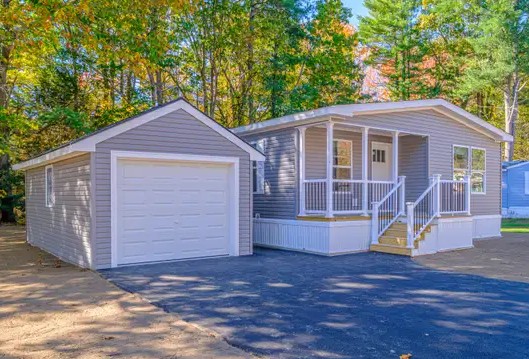
A manufactured home at Blue Haven in Saco (Photo ReMax Realty)

Without local action, towns should expect to see more residents advocating publicly for relief and more households turning to General Assistance simply because their money no longer goes as far as it used to. This is not speculation—it is a predictable outcome of inaction.

We all understand that mobile home parks are a business, and businesses make money. But when the profits generated from Maine residents do not stay in Maine, that becomes a direct problem for our communities.

If these equity firms were locally owned—if the revenue from lot rents circulated back into our local economy, our infrastructure, and our tax base—this conversation would look very different. Instead, we are watching the opposite happen.

Take Saco as a clear example.

Blue Haven Mobile Home Park’s majority ownership is held by the BRT Charitable Foundation, a California‑based nonprofit with tax‑exempt status. They do not pay state or federal taxes, and their reported donations and contributions are made entirely in California. Nothing we have seen indicates that any portion of the profits generated from Saco residents are being reinvested here in Maine.

When out‑of‑state equity firms extract revenue from Maine communities without reinvesting in local infrastructure, services, or the residents who generate that revenue, the burden shifts directly onto municipalities.

Local taxpayers end up subsidizing the gaps—whether through increased General Assistance requests, strained social services, or the long‑term costs of deferred infrastructure maintenance inside these parks.

Nothing we have seen indicates that any portion of the profits generated from Saco residents are being reinvested here in Maine

This is not just a housing issue. It is an economic leakage issue, a municipal budget issue, and a community stability issue. Maine towns and cities have a choice: put reasonable protections in place now or continue absorbing the financial and social consequences later.

Residents are already feeling the strain. Without action, municipalities will feel it next.

Kathy Dobbins, president

Blue Haven Committee, Saco

_______________________

NOTE: The Biddeford Gazette strongly encourages reader feedback and public commentary regarding our coverage and issues directly related to the city of Biddeford. To submit a letter to the editor or guest column, please contact us at biddefordgazette@gmail.com

Never miss an update! Subscribe today!

_____________________

THE BIDDEFORD GAZETTE | A Legacy of Trusted, Independent Journalism

Our editorial standards and policies: Biddeford Gazette | Standards & Policies

© 2026 Biddeford Gazette, Inc. All Rights Reserve

LETTER: City is treating UNE unfairly

By BERNARD ROY, Special to the Gazette

I understand there is a moratorium on UNE initiated by the mayor and city council.  UNE is an institution that is a huge plus for Biddeford.  They hire professionals as professors, adjunct professors and administrators who live in our community.  More importantly, UNE educates young people from Maine who aspire to better themselves and get good paying jobs. 

In addition, UNE provides jobs for residents from Biddeford and surrounding areas to maintain the building, grounds and services.  UNE is not a burden to residents of Biddeford.

The Portland Press Herald had an article (Biddeford Committee plans public hearing, Feb. 24, 2026) about the moratorium, which revealed the hidden agenda for this moratorium.

It appears the Hills Beach residents want to constrain development and growth of UNE.  They are more interested in keeping people out and the coastline to themselves for nothing more than selfish reasons.

Biddeford has failed to provide public parking at every beach in Biddeford for all the residents.  When I drive through Biddeford Pool these days, I noticed all the places I had parked to go scuba diving when I was in high school are now blocked or have no parking signs, essentially keeping city residents out.

The Biddeford City Council recently enacted a six-month moratorium on continued development at the University of New England’s Biddeford campus to allow city officials and a new subcommittee time to review and recommend potential changes

 If you drive to Goose Rocks Beach, you are welcomed with a sign that says, “welcome to Goose Rocks Beach, no parking on any street any time”.  When you drive through, you can see a beautiful beach near the road. 

Most of the time there are very few people on the beach.  But there is no public parking anywhere.  Instead, you find a pseudo security guard following you to make sure you leave. He essentially chases you out. 

My sister stopped there last year to show her daughter the beach and was rewarded very quickly with a parking ticket.  I thought, here I am a resident of Biddeford and could not go to one of our beaches. 

______________

Editor’s Note: Goose Rocks Beach is located in and controlled by the town of Kennebunkport, not Biddeford)

______________

Driving through, I noticed most of the license plates are from out of state.  Is this where Hills Beach is going to not provide any public parking?

 We see our coastline being bought up by many who are from out of state and moving to Maine to retire.  If you read the Portland Press Herald article on February 18, Maine has become the oldest state, where people over 65 outnumber the people under 18 in Maine. 

It is one thing to buy up the coastline, but another when these people do whatever they can to prevent Maine residents from accessing the beaches in order to keep the coastline to themselves.  I have 22 nieces and nephews and only two still reside in Maine.  The others all had to go out of state to find good paying professional jobs.

If you watch the video of the public hearing meeting just before the city council voted for the moratorium, you will see there was absolutely no interest of any city council member to listen to public inputs.  They were simply going through the motions and had their minds made up.

It will be interesting to see if the public hearing meeting (March 2) will be a repeat of that or whether anyone on the city council will listen to public inputs and take them into account.

 Council members should be representing all city residents, not just a handful in Hills Beach. 

When one sees the committee made up of three city council members who live in Hills Beach and Patricia Boston, a Hills Beach resident heading up the committee, there is little faith they will do their job of representing all residents of Biddeford, but more for their own benefit.  

I believe this committee is a serious conflict of interest and unethical.  I hope the mayor and other city council members choose to do that right and just thing and abandon this moratorium.

ABOUT THE AUTHOR: Bernard Roy is a former Biddeford resident, and 1971 graduated of Biddeford High School. Today, he resides in Ada, Michigan

_________________

NOTE: The Biddeford Gazette strongly encourages reader feedback and public commentary regarding our coverage and issues directly related to the city of Biddeford. To submit a letter to the editor or guest column, please contact us at biddefordgazette@gmail.com

Never miss an update! Subscribe for free today!

THE BIDDEFORD GAZETTE | A Legacy of Trusted, Independent Journalism

Our editorial standards and policies: Biddeford Gazette | Standards & Policies

© 2026 Biddeford Gazette, Inc. All Rights Reserved

OPINION | Mayor explains new UNE committee

By MAYOR LIAM LAFOUNTAIN, City of Biddeford

On Monday, March 2 at 6 p.m., the Institutional Zone Review Committee will hold its first public hearing at City Hall. The meeting begins the public input phase of a broader review of how Biddeford regulates institutional development.

For many residents, the term “Institutional Zone” may not be familiar. In practical terms, it is the zoning framework that governs development at the University of New England’s Biddeford campus.

UNE’s campus sits largely within an area that, under typical zoning rules, is generally limited to single-family houses.

In 2001, the city created a dedicated zoning district to allow the university to build and grow in ways that no other entity could within that setting. The ordinance established a structured process requiring a comprehensive Institutional Master Plan, a document outlining anticipated growth over five to ten years and analyzing impacts on traffic, parking, infrastructure, municipal services, and campus design standards.

Biddeford Mayor Liam LaFountain, City of Biddeford photo

The University of New England has long been an important part of Biddeford’s civic and economic fabric. It is one of the city’s largest employers and contributes to the local economy, research activity and cultural life.

Students, faculty, and staff are neighbors and active participants in Biddeford. The relationship between Biddeford and UNE has evolved over time, shaped by growth on both sides.

The City’s zoning has long provided a clear pathway for institutional growth. However, the Institutional Zone ordinance has not been comprehensively updated in nearly 25 years. As both the university and the city have evolved, it is reasonable to review whether that framework remains aligned with current conditions and future expectations.

In recent years, several development projects within the Institutional Zone have generated strong reactions. Often, disagreements have centered less on whether development should occur and more on how clearly the ordinance defines what is permitted, how impacts are evaluated, and how decisions are made. When expectations among the university, the city, and residents are not fully aligned, even well-intended projects can become contentious.

That context, in part, led the city council to establish the Institutional Zone Review Committee at the beginning of this council term.

The committee serves in an advisory capacity. It does not approve projects, determine property sales, or make final legislative decisions. Its responsibility is to review the ordinance, gather public input, and recommend whether revisions are warranted. Any proposed changes will proceed through the standard public legislative process before the Planning Board and City Council.

Formed through the regular public appointment process, the committee operates in open session under Maine’s Freedom of Access laws. All members are Biddeford residents. The membership includes two city councilors, the president of the University of New England, the president of the Hills Beach Neighborhood Association, a facilities manager who previously worked for UNE and is a UNE graduate, and a local real estate professional. Together, they reflect a range of civic, professional, and neighborhood perspectives within the city.

Meetings are open to the public, materials are posted online, and the process is structured to ensure transparency, accountability, and broad participation before any ordinance changes are considered.

________________

The process is structured to ensure transparency, accountability,

and broad participation before any ordinance changes are considered.

__________________

Residents may attend meetings in person or communicate directly with the committee via its group email account at InstitutionalZoneReview@biddefordmaine.org

As part of this review, the City Council adopted a temporary six-month moratorium on new institutional development and university uses. The pause is not directed at any single proposal and does not prohibit the purchase or sale of property within the Institutional Zone, nor does it prevent any property owner, including the University of New England, from entering into a real estate transaction.

It applies only to new development activity or changes of use during the review period, allowing the city to evaluate and, if necessary, update the ordinance before additional projects proceed under standards that may soon change.

Zoning ordinances shape municipalities for decades, influencing infrastructure investments, traffic patterns, public safety demands and neighborhood character.

Recent institutional projects have underscored the need for clearer expectations and a more consistent and transparent framework. As public interest has grown, so too has the expectation that development decisions be predictable and participatory. Reviewing the ordinance openly and deliberately is a responsible step toward that goal.

Public comment from Biddeford residents on March 2 and in the months ahead will help inform this work and strengthen the final recommendations. The objective is a regulatory framework that provides clarity, consistency, and confidence as institutional growth continues in Biddeford.

_________________

ABOUT THE AUTHOR: Liam LaFountain is serving his first term as Mayor of Biddeford and previously served two terms on the Biddeford City Council. He welcomes questions, comments, and ideas and can be contacted directly at liam.lafountain@biddefordmaine.org. The views and opinions herein are solely those of the author.

Never miss another update! Subscribe for free today!

THE BIDDEFORD GAZETTE | A Legacy of Trusted, Independent Journalism

Our editorial standards and policies: Biddeford Gazette | Standards & Policies

© 2026 Biddeford Gazette, Inc. All Rights Reserved

LETTER | Let’s focus on collaboration, not division

City is on the right track in its thoughtful, measured review of UNE development plans

I read the recent letter regarding the University of New England review committee with concern, but also with a sense that the issue deserves a more balanced perspective.

What was city thinking? Biddeford Gazette, Feb. 28, 2026

It is important to remember that residency alone does not disqualify someone from serving fairly or objectively. Hills Beach residents are citizens of Biddeford, just as much as anyone living downtown, in the mills district, or elsewhere in the city. Suggesting that they are inherently incapable of acting in the broader public interest risks dividing our community rather than strengthening it.

The committee’s role is to review plans and gather input — including through a public hearing — not to act as “plaintiffs” or to obstruct progress. The public hearing itself is evidence of a transparent process that invites participation from the entire community.

The University of New England is indeed an asset to Biddeford. Its educational, economic, and cultural contributions are significant. At the same time, thoughtful review of development proposals is not the same as impeding progress. Responsible growth benefits from careful consideration of environmental impact, neighborhood character, traffic, infrastructure, and long-term planning. That is not obstruction — that is governance.

________________

“Thoughtful review of development proposals

is not the same as impeding progress.”

________________

If residents are concerned about representation, the solution is engagement. Attend the hearing. Submit comments. Volunteer for boards and committees. Run for office. Democracy functions best when more voices participate — not when we question the legitimacy of neighbors simply because of where they live.

Biddeford is stronger when we work together — university community, beach residents, mill district entrepreneurs, and long-time families alike. Let’s focus on collaboration rather than division.

Mark Poirier, Biddeford

NOTE: The Biddeford Gazette strongly encourages reader feedback and public commentary regarding our coverage and issues directly related to the city of Biddeford. To submit a letter to the editor or guest column, please contact us at biddefordgazette@gmail.com

Never miss an update! Subscribe for free today!

THE BIDDEFORD GAZETTE | A Legacy of Trusted, Independent Journalism

Our editorial standards and policies: Biddeford Gazette | Standards & Policies

© 2026 Biddeford Gazette, Inc. All Rights Reserved
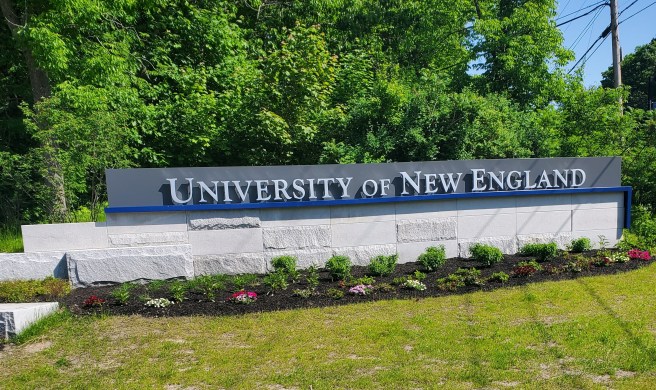
READER OPINION | What was city thinking?

Weighted UNE committee is appalling and patently unfair to UNE

By DIANE SNOW, Special to the Gazette

A recent Portland Press Herald story regarding the committee set up to review the plans for University of New England [Biddeford Committee plans public hearing, Feb. 24, 2026] left me appalled because the committee is comprised primarily by Hills Beach residents.

That the chairman of the committee [Councilor Patricia Boston] is a Hills Beach resident was surprising enough.  Now to find out that three of the six committee members are Hills Beach residents, was not just surprising, it was shocking. 

How can anyone expect an honest and objective assessment when the “plaintiffs” have become the “jury”?

This issue affects not just the residents of Hills Beach; it affects the entire community. 

RELATED: UNE Oversight Committee begins work

The university is a major prize in Biddeford. Most cities would give their right arm for this privilege.

A more disturbing question: Whose welfare do our elected officials represent?  The wealthy beachfront residents or the community at large? 

Members of the newly former Institutional Zone Review Committee held their first meeting on Feb. 19, 2026. The committee’s first public hearing will be held on Monday, March 2, beginning at 6 p.m., at City Hall in Biddeford (Gazette photo)

That the Hills Beach residents wield outsized power is clear.  How long has this been going on? Do we need to remind city officials that the taxes in the city are paid by all property owners, not just the beachfront owners? 

There is plenty of real estate in vacant mills that need interested entrepreneurs willing to establish flourishing businesses.  A university, with its educational and cultural benefits, is a major attraction. 

____________

The university is a major prize in Biddeford. Most cities would give their right arm for this privilege.

_____________

Impeding the progress of UNE is harmful to Biddeford.  This outsized influence of a small, privileged group has also clarified the means by which beach access has become so restrictive. 

Has anyone noticed how difficult it is to access our beaches?  I once received a parking ticket at Goose Rocks beach when I stopped there to give a young girl from New York City — who was staying with us through the Fresh Air Fund — a chance to put her feet in the ocean for the first time. 

The beauty of the world does not only belong to a select privileged group.

The mayor and city councilors were elected to represent the interests of the entire community, not just a single group. 

It is time to address this travesty.  Citizens of Biddeford, know whose interests your elected officials represent.  Let them know of your concerns, and above all, think carefully next time you are at the polls.

Diane Snow was born and raised in Biddeford. Today, she lives in Cumberland, Maine

____________

NOTE: The Biddeford Gazette strongly encourages reader feedback and public commentary regarding our coverage and issues directly related to the city of Biddeford. To submit a letter to the editor or guest column, please contact us at biddefordgazette@gmail.com

Never miss an update! Subscribe for free today!

THE BIDDEFORD GAZETTE | A Legacy of Trusted, Independent Journalism

Our editorial standards and policies: Biddeford Gazette | Standards & Policies

© 2026 Biddeford Gazette, Inc. All Rights Reserved
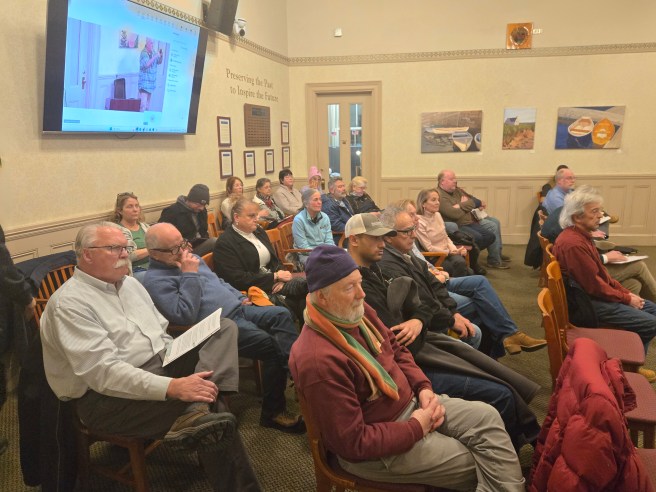
OPINION | Biddeford should keep Center

By RANDY SEAVER, Editor

Biddeford Mayor Liam LaFountain ran his campaign last year on a platform dedicated to restoring accountability and increasing transparency at City Hall.

Those were good messages, and the voters agreed with LaFountain, giving him the edge over the incumbent former mayor.

LaFountain pledged to hit the ground running, and he’s already made good on those campaign promises.

As an example, LaFountain – with unanimous support from the city council – was able to revive a new committee to review ongoing development at the University of New England.

LaFountain has also steadily pushed for transparency on issues ranging from the city’s overdue financial audits to how city spending is handled; and how major development projects are reviewed by city staff.

We applaud LaFountain’s commitment to transparency and accountability, but we would caution the new mayor to carefully consider and weigh a proposed change to how the city handles its legal matters.

Shortly after his inauguration in December, LaFountain proposed an idea to do away with having an outside, private attorney represent Biddeford as its city solicitor.

RELATED | City considers hiring ‘in-house’ attorney

While the council supported renewing City Attorney Harry B. Center’s contract for only six more months, it’s unclear whether a potential change would ultimately be supported by every member of the council, when push comes to shove.

Harry B. Center, a native son, has served the city of Biddeford for many years, first appointed by former mayor Roger Normand in 1992 (Courtesy photo)

Regardless of how the council feels about ditching Center and instead hiring an in-house, full-time city attorney, we think such a move would be a mistake.

The basis of our opinion is founded upon three basic points: experience, local knowledge and financial costs to the taxpayers.

EXPERIENCE:

Center began serving Biddeford as its city solicitor more than 30 years ago, first appointed to the job by former mayor Roger Normand in 1992.

Since that time, Center has served as city solicitor under five different mayors, including James Grattelo, Donna Dion, Alan Casavant, Marty Grohman and now Liam LaFountain.

Although Center resigned his position in 2004 to pursue a new job in the private sector, he returned after being appointed by Casavant to replace Keith Jacques upon his retirement as city solicitor in 2022.

Over the last three decades, Center has served as the city’s chief legal counsel on a wide range of issues – including controversial matters related to the former Maine Energy trash incinerator and widespread citizen concerns about a controversial research pier being proposed by the University of New England.

Simply put, Mr. Center’s institutional knowledge cannot be matched.

LOCAL KNOWLEDGE:

Center is much more than just another department head or city employee. His roots in the community go back for generations.

He was born and raised in Biddeford. He attended St. Mary’s parochial school and then graduated from Biddeford High School in 1980.

If Biddeford needs representation on issues involving far-reaching implications for the city’s future, we think it makes sense to have an attorney who truly understands the community he is fighting for and representing.

Mr. Center is not only a highly qualified attorney and a partner in a Biddeford-based firm, he also understands the city’s history, its culture and its people.

Mr. Center’s blood runs black and orange, and that should count for something.

Although we have sometimes found ourselves in disagreement with some of Center’s opinions, we also feel strongly that he has consistently represented the city with passion, dedication and a deep commitment to the highest standards of his profession.

_________________

Mr. Center’s blood runs

black and orange; and

that should count for something.

_________________

FINANCIAL CONSIDERATIONS:

Finally – although we recognize and appreciate some calls for a new approach and a breath of fresh air, we should all consider the financial implications of hiring an in-house attorney to serve as the city solicitor.

Currently, Center bills the city at an hourly rate of $255 per hour, a fraction of what most attorneys with his experience and credentials charge in the Portland metropolitan area.

The city’s primary financial advantage – in addition to Mr. Center’s deeply discounted fee — is the fact that he is not a full-time employee. Mr. Center receives no benefits from the city, unlike full-time department heads.

Center’s firm is headquartered on Main Street, almost directly across the street from City Hall’s main entrance. For all intents and purposes, he’s practically already ‘in-house’ counsel for the city.

Could the city hire a new attorney for less than what Center is charging? We strongly doubt that possibility, especially if the city wants someone with experience.

Moreover, creating yet another administrative position comes with all sorts of other somewhat hidden considerations, including office space, equipment and support staff, not to mention personnel benefits, including vacation and retirement benefits.

In summary, Harry Center has served the city of Biddeford with distinction and honor for many years. In our opinion, there is no compelling reason to throw away that experience and commitment on the gamble of a new approach.

That’s our opinion, and we welcome yours. You may submit either a guest column of the same length or a letter to the editor by contacting us at biddefordgazette@gmail.com.

_________________

Never miss another update! Subscribe for free today!

THE BIDDEFORD GAZETTE | A Legacy of Trusted, Independent Journalism

Our editorial standards and policies: Biddeford Gazette | Standards & Policies

© 2026 Biddeford Gazette, Inc. All Rights Reserved
OPINION: Life During Wartime, when reporters compete

When journalists compete, readers win | Good news for people in Biddeford

Whether you’re buying a new car or just picking up the week’s groceries, you are always better off when you have choices and competition in the marketplace.

It’s no different when it comes to the highly competitive world of journalism. Having choices about where you get your local news ensures that you are well-informed and up to date about what is happening in your community.

Most journalists I know – me included – would rather have “exclusive rights” when it comes to local news reporting. We’re doing just fine. There’s no need for competition. Thank you very much.

But if there is only one dominant media outlet in any market – large or small –news consumers suffer.

Competition keeps journalists on their toes, hungry to find new and more detailed information. Competition also serves the public as an appropriate ‘check and balance’ on each reporter and every media outlet.

Bias and inaccuracy are exposed when multiple journalists cover the same beat.

The idea – and the importance – of “getting the scoop” is a well-known mantra, that even those outside the realm of the so-called Fourth Estate understand and appreciate.

But getting the scoop should be much more focused on getting the story right rather than getting the story first.

So, how does all of this impact local news consumers in Biddeford?

What’s the buzz? Media competition in Biddeford

The local news landscape in the Biddeford area has changed dramatically over the last 30 years.

I have written about this subject ad-nauseam on my personal blog, Lessons in Mediocrity.

I grew up here, and when I returned to Biddeford in the mid-1990s, there were three newspapers regularly covering City Hall, local politics, news and events.

The Portland Press Herald – Maine’s largest daily newspaper – had a fully-staffed regional bureau on Main Street. The legendary and award-winning Journal Tribune – an afternoon daily – was then “the paper of record.”

At the same time, the weekly Biddeford-Saco-OOB Courier – a locally-owned publication — was keeping the big boys on their toes, filling the gaps and providing (during my tenure as editor) a somewhat manic approach to covering City Hall.

What happened?

For all intents and purposes, it was like a slow-acting bomb was triggered. There were a lot of things at play, most notably corporate restructuring of local media and big changes in how consumers accessed their news and information.

Welcome to the internet and social media.

Suddenly, everyone was a reporter. The Fourth Estate was being overrun by a mob of discontented citizens who no longer trusted the media or valued its self-described role as guardians of local news and information.

The Journal Tribune – after more than a century of providing local news in Biddeford – permanently closed its doors in October 2019. The Press Herald closed its regional bureau; and the Courier was sold and then – just last year – ceased publishing its print edition and was folded into an electronic newsletter distributed by the Press Herald.

Rising from the ashes

It may have happened slowly, but over time folks in the Biddeford area realized that they were living in a vacuum of local news coverage. The local newspapers were always taken for granted.

Many of us didn’t recognize how lucky we were to have three independent, professional publications covering Biddeford news.

Not surprisingly, it was a local journalist who took the very first step in filling the news vacuum in Biddeford.

Liz Gotthelf, a former Journal Tribune reporter, launched Saco Bay News – a digital publication – only months after her employer sent her and her co-workers packing in 2020.

Liz Gotthelf (Saco Bay News photo)

It likely would have been easier for Liz to find a job at another newspaper or go into the much more lucrative field of public relations. But with tenacity and grit, she almost single-handedly built a trusted, local media source.

Saco Bay News does an excellent job of covering local news, but since Liz is basically running it as a one-person show, she is stretched thin and challenged by simultaneously covering three communities: Biddeford, Saco and Old Orchard Beach.

Another fighter enters the ring

Almost two years ago, I found myself increasingly frustrated about some local issues, including Biddeford’s brash and rather obnoxious former city manager and a lack of coverage about a controversial project put forth by the University of New England.

In November of 2024, I tentatively launched the Biddeford Gazette as a special section on my blog. Two months later – following my wife’s suggestion – I formally launched the Gazette as a stand-alone publication.

Biddeford is the largest community in York County, and the eighth-largest city in Maine. I thought the city deserved its own news source.

I doubt that Liz – a good friend and former co-worker – was very happy about a new competitor, but readers almost immediately embraced the Gazette because of its commitment to be a Biddeford-only publication.

There’s an old saying: “Write what you know.”

Well, I know Biddeford. My family’s roots here go back generations. I was raised on the third-floor of a Quimby Street triple decker and received First Communion at St. Mary’s.

Heck, I even had a paper route delivering the Journal Tribune in the 1970s.

As a professional journalist, I have been covering the city of Biddeford for nearly 30 years. Thus, I have a somewhat unfair advantage over Liz and various reporters from the Press Herald. I know this city and its people, and they know me.

The media landscape continues to change

Today, any person with a smartphone and an internet connection can set themselves up as a journalist or as “a community reporter.”

That’s a good thing, and that’s a bad thing. Allow me to explain.

Last year, during a small, community symposium about local media issues that was hosted by The Maine Monitor at the McArthur Library, several folks raised concerns about how to “separate the wheat from the chaff.”

In an age of rampant internet communication, how are consumers supposed to discern and distinguish the news being fed to them, asked Susan Gold, a veteran journalist who once worked at the Journal Tribune.

Sadly, there is no easy answer to that question.

As I said at the top, increased competition among the media is good for you, but you have to be careful.

A few months ago, another digital media outlet emerged in Biddeford.

The Biddeford Buzz was launched last summer by Josh Wolfe, a man who was reportedly less than satisfied with the area’s existing news coverage, especially the Gazette.

The Biddeford Buzz may not be my cup of tea. Josh has had no editorial training or professional news experience prior to launching his own publication. For example, the Buzz recently published a story about a political candidate simply by “copying and pasting” something the candidate wrote on Facebook. She called me to complain. “He [Wolfe] never even called me,” she said.

But what Mr. Wolfe may lack in experience, he more than compensates with enthusiasm and a dogged desire to keep other reporters on their own toes.

Unlike many other reporters, Wolfe has become a regular fixture at Biddeford City Council meetings. He has a near perfect attendance record, always sitting up front and eager to cover even rather benign city issues.

Furthermore, — and perhaps most importantly — the Biddeford Buzz gives its readers and others another platform to share their own news and opinions about the city of Biddeford. That’s very important, especially for people who have a rather dim view of the Gazette or other local publications.

More choices often lead to better outcomes, and at least Biddeford consumers are no longer living in a news vacuum

CORRECTION: The original article contained an error. The Journal Tribune closed in October 2019, not in 2020. The story has been updated, and we apologize for the error.

____________

ABOUT THE AUTHOR: Randy Seaver is the editor and founder of the Biddeford Gazette. He is a veteran journalist and regularly blogs about media issues at Lessons In Mediocrity | Outlaw Journalist. He may be contacted at randy@randyseaver.com

Never miss an update! Subscribe for free today!

______________________

Our editorial standards and policies: Biddeford Gazette | Standards & Policies

© 2026 Biddeford Gazette, Inc. All Rights Reserved

OPINION | Speaker Fecteau: ICE activities in Maine do not match our state’s values

By RYAN FECTEAU, Special to the Gazette

A new legislative session is now underway, and there are many pressing matters in front of us that impact Biddeford residents and Mainers from all over. Whether addressing Maine’s housing crisis to overcoming federal funding cuts to important programs like SNAP and healthcare, we have a lot of work to do to make sure Maine families can get ahead and stay ahead.

While our legislative work progresses with the normal cadence of public hearings, work sessions, and floor votes, what has been happening outside the State House, and in our own community here in Biddeford, is anything but normal.

I was dismayed by the surge of ICE agents in our state under the grotesque title of ‘Operation Catch of the Day’. These agents were shirking good policing standards in favor of warrantless, indiscriminate, and quota-driven detentions. I know their actions sowed fear in our community, especially for people of color. It was painful to hear from friends, including those who are lifelong U.S. citizens, who feared they could be profiled and detained based entirely on the color of their skin. So many are now carrying their “papers” (e.g., a birth certificate or passport). Is this America?

House Speaker Ryan Fecteau (D-Biddeford) Contributed photo

Moreover, the surge of ICE agents and their actions were completely inconsistent with President Trump’s campaign promise to “go after criminals”. The headlines told the true story: whether restaurant workers at Kobe in Biddeford, or corrections officers at Cumberland and York Counties, or a civil engineer with a work visa, this “immigration crackdown” appears less focused on criminals and more about inciting fear and terror among people who came here to chase the promise of America: life, liberty, and the pursuit of happiness. I was horrified at the news of a single mom snatched by agents after dropping her daughter off at Biddeford Primary school, and the arrest of Marcos Gaspar Da Silva, who worked on a home renovation project for me. He’s highly rated on the handyman app Thumbtack, because, as I learned, he is hardworking and diligent.

While politicians in DC may say that the “surge” or “enhanced operations” have ended, the devastation left in the wake of ICE’s actions is far from over. ICE agents are still operating in Maine. Families are still seeking information on loved ones who continue to be detained. Lawyers are still trying to connect with their clients as those clients are shuffled among detention centers outside Maine and across the country. Our neighbors are still fearful of going outside, of simply being seen in our community, because they worry they could be next.

_______________

“What has been happening outside the State House,

and in our own community here in Biddeford,

is anything but normal.”

__________________

If what’s happening in Maine wasn’t enough, a nurse who worked at the VA hospital in Minneapolis was killed by an ICE agent just a few weeks ago, at least the fourth shooting fatality linked to immigration enforcement since Trump returned to the Oval Office. The Trump Administration hurriedly made public comments that suggested Alex Pretti was going to carry out a mass shooting against ICE. Of course, this assertion unravels when you see with your own eyes the video of Alex with his hands down on the pavement, surrounded by six or more ICE agents, being shot. Alex is shot just moments after a different agent removes Alex’s gun from a holster. Alex was exercising his Second Amendment rights and had a permit to carry. It didn’t matter. He was killed.

These operations across our country are not making us safer. What we are seeing is inconsistent with safety. There is a reason why we are a nation of laws. There is a reason why warrants are required to conduct searches and arrests. These things demand precision and liability. The rogue, indiscriminate, inhumane, and brutish nature of these ICE operations means innocent and lawful people are being wrongfully detained. It means this agency’s credibility is now nonexistent.

In the legislature, we’ve taken action to protect the rights of Mainers. This fall, LD 1971 became law, ensuring that workers are not detained, investigated, arrested, or searched by state, county, and local law enforcement officers solely for immigration enforcement purposes. And this session, LD 2106 proposes to require a valid, judge-signed warrant for immigration enforcement in sensitive locations like schools, hospitals, daycares, and libraries.

These are uncertain and perilous times. I’ll be honest, it can feel hopeless to see such federal abuses of power and have little oversight. However, I am proud of the ways in which Mainers across our state are standing up for their neighbors, and making it crystal clear that ICE is not welcome to bring their reckless tactics here to foment fear and chaos. These are the moments where we show the best of who we are. These are the moments where we conquer hate with love, fear with hope, and stand strong against a tide that seeks to weaken the pillars of our constitutional republic. These are the moments that define us.

_____________________

Ryan Fecteau of Biddeford is currently serving as Speaker of the House in the Maine House of Representatives.

Mr. Fecteau represents District 132 in the House of Representatives.  He may be contacted at ryan.fecteau@legislature.maine.gov

Never miss an update! Subscribe for free today!

OPINION: City showed no compassion for the sisters who have supported Biddeford

Dear Editor:

The moratorium on the sale of St Joseph’s convent by the city council took me by surprise.

It is not just that the city council appears so unwelcoming to the university, but it is their callous disregard for the plight of the nuns who so crucially need the income for their continued maintenance. Council unanimously halts UNE development

Have the members of the city council forgotten that these nuns spent their lifetimes giving the children of the city an exceptional education, permitted many of them to go on to graduate and postgraduate educations and professional lives? How many on the city council had their parents, themselves, or their children taught by the nuns?

The University of New England has expressed interest in purchasing the former St. Joseph’s Convent on Pool Road in Biddeford to be used for additional student housing (File Photo)

Do the city council members not realize that the plight of the nuns results from the fact that they worked without salary and do not receive social security benefits as the rest of the community which they taught?

You would think that there would be an outpouring of gratitude for the immense benefit to the community provided by these sisters. Instead total ingratitude and disregard.

I cannot believe the citizens of Biddeford who I grew up with would support this callousness. It leads me to wonder how representative of the community the city council is.

A second issue:  Most communities welcome a university campus in their city.  The professional management, teaching, and research staff enhance the economic, social, and cultural fabric of the community, not to mention the educational benefits available locally.  Many people looking for a community to relocate will consider a local university as a major benefit.

I also find it surprising that someone would bring up the value of the land the school sits on.  You can be land rich and finances poor.   

I myself had to go out of state to medical school because Maine was one of the few states with no in-state medical school at that time.  I’m also convinced that my education at St Joseph’s Gramnar and High School were a major factor ability in my admission to that most competitive of professions.  I also know how to be grateful. 

This brings up another question. Who are these people whose complaints have such an outsized influence on the council?

Are they on the council themselves? What is their relationship to the council members?  Who is the council representing?  Certainly not the community, and certainly not its most deserving and vulnerable members, women in their 80s and 90s who taught generations of children without pay.

The ingratitude shown by the city council cannot possibly represent the sentiments of the community and the entire process should be investigated and reviewed.

Shirley Roy, Biddeford

Editor’s Note: The city’s six-month moratorium on development at UNE’s Biddeford campus, does NOTHING to prevent the university from moving forward with its planned purchase of the St. Joseph’s Convent. The moratorium also does not apply to St. Joseph’s Convent, which is located nearly two miles west of UNE’s Biddeford campus.

_________________________

The Biddeford Gazette encourages robust community conversations and welcomes letters to the editor and guest columns submitted by our readers. For more information about submitting a letter or column, please click this link. CONNECT WITH US

Never miss an update! Subscribe for free today!

OPINION: Is Graham Platner more than image?

Dear Editor:

Friday morning, I engaged with a post on the Instagram account of U.S. Senate candidate Graham Platner. My comment was not a personal attack, but a critique of messaging and political culture. Earlier that day, I had been watching a panel of reporters, cultural critics and activists discussing a racist meme Donald Trump posted and later deleted about the Obamas.

Like many people, I’ve had a hard time disengaging from the nonstop dystopian news cycle. One point from that discussion stuck with me: a racist president does not emerge in a vacuum, but from history and cultural norms. It made me think about how often we focus on political figures as personalities or celebrities rather than the communities they are meant to serve. It also pushed me back to question how some people are more readily granted credibility, relatability and benefit of the doubt than others.

U,S Senate candidate Graham Platner visited Biddeford in November (File Photo)

That same morning, I saw a Platner post celebrating his status as a Senate frontrunner. Even though I wasn’t sure any good would come of it, I decided to speak up. My comment was sharp but focused: I may ultimately support his policy positions, but I questioned ego-driven messaging and the tendency to rally around someone simply because they feel relatable, even when others have long championed the same ideas.

My motivation was not that I dislike Graham Platner, or even that I don’t personally relate to him. I grew up in rural Maine. I’ve worked since high school to put myself through college. I have friends from many demographics, viewpoints, and walks of life, including veterans who are no longer with us. I’m outspoken, and in some ways I can see pieces of myself in Graham, as much as a woman can. I was initially excited about his candidacy and even defended his rugged, relatable rhetoric to my skeptical mother.

Later, I learned about past comments he made about sexual assault in the military and about Black people tipping. I was told those remarks were from 2012 by people I respect, but it has still been a lot to grapple with. Wanting to be fair, I attended an event where he spoke at Biddeford Middle School. In person, he was engaging and more humble than his social media presence suggests. He spoke about hardworking Mainers and real community issues (he also mentioned liking Kurt Vonnegut — hey look, not something I’m gonna base my vote on, but respect). I found him personable, but I also noticed him shy away from more specific policy questions. That mirrors what I see in his campaign messaging: broad themes, with far less discussion of specific legislation.

He does come across as an everyman. It’s admirable that he served as a Marine. It’s also great that he was able to fly his wife out of the country for IVF, and I fully support access to that care. But that level of access isn’t feasible for many Mainers. Is he really the everyman of Maine?

I also find myself questioning why many people readily frame him as inherently virtuous. Is it the polished image? But if I suggest it may also relate to who he is and how he presents, I risk being accused of “identity politics,” yet image clearly plays a role in how candidates are received. More than that, the tone of his campaign also gives me pause. Much of his messaging focuses on projecting confidence, bravado, and victory, while specifics go unaddressed.

I question why we so often elevate candidates based on relatability and image rather than depth of policy discussion. For me, this raises broader questions about who we instinctively see as credible and why. Is this result of a two-party system? Of our own ability to embrace nuance? Modern culture? Something else? 

________________

I question why we so often elevate

candidates based on relatability and image

rather than depth of policy discussion.

_________________

When I made my comment, perhaps not unexpectedly, I received dismissive replies from his supporters. One person, who said he was a friend of Graham’s, said I seemed “insufferable” and focused on defending Mr. Platner’s character instead of addressing the substance of my comment. Another person mischaracterized my argument in a way that echoed familiar tropes often used to trivialize women’s political voices, and suggested I must think Graham is unintelligent because he is a man. After several rounds in which he ignored my actual points and resorted to personal attacks, I checked his profile and saw that he does not appear to be a U.S. voter.

I continued monitoring the comments partly out of concern, because expressing political opinions online can invite harassment. I then noticed that Waukeag Oyster Company, an oyster farm business founded by Graham Platner, “liked” comments suggesting my critique was simply about him being a man, while my original comment went unanswered. Public “likes” may seem small, but they signal which messages a campaign chooses to acknowledge or amplify. I do not know whether it was Graham himself, a business partner, or a social media manager engaging with those comments. Still, liking a response that framed my critique as gender-based, rather than engaging with the substance of what I said, felt dismissive and unnecessarily divisive. Especially considering that this person, according to their Instagram bio, is not even part of Mr. Platner’s voter base.

I messaged Waukeag Oyster Company to point this out and received no response.

Look, if Graham Platner gets elected, I can live with it. I may end up voting for him if he is truly the frontrunner, and I will more than likely include him in my ranked-choice ballot in the primaries. But what concerns me is when supporters place personality and relatability over policy. In an age of rising authoritarian tendencies, we should be asking where solidarity turns into conformity, and why we tolerate brashness in some demographics while condemning it in others. Not for the sake of purity, but for equity and for preserving our own critical thinking, rather than saying yes to whoever is speaking the loudest.

Sincerely,

Victoria Gordon, Biddeford

Note: Victoria Gordon serves on the Biddeford Gazette’s Advisory Board, The Gazette welcomes letters and guest columns from its readers. More information here: CONNECT WITH US

____________________

Never miss an update! Subscribe for free today!

OPINION: Those were the days . . .

By RANDY SEAVER, Editor

How do you know you’ve been covering Biddeford news for a long, long time?

I have covered the city’s annual WinterFest celebration since — well – since before it was called WinterFest.

Biddeford’s annual downtown winter celebration was the brainchild of newly elected Mayor Alan Casavant in 2012.

Casavant — who was also serving as a state representative back then –had attended a community dog-sledding event and celebration in Fort Kent.

“I was really impressed by the community turnout,” the former mayor said during a recent interview. “It wasn’t just dog-sledding and races, they had lots of different activities. It really brought people together.”

Casavant returned home full of optimism and ideas about how Biddeford could do something similar.

Let her rip! Former mayor Alan Casavant tackles the man-made sledding hill on Adam’s Street during the very first WinterFest celebration in February 2012. The annual festival was then known as L Fete d’ Hiver

The city was in the early stages of a downtown renaissance, and Casavant was eager to draw people back to the downtown area — even though MERC was still burning garbage roughly 1,200 feet away from the first man-made sledding hill on Adams Street and the fact that there were then fewer than 438 places in downtown Biddeford to get gourmet coffee, craft beers and specialty pizzas.

Casavant enlisted the help of resident John Maxson who jumped into the project with both feet and a smile that never faded until his passing several years ago. Maxson’s memory and community service is enshrined by a bronze plaque that was placed on the outside wall of City Hall near Adams Street.

Originally, the celebration was called La Fete d’ Hiver, a nod to the city’s then dominant Franco-American heritage.

The first festival exceeded expectations for community turnout, and the weekend celebration was later expanded and became more popular with each passing year and a growing base of volunteers.

But by the third year, the name La Fete’ d’ Hiver was dropped and replaced with a more inclusive moniker: WinterFest, much easier for most of us to pronounce and spell.

Look, my family attended Mass at St. Mary’s, not St. Andre’s or St. Joseph’s.

When my parents bought their first home in Saco, I served as an altar boy at Most Holy Trinity, not Notre Dame.

I graduated from Thornton Academy, not St. Louis High School.

I knew just enough French to get in trouble and flirt with local girls. Et, pourquoi  pas?

I’m not trying to position myself as the defender of Biddeford’s Franco-American heritage. Growing up in Saco, we made jokes about French people.

Laura and I were getting our groove on during the city’s first WinterFest celebration in 2012

It should also be noted that Biddeford’s cultural roots are not just pure-bred French Canadian. Our community was also built by immigrant factory workers who came here from Ireland, Greece, Albania and numerous other countries, including Syria, Russia and Italy.

When it comes to cultural diversity, Biddeford pretty much knocks it out of the park.

But I do feel sad and a bit troubled by the gentrification now taking place in my community.

What’s next? Are we going to rename the city’s annual La Kermesse celebration as SummerFest?

I think the Lincoln Hotel lobby is fantastic and a wonderful place to meet friends. I enjoy hanging out at Element’s and drinking really good beer at Sacred Profane.

__________________

But I do feel sad and a bit troubled

by the gentrification now taking place

in my community.

_________________

But like many other people, I do so sometimes wax nostalgic about getting new school clothes at Butler’s, eating at the Woolworth’s lunch counter or browsing the vast collection of records at Murphy’s Music.

The once vibrant shoe factory on State Street is now an apartment complex. You no longer get your local groceries at Sevigny’s Market and charge your purchases to your weekly slip.

You blissfully ignored whatever it was that would periodically spew forth directly into the river from the Saco Tannery.

There will be many activities for adults and children throughout the weekend, but the downtown sledding hill remains as a favorite among area children. (Photo by Devin Wright)

There was no Home Depot. You went to McKenney & Heard Hardware on Main Street, You got your prescriptions at Doyon’s Pharmacy not Wal-Mart.

If you lived in Biddeford, your furniture came from Warren’s. If you lived in Saco, you probably bought your new dining set at Atkinson’s.

With each passing day, it is getting harder and harder for longtime residents to keep pace with soaring rental costs and restaurants that now cater to a younger, more affluent clientele.

People tell me all the time that they miss print newspapers like the Journal Tribune or the Biddeford-Saco Courier.

I shrug and say, “Oh well. Times change. Now you have the Biddeford Gazette and Saco Bay News.

Change is the only constant . . . that and the joy that can be found in community events like WinterFest. Enjoy!

For more information about this weekend’s events, please visit: WINTERFEST | 2026

_______________________

Randy Seaver is the editor and founder of the Biddeford Gazette. He may be reached by email: randy@randyseaver.com

You may view and learn more about our editorial standards and policies here:

Biddeford Gazette | Standards & Policies

c.) 2026 All Rights Reserved; Biddeford Gazette, Inc.

Never miss an update! Subscribe for free today!

OPINION: Supporting our municipal workforce; how AI can help cities serve better

By MARTY GROHMAN, Special to the Gazette

Our municipal employees are the backbone of our communities. They plow our streets at three in the morning during snowstorms. They respond to service requests, maintain our infrastructure, and keep our cities running smoothly day after day. These dedicated public servants often work with limited resources, facing growing demands while dealing with staffing constraints and aging technology systems.

We owe it to them to provide every tool that can make their jobs easier, safer, and more effective. Artificial intelligence isn’t about replacing these hardworking people—it’s about giving them support so they can focus on what matters most: serving our residents.

Photo: Open.gov

Starting Small: Meeting Minutes and Administrative Tasks

The simplest place to start is often the most impactful. Consider the countless hours municipal employees spend transcribing meeting minutes, summarizing discussions, and producing reports. In Gray, Maine, Communications and IT Director Kyle Hadyniak has embraced this exact opportunity.

Gray uses Microsoft Copilot to create meeting recaps of Town Council sessions much faster than manual transcription would allow, with the AI automatically generating timestamps and natural language summaries that help Hadyniak turn around news articles in just an hour or two. This means residents get information about their local government faster, and it means one less tedious task weighing down a small municipal staff.

Gray adopted a formal AI policy in the summer of 2025 that requires staff training before receiving access to AI tools and emphasizes that AI outputs must be treated as draft material requiring human review. This responsible approach recognizes that technology should augment human judgment, not replace it.

The impact goes beyond time savings. When communications staff can produce meeting summaries quickly, they have more time for community engagement, answering resident questions, and improving accessibility. Hadyniak noted that small municipalities in Maine with fewer than ten full-time staff members would particularly benefit from AI tools to handle smaller administrative tasks.

Making Our Streets Safer and More Efficient

Syracuse, New York, demonstrates how municipalities can use technology to enhance essential services while maintaining transparency and community oversight. 

For snow removal operations—a critical service in upstate New York—Syracuse’s Department of Public Works has implemented GPS fleet tracking and AI cameras on trucks. These systems don’t just monitor employees; they protect them. Cameras provide visual documentation of road conditions and can help verify crew safety and accountability. Real-time GPS tracking allows operations superintendents to optimize routes, respond to service requests more effectively, and ensure no streets get missed during storms.

Think about the worker driving a plow truck for twelve hours straight during a blizzard. That technology means their supervisor knows where they are, can send help if needed, and can verify their route is safe and efficient. It means fewer callbacks to streets that were already plowed and better coordination across the entire fleet.

Looking Forward: Smarter Services, Better Communities

The next generation of municipal AI applications will transform how cities deliver services:

Route Optimization for Waste Collection: AI can analyze traffic patterns, construction zones, and historical data to create more efficient garbage and recycling routes. Drivers spend less time in traffic, trucks use less fuel, and residents get more consistent service.

Predictive Infrastructure Maintenance: Machine learning can identify patterns in service requests and sensor data to predict when a water main might fail or when a road needs repaving—before it becomes an emergency. This helps cities budget more effectively and prevents those frustrating situations where the same street gets dug up multiple times.

Intelligent Website Navigation: Many municipal websites are difficult to navigate, especially for residents who aren’t familiar with government terminology. AI-powered search and chatbots can help residents find the right form, understand a regulation, or get connected to the correct department without spending hours clicking through menus or waiting on hold.

Smart Permitting Systems: AI can review permit applications for completeness, flag common errors, and route them to the appropriate reviewers automatically. This speeds up processing times for residents and businesses while freeing up permit staff to handle complex cases that need human expertise.

A Commitment to Our Employees

Our municipal employees didn’t sign up for endless paperwork and administrative burden. They chose public service to make a difference in their communities. We need to innovate to keep our taxes down, and every minute we can give back to our hardworking employees through smart automation is a minute they can spend on more meaningful work—and providing the personal touch that no algorithm can replicate.

As we move forward, the question shouldn’t be whether to embrace AI in municipal operations, but how to implement it responsibly in service of the dedicated people who serve our communities every day. They’ve earned our support, and technology is one more way we can show we value their contributions.

The future of municipal service isn’t about choosing between people and technology—it’s about using technology to empower people to do their best work. Our employees deserve nothing less.

_____________________

ABOUT THE AUTHOR: Marty Grohman of Biddeford is a former Maine State representative and former mayor. He has served as the Executive Director of E2Tech, a clean energy trade association, and built a successful manufacturing business in southern Maine.

Never miss an update! Subscribe for free today!

OPINION: Helping parents afford childcare

By STATE SEN. HENRY INGWERSEN, Special to the Gazette

On the first day of the legislative session, I joined my colleagues in the House and Senate at a press conference to outline our sweeping “Lower Costs, Stronger Communities” bill package. From health care and energy to childcare and housing, we are going to work hard to lower everyday costs for Maine families.

As part of this package, I’d like to highlight my bill, LD 1859, “An Act to Improve Access to Child Care and Early Childhood Education by Establishing Regional Resource Hubs.” It seeks to address Maine’s childcare crisis by creating a network of regional hubs to connect families, childcare providers and employers with much-needed information and support. It would help them locate early childhood programs and similar resources, including training opportunities for providers in the state. I know that childcare is a personal issue for many, and, as a grandfather, it’s personal for me and my family, too.

Photo: Minnesota Department of Children, Youth and Families

In that same vein, following another press conference a couple of weeks later with Senate President Mattie Daughtry, parents and childcare workers, I introduced a bill to invest in Maine’s essential child care system. I presented LD 2066, “An Act to Establish the Child Care Employment Award,” to the Health and Human Services Committee, which I chair. 

Seeking to build on a successful two-year pilot program, the bill would make the Child Care Employment Award (CCEA) a permanent component of Maine’s child care subsidy system, supplemented by the Child Care Affordability Program (CCAP). The CCEA maximizes existing public investments in child care and gives an added boost to those who work as child care professionals. 62% of participating families are eligible for the CCAP and receive subsidies from it. The CCEA covers the required co-payments for those children whose parents are child care professionals at an average of $114 per child. That’s real money that parents can keep in their pockets. This is an added incentive to the child care staff who currently are some of the lowest-paid professionals in Maine.

At its core, this bill recognizes a simple truth: our child care system cannot function without the educators and staff who show up every day to care for Maine’s youngest children – and those workers must be able to afford child care themselves. When child care workers can afford care for their own children, staffing levels stabilize, classrooms stay open and parents across all sectors can continue working. This program is not simply a benefit for individual educators – it is essential infrastructure.

I told the Committee: As of September 2025, the program currently supports 511 Maine children from 313 working families. Without additional funding, 470 children from 312 families will remain on the waitlist. These children – and their hardworking parents – have already waited too long. We need to get them off the waitlist and into child care centers across the district, like St. Louis Child Development Center in Biddeford.

I had the opportunity to tour St. Louis Center in Biddeford in the fall. During the visit, I learned about the high-quality childcare that St. Louis has been delivering to children of all backgrounds and needs for over 35 years. Indeed, the Center has extensive experience navigating Maine’s childcare system, and they excel at working with families from all walks of life. I especially appreciated their comments and feedback on how we can make the childcare system less burdensome for care providers and families alike.

I, along with some of my colleagues, have taken that feedback to heart. The child care workers at St. Louis emphasized the importance of predictability and stability in state child care programs in order for centers to keep their doors open and retain staff. We need to continue to fund and support the child care subsidy system, and we need to be creative in making it work for more families.

With these critical investments, we can support Mainers with children and those who take care of them, making it easier and more affordable to start a family here in Maine.

___________

State Sen. Henry Ingwersen represents the communities of Arundel, Biddeford, Dayton, Hollis and Lyman in the Maine Senate. (District 32)

He may be contacted at henry.ingwersen@legislature.maine.gov

Never miss another update! Subscribe for free today!

OPINION: Credit Enhance Agreements aren’t the problem

By SAM PECOR, Special to the Gazette

A January 13 City Council workshop meeting included an in-depth presentation by Philip Saucier of Bernstein Shur on TIFs (tax increment financing) and CEAs (credit enhancement agreements).

These terms get thrown around like they’re the same thing. They’re not. They’re separate tools, each with a purpose and each capable of being used well or badly.

In my day-to-day life, I might go from using my computer to using a table saw. Both are tools. Both can do real damage if you use them carelessly. The solution isn’t to ban computers because identity theft exists, or to ban table saws because they can take a finger.

Photo By Patrick Fitzgerald -Wkipedia

The solution is guardrails: good practices, good rules, and an understanding of the risks.

CEAs work the same way. A CEA isn’t automatically “a giveaway.” It’s a contract that can be written with real conditions. It can be as simple as reimbursing a percentage of new tax revenue, or it can be designed to pay only when specific outcomes are delivered. That distinction matters because Biddeford’s biggest redevelopment controversies haven’t been about the existence of a tool. They’ve been about leverage.

My interest in municipal governance was spurred by the MERC redevelopment process, a slow, meandering saga that’s now closing in on a decade since the first site concepts were drafted.

When you read the agreements closely, what jumps out isn’t just time. It’s how little enforceable leverage the city retained to shape a defining downtown project. Ironically, one of the most criticized mechanisms in these deals is also one of the best ways to demand results: a well-structured CEA.

If the city wants outcomes like housing units, specific mixes of development, public infrastructure commitments, and timelines that actually mean something, CEAs can be written to require them. Tie reimbursements to milestones. Build in performance metrics. Use phased triggers and claw backs when promised deliverables don’t show up.

That’s not anti-development. That’s basic accountability.

So, while I understand the instinct to be skeptical of CEAs, especially given how some have been structured in the past, I’d caution the City Council against rejecting a tool that can provide serious negotiating leverage.

The problem isn’t CEAs. The problem is CEAs written with no teeth. CEAs are a tool. Like a table saw, they deserve respect. Used well, they build something real.

Used carelessly, people get hurt.

___________

Sam Pecor

Sam Pecor is a Biddeford resident and a member of the Biddeford Gazette’s advisory board. The views expressed are those of the author. The Gazette welcomes guest columns and letters to the editor from our readers.

For more information, please contact us

Never miss another update! Subscribe for free today!