You see it all the time.
Whenever elected officials or media outlets use the words “affordable housing,” there is often an almost immediate pushback from people who say those housing units are not really “affordable.”
This is especially true in the city of Biddeford, the latest community to join southern Maine’s so-called “gold coast.”
Until just a few years ago, Biddeford was an anomaly among coastal communities in southern Maine. It was a mill town. Its demographics were dominated by working-class families.
The city’s downtown struggled throughout the 1990s, as the mills began closing. The city’s biggest downtown asset and largest overall taxpayer was the MERC trash incinerator that produced foul odors while burning trash from all over Maine.
That’s all changed over the last few years. Today, Biddeford is a desirable community and has the state’s highest number of younger adults. Biddeford is now a “cool place” to live, and people from all over New England and beyond are moving here for a better quality of life.
RELATED: BIDDEFORD HOUSING CRISIS: Part One
That positive change, however, has a big impact on regional housing costs.
So, what is “affordable” housing?
“A lot of this is subjective,” said Mayor Marty Grohman during a previous interview. “What is affordable for one person may not be affordable for another person.”
So, who decides if a housing unit is “affordable?”
Federal, state and local rules
State Rep. Ryan Fecteau (D-Biddeford) is also a senior development officer for Avesta Housing, Maine’s largest, non-profit housing development firms.
“The term ‘affordable’ really depends
— State Rep. Ryan Fecteau (D-Biddeford)
on the family or the individual.”
“There is no state or county in the United States where a renter working full-time at minimum wage can afford a two-bedroom apartment,” according to Avesta’s website. “Housing availability has shrunk to record lows while rental costs have increased dramatically. The magnitude of the affordable housing crisis we are currently facing calls for bold and innovative solutions.”
Fecteau says that he and other legislators view the need for affordable housing in Maine as a top priority.
“The term ‘affordable’ really depends on the family or the individual,” Fecteau said. “But we do have state and federal requirements that developers need to follow if they want tax credits or other incentives to build housing projects.”
RELATED: Biddeford Housing Crisis, Part Two: The Experts Speak
Fecteau says the city of Biddeford has made significant strides in addressing a wide range of housing needs, including low-income projects, senior housing and affordable housing.
For most of York County, Fecteau said, low-income is considered to be 60 percent or below of the area’s median income (AMI).
Today only a person earning $44,900 or less qualifies for low-income housing. Low-income housing (usually including basic utilities) is targeted to cost 30 percent of the household’s net income.

Guy Gagnon, executive director of the Biddeford Housing Authority, says his non-profit organization caps their low-income rental costs at $1,350 for a one-bedroom apartment; and $2,125 for a three-bedroom unit.
Fecteau and Gagnon both point out that there is sometimes a big difference between low-income housing and other housing that is described as “affordable.”
Missing puzzle pieces
Gagnon points out that providing affordable housing is not just a Biddeford problem.
Since 2018, the rental cost burden across the state has increased sharply for most households, especially for those with household incomes between $35,000 and $75,000 in total household income.
According to George Gervais — Biddeford’s Director of Community and Economic Development — the city had 10,576 housing units at the beginning of March this year.
In just the last few months, several new housing units have been added to the mix, including projects such as The Levee and The Eddy, both of which are described as “affordable housing.”
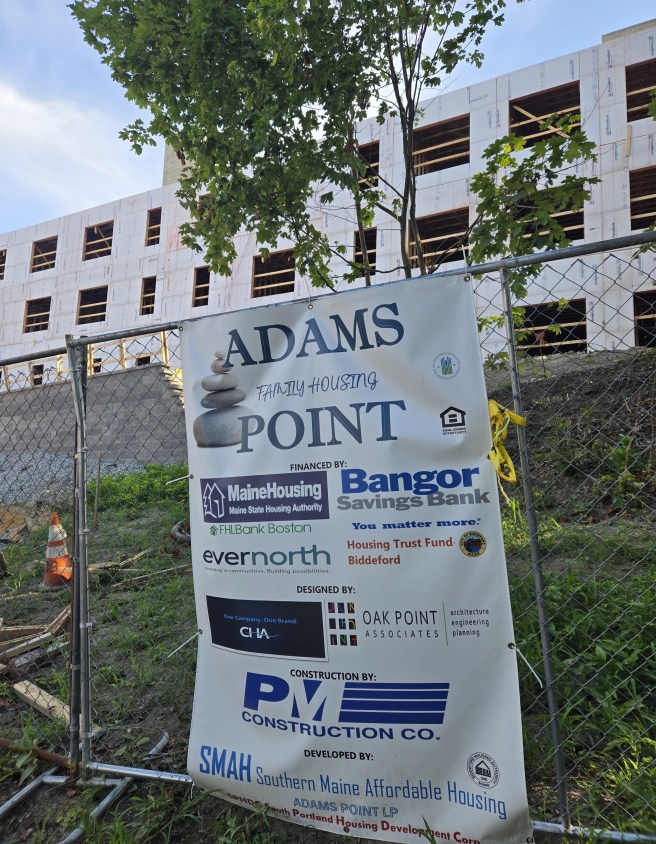
More low-income housing is also being added to the mix. Within a few months, the Adams Street project will offer 39 new units for low-income renters.
Gervais said rental units make up slightly more than 53 percent of the city’s occupied housing.
Despite the increasing supply of housing, average monthly rents in Biddeford remain steep, ranging between $1,700 and $3,200, from studio apartments to three-bedroom units.
City Council President Liam LaFountain said he is feeling a bit discouraged because the increasing amount of housing is not doing much to drive down rental costs or the cost of a single-family home.
The average home values in Biddeford are continuing to rise, outpacing employment earning gains. The average home value in the city is slightly more than $478,000.
Earlier this year, Gervais told the city council that more than 2,100 units of housing are currently in some form of development.
Of those 2,100 new housing units, only 319 units are planned as affordable housing units in which rental costs are calculated by the area’s median income.
Grohman said that he and the city council set a goal last year to create 180 units of ‘affordable” housing every year for the next five years.
But can Biddeford residents keep up with rising housing costs?
Gagnon and LaFountain said they and others are doing everything possible to address the issue, at least on the local level.
“Our mission is to touch as many demographics as we can,” said Gagnon. “From our unhoused population to affordable apartments and homes for families and seniors.”
Gagnon said he is particularly concerned about families of two or more people being able to find an affordable living solution.
“You hear a lot of talk about one and two-bedroom apartments, but you don’t see much about three or four-bedroom units,” Gagnon said.
The Biddeford Housing Authority was responsible for the development of 47 “market-rate” units that range from $925 a month for a one-bedroom unit to $1,100 for a two-bedroom unit.
“We were able to pull that off because a lot of things went right for us,” Gagnon said. “We got our financing from a local lender with a very competitive interest rate and term. We were then able to pass those savings on to the renters.”
Gagnon said it is difficult for both non-profit and private developers to offer “affordable housing.”
“You have to consider interest rates, material and labor costs and lots of other factors,” Gagnon explained. “Typically, you don’t begin to see a return on your investment for 15 years or more.”
Gagnon said many people might be surprised to learn that it was President Ronald Reagan – a staunch fiscal conservative – who helped create federal tax credits for developers willing to build affordable housing for lower income families.
Gagnon says he would like to see the city and state move from a focus on creating more units and instead use that extra funding to develop fewer units that could be less expensive.
“People are generally impatient,” said Gagnon. “They want it fixed now, but the reality is that this is not just a Biddeford problem.”
Gagnon does, however, acknowledge that the city has some unique challenges.
“There are two very different groups of people in Biddeford,” Gagnon explained. “There is the old Biddeford and the new Biddeford. The new Biddeford people have access to higher regional incomes and can live here while tele-commuting.
“Meanwhile, the old Biddeford people are still relying on traditional incomes. I had a friend recently tell me that if Portland is Manhattan, then Biddeford is Brooklyn.”
The median household income in Biddeford is $69,794. For comparison purposes, the median household income in Saco is $84,328; and $93,167 in Kennebunk.
How do city officials define ‘affordable’ housing?
LaFountain says the city of Biddeford is using a diverse set of tools to address the costs of housing, including creating Inclusionary Zoning (IZ) rules that require any developer proposing to build more than eight units to offer at least 10 percent of those units within AMI guidelines.
“There should be housing that is attainable for all Biddeford residents,” LaFountain said. “That is the goal, but it’s going to take time, money, effort and a lot of other things beyond the city’s control to make that happen.”
The city of Biddeford describes affordable housing in the following ways:
Low-income: A development in which a household whose income does not exceed 70 percent of AMI as defined by the U.S. Department of Housing and Urban Development (HUD) stipulating that rental costs cannot exceed 30 percent of the household’s monthly income.
Owned housing: A development in which a household whose income does not exceed 120 percent of AMI;
Affordable housing: Housing for which the percentage of income a household is charged in rent and other housing expenses or must pay in monthly mortgage payments and does not exceed 30 percent of a household income.
Workforce housing: Housing where the rent is affordable to a household earning 80 percent or less than AMI, and where the units are rented to a household earning 80 percent or less than AMI.
“I understand why some people balk when we talk about affordable housing,” LaFountain said. “It is a subjective issue, but is also a very important issue.”
_____________
Randy Seaver is the editor and founder of the Biddeford Gazette. He may be contacted by email: randy@randyseaver.com
NEVER MISS ANOTHER UPDATE! Subscribe for free today!

 BIDDEFORD GAZETTE
The issue that is barely mentioned in these articles, is the issue of families with children. Do you see it mentioned in Biddeford’s description of what is considered affordable housing? I’ve once heard people discuss their opposition to a housing project because people in the wage level the project was to serve were prone to have children and they did not want their school budget to go up.
LikeLike
Randy, wh
LikeLike