
By TORRIE HERRINGTON, NOTUS for The Maine Monitor
Republicans are trying their best to tie Democrats to fraud this election cycle.
President Donald Trump has spent months hammering Minnesota for its handling of a welfare scheme. The Republican National Committee has referred to Maine’s governor, who is now running for Senate, as “Fraudulent Janet Mills.”
And the National Republican Congressional Committee has singled out multiple candidates who they say failed to stop fraud on their home turf.
“Billions of dollars intended for families and communities in need have been diverted to benefit fraudsters,” NRCC spokesman Mike Marinella said in a statement. “Working families are furious, and Democrats can’t run on ‘anti-corruption’ while their own states are ground zero for massive fraud.”
Both parties are seeking to mix other alleged malfeasance into their affordability messaging. Democrats are emphasizing anti-corruption policies and the Epstein files scandal, saying their opponents are protecting elites over ordinary Americans.
Republicans are countering that Democrats have looked the other way on fraud, allowing people to take benefits meant to go to the people who need them.
Republican strategist Matthew Bartlett, who served as a political appointee in the first Trump administration and is co-founder of Darby Field Advisors, said fraud is on voters’ minds right now, particularly after the federal government sent large amounts of money out via the states.
“Very legitimate questions about ‘where did all this money go?’ exist,” Bartlett said. “Very sadly, I think there are instances of waste, fraud and abuse. So that is in the public interest, that is a legitimate question if you’re an elected official.”
However, he said, “Is this the top priority of the American voting public right now? No.”
Emily Cain, former Maine state senator and executive director of EMILYs List, agreed that fraud is important to root out but not at the top of voters’ minds.
“If someone is breaking the law or taking advantage of a system they should be held accountable. That is just true. But is fraud the thing that people are thinking about when they’re going to the grocery store this week? No, it’s not,” Cain said. “Republicans are feeding them a narrative of fraud because they don’t have anything else to campaign on right now.”
Democrats largely argue that the ties between them and alleged fraud perpetuated by outside actors is tenuous, such as pinning alleged health care fraud on a candidate for supporting a health care policy.
In Maine, there is a potential fraud scandal underway. The state paused payments to Gateway Community Services, which overbilled MaineCare, the state’s Medicaid program, for interpretation services by more than $1 million, according to an audit by the Department of Health and Human Services. Gateway denies the allegations of fraud.
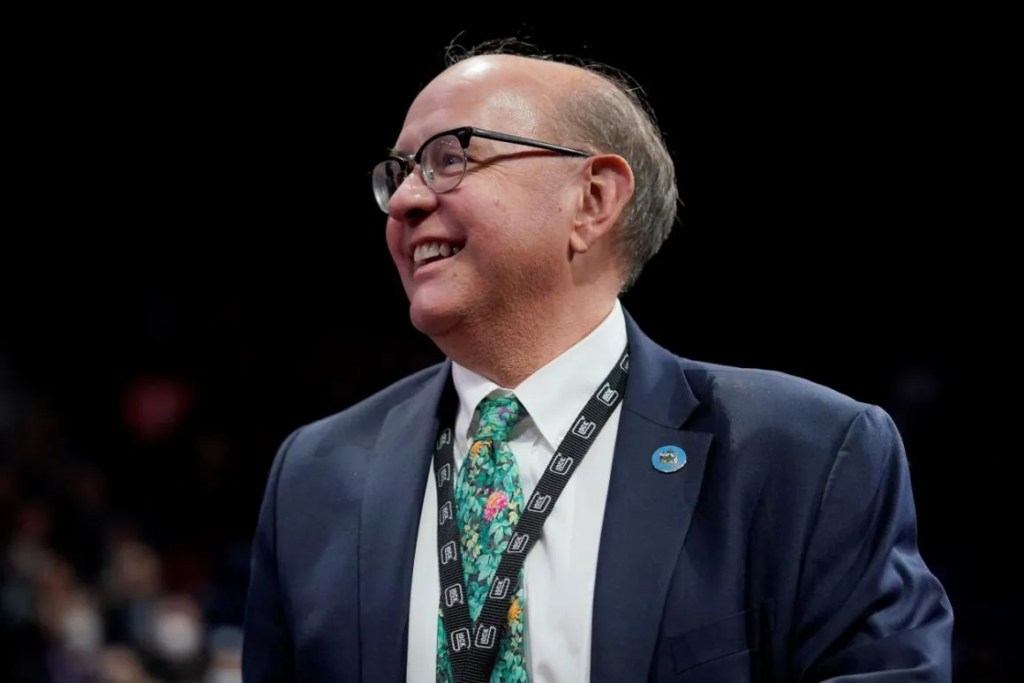
The NRCC is targeting state auditor Matt Dunlap, who is running for Maine’s 2nd Congressional District, by claiming he failed in his role and should have included Gateway as part of his audit that included Maine Department of Health and Human Services.
In a statement in response to the allegations, Dunlap campaign manager Harry Burke said, “The work of the Auditor of Maine is confidential. Period. Matt will not comment on any audit that may or may not be conducted. The audit work will speak for itself.”
In a conversation about general audit practices, Dunlap explained that his job as state auditor is to audit the major agencies, such as the Maine Department of Health and Human Services, and not the smaller nonprofits or programs which get their funding from the major agencies.
For example, in the 2024 audit report, there are recommendations for the state DHHS on how to better operate, but none of the smaller organizations it works with are listed in the audit; that is something DHHS audits internally.
“The purpose of an audit is to improve an organization. We’re not trying to play gotcha, we’re trying to help these agencies be better,” Dunlap said. “If business is the language, auditing is a spellcheck.”
Republicans also singled out one of Dunlap’s Democratic opponents, state Sen. Joe Baldacci, saying he was tied to the potential fraud. Baldacci voted in favor of expanding MaineCare.
“Anyone who defrauds MaineCare should be prosecuted to the fullest extent of the law. Period,” Baldacci said, adding that he has long been a champion for affordable health care.
The Republican National Committee has targeted Senate candidate Gov. Janet Mills, connecting her to fraud in multiple statements pointing to Medicaid overbilling and refusing to turn over SNAP data to the federal government.
Mills accused the Trump administration of using fraud as an excuse to attack Maine with Immigration and Customs Enforcement.
“This is part of President Trump’s malicious playbook of using his administration’s power to punish anyone who dares to stand up to him or who disagrees with him,” Mills said in the Feb. 9 statement. “That is why as governor, my Administration has implemented new and unprecedented licensing requirements for Medicaid providers, prioritized audits, and worked directly with State and Federal authorities to hold accountable individuals who attempt to defraud our state.”
The push goes beyond Maine.
The NRCC accused Democratic Rep. Dave Min in California’s 47th Congressional District of trying to cover up fraud because he dismissed the administration’s investigation into Minnesota as “partisan and racist” during a House Oversight Committee hearing.
The Min campaign pointed out that the lawmaker started out his remarks in the hearing by calling what happened in Minnesota “ fraud of the worst kind” and calling for “aggressive enforcement and accountability when it comes to taxpayer dollars and their disbursement.”
Min called the hearing “partisan and racist” because “we have not had other hearings when it comes to fraud that takes place in Republican-led states. We have not had hearings in this committee as far as I am aware or on any other committee this year as long as I’ve been in Congress that go after those who are not Somali-American.”
The NRCC said that Min should be more concerned about fraud at home in California.
“I started my career as an SEC enforcement attorney, where I cracked down on corporate greed and fraud. As a member of the Oversight Committee, I will always fight for accountability with your taxpayer dollars, weeding out fraud wherever it is discovered,” Min said in a statement to NOTUS.
In New York, then-Republican candidate for attorney general Khurram Dara called for an investigation into New York’s Consumer Directed Personal Assistance Program — with a dig at Democratic Gov. Kathy Hochul.
“In Minnesota, a fraud measured in the hundreds of millions triggered indictments, federal coordination, and asset seizures,” Dara, who dropped out of the race last week. “In New York, a program with more than $10 billion a year flowing through it was allowed to operate for years with virtually no enforcement. The scale here is far larger, yet the response was far weaker.”
A spokesperson for Hochul called the claim “old news.”
“Governor Hochul already put an end to waste, fraud and abuse in CDPAP by cutting out hundreds of middlemen over a year ago — and it’s already saving over $1 billion for New York taxpayers,” the spokesperson said.
________________

ABOUT THE AUTHOR: Torrie Herrington covers the Maine and Vermont congressional delegations for NOTUS, in partnership with The Maine Monitor and VT Digger. Torrie grew up in Arkansas and graduated from the University of Central Arkansas with a bachelor’s degree in journalism and public relations. At UCA, she was editor in chief of the student newspaper, The Echo, where she reported on local political races, a professor accused of misconduct, campus events and more. She has also interned at the Log Cabin Democrat, where she covered community events and nonprofits. You can contact her at TorrieHerrington@notus.com
NOTE: This story was produced as part of a partnership between NOTUS, a publication from the nonprofit, nonpartisan Allbritton Journalism Institute and The Maine Monitor, a nonpartisan, nonprofit news organization covering the state of Maine.

 BIDDEFORD GAZETTE