
By RANDY SEAVER, Editor
Even as a lawsuit filed by the city of Biddeford against both the University of New England and the Saco River Corridor Commission continues winding its way through York County Superior Court, a Biddeford resident is ramping up his own efforts to raise awareness about the issue.
John Schafer, the former chair of Biddeford’s Harbor Commission, claims the university misled the public during the application review process of a large-scale and somewhat controversial research pier that UNE is hoping to construct on the Saco River.
RELATED | City files lawsuit against UNE, SRCC
Moreover, Schafer is also raising questions about a $3.5 million grant that UNE secured through the efforts of U.S. Senator Susan Collins (R-Maine), chair of the Senate Appropriations Committee.

Schafer points out that more than three years ago, UNE released a map called “Restrictions on Developable Areas.”
While Schafer says that map clearly shows where construction on the UNE campus was “illegal,” UNE representatives adamantly denied those claims, saying that it is Schafer who is misleading the public.
“The suggestion that we deliberately misled anyone is simply untrue,” said Sarah Delage, a university spokesperson. “UNE has been open and honest with all government agencies throughout this process, including Senator Collins’ office and the federal agency that awarded the grant.”
Buffer Zone | A matter of semantics?
Schafer and others – including Biddeford’s city attorney Harry Center – say the 250-foot buffer zone shown on the map illustrates an agreement that UNE made with the SRCC in 2001 when it wanted to build two new dormitories.
In fact, the so-called buffer zone is a central argument in the city’s lawsuit against UNE and the SRCC.
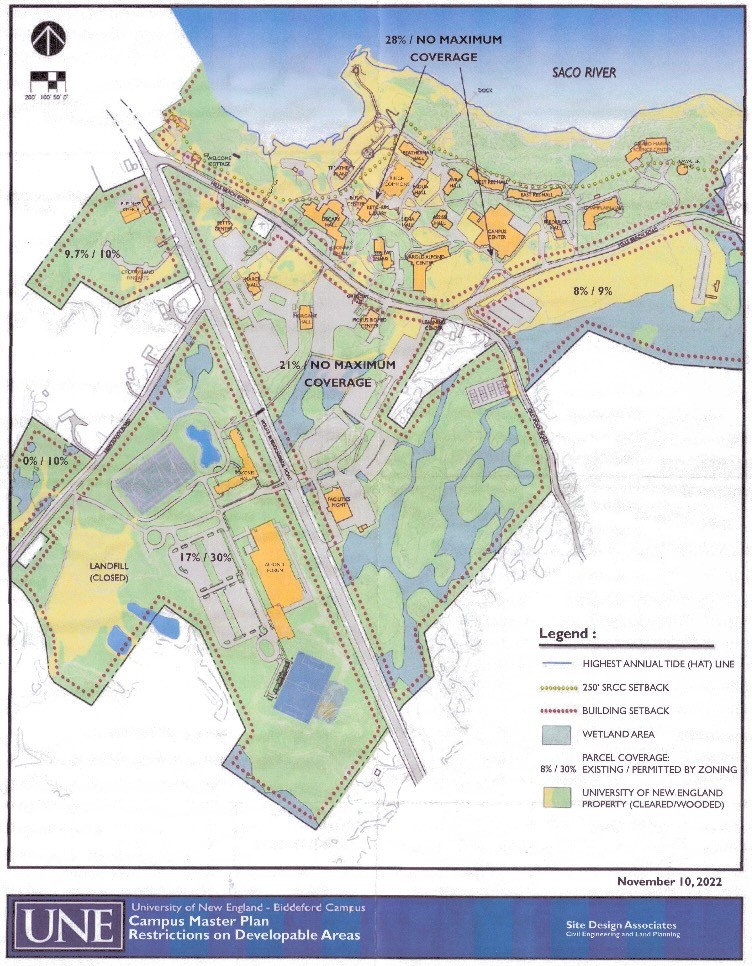
Delage and other UNE officials describe the buffer zone as a “vegetative buffer” that does not preclude certain activities, such as the need to construct a paved access for the proposed pier.
“This type of buffer is not a “No-Build” buffer,” Delage told the Gazette during a March 4 telephone interview. “It designates an area where additional permits and oversight are required for approval to build anything new.
“It is not prohibited to build within a buffer, provided you obtain the proper permits,” Delage added. “This is standard practice under Maine’s shoreland zoning rules and is not unique to UNE’s property.”
Center, speaking as Biddeford’s chief legal counsel, told the Gazette that the buffer has indeed become a matter of semantics.
“What’s the point of a ‘vegetative buffer’ if it doesn’t preclude development within that area?” Center asked.
“They [UNE] admitted and acknowledged the existence of that buffer as recently as 2022,” Center said. “It’s an issue that the SRCC ignored in their own review of the proposed pier project.”
_____________
“What’s the point of a ‘vegetative buffer’ if it doesn’t preclude development within that area?”
— Harry Center, Biddeford’s attorney
________________
Center says the issue will be a statutory matter for a Superior Court judge to decide later this year.
RELATED | UNE pier approval tainted by glaring mistake
For his part, Schafer points to an Oct. 14, 2026 Biddeford Gazette story and the comments then offered by Delage, saying that the Saco River Corridor Commission did not impose a ‘no-build’ or ‘no construction’ zone within a 250-foot zone from the river.”
“Well, I guess at least now the university is finally admitting that there actually is a buffer zone,” Schafer said, pointing to the university’s own map.
Federal law | Was Collins wrong to provide funding?
Schafer said he is troubled by the fact that Senator Collins’ office announced a $3.5 million grant for the research pier roughly one month after the university released its own map clearly showing the buffer zone.
“Federal grants typically take many months or even years to secure,” Schafer says.
“Two scenarios are possible,” he added. “Either Susan Collins and federal authorities are incompetent, or UNE deliberately withheld information from Collins and the feds as the university chased taxpayer funding.”
Phoebe Keller, a spokesperson for Senator Collins, told the Gazette today that the senator’s office would be unable to provide any “on-the-record” comments regarding this story.
Schafer says he does not believe that Collins or any other member of Congress did anything wrong in supporting the university’s funding request.
Instead, Schafer says he believes the university withheld information about the buffer zone when applying for the federal grants.
Delage, however, says there was no deliberate plan to omit any factual information during the federal application process.
“We did not get into any of those types of specifics because it’s not part of the process of seeking funding for a project,” Delage said. “The use of grant funds for any project is predicated on securing required local and regulatory approvals and securing a grant does not circumvent or negate the need for securing approvals.”
Furthermore, Delage said that “singling out” the SRCC misses the point that the project also required approvals from the Biddeford Planning Board, the Maine Department of Environmental Protection and the U.S. Army Corps of Engineers.
Each of those review agencies, Delage noted, approved the university’s proposed pier project.
And Delage said that the map now being circulated by Schafer and others concerned about the project is not a smoking gun.
“It simply shows standard environmental zoning boundaries routinely used by the city of Biddeford, the SRCC and the Maine Department of Environmental Protection,” Delage said.
_________________
“We did not get into any of those types of specifics because it’s not part of the process of seeking funding for a project,”
— Sarah Delage, UNE spokesperson
Schafer says he will continue raising concerns and asking “tough questions” about the university’s pier project.
“I’ve asked the president of UNE [Dr. James Herbert] three times to release the application they filed with the feds,” Schafer said. “The Biddeford Planning Board also asked them to release an exact copy of that application. They [UNE] have consistently refused to answer that question.”
Schafer says that UNE’s consistent refusal to discuss whether they specifically included mention of the buffer zone likely explains how the project received a $3.5 million federal grant.
“Senator Collins is not incompetent, nor is the federal agency that issued the grant, but they were intentionally deceived,” Schafer said.
_______________
ABOUT THE AUTHOR | Randy Seaver is the editor and founder of the Biddeford Gazette. He has been covering Biddeford news and politics for nearly three decades. He may be reached by email: randy@randyseaver.com
Never miss an update! Subscribe for free today!
FOLLOW THE GAZETTE


____________________
THE BIDDEFORD GAZETTE | A Legacy of Trusted, Independent Journalism
Our editorial standards and policies: Biddeford Gazette | Standards & Policies
© 2026 Biddeford Gazette, Inc. All Rights Reserved

 BIDDEFORD GAZETTE